

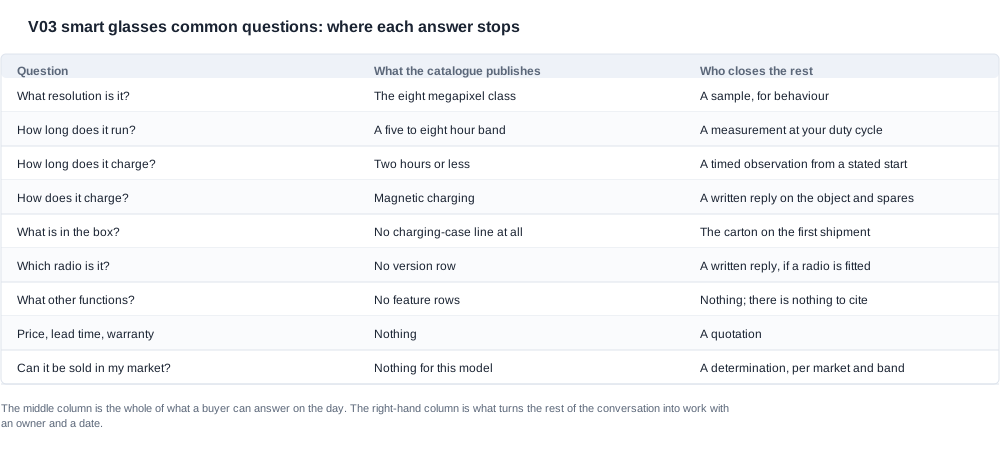
Camera buyers ask the same nine questions, in roughly the same order, and most of them get answered loosely somewhere between the first email and the first order. The looseness is rarely a matter of knowledge. It is a matter of shape: several of these questions have a short answer that is real and partial, and a short partial answer sounds like a complete one.
The nine are set out below in the order they usually arrive, each with what the catalogue publishes, what it does not, and who can close the rest. Two of the nine are answered outright from the page. Four need a written reply or a timed observation. Two are determinations that the buyer has to make internally. And one is a commercial term that belongs in an enquiry rather than in a conversation.
Nothing in these answers describes how the product performs, and nothing here should be read as a claim about the camera, the picture, the audio or the comfort of wearing it. Where the record is silent, the answer is a question with an owner, and that is the honest end of the exchange.
V03 smart glasses common questions: the ones that get answered loosely
The two that are answered outright
"What resolution is it?" The catalogue publishes the eight megapixel resolution class for this model, and that is the whole of the camera entry. Nothing behind the class is published — not the sensor, not the way the lens sees, not the rate, the storage or the format — so the class is a label rather than a description of output. A listing can print the class; it cannot print a comparison of image quality.
"How much does it cost, what is the lead time and what is the warranty period?" None of the three is published for any model in this range, because all three are commercial terms rather than product facts. They arrive in a quotation, and the only thing a buyer can do about them is make sure two quotations were written against the same configuration before comparing them.
The four that need a written reply or a timed observation
"How long does the battery last?" The catalogue publishes a five-to-eight-hour band, and it publishes it on a row whose label reads as charging duration rather than running time. The conditions behind either end of the band are not published, and the only way to know which end applies to a particular channel is to measure at that channel's own duty cycle.
"How long does it take to charge?" The catalogue publishes a ceiling of two hours or less, which is a bound on an interval rather than a duration. The state the interval begins from, and what the charge restores, are not published. A timed observation from a recorded starting state closes the question for one unit; a written statement closes it for a lot.
"How does it charge, and what comes in the box?" The charging method is published as magnetic. The object that the unit actually sits on, whether a replacement can be bought, and what the accessory position is, are not: the catalogue prints no charging-case line for this model, which is an absence in the documentation rather than a statement that nothing is included.
"Which Bluetooth version does it carry?" No version row is published for this model. If a radio is fitted in the unit, the generation is a written answer, and it belongs to a different evidence type from the camera entry because it is a radio question rather than an imaging one.
The two that are the buyer's own work
"Can it be sold in my market?" Nothing in the published record answers this for any model, because the answer is a determination made against the finished product, for a named market and an intended age band, by the party that carries the obligation there. It is also the item with the longest elapsed time, which is why it should be started internally rather than requested.
"Does it do anything else besides taking pictures?" No feature rows are published for this model, so there is no second function to select it for and nothing to describe. A buyer who needs a function should look for a model whose rows carry one.
What the catalogue settles outright

Two questions close immediately, and they close because the published rows are unambiguous.
The camera class is the eight megapixel class, published for this model and shared across a group of camera models. That sharing is useful: it means a channel stocking several camera products has a common vocabulary for the camera entry, and it means a buyer comparing two models can establish quickly whether the two are in the same class or not. What it does not do is tell a buyer anything about the output of either.
The cell figure is two hundred and twenty milliampere-hours, published with a label. It is a small number relative to the range, which is worth knowing for a channel building a tier structure, and it is an energy figure rather than a runtime figure, which is worth remembering every time somebody asks how long the product runs.
The two facts are useful together because they answer two different questions. One tells a buyer what the camera is, and the other tells a buyer how much the product holds. Neither tells a buyer what the product does in a day, and the number that everybody actually wants — the day count — is the one that has to be produced by the buyer's own measurement.
The four answers that a supplier can give in a week
These four are the ones a buyer should put in the first message, because each of them is a question with an answer and because the answer changes what the buyer can write.
- What produced each end of the endurance band, and under what condition. This determines whether the band is a planning range or a number that has to be measured.
- Which object does the unit sit on to charge, and is a spare obtainable? This determines whether the charging method is a convenience or a dependency, and it is a question about a specific object rather than about a method.
- What is the accessory position for this designation, and when will it be confirmed? The catalogue prints no line for it, so the only way to have the answer is to ask for it and to record the date.
- If a radio is fitted, what generation is it, and what was it evaluated against? No version is published, so this is a written answer that belongs with the rest of the documentation.
The questions to ask before you order are the same four, and the criterion for a usable reply is identical each time: a figure with a unit and a method, a condition somebody else could repeat, and a date against it.
The two answers the buyer produces itself
The market determination and the commercial terms are both inside the buyer's gift, and both are regularly pushed onto a supplier because asking for them feels more productive than answering them. Neither is, and a channel that waits for a supplier to produce either of them will wait longer than the schedule allows.
The determination is a decision about a market and a band, made against the finished product. The terms are a negotiation about a configuration, and the configuration has to be fixed before the negotiation starts or the two answers will not be comparable.
Three of the nine are really two questions each
Three of these arrive as a single sentence and split cleanly into two once they are handled properly, and the split is where the useful answer is hiding.
"How long does the battery last?" is two questions. The first is what the catalogue publishes, and it is a band of two values. The second is the one a buyer actually needs, and it is how long the unit lasts at a duty cycle the buyer has chosen and can defend. Answering the first and treating the conversation as finished is how a channel ends up with a runtime claim it cannot support.
"How long does it take to charge?" is also two. There is the published bound, which is a ceiling on an interval, and there is the interval itself, which depends on a starting state nobody has stated. A buyer who has the second answer can write a routine; a buyer with only the first cannot even tell a customer how long to wait.
"Can it be sold in my market?" splits into a question about the product and a question about an obligation. The product question is whether the finished unit has the features and the documentation the market expects. The obligation question is whose determination it is. Both have to be answered, and the second one is the one that determines the schedule, because it is the one that is not a request.
Splitting a question before answering it is cheap, and the discipline it produces is what stops a short answer from being mistaken for a complete one.

The questions that need a written answer
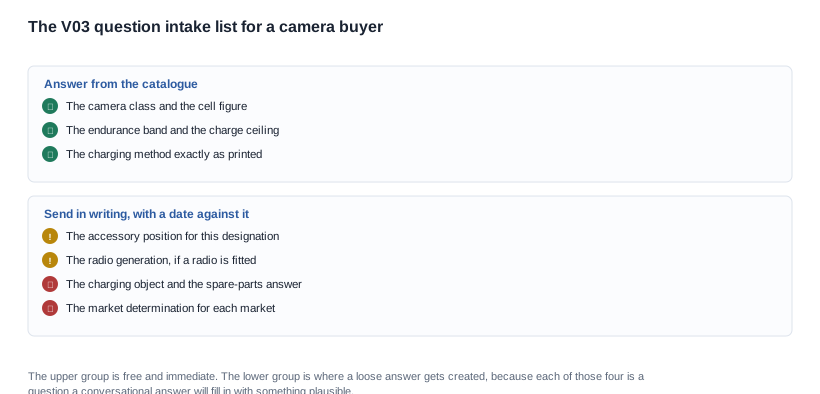
The four questions above need a written answer, and the form of the request is what makes the answer usable.
Ask for the object, not the category. A request for the accessories will be answered with a list that fits one configuration, because that is what the supplier has. A request for the contents of the carton for a named designation, at a named configuration, on a named date, gets an answer that can be checked against the goods.
Ask for the method. Every figure in the reply should arrive with the way it was produced, and a reply without one produces a number that cannot be compared with a number from another supplier.
Ask for the party as well as the answer. A reply that does not say who produced it has to be chased, and the chase is the second round that a good request would have avoided.
Ask for the date. A figure with no date has no validity, and the questions that are most often left open are the ones where the answer changes as the product changes.
Why the written form matters more than the content
A conversational answer gets remembered, and a remembered answer travels. It ends up in a specification sheet, then in a data feed, then in a listing, and by the time it is on a product page it has lost the conditions that made it true and gained the authority of a number on a catalogue. The written form stops that journey at the first step, because a written answer can be attached to a file and quoted with its date attached.
This is the whole of the difference between an intake and a conversation. An intake produces a set of answers that can be used. A conversation produces a set of impressions that have to be re-established every time somebody new asks.
The questions that need a sample rather than a reply
Two of the nine cannot be answered by a supplier in writing at all, because they are properties of the goods rather than statements about them.
How the unit behaves across a working day is a measurement, and the measurement has to be run at a duty cycle that the channel will actually ship, with the start and the end of use logged for each day. One unit produces an anecdote; a sample produces a figure that a lot can be accepted or rejected against.
What the camera does in ordinary use is a measurement too, and it is one that a channel can only make itself. The class tells a buyer where to start; the sample tells them what they are selling.

Answering when there is no answer to give
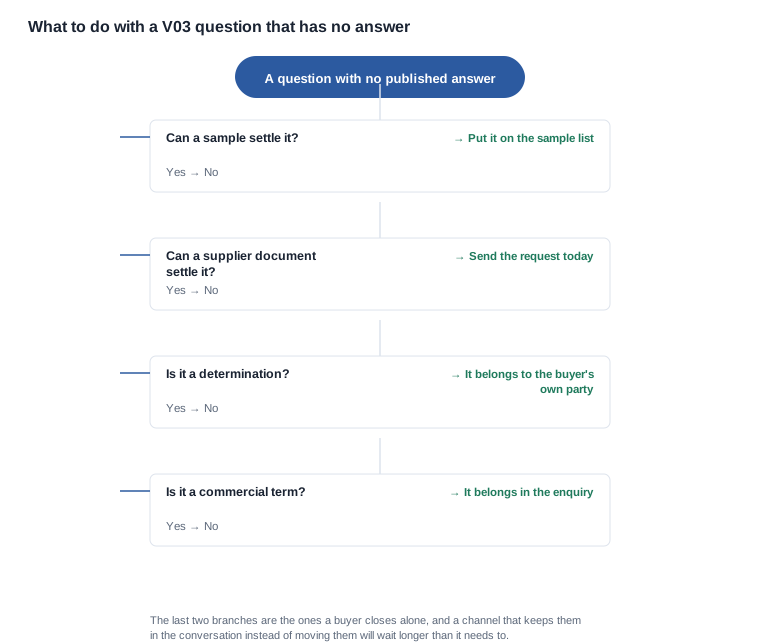
The hardest question to answer well is the one where the honest answer is that nobody knows yet, because the pressure in a buying conversation is to fill the silence rather than to date it.
There are three ways to fill a silence, and only one of them is safe. A typical figure is the most tempting and the most dangerous, because a number borrowed from a neighbouring model becomes this model's number the moment it is written down, and the person who wrote it has no way of defending it. An assurance is softer and almost as bad, because an assurance without a method produces the same number later with more confidence attached. A request with a date is the only one that survives, because it is a statement about work that somebody has agreed to do.
The two non-answers to avoid in this category
"It depends." Technically true and nearly useless, because the useful part of the answer is the condition, and the condition is usually the thing that is not published. The version that works names the condition: the answer depends on the duty cycle, and the duty cycle is yours to set.
"Typically" or "around" before a number. These words do the work of a measurement without the work of one, and they survive into product copy where the qualifier is dropped and the number stays.
The criterion for a good answer
Four tests, and any answer that fails one of them is not finished. Is the quantity stated in words rather than implied by the name of a field? Is the condition attached in the same sentence? Is the party that produced it named? Is there a date on it? A sentence that passes all four can go into a specification sheet, and a sentence that fails one of them will be corrected later at a cost that is much higher than the cost of correcting it now.
What an unanswered question actually costs
It is worth pricing the silence, because the two answers look identical from the outside and they are not. A question answered with a dated request has a cost: a message, a reply, and a small amount of waiting. A question answered with a plausible sentence has a cost too, and it is paid later, in a support queue, in a tender response that has to be rewritten, or in a carton that has to be reprinted. The difference between the two is the difference between a cost and a liability.
The support cost is the one that arrives first. A customer with a question that the channel answered loosely will ask it again, and the second time it will be to a person rather than to a page. The questions most likely to come back are exactly the ones on this list: how long it runs, what is in the box and whether it can be sold where the customer lives.
The documentation cost is the one that arrives in a week of the year nobody planned for. A tender response or a retailer review that quotes a figure without its condition has to be corrected at the point somebody else has found it, and the correction is a re-issue rather than an edit, because the document has already been issued.
The inventory cost is the quietest. A channel that ordered against a loose answer has bought a quantity that was decided on a number nobody measured, and the only way to correct it is to buy again later, at a different price, in a different market window.
The criteria for judging whether a question has been closed properly are short enough to apply to every one of the nine. It is closed when the quantity is stated, the condition is attached, the party is named and the date is on it. Anything less is a conversation, and a conversation is a cost that has not been sized.
Our own position on these questions
Our published rows for this model are what the catalogue prints, and we do not stretch them into answers the record cannot support. The camera class, the cell figure, the endurance band, the charge ceiling and the charging method are available to anyone, and the conditions behind them are not. We will not estimate a weight, a capacity, a runtime, a lead time or a price, and we will not tell a buyer that a model is documented for a market, because the determination is not ours to make.
What we will do is take the questions a channel is being asked and mark each one against the four tests above, so that the ones we can answer are answered on the spot, the ones we cannot are dated, and the two that belong to the buyer are moved onto the buyer's own list with an owner against them.
The nine questions above are not the whole of what a camera programme has to settle, and a buyer who works through them will find a second set behind them: the configuration, the accessory position, the file scope and the acceptance criterion. Those are the items with owners and elapsed times, and they are the ones a channel should price before it commits to a launch date rather than after it has a carton in a warehouse.
The practical order that follows from all of this is short. Answer what the catalogue answers, date what it does not, move the two determinations to the buyer's own list, and measure the two that only a sample can settle. Everything else about this model is a question of presentation, and presentation is the cheap part.
Every gap referenced in those questions is grouped by the party that can close it in the gaps note for this model.


