

A camera product's file is not a smaller version of an audio product's file, and for this family the difference is sharper than it first looks, because the two designations in it publish the same power rows while their accessory trails do not match. A file that treats the family as one thing will cover one of the two designations properly, half-cover the other, and leave the two in a dispute at delivery rather than at the factory.
That is the whole of the argument on this page, and it is an argument about evidence rather than about marks. The published record for these two designations is short and, for a compliance owner, unhelpfully distributed: the electrical rows sit together, the accessory position sits apart, the lens configuration sits in a feature line rather than in the name, and the camera entry is a class with no method attached to it. A file assembled from that record without checking each piece's scope will look complete and cover neither designation completely.
This article walks the family file as it should be built, and it spends most of its time on the three places where the family breaks: the accessory trail, the endurance label, and the lens configuration. What it does not do is repeat the general material that applies to any product in any market. The questions below are the ones that are specific to these two designations, and they are the questions a compliance owner can put in writing today.
The boundary worth stating at the start: none of this is a statement that a model is or is not documented, and nothing here describes what any unit does. The record for these two designations is what it is, and the work described below is about making that record usable in a file.
V03 smart glasses certification status: the evidence this family needs
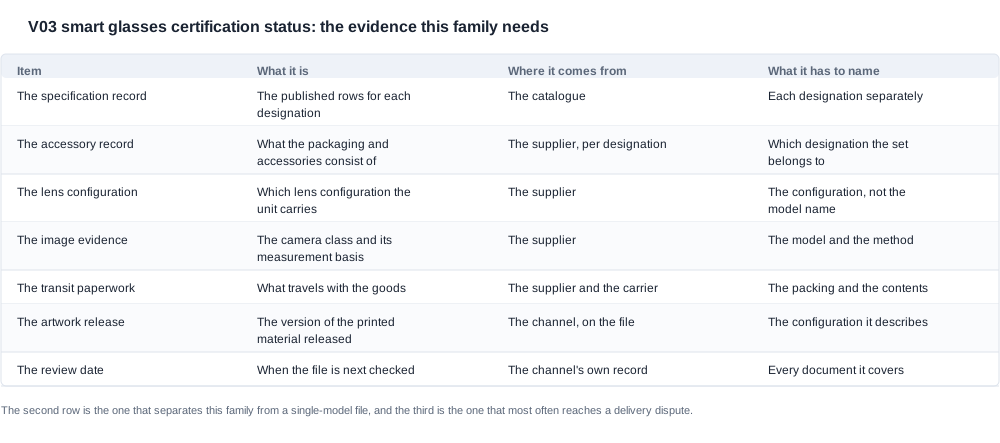
The seven pieces, and where each one comes from
The table lists what a compliance owner has to assemble for this family, and the third column is the one to read slowly, because it says who actually holds each piece. Only two of the seven are held by the catalogue. The rest are held by the supplier, by the carrier, or by the channel itself, and the two the channel holds are the two that nobody else will do.
The specification record is the published rows, and it is held by the catalogue for each designation separately. It is the easiest of the seven and the one that is most often treated as the whole file, because it is the only piece a buyer can obtain without asking anyone for anything.
The accessory record is what the packaging and the accessories consist of, and it is held by the supplier and it is per designation. This is the piece that distinguishes this family, and the reason is in the next section.
The lens configuration record identifies which lens configuration a unit carries, and it is held by the supplier. It has to be written onto the order rather than inferred from the model name, and the reason is that the configuration is not carried in the name.
The image evidence is the camera class together with the basis on which it was measured, and it comes from the supplier. For a camera product this is a separate evidence type from the electrical work, and a file built on an audio-model template will not have a slot for it.
The transit paperwork describes what travels with the goods, and it is shared between the supplier and the carrier. The contents of the package drive it, so the accessory record has to be settled before the transit record can be.
The artwork release is the version of the printed material that has been approved, and it is held by the channel on the basis of the supplier's file. It is a channel document rather than a supplier document, and it is where a configuration question becomes visible to a customer.
The review date belongs to the channel's own record, and it has to cover every document in the file, including the ones the channel did not assemble. A file with no review date does not expire; it simply becomes wrong at a moment nobody is watching.
How to evaluate what a supplier sends back
When the reply arrives, the work of evaluating it begins, and the evaluation is a comparison against a list rather than an impression of completeness. A file that looks thorough is the most common failure in this step, because the material arrives in a folder and a folder feels like an answer.
The criteria a compliance owner can apply to what comes back are five, and they are deliberately blunt.
Does every document name a designation rather than the family? A document that says the family is not a document for either unit, and it cannot be attached to an order line. This is the first check because it is the one that decides the rest.
Does the accessory trail in the reply match the accessory position the catalogue prints? If the reply includes a case for the designation whose page publishes no case line, that is a question rather than a gift, and it needs an answer before the file is accepted.
Is the configuration named wherever a configuration is relevant? The lens line, the colour option, the case position and any print treatment have to appear on the documents that will be used to check a delivery, not only on the one that describes the product.
Is every quoted figure traceable to a labelled row? A figure in a supplier document that cannot be traced back to a row with a quantity attached is a figure with an unknown meaning, and it is the one that causes a dispute.
Does the reply answer the question that was asked, or a nearby question? The red flags are a reply that answers the family rather than the designation, a reply that supplies a product page instead of a document, a reply that quotes a figure with no condition, and a reply that answers the specification question with a marketing sentence. None of those is a refusal, and each of them leaves the item open.
The practical way to run the check is a line-by-line comparison against the request list, with each item marked complete, partial or absent, and a partial treated as absent. That is a short piece of work, and it is the difference between a file that can be attached to an order and a file that has to be re-requested in the week the artwork is due.
The cost of the open items, and how to prioritise them
Open items in a file like this are not all equal, and treating them as equal is what turns a short list into a long schedule. The way to sort them is by what each one blocks.
Items that block a delivery decision. The accessory position for the designation whose page prints no case line, and the lens configuration for the designation that carries one. Both of these decide what the channel is buying, and neither can be resolved by a document that is already in hand. The total cost of leaving them open is a dispute, and the cost of closing them is one written question.
Items that block a document review. The image evidence for a camera product, because it is a different evidence type from the electrical material and has to be requested against its own method. The cost of leaving this open is that the file is complete for an audio-style product and silent on the part that matters most to a camera buyer.
Items that block nothing yet. The review date for each document, and the notification obligation for a component change. Neither blocks anything this quarter, and both are far cheaper to set now than to retrofit once the programme is in two markets.
The trade-offs are real and they are usually made badly under time pressure. A broader set of evidence makes a product easier to write about and easier to sell, and it also makes it easier to claim things the evidence does not quite support. A tighter set of evidence makes a product harder to present and much harder to challenge. The check that keeps the two apart is the one in the checklist above, and it applies to a supplier's document exactly as it applies to our own published rows.
The order in which the pieces have to be assembled

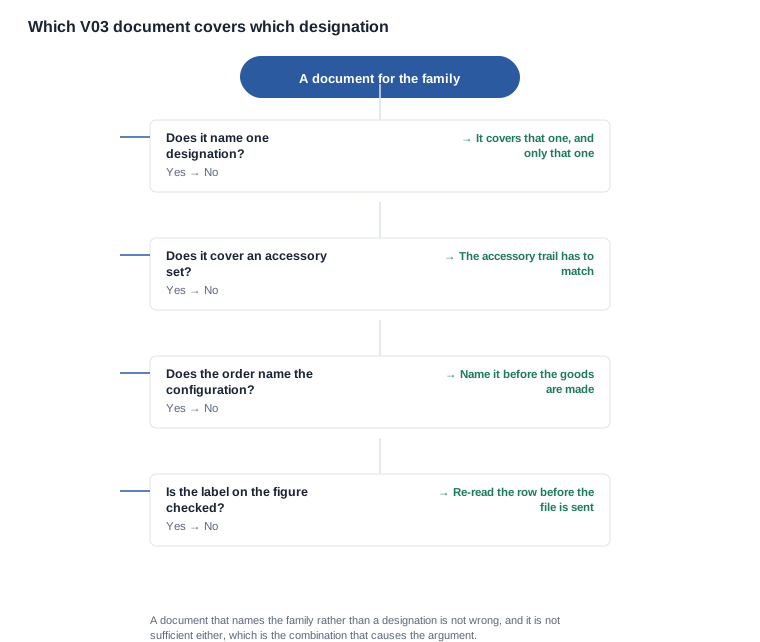
The sequence in the image is not a formality. Three of the steps are dependencies, and getting them out of order is the most common way a family file ends up internally inconsistent.
Start from the two designations rather than from the family. A family-level request is answered with a family-level document, which by definition covers neither designation completely. The cost of two requests is one extra exchange; the cost of one family request is a gap that surfaces at delivery.
List the accessory trail for each one separately. The two designations in this family do not travel with the same accessories, and a request that asks for "the accessories" will be answered with a set that suits one of them.
Put the lens configuration on the order line. Not on the artwork, not in the description, and not in a conversation. On the order, where it binds.
Ask for the image evidence separately from the electrical evidence. They are produced against different test arrangements and they are reviewed by different people, and a request that bundles them produces a single answer that satisfies neither.
Check the endurance label on every document that quotes a figure. This is in its own section below, and it is the step most often skipped, because the number is right and only the label is wrong.
Record which designation each document covers, inside the file. A cover sheet that lists the documents is not the same as a file in which each document's scope is unambiguous.
Two models, two accessory trails, and two sets of documents
The reason this family needs two files rather than one is the accessory position, and the difference has to be stated precisely because the two statements look similar and are not.
For one designation, the catalogue prints a charging-case line that says the model is published without one. That is a positive statement about the product: the case is not part of the package, and the packaging specification reflects that.
For the other, the catalogue prints no charging-case line at all. That is a statement about our documentation, not about the product. It leaves the question open, and it means the accessory set for that designation is not something a buyer can read off a page.
The consequence runs through the whole file, which is why the difference is worth more than a footnote.
The packaging specification differs. One design has no case in the carton to describe, and the other has a question mark where the case would be. A carton artwork that says one thing for the family says the wrong thing for one of the two.
The transit record differs. What is inside the box affects the declaration, the packing and the handling. A case in the carton is an item to declare; the absence of a case line leaves the contents unconfirmed until the supplier answers.
The claims a channel may make differ. A channel that has confirmed a case for one designation and not for the other cannot describe the pair as "complete with a case", and it cannot describe the pair as "no case included" either. Both sentences would be true of one designation and wrong about the other.
The service story differs. A customer whose unit arrives with a case the listing did not mention has a problem that is a documentation failure rather than a manufacturing one, and the desk will meet it either way.
The practical instruction is short. Build one accessory record per designation, in writing, before the artwork is approved, and treat the one that is still unanswered as an open item with a name and a date against it rather than as an answer.
The questions to put in writing, per designation
- What is in the box for this designation, item by item, and does it include a charging case?
- If a case is not included, is one available for this designation, and can it be ordered separately?
- What does the packaging specification look like for this designation, and does it change with the case position?
- What is the declared content for transit purposes for this designation, in the configuration you will ship?
- Does any of the above differ for the other designation in the same family, and which lines?
Question five is the one that gets skipped, and it is the one that tells a channel whether a single packaging artwork can serve both designations or whether it has to be two.

Reading the endurance label as a specification risk
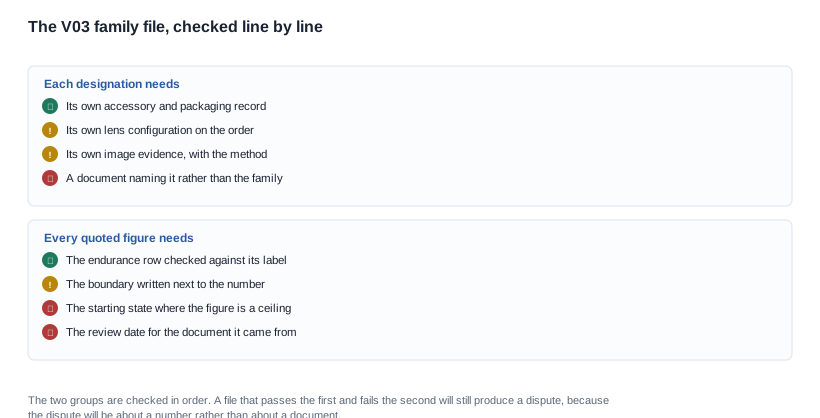
There is a line on this family's catalogue pages that reads five to eight hours under a label that says charging duration, and the actual charge time is on a different line with a ceiling of two hours or less. The number is not in dispute anywhere. The label is.
Why the label becomes a document risk. A product page is read by a buyer who is looking for a runtime. A document is assembled later, by a different person, often from a copy of the page rather than from the page, and it is read by a reviewer who is checking a figure against a requirement. At every one of those three steps there is an opportunity for the endurance to become a charge time, and once it has, the document says something untrue about the product in a place where a claim is supposed to be defensible.
The two failures, in opposite directions. Read the endurance row as a charge time and the document claims a five-to-eight-hour recharge, which any customer will test and any reviewer will reject. Read the charge ceiling as a duration and the document claims a recharge that is quicker than the record supports, which is the more dangerous of the two because it does not look absurd on the page.
The check that prevents both. Read the label, not the value, and then read the value in the sentence that says which quantity it is. A figure quoted in a file should travel as a pair: the quantity and the condition. "Running time five to eight hours, condition to be established" and "charge time two hours or less, starting state to be established" are both defensible. "Battery five to eight hours" and "Charging two hours" are not.
Where the mislabel survives longest. In spreadsheets, in data feeds and in translations. Those are the places where a number is detached from its label and carried forward as a field, and a field with the wrong name is indistinguishable from a field with the right name. Any channel feeding product data into a system should put the quantity into the field name, not only into the value.
The rest of the specification risk on the same pages
Three more items on the same pages deserve a line each, because they are quoted in documents more often than the accessory question is.
The camera entry is a class. Eight megapixel is published for both designations in this family, and nothing behind it is. A document that cites the class is citing a label; a document that cites a sensor, a field of view, a frame rate or a storage capacity is citing something that has to come from the supplier with a method attached.
The radio is not published for either designation. If a radio is fitted in either of them, the generation is a written answer rather than a published line, and the evidence behind it is a different type from the image evidence, because it is a radio question rather than a camera question.
The endurance band is a band. A document that quotes one of its ends has quoted an outcome whose condition the record does not state, and the condition has to travel with the number or the number should not travel at all.

Where the colour-changing lens has to be named on the order
The second designation in this family carries a feature line naming a colour-changing lens, and the product name does not. That single fact creates a documentation requirement that has nothing to do with testing and everything to do with what was ordered.
The gap. A buyer writes "V03 Pro" on a purchase order, a tender response, a data feed and a carton artwork, and in each of those places the configuration has been left out, because the model name did not carry it. The unit that arrives has a lens configuration in it that the order does not mention, and there is nothing on the order to point at.
Why that becomes a dispute rather than a return. The goods are not faulty. They are a configuration the buyer did not order, because the configuration was not something the buyer wrote down. The supplier has delivered to the order, and the channel has received something it did not ask for, and the only way to resolve it is to agree on what was meant, which means going back to the catalogue and reading a feature line that nobody read at the time.
What has to be done about it. The lens configuration goes onto the order line as a named item, in the same way the model designation goes onto it. It goes onto the packaging specification, because the carton has to describe what is in it. It goes onto the artwork release, so the printed material and the goods match. And it goes into the file, as a configuration record, so that a later question about what was supplied has an answer.
The colour question is not the only configuration question. The same designation carries colour options in its own right, and a channel doing private label work will have its own artwork on top. Each of those is a line on the order rather than an assumption, and the cost of putting them there is a line; the cost of leaving them off is a dispute that is settled by whoever is more patient.
The check that catches it
A single question, asked of the order before it is released: for every line on this order, can a person who has never seen the catalogue describe exactly what will arrive? If the answer is no on any line, the line is not finished, and the two ways to finish it are to name the configuration and to confirm it with the supplier. A colour-changing lens, a colour option, a case position and a logo treatment are the four that most often fail that test in this family.
Where a family file is most often assembled wrongly
Three failure modes, and they are worth naming because each of them produces a file that looks finished.
One file for two designations. It is easier to request, it is faster to assemble, and it is complete for at most one of the two. The tell is a cover sheet that says the family rather than a designation.
A specification record used as the file. The published rows are the easiest thing to obtain and the least likely to be sufficient, and they are the part of the file that nobody checks, because everyone can read them.
A configuration left in the feature line. The colour-changing lens is published as a feature rather than in the name, which is the right way to publish it and the wrong way to order it.
Our own position on this family is that we publish the rows the catalogue prints for each designation, including the configuration lines, and that we will not restate a document scope we have not been given. We will not tell a channel that a model is documented, and we will not describe a missing accessory line as though it were a product fact, because the difference between a published absence and an unprinted one is the difference between a statement and a gap.
Give us the two designations, the configurations you intend to ship and the markets in order, and we will mark the seven pieces above against them, show which of them are held by the catalogue and which by the supplier, and give you the request list for the ones that are neither.
Where this model sits against the other camera products is set out in the range comparison for this model.


