

Choosing between camera models is a procurement exercise dressed up as a product decision, and the disguise is what makes it hard. Two products sit side by side on a screen, each with a specification block, and the block looks like it contains the answer. It rarely does, because the range publishes comparable facts in some places and near-empty ones in others, and the near-empty places are exactly the ones a buyer wants to compare.
The camera models in this range publish eleven designations across two resolution classes, several cell tiers, and a mixture of charging methods, accessory positions and feature lines. That mixture is the reason there is no ready-made ranking, and it is also the reason there is a workable method. A range that publishes the same kinds of fact for every model can be compared directly, and a range that does not can be compared only on the axes where it does.
This article works through the axes for the V03, says where the model sits on each of them, explains the two comparison traps that camera buyers fall into most often, and then turns the result into something a channel can act on. It does not produce a verdict, and the reason is not diplomacy. The published record does not support one, and a verdict produced from it would be a conclusion rather than a comparison.
The boundary on the whole of this is worth stating at the start: nothing here describes how any unit performs, and nothing here invents a figure. Where the range publishes a fact, the fact is set out with what it settles and what it leaves open. Where it publishes nothing, the article says so and names the party who can close the gap.
V03 smart glasses how it compares: the axes a buyer can compare
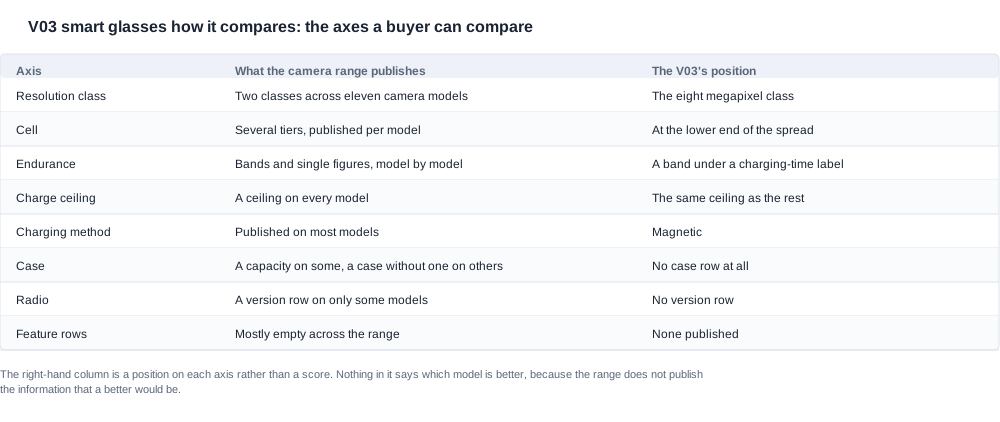
The eight axes, and how far each one can be pushed
The resolution class is the strongest axis in the category and the one most often over-used. It is strong because every camera model publishes a class and the classes are shared, so two models can be placed on one scale. It is weak because everything behind the class is unpublished, so the class is a label rather than a comparison of output. A buyer who puts two models on different classes has learned that they differ; a buyer who has put them on the same class has learned almost nothing.
The cell is a fact and almost never a comparison. The camera range publishes more than one cell tier, and this model sits at the lower end of that spread. A cell figure means nothing without a load, and no load is published for any model in the range, so a comparison built on cell size is an arithmetic exercise with no conclusion attached to it.
The endurance is where the range is most uneven. Some models publish a band and some publish a single figure, and a band is a more demanding thing to write about than a figure because a figure can be quoted and a band has to be explained. This model publishes a band, and publishes it under a label that says charging duration, which is a separate and entirely avoidable headache.
The charge ceiling is the same across the range, and a row that is the same on both sides of a comparison cannot decide anything. It is still worth reading, because it is the row that tells a channel that one charging routine will serve the whole range.
The charging method is published on most models, and this one is among them. It is a genuinely useful axis because it settles whether a channel is managing one charging routine or several, and because a contact-based interface raises the spare-parts question that a channel has to answer before it commits to a range.
The accessory position is the messiest axis in the category. Some models publish a case with a capacity, some publish a case without one, some publish no accessory line at all, and the four are four different commercial situations. This model is in the third group, which makes it the hardest one to plan an accessory line around and the easiest one to get wrong by inference.
The radio is published on only some models, and the models it is published for are not the same models that publish a charging method. This model publishes no version row, so anything about its radio has to be established in writing.
The feature rows are close to empty across the camera range. This model publishes none at all, which means it cannot be selected for a feature, and a buyer whose proposition depends on a function has to look for a model whose rows carry it.
Where the V03 sits, and what each position does not settle
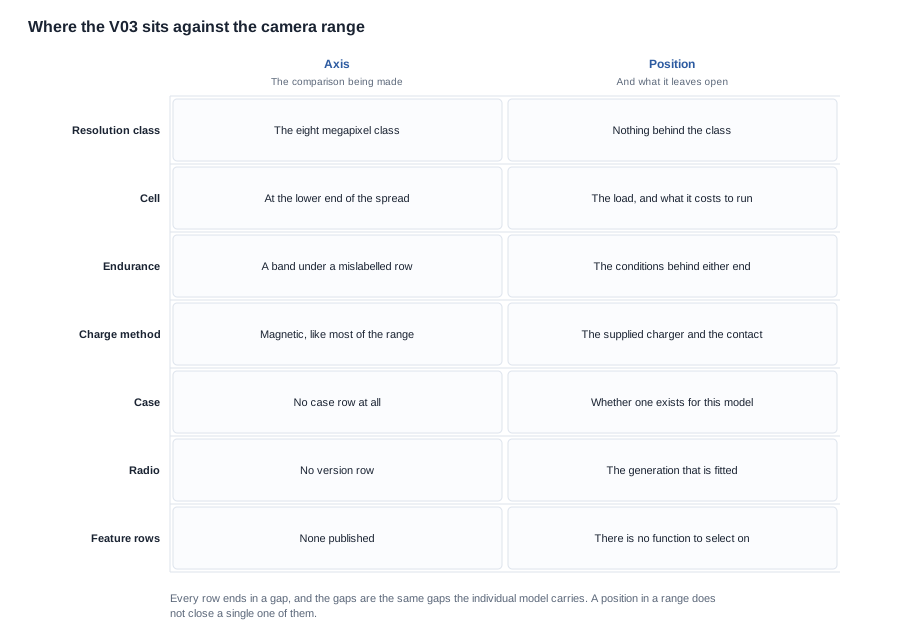
Read that matrix as a list of positions with a condition attached to each, because that is what a position in a range is. The class places the model in the larger of the two resolution groups, and publishes nothing behind it. The cell places it at the lower end of the published spread, and publishes no load. The endurance places it among the models with a band, under a label that has to be corrected wherever it is quoted. The charging method places it with the majority, and publishes no charger. The accessory position places it with the models whose file is incomplete, which is a different thing from the models whose file says no accessory. The radio places it with the models that publish nothing, and the feature rows place it with the models that carry no function to select.
None of those positions is a verdict, and the reason is worth stating once: a position in a range tells a buyer where a model sits among the others, and a verdict needs a measure of the others. The range publishes one.

Where the V03 sits on charge interface and endurance
The two axes a channel will actually argue about are the charging interface and the endurance, because they are the two that reach the customer's day. Both are worth taking carefully, and both are frequently mishandled in a way that has nothing to do with the product.
The charge interface, comparatively
On the interface, this model sits with the larger group of camera models, which means a channel stocking several camera products is probably running one charging routine rather than several. That is a real saving in training, in support and in the number of spare items a channel has to hold, and it is worth putting in a business case even though it does not appear in a specification.
What the interface position does not tell a channel is what the supplied object is. A contact, a lead, a pad and a dock are four different things to put in a box, four different things to photograph for a product page, and four different things to explain to a customer. Where a range publishes the method and not the object, the object has to be requested, and it is the kind of detail that is cheap to ask for and expensive to discover after a launch.
It also does not tell a channel whether a second unit can be charged. A contact-based interface tends to mean a proprietary source, and a proprietary source tends to mean that a customer who loses the charger cannot charge the product. Whether a spare can be bought separately is a question worth asking before the range plan is fixed, and it is a question that a comparison of published rows will never answer.
The endurance, comparatively
On the endurance, this model publishes a band where some of its neighbours publish a figure. Two consequences follow, and the first is the awkward one.
A band is harder to sell than a figure. A channel with a competitor on a single figure has a simpler sentence to write, and in a listing comparison the simpler sentence wins, whatever the underlying measurement was. A band has to be explained, and the explanation takes a sentence that a customer reads once.
A band is also harder to criticise. A figure is a single number that can be quoted back at a supplier with a question. A band is a range with two ends, and the only way to criticise it is to ask what produced each end, which is a slower conversation that most competitors do not have the patience for. For a channel that intends to publish a runtime, that asymmetry is an advantage and it is worth being deliberate about it rather than accidental.
The comparative point that matters most for a buyer is this: a band and a figure are not comparable, even when they are the same number. If a neighbouring model publishes a single figure and this one publishes a band, then the two figures are not the same kind of measurement, and a comparison sheet that puts them in the same column is comparing a range with a point. That is the trap, and it is the one that produces the confident, wrong recommendation that nobody in the channel can defend six months later.
The two questions that resolve both axes
Both axes close on the same two answers, which is convenient for a buyer who only has budget for one request.
What produced each end of the band, and under what condition. That determines whether the band is a planning range, a spread across units, or a figure that has to be measured before it can be used at all.
What object is supplied to charge the unit, and can a replacement be bought? That determines whether the interface is a convenience or a dependency, and it is the item that decides whether the charging axis settles the question or merely moves it.
Neither answer is in the published record, and both are cheap to request. A buyer who has them can compare this model with anything else in the range on the two axes that reach the customer. A buyer who does not have them is reading a specification sheet.

Choosing between camera models without inventing a ranking
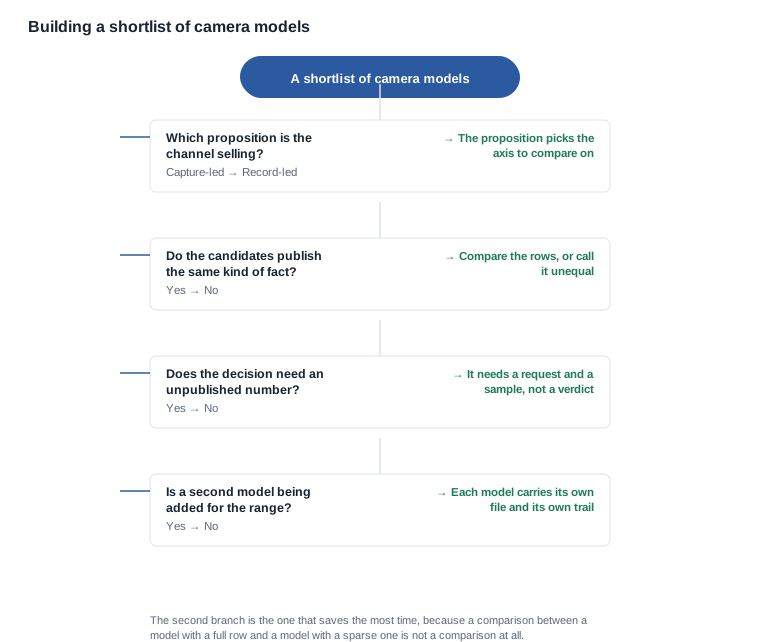
The decision chart is the method in four questions, and the second branch is the one that saves the most time. A comparison between a model with a full published row and a model with a sparse one is not a comparison that needs resolving, it is a comparison that has to be declared unequal, and saying so out loud is faster than building a spreadsheet around it.
The three traps that camera buyers fall into most often are worth naming, because each of them produces a confident answer that nobody can later defend.
The trap of the cell table. A buyer ranks the camera models by cell size and finds a tidy order. The order is arithmetic, and it says nothing about runtime, because the load behind every model in the range is unpublished. A table like that will be circulated, believed and eventually contradicted by a customer.
The trap of the resolution class. A buyer places two models on different classes and treats the higher class as the better camera. The class is a label, the sensor behind it is unpublished for both, and the two may be closer than the classes suggest or further apart. What the class does settle is that the two are not the same product, which is a real finding and a weak conclusion.
The trap of the feature rows. A buyer looks for a model that publishes a function and builds a range around it. In this category most camera models publish no function at all, and a model with no published feature row cannot be chosen for a feature. That trap produces a range that is built on the one axis with the fewest facts in it.
The questions to settle before a shortlist is signed
- Which axis does our proposition actually depend on, and does the catalogue publish that axis for every candidate? If it does not, the comparison cannot be made and the gap has to be closed first.
- Which facts does each candidate publish, and which does it leave open? Two lists, side by side, with the gaps written next to the facts rather than on a separate page.
- Which of the open items can be closed on a sample, and which need a document from the supplier? The sample list and the request list are different documents with different elapsed times.
- Are the two models being compared publishing the same kind of fact on the axis that matters? If not, the honest answer is that the comparison is unequal until a request has been answered.
- What is the total cost of the comparison, once the samples and the requests are counted? A comparison that needs three samples and four documents is a programme, and it belongs in the schedule as one.
What to do when the two candidates publish different kinds of fact
The unequal case is more common in this category than the equal case, and it needs a different procedure rather than a more careful comparison.
Step one: write down what each side publishes, as a list of kinds rather than a list of values. One side may publish a single figure where the other publishes a band, one may publish an accessory position where the other publishes nothing, and one may publish a radio version where the other publishes no radio at all. Written as kinds, the differences are obvious; written as values, they disappear into a table that looks symmetrical.
Step two: find the one axis where the two sides do publish the same kind of fact. There is almost always one, and it is usually not the axis the buyer cares about most, which is itself worth knowing. A comparison that has one comparable axis is still a comparison, provided the conclusion is scoped to that axis.
Step three: treat every other axis as a request rather than as a difference. A missing row is not a disadvantage and it is not an advantage. It is an item to be asked about, and it goes into the same request list as the axis that is comparable.
Step four: decide what would change the answer. A buyer who can say which measurement, once obtained, would move the decision from one model to the other has a useful comparison. A buyer who cannot is looking for a reason rather than for an answer, and the search will end in whichever model they were leaning towards anyway, without a document to justify it.
The criteria for judging the request that follows are simple: it asks for the item by name, it names the party who can answer it, it states the method the answer will be produced with, and it has a date against it. Anything shorter produces an answer that cannot be compared with the other side, and an answer that cannot be compared has not closed the question.

The commercial read for a channel
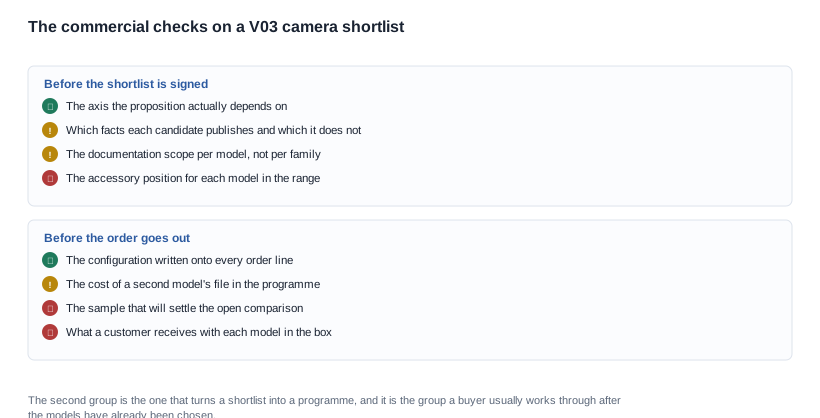
The last section is the one a channel acts on, and it is about what the comparison costs rather than what it concludes.
A camera shortlist is a documentation programme from the start. Each model in the range carries its own accessory position, its own configuration questions and its own file scope, so a channel that adds a second camera model is adding a second set of documents rather than a second line on an order. The correct question to ask a supplier about a two-model range is what the second model adds to the file, not what it adds to the shelf.
The accessory position is the line item that decides the range. A model whose accessory is published as absent, and a model whose accessory is simply not published, behave very differently in a range plan: one has a settled packaging specification and the other has an open question that has to be answered before the artwork is approved. A channel building a two-model range has to know which of the two it is buying, and that knowledge is worth a written answer.
The configuration is what the channel is actually buying. Model names are convenient and they are not configurations. Which lens is fitted, which colour was chosen, whether an accessory is in the carton and what print sits on the shell are the items that arrive, and each of them belongs on an order line. A range plan built on model names will be re-costed after the first shipment, and the re-cost will be an artwork reprint rather than a line-item adjustment.
The support cost follows the shortlist. A model with no published function generates support contacts about what the product is for, and a model with an open accessory question generates contacts about what should have been in the box. Both are documentation failures rather than product failures, and both are cheaper to prevent.
The criteria for deciding whether a second camera model belongs in the range are therefore not aesthetic. They are whether the second model adds a proposition the channel cannot already serve, whether its documentation scope is something the channel is prepared to carry, and whether the total cost of the extra file, the extra samples and the extra configuration work is smaller than the shelf space and the demand it wins. Those are the questions the comparison is supposed to answer, and none of them is answered by a specification block.
Our own position on this model is that we publish the rows the catalogue prints for it and we do not extend them into a position in the range, because a position requires a comparison the record does not support. We will not state that this model is better or worse than a neighbour, and we will not carry a cell size or a resolution class across into a conclusion the documentation does not contain.
Put the three models you are weighing, the axis your proposition depends on and the markets in the order you intend to enter them in front of us, and we will mark each candidate against the eight axes, show which comparisons are actually available, and tell you which of the open items your sample programme can close.
The kind of programme this model suits, and the kind it does not, is set out in the programme note for this model.


