

A limitations page is worth writing only if it is a working document, and the test of that is simple: does a reader finish it knowing what to do next? A list of absences is a wall. A list of absences with an owner, a method and a consequence attached to each is a programme, and the difference between the two is the whole purpose of this page.
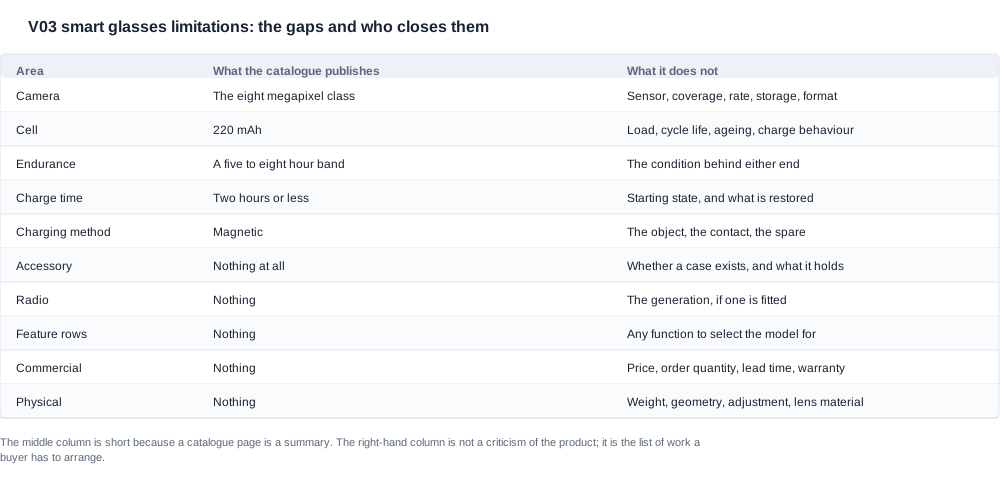
There is a second thing worth doing before the list, and it is the part that usually gets skipped. Three of the things that look like limitations in this model's published record are not limitations at all, and a buyer who treats them as limitations will spend a budget closing a gap that does not exist. They are the shape of the record rather than a shortcoming of the product. The other three are genuine, and they are the ones that decide whether this model fits the programme in front of you.
So this page separates the two, then works through the real gaps in three groups: the ones in what the catalogue publishes, the ones only a sample can settle, and the commercial ones, which are a negotiation rather than a gap.
Nothing here describes how the product performs, and nothing here is an estimate. Where the record is silent, the article says so and names the party who can close it.
V03 smart glasses limitations: the gaps grouped by who can close them
Three things that are not limitations
The endurance band is not a weakness. A range that publishes five to eight hours is publishing a range, and a range is more honest than a point. The difficulty it creates is a presentational one, and it has a known remedy: explain the band, or measure it and publish a figure of your own. What it does not mean is that the product is unreliable.
The empty feature line is not a missing argument. No function is published for this model, which means there is no function to select it for and no function that a listing can promise. For a channel whose proposition is the camera, that is a clean position rather than a thin one. For a channel whose proposition is a capability, it is a reason to look at a different model, and the reason is honest either way.
The unprinted accessory line is not a statement that nothing is included. The catalogue prints no charging-case line for this model, and the difference between a line that says there is no case and a line that is not printed is the difference between a product fact and a documentation gap. Reading an unprinted line as a negative statement is how a channel ends up promising an accessory that does not exist, or denying one that does.
The three that are real
The accessory position is unknown. Nobody can say from our documentation whether a case exists for this model, what it does, or what it holds. That blocks the packaging specification, the contents of the carton, the transit record and the accessory programme, and it is a question with an answer that can be requested.
The radio generation is unknown. No version row appears for it, so a written specification that has to name the radio cannot take that name from our pages, and the evidence for it is a different type from the camera evidence.
The configuration is not carried in the name. The options a channel can order are defined in conversation and in a feature line rather than in the product name, which means the order has to carry them explicitly or the goods and the paperwork will not match.

The gaps in what the catalogue publishes
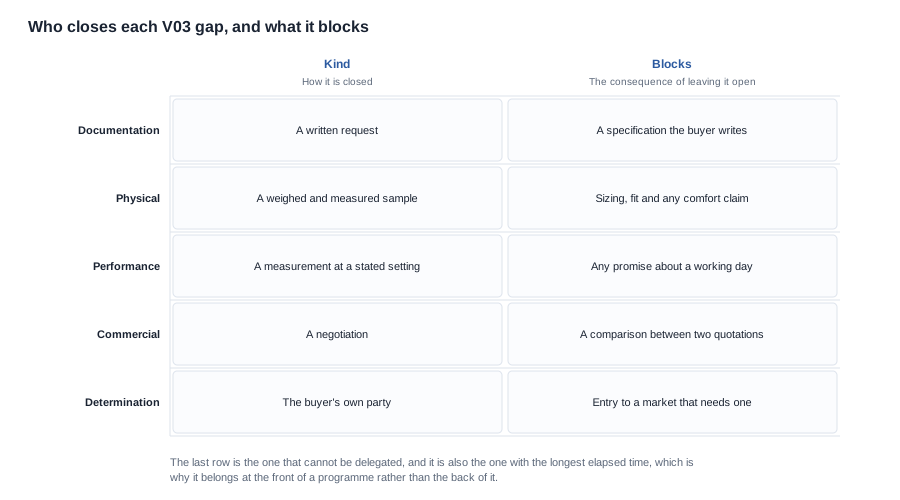
The matrix sorts the gaps by the party that can close them, and the sorting is the practical part, because each kind has a different cost and a different elapsed time.
The documentary gaps, and who closes them
Five of them, and each one has an owner, a method and a consequence. Written this way they stop being a list of complaints about a catalogue and become five items in a programme.
- The accessory position. Owner: the supplier, answering in writing against this designation. Method: a statement of the carton contents, dated, with the configuration it applies to. What it blocks: the packaging specification, the label artwork, the transit record and the accessory programme. The reason it is first is that it blocks the most.
- The radio generation. Owner: the supplier, and only if a radio is fitted in the unit. Method: a written answer, together with the evaluation the fitted radio was measured against. What it blocks: a radio specification, and any statement about pairing behaviour.
- The camera detail behind the class. Owner: the supplier, answering with a method attached to each item. Method: a request that asks for the sensor, the coverage, the rate of capture, the storage and the format separately, so that a reply can be checked item by item. What it blocks: any description of what the camera does well, and any comparison with another model on that axis.
- The configuration options. Owner: the supplier first, and then the channel, because a channel doing private label work has to decide what it is actually selling. Method: a list of what can be ordered, written onto the order line. What it blocks: the artwork, the packing list and the delivery check.
- The cell detail. Owner: the supplier. Method: a request for the specification of the cell as fitted, for its charge and discharge behaviour, and for anything available on ageing. What it blocks: a statement about how the product behaves over a year of use, which is a question a channel in the second year of a range will be asked.
A sixth item belongs on the same list and is easy to forget because it is not a gap at all: the review date. It is a commitment rather than a question, and it is the one that keeps the other five honest over the life of the programme.
The accessory position. Owner: the supplier, in writing, against this designation. Method: a written answer naming the contents of the carton, with the date attached. What it blocks: the packaging specification, the label, the transit record and the accessory line.
The radio generation. Owner: the supplier, and only if a radio is fitted. Method: a written answer, with the evaluation the unit was measured against. What it blocks: a radio specification, and a claim about pairing behaviour.
The camera detail behind the class. Owner: the supplier, with a method. Method: a request that asks for the sensor, the coverage, the rate, the storage and the format individually, so that a reply can be checked. What it blocks: any description of what the camera does well, and any comparison with another model on that axis.
The configuration options. Owner: the supplier, and then the channel, because a channel doing private label work has to decide what it is selling. Method: a list of what can be ordered, written onto the order line. What it blocks: the artwork, the packing list and the delivery check.
The cell detail. Owner: the supplier. Method: a request for the specification of the cell as fitted, its charge and discharge behaviour, and anything available on ageing. What it blocks: a statement about how the product behaves over a year of use.

The gaps that only a sample can settle
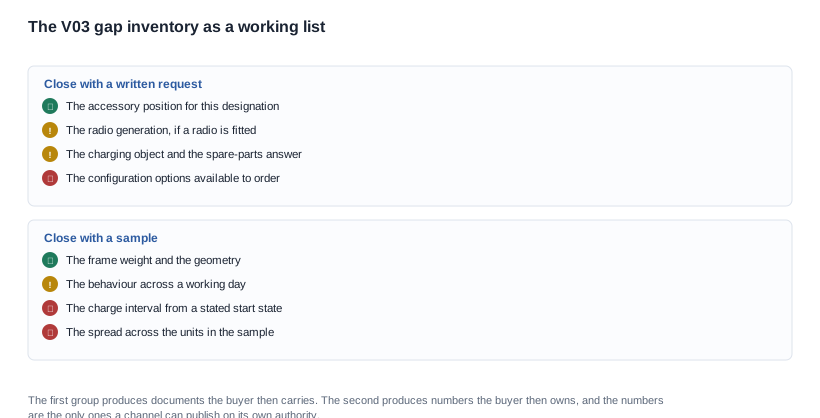
The frame weight and the geometry. No weight, no dimensions and no adjustment range are published, and they are the three figures a channel needs before it can talk about fit, sizing or how a customer will carry the product. Only a weighed and measured sample produces them.
The behaviour across a working day. The band is published and the conditions are not, so the only route to a day count is a measurement at a duty cycle the channel will actually ship, with the use logged day by day.
The charge interval from a stated start. A timed observation on a unit, with the state recorded before and after, is a small job and the only thing that produces a usable number.
The spread across the units. A single unit gives an anecdote. A figure that a lot can be accepted or rejected against needs units drawn from the batch under order, and the sample has to be sized before the measurement rather than after it.
What a sample programme has to establish, in order
Four jobs, and the order is not arbitrary, because two of them are worthless if the unit is not the configuration the channel intends to ship.
First, identity. That the units in the sample are the ordered configuration, with the print and the finish matching the approved artwork. A sample of a different configuration measures a different product, and the measurement will be filed against the wrong specification.
Second, the physical facts. The weight, with the configuration stated, and the dimensions the fit depends on. These are observations rather than tests, they take minutes, and they are the figures a channel can quote on its own authority.
Third, the working behaviour. The camera class behaving as published, the recording starting and stopping and storing, the charge interval completing from a recorded start state, and the radio pairing where one is fitted. Each of these has a condition attached, and each condition has to be written down at the moment the observation is made.
Fourth, the endurance sample. The use logged day by day over a working week, at the duty cycle the channel will ship, with the start and the end of use recorded for each day. The output that matters is the count of complete days, and the spread across the units is what turns that count into something a lot can be judged against.
The number of units in the sample is the one figure in this whole page that is a commercial decision rather than a technical one, and it is the one most often set too low. A sample of one establishes what is possible. A sample of three establishes an anecdote with a spread. A sample that a lot can be accepted or rejected against has to be sized before the measurement and not after it, which is why the sample order belongs on the schedule rather than in the conversation.
How a gap becomes a task

The six steps in the image are the whole method, and the first one is where most programmes fail. A gap written as an absence has no answer, so it stays open indefinitely; a gap written as a question has one, so it can be sent. The third step is the one that costs the most to get wrong, because a request that goes out at the artwork stage arrives too late to change the artwork.
The last step is the one that is easiest to omit and the one that matters most over a programme's life. A gap that was closed by a document reopens when a component changes or when a standard moves, and a channel without a re-opening rule will keep quoting an answer that has expired.

The commercial gaps, and the difference between a gap and a negotiation
The last group is not really gaps, and calling them gaps is a category error that costs money. A price, an order quantity, a lead time and a warranty period are not absent information about the product. They are commercial terms, and they are absent because they are negotiable, which means they belong to a conversation rather than to a request.
What is genuinely absent commercially. The price structure and the tiers that exist. The order quantity at each tier. The lead time, and whether it is per tranche or per order. The warranty term and the claim path. The packing and shipping data that a freight model needs. And the file scope per designation, which is a cost rather than a term but has to be priced before an order rather than discovered after it.
Why the distinction matters. A request is answered by somebody else, on their clock, and it is free to send. A negotiation is conducted by the buyer, at the buyer's cost in preparation, and it produces a commitment. A channel that files its commercial questions with its documentary questions waits for a quotation it could have asked for, and meanwhile plans a range on a number nobody has agreed.
The four that are worth negotiating rather than asking about. The order quantity, because it multiplies with the configuration count and it is the one number that decides how much of the range can be held. The tranche structure, because it decides whether a late discovery stops a shipment or delays a shipment. The artwork round allowance, because each round is a week and the number a channel plans for is usually lower than the number it needs. And the claim path on a warranty, because a long term with a slow path is worth less to a channel than a shorter one that is easy to use.
The trade-off that sits underneath all four. A tighter order structure gives a channel a smaller commitment and a slower ramp; a looser one gives a better unit price and a heavier risk. Neither is better, and the right answer depends on the launch date, the cash position and the number of markets in the first year, which are three things only the buyer knows.
The trade-off that sits underneath all four
A tighter order structure gives a channel a smaller commitment and a slower ramp; a looser one gives a better unit price and a heavier risk. Neither is better, and the right answer depends on the launch date, the cash position and the number of markets in the first year, which are three things only the buyer knows.
There is a second trade-off underneath the first, and it is about what the channel wants to be able to say about the product afterwards. A channel that fixes the accessory question early, that measures the day profile early, and that writes the criterion into the order is buying the ability to defend its own copy two years later, when the people who wrote it have moved on. A channel that leaves all three open is buying a faster launch and a slower answer to every question a retailer or a customer asks afterwards.
That is the real shape of the decision in this category, and it is why the list of gaps is not an argument against the model. The gaps are ordinary, they are closable, and each of them costs something. What matters is that a channel knows the cost before it commits, which is what this page is for.
A worked example of the difference
A channel is pricing a camera line and finds that the order quantity for the configuration it wants is higher than it can commit to. The instinct is to treat it as a gap and put it on the request list, which means waiting for a supplier to tell it what it already knew. The better move is to treat it as a negotiation: to ask what the quantity is composed of, because a quantity that includes several colourways and a per-designation minimum is a different proposition from one that includes a single configuration, and the two can be very different numbers.
The same reasoning applies to the lead time. A single figure for an order is a planning number; a per-tranche sequence is a schedule, and only the second lets a launch date be set honestly. The question that gets the second one is the question worth asking, and it is worth asking in the first message rather than in the third.
Where the limits of this record really sit
The record for this model is what the catalogue prints, and a gap is an accurate description of that record rather than a criticism of the product. Where the record speaks, we speak with it, including the band and the ceiling and the class. Where the record is silent, we will not fill the silence with a plausible figure, because a plausible figure that ends up on a carton becomes a statement the channel has made on our behalf, and nobody in the channel will be able to defend it.
What we will do is tell a buyer which of the items in this list their own programme already closes, which of them need a supplier document, and which need a sample, and in what order. A channel that has a configuration process, a sample programme and a documentation habit can work with this record comfortably. A channel that does not will find the same record frustrating, and the frustration is information rather than an obstacle.
Put the configuration you intend to ship, the destinations in your sequence, and the sample size you can put on a desk in front of us, and we will mark the gaps against those three answers and hand back the request list for the ones that remain open.
The list we hand back will be short, it will name a party against every line, and it will be in the order the programme needs rather than the order the questions arrive. That last point is the whole difference between a gap list and a plan, and it is the only part of this page that a reader can act on without a conversation with us.
How this designation compares with the one it sits next to in the range is set out in the comparison of the two designations.


