

Two beliefs are worth retiring before you compare these models, and both cost money if you keep them. The first is that a bigger battery means a better product. The second is that the two-hour charge time and the seven-hour runtime on either model tell you anything about how the product behaves in a customer's hands. Neither survives contact with the published rows, and what replaces them is a simpler answer: the charging case is the whole difference between these two models, and everything else is close enough that arguing about it is wasted effort.
Myth one: the CY05 is the better product because it has a bigger battery
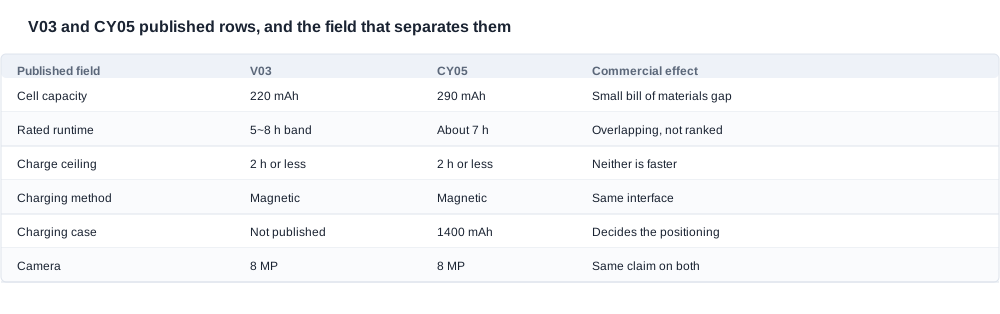
The CY05 carries a 290 mAh cell. The V03 carries a 220 mAh cell. Seventy milliamp hours, on the face of it, is a meaningful step.
Read the runtime figures before you draw the conclusion. The CY05 is rated at approximately seven hours. The V03 is rated at five to eight hours. A smaller cell producing a comparable figure, with a wider spread on top, is not a mystery; it is the signature of a platform whose published number moved with the workload. Cell capacity sets the ceiling. It does not set the runtime. Average power draw does that, and average power draw is a function of how long the camera sits idle, how often the radio reconnects, and what the test method was.
The test condition is not published for either model, so the honest reading of the two figures is that they overlap and neither is clearly ahead. What you can say is that the V03 reaches its lower bound more easily. If your customer's workload is heavy, the CY05's larger cell gives it more headroom. If the workload is light, the V03 gets closer to the same result for less cell.
A third factor sits underneath both figures and is published for neither: the case. The CY05's 1400 mAh case is a second cell in the box, and whether the quoted runtime was measured with the case in the charging cycle or without it changes the answer materially. Until that is closed in writing, the two runtimes are numbers from different experiments.
The practical test for a buyer who wants to act on the capacity difference anyway is simple and cheap. Order one unit of each and run them under a workload you can describe in a sentence: a fixed number of captures, a fixed idle period between them, the radio connected throughout. Record the elapsed time to the point where the device will no longer complete a capture. That single number is worth more than either published figure, because it is measured under a condition both your channel and your customer can be told about, and it is reproducible on the next sample order.
If that test shows a meaningful gap, the capacity difference is real and the CY05 should be positioned on it. If it shows a small gap, the seventy milliamp hours were absorbed by workload variation, which means the V03's smaller bill of materials was the better economic outcome all along. Either result is useful, and neither requires the catalogue to publish anything new.
A bigger battery is not a better product. It is a different bill of materials, and it comes with a cost line that has nothing to do with the customer's experience.

Myth two: the runtime figure is what your customer will get
Both models publish a rated runtime, and neither publishes the condition the rating was measured under. For a camera device this matters more than for an audio device, because the camera is the load that is on or off depending on what the user is doing.
A camera that stays powered and connected while nobody is filming is drawing current for no benefit. A conservative operating habit — open the case, shoot the sequence, put the frames back — removes most of the variance, and it costs the customer nothing. This is worth putting in your product instructions, because it is the difference between a product that appears reliable and one that appears erratic, and because the returns conversation is very different when the instructions and the published band agree.
The battery specification guidance sets out the questions to ask a supplier about test conditions, and it is the same set of questions for every model in this range. The list is short: what load was applied, whether the radio stayed connected, whether the case was in circuit, what ambient temperature, how many samples, and whether the figure is a band or a single reading.
Three consequences follow for a buyer comparing the two models. First, the charge ceiling is identical, so neither can be positioned as the faster charge, and a promise about charging is a promise about a ceiling that both products share. Second, a runtime band and a runtime approximation are different kinds of statement, and a retailer who quotes either as a single number has already misrepresented the row. Third, the gap between the two published figures is smaller than the gap between either figure and its own test condition, which means comparing them precisely is a way of manufacturing false confidence.
There is a fourth, and it is the one that decides whether the runtime ever becomes a support problem. Neither row publishes a charging cycle count, so neither model can be described as a unit that holds its runtime over a year of daily use. A buyer who writes the runtime into a product page should write the band, state that it is measured under an unpublished condition, and pair it with the operating guidance; a buyer who writes a single figure without that qualification has created a claim that the first customer who measures it will treat as a defect. In a category where returns cost more than margin, that asymmetry is the whole argument.
V03 smart glasses vs CY05: what actually separates them
Strip out the rows that match or overlap and one difference is left, and it is not a small one.
The CY05 publishes a 1400 mAh charging case. The V03 does not publish one at all. Its row lists magnetic charging and stops there. In this category a case is worth more than most of the specification rows on the sheet: it removes the anxiety of running out of power, it raises the achievable basket value at retail, and it changes the packaging design, the shipping weight and the landed cost.
Everything else is either identical or overlapping. Both publish an 8-megapixel camera, a charge time of up to two hours and magnetic charging. Both sit on the same AI voice assistant and low-power Bluetooth platform, which is why a buyer who has qualified one of them has already qualified the platform the other one runs on.
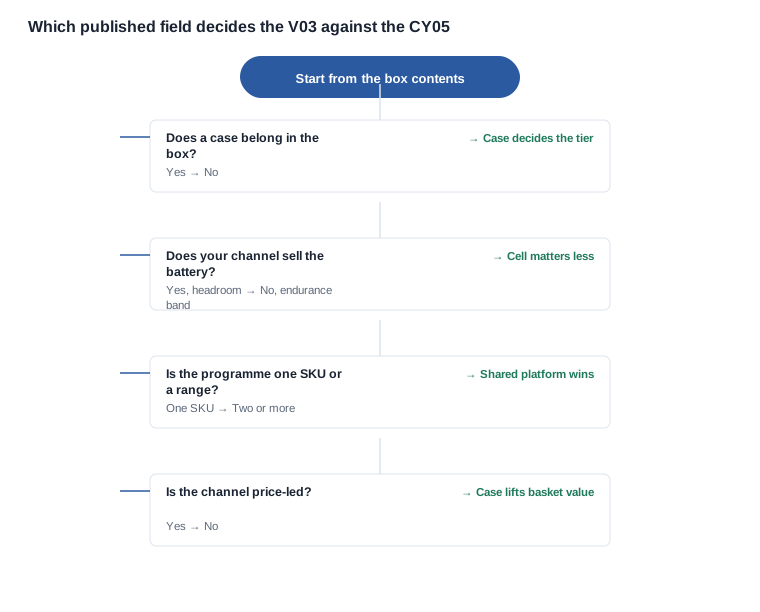
So the price positioning between these two models is a case decision. If your retail model depends on a case in the box — and in a camera category, most do — the V03 is starting from behind and you should be reading the L1 Pro and the CY03, and the L2 Utral and the CY05 or the MT6 instead, all of which publish a case. If your product is a first unit, a giveaway, or a lightweight SKU that travels well, the V03 is the correct choice and the absence of a case is a saving rather than a gap.
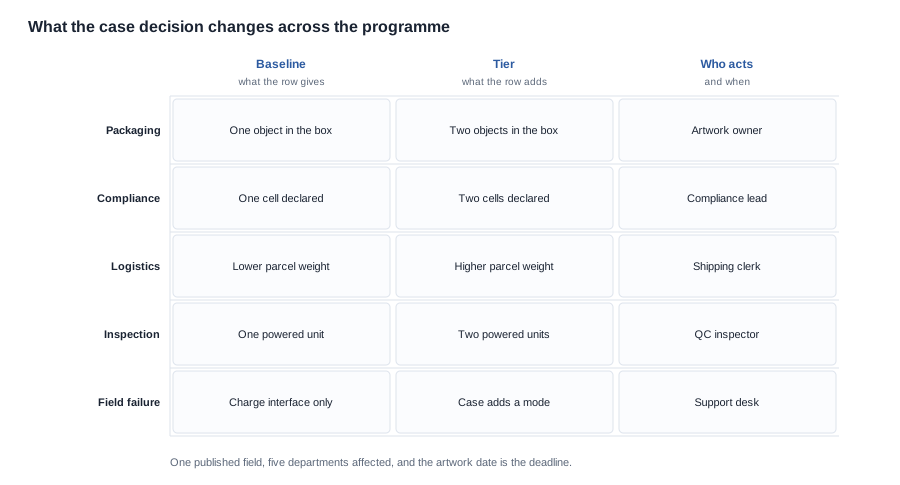
The knock-on effects of that single field are worth spelling out, because they are the reason a case decision is a packaging decision, a compliance decision and a logistics decision at once.
A case is a second purchased object. It has to be manufactured, packed, protected in transit, described on the carton and explained in the instructions, and each of those is an artwork approval with a date attached. It is also a second cell, which means a second declaration for the destination market and a second inspection point in the quality control plan. It adds packing volume, which moves the freight band and therefore the landed cost. And it is a second failure mode in the field, so a case that fails generates a support case that a cable product never produces.
Against that, a case removes the single objection a retail buyer raises most often in this category, which is what happens when the device runs flat away from a socket. The V03's answer to that objection is the magnetic charge, and magnetic charging is fast enough and simple enough to be a legitimate answer — but it is an answer the buyer has to be given, not one the packaging can demonstrate.
It is worth being explicit about which of these is a bigger problem for which kind of programme, because the two get confused constantly. For a programme that is sold as a first unit, an incentive, a giveaway or a lightweight travel SKU, the absence of a case is a packaging economy: one object, one cell, one declaration, one inspection point. For a programme that is sold as the main retail product, the absence of a case is a missing demonstration, and the objection it raises arrives at the point of sale where it is most expensive to answer.
The same distinction applies to the two-hour ceiling. On a cable product the ceiling is the whole charging story, so it deserves to be written on the carton and matched in the instructions. On a case product the ceiling describes the glasses only, and the case's own behaviour is the part the customer will actually notice — which is exactly why a buyer who has closed the charging method for the CY05 still has an open question about the case, and why the CY05's published case capacity of 1400 mAh is the number worth requesting the test condition for.

What the two models still do not tell you
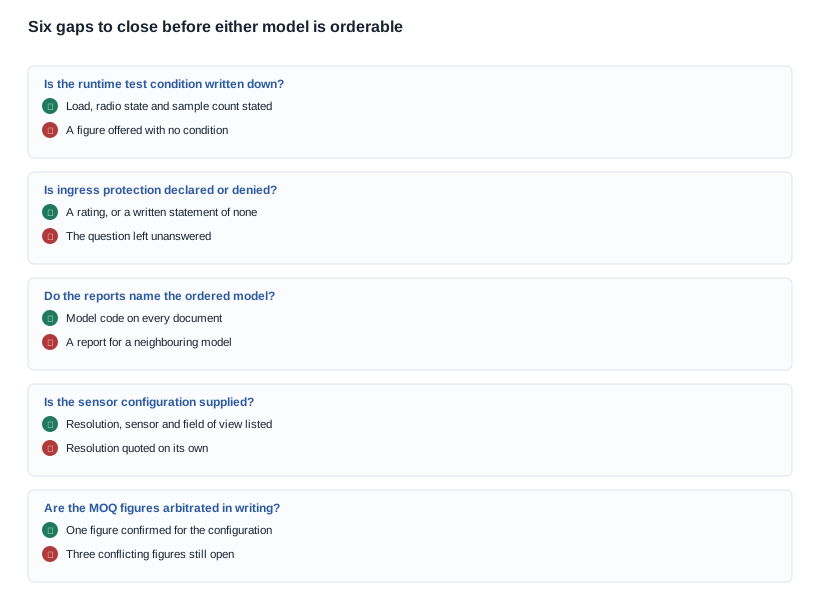
The gaps are identical between them, and they are the gaps that decide whether either product works for you.
- Sensor model, field of view, video resolution and frame rate — not published for either.
- Frame weight and temple dimensions — not published for either.
- Ingress protection — not published for either, and for a camera product sold outdoors that is a blocker rather than a detail.
- Certification numbers, issuing bodies and covered model schedules — not published for either.
- Storage capacity, file format and overwrite behaviour — not published for either.
- Minimum order quantity, lead time and price — not published for either, and our internal documentation currently holds three conflicting minimum order quantity figures that have not been arbitrated.
Those six gaps are the same on both rows, which is useful in one specific way: a single diligence request closes both, and a supplier who answers all six for both models in one written reply has done something a supplier who answers one model at a time has not.
Three of them are worth handling differently from the rest. Ingress protection is a binary question — a declared rating or a written statement that none is declared — and the red flags here are simple: a rating inherited from a neighbouring model, or a general statement that the product is protected. Either should be asked before the sample rather than after, because the answer determines whether the product can be sold into your channel at all. Certification is a document question rather than a field question, and the only acceptable answer is a report or declaration that names the ordered model. The conflicting MOQ figures are an internal problem on our side and should be resolved in writing before any quotation is treated as firm.
The remaining three share a property that makes them cheaper to close than they appear. Frame weight, sensor configuration and storage behaviour are all measurable on a sample order, and a sample order closes all three at once. A buyer who treats them as three separate investigations is doing three sample orders instead of one, and a buyer who treats them as settled because nobody objected has published three claims that cannot be defended when a customer measures them.
There is one more asymmetry worth noting. Because both models print the same charging method and the same charge ceiling, a buyer who has already qualified the platform for one model has removed the largest technical risk for the other. The remaining work on the second model is commercial and documentary rather than technical, which is the strongest practical argument for choosing both or neither rather than one.

How to run the price comparison without a published price
Neither model publishes a price, so the only honest way to compare them commercially is to build the comparison from the fields that are published and to treat the rest as terms to be negotiated. Before you commit to either route, the shortlist should be written down rather than assembled from memory, because the two models are easy to confuse precisely because their published rows overlap. Five steps do the comparison properly.
Step one: agree the criteria before you compare anything. Write down whether the comparison is between two products or between two programmes. A product comparison asks which unit a customer should buy; a programme comparison asks which route to a private-label SKU costs less after tooling, artwork, compliance and qualification. The two answers can differ, and a buyer who mixes them will negotiate on the wrong variable.
Step two: build the bill of materials difference explicitly. For the V03, the box contains one powered object and the magnetic interface. For the CY05, it contains the device and a 1400 mAh case, with its own cell, its own packing volume and its own failure rate. Price the case as a line item rather than absorbing it into a unit price, because an absorbed accessory is an accessory nobody inspects and nobody claims warranty on.
Step three: model the landed cost, not the ex-works price. Add packaging, freight, duty, the charging accessory, and the amortised cost of tooling and artwork to both sides. For this pair the freight line will move by less than a buyer expects, because the case is small; the packaging and artwork lines will move by more.
The line buyers most often omit is the second declaration. A case carries a cell, and a cell carries a document that has to be issued, reviewed and filed for the destination market before the shipment is allowed to move. On a first order that work is fixed cost, and on a range it is amortised across the models that share it — which is one more reason the platform-sharing line, not the freight line, is where the real comparison sits.
A second omission is the warranty denominator. A cable product returns against one object; a case product returns against two, and the case is the part most likely to come back. Ask for the two failure rates separately rather than a blended figure, because a blended rate hides exactly the number that determines your after-sales cost.
Step four: add the qualification cost that platform sharing eliminates. Both models sit on the same platform, so an app, a firmware branch and a compliance file confirmed for one serves the other. That saving is invisible in a unit price comparison and is usually the largest single number in a two-model range business case.
Step five: fix the terms before you fix the price. Unit price at volume, MOQ, tooling cost and ownership, lead time, warranty period and remedy, payment terms, deposit percentage and incoterms are all still open on both models. Negotiate them in that order rather than starting with the unit price, because a supplier that concedes the unit price early has less left to give on the terms that decide whether the programme works.
The trade that usually works in this category is forecast rather than price. A supplier who will move on the unit price for nothing will often move on the warranty period, the defect threshold, or the shape of the bulk order schedule in exchange for a stated annual volume and a longer commitment, because those terms cost the factory less than a point of margin does. Write the forecast you are willing to stand behind, and do not offer one you are not.
How to evaluate the two quotes once they arrive is therefore a documentation test rather than a price test: the quote that names the case as a priced line, states the warranty denominator, and fixes the incoterm is worth more than a lower quote that does none of those things. Finally, settle the incoterm before anything is signed, because it decides who carries risk at each point of the shipment and therefore who is arguing about what when a container arrives with a problem. A comparison in which the two models are quoted on different incoterms is not a comparison at all, and reconciling it at the shipping stage is far more expensive than reconciling it in the quotation.

The judgement behind this comparison
The V03 and the CY05 are one platform with two packaging tiers, and the sensible thing to do is pick the tier that matches your channel rather than spend a week comparing battery figures that overlap. If a case belongs in the box, take the CY05. If it does not, the V03 is the lighter option and the correct one, and we will not pretend the missing case is a problem it is not.
We will also say the harder part plainly: we cannot substantiate a resolution or image-quality advantage for either of these models on paper, because the sensor figures are not published. If your channel sells on camera quality rather than on price, neither of these is the right basis for a decision, and you should ask for a physical comparison. The camera family is on our AI camera glasses range page, and the model-level detail behind the case-equipped tier is in CY05 compared.
Related reading
- How the case-equipped tier performs — CY05 compared
- Why the same platform publishes two runtime numbers — battery life
- Turning a tier into a private-label SKU — OEM and ODM options
Tell us the channel, the volume and the target market, and we will come back with what is available and what is not.


