
The CY05's position in the camera range is easy to state and worth stating precisely, because it is one of four models that sit on the same power block. It publishes an 8-megapixel camera, a 290 mAh frame cell, a charge time of two hours or less, a rated runtime of about seven hours and a 1400 mAh charging case. The L2 Utral and the L1 Pro, and the CY03 publish the same three power rows, and the L2 Utral adds a published Type-C interface and a second case capacity.
So the CY05 is the plain, 8-megapixel, 1400 mAh case member of a four-model platform — which is either exactly what a buyer wants, or a reason to look further along the range. Neither reading can be settled from the camera row, because the sensor model and field of view are not published for any camera model in this family. What can be settled is which platform to qualify, which accessory chain to design around, and which models in the range are actually competing for the same brief.
This page works through the range in four blocks rather than as a list of eleven, because a buyer comparing camera glasses is usually choosing between two or three candidates and needs to know which rows separate them before anyone spends time on samples.
Cy05 across the camera range: the 290 mAh block and its three siblings
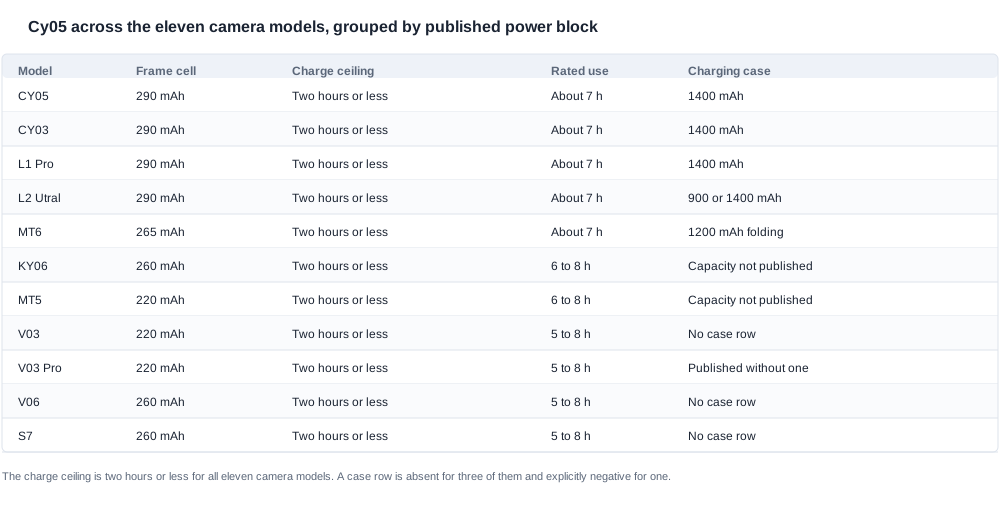
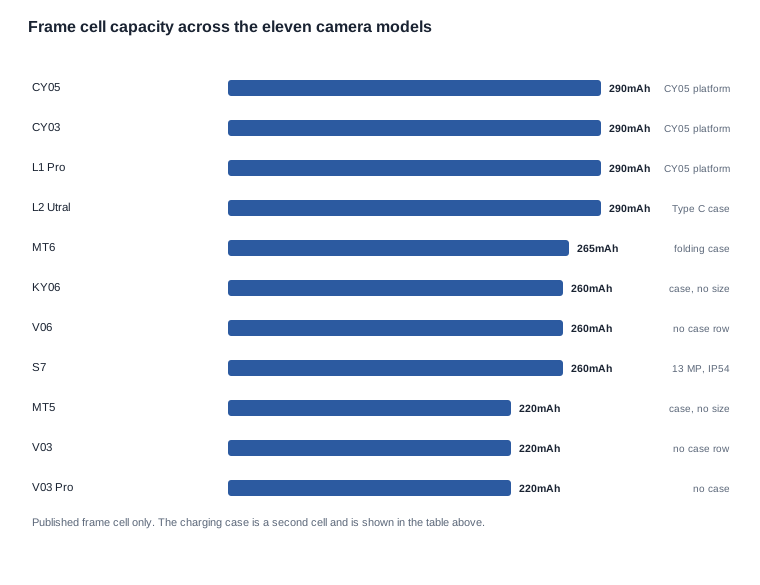
Four camera models publish a 290 mAh cell, a two-hour-or-less charge ceiling and a rated runtime of about seven hours: the CY03 and the L2 Utral, and the L1 Pro and the CY05. Every one of them also publishes a charging case. Three publish a 1400 mAh case, and the L2 Utral publishes two capacities at 900 mAh and 1400 mAh.
The four-model block is the reason a camera range is affordable to qualify, and it is the reason the published rows cannot tell you which of the four to order. One app, one firmware branch, one accessory family, one box structure and one certification file for the family — that is what the sharing buys, and the cost of the sharing is that a specification comparison between the four is a comparison between identical rows.
The one published difference inside the block is the camera tier. The CY05 and the CY03 publish 8 megapixels; the L1 Pro and the L2 Utral publish 13. And the evidence behind that difference is thin for all four of them: no sensor model, no field of view, no video resolution, no frame rate, no aperture and no pixel size is published for any camera model in this range. A 13-megapixel sensor with small pixels can produce a worse image than an 8-megapixel sensor with large ones, so a comparison advantage of this kind should not be claimed externally until it has been checked against a competitor's unit in the hand. The camera imaging guidance sets out the test.
The second difference inside the block is the charging interface, and it is narrower than it looks. The L2 Utral publishes a Type-C charging interface. The CY03 and the L1 Pro, and the CY05 publish no charging method row at all — the row is absent from their catalogue entries, not filled with a different value. Four camera models across the range share that absence, and the CY05 is one of them. That distinction matters for accessory design, because a magnetic frame needs a dock or a pad in the box while a Type-C frame does not.
Where the CY05 sits inside its own block
Inside the four-model group, the CY05 is defined by three things and only three things. It is the 8-megapixel member, so it is the lower resolution of the two tiers. It carries the standard 1400 mAh case rather than the L2 Utral's dual option. And it publishes no feature of its own — no lens description, no temple description, no colour list, no control method.
By contrast the V03 Pro in the same range publishes a photochromic lens, flexible temples and three colourways, and it sits on an entirely different power block at 220 mAh. That is the useful shape of the range to hold in mind: the 290 mAh block is a platform for scaling a line, and the photochromic lens is a separate proposition on a separate platform rather than an option within the first one.
The 220 mAh and 260 mAh blocks read against the CY05
Two smaller cells carry the other seven camera models. The 220 mAh block is the V03 and the MT5, and the V03 Pro. The 260 mAh block is the S7 and the KY06, and the V06, with the MT6 sitting just below both at 265 mAh.
The 220 mAh block is the light-parcel block. Its three models publish endurance as a range of 5 to 8 hours, which is a different disclosure type from the CY05's point figure and, in fairness to them, a more informative one: a range indicates more than one condition was measured. The V03 and the V03 Pro publish no charging case row, and the V03 Pro has no charging-case row. The MT5 carries a case whose capacity is not published, which makes it the one model in the range configured exactly like the CY05 — a case-equipped camera platform with an unpublished case figure — and therefore the natural alternative when a buyer wants to compare two case-equipped platforms side by side.
The 260 mAh block is the sport-leaning block, with one exception. The V06 and the S7 publish an IP54 ingress marking and a removable inner frame, and they are the only two camera models in the entire catalogue that carry an IP rating. The KY06 shares their cell but not their sport features: it publishes a 6-to-8-hour range and a charging case with no capacity stated, and nothing in its entry claims an ingress rating or a removable frame. The MT6, at 265 mAh, is the outlier that carries the 1200 mAh folding case and the only frame weight our catalogue publishes anywhere — 158 g for the glasses body including its battery and camera, excluding the folding case.
That 158 g figure is the one number in this range that a buyer can put on a product page, and it belongs to the MT6 alone. It is not a proxy for the CY05, which carries a larger cell and a different case configuration, and a buyer who substitutes it will find out at the sample stage rather than on the listing.
The case status has three states, not two
Across the eleven camera models, the charging case appears in four different situations, and the distinction between them is worth holding because it is the difference between a published absence and an unpublished row.
Five models publish a case capacity: the L1 Pro and the CY05, and the CY03 — each at 1400 mAh, the L2 Utral at 900 mAh or 1400 mAh, and the MT6 at 1200 mAh in a folding case. Two models carry a case whose capacity is not published: the KY06 and the MT5. Three models have no charging case row at all in their catalogue entries: the V03 and the V06, and the S7. And one model has no charging-case row: the V03 Pro.
So seven camera models ship with a case, the V03 Pro has no charging-case row, and for the V06 and the S7, and the V03 the catalogue simply does not publish the row. That last group is an open question rather than a settled fact, and it is one of the items worth raising in a written request, because a buyer who assumes the absence is a decision may be leaving an accessory on the table that the model can actually carry.
What a shared 290 mAh platform actually saves a multi-model brand
The commercial argument for the four-model platform is not a discount — we publish no unit price and no price tier, so any such claim would be invented. It is a fixed-cost argument, and it is the kind of argument a procurement manager can defend to a finance reviewer without needing a quotation.
One qualification programme instead of four. Sensor selection, the app, the firmware branch, the packaging structure and the accessory tooling are set once for the platform. The marginal cost of adding the L1 Pro to a range that already carries the CY05 is the cost of a different sensor tier and a different listing, not the cost of a new product platform.
One accessory chain. The case is shared across the four, which means one case SKU, one spare-parts policy and one packaging specification rather than four. The model readiness overview sets out how this sharing is normally structured, and the scaling piece covers what each additional model actually costs once the platform is qualified.
One certification file for the family. This is the item with the longest timeline, and it is worth being precise about what our documentation does and does not say. Our catalogue carries a company-level export certification page whose content is images rather than text, and its text contains no reference to CE, FCC or RoHS anywhere. There is no per-model certification row for the CY05 or for any other model in the range. A certification position for a platform therefore has to be requested in writing for each destination market, and a platform where four designations share one document is cheaper to qualify than four platforms. The certification coverage page explains what that means in practice.
One support script. Returns triage, instructions, packaging artwork and the troubleshooting flow are set once, which is where the real operating saving sits for a brand that expects to move volume rather than samples.
The accessory economics of the 290 mAh block
The fixed-cost argument is usually made in software terms, and for a camera range the packaging and accessory terms are where the money actually sits. Four models that share a 1400 mAh case share one case part number, one spare-parts holding, one carton specification and one battery transport document covering the second cell in the parcel. A range where three models carry different cases carries three of each of those.
That has a second-order effect that procurement teams recognise immediately: the case is a second lithium cell in every shipped unit, which changes the packed weight, the carton dimensions, the volumetric calculation and the freight class. A range that shares the case shares that cost line too, which is a reason the 1400 mAh case is a range decision and not only a product decision. It is also why the L2 Utral's second case capacity is commercially interesting: offering a 900 mAh option lets a brand build two price points from one platform, which is a cheaper tier strategy than developing a second product, and it does so by changing one line on a product page rather than by qualifying another model.
The cost of the sharing sits on the shelf. Four models with four identical power rows and two camera tiers produce listings that are hard to tell apart in a marketplace, because the shopper is being asked to choose between a 1400 mAh case and a 1400 mAh case. The way round that is not a better product page — it is an honest reason to prefer each listing, and only three reasons exist in the published data: the camera tier, the charging interface, and the certification position. The charging case options analysis works through the accessory cost in more detail, and the shipping weight breakdown covers the parcel arithmetic.
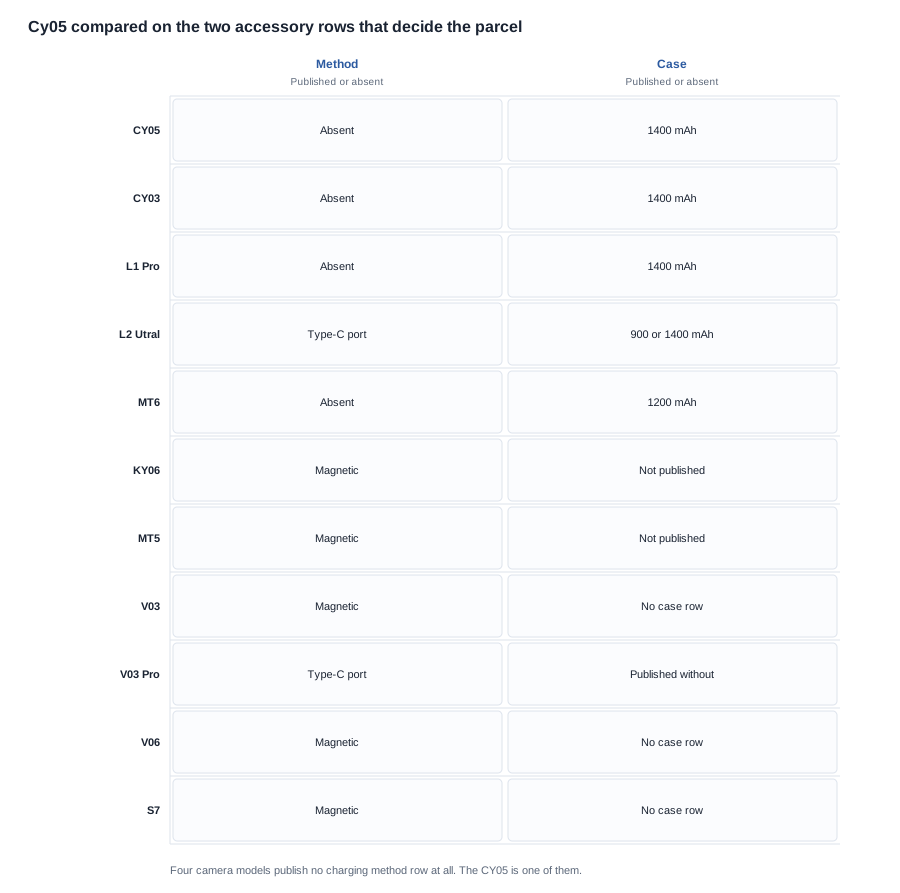
The counterweight is real and should be stated rather than argued away. A platform where four models share their electrical rows produces four listings that are hard to tell apart on paper, and the published rows do not help a buyer write the difference. The camera tier separates two of them. The charging interface separates one. The remaining pair, the CY05 and the CY03, is separated by nothing published at all.

The camera comparisons the published rows do not settle
A range comparison is only as good as the rows that differ, and in this family the rows that differ are fewer than a buyer expects. Here is the complete list of what the published camera rows cannot answer.
- Sensor, field of view, video resolution and frame rate — not published for any of the eleven camera models.
- Frame weight, temple length and lens dimensions — not published for the CY05 or for any camera model except the MT6 glasses body.
- Runtime test conditions and the starting point of the charge-time figure — not published for any model.
- The charging input and the charge indicator behaviour — not published for the four models whose charging method row is absent, which includes the CY05.
- The case's own recharge time, and whether a case is sold separately — not published for any model.
- Ingress protection — published only as IP54 on the V06 and the S7, and not published for the MT5 and the V03, the L1 Pro and the KY06, and the MT6 and the CY05, and the L2 Utral and the CY03 or the V03 Pro.
- Certificate numbers, issuing bodies, validity periods and covered model schedules — not published, and the compliance work sits inside the landed cost.
- Storage capacity, file format and overwrite behaviour — not published.
- Minimum order quantity, lead time and unit price — not published. Our internal documentation has historically held more than one minimum order quantity figure that has not been arbitrated, which is a further reason to treat any figure you are quoted as something to have confirmed in writing.
The tier structure the range supports, and the one it does not
Across the eleven camera models, the pixel counts fall into two groups, and a buyer planning a tier ladder should know exactly how they fall because a tier ladder is only useful if each tier has a defensible reason to exist.
Eight models publish 8 megapixels: the V03 Pro and the MT5, the V06 and the CY05, and the MT6 and the V03, and the CY03 and the KY06. Three publish 13 megapixels: the S7 and the L2 Utral, and the L1 Pro. The 13-megapixel group is the smaller of the two, and within it the models differ from each other on published rows — the L1 Pro and the L2 Utral share the 290 mAh block and the 1400 mAh case, while the S7 sits on the 260 mAh sport block with an IP54 marking and a removable inner frame. That gives a 13-megapixel shopper at least three distinct propositions rather than one.
The 8-megapixel group is where the range runs out of honest axes. It contains the entry pair with no published case row, the photochromic model with a lens and three colourways, two sport-leaning models, one model with a published weight and a folding case, and the four-model 290 mAh platform. Within that group the CY05 is the member with the most standard configuration and the least published of its own — which is a perfectly good position for a volume SKU and a poor position for a hero product.
What the range does not support is a single linear ladder from cheapest to most capable, because price is not published anywhere in our documentation and the only axes that exist are capability, accessory and certification. A buyer who wants a good-better-best structure has to build it on those three axes or invent a fourth, and inventing one is the failure mode this page is written to prevent. The range selection guide covers how the tiers are normally structured, and the battery comparison across the camera range sets out where each model sits on the published power rows.
A method for comparing without a published price
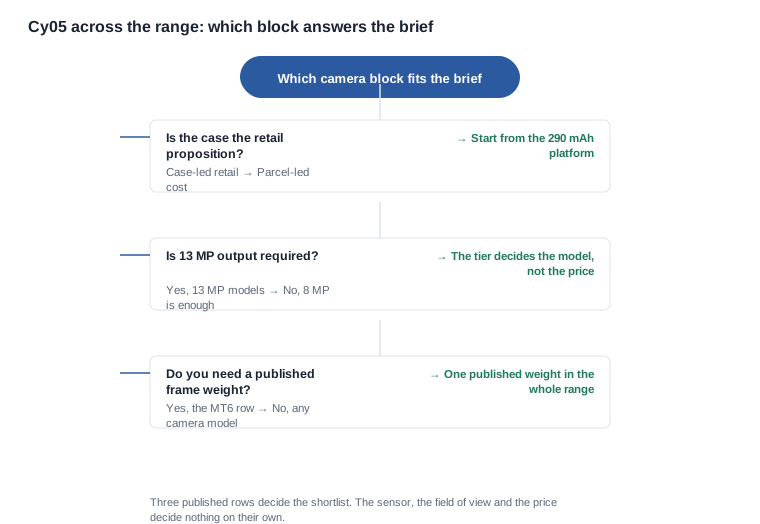
Since price is not published, the comparison has to be built on the rows that are. The practical sequence is short enough to run inside a supplier meeting. Fix the proposition first — a case-led retail day, a resolution tier, or the lightest published parcel — and let that single sentence eliminate most of the eleven models. Then shortlist two, and record which published row made each one eligible, because a shortlist with an unrecorded reason becomes a shortlist with no reason. Then request the missing rows for both shortlisted models in one message, with the answers tied to each model designation rather than to the family. Then sample one unit of each and run the same capture and charging script on both, because the comparison is no longer a catalogue exercise at that point.

Finally, score the shortlist on delivered cost, certification scope and the count of items still open. That last number is the one that gets skipped and it is the one that predicts a delayed launch: a model with four open items and a six-week certification timeline behaves differently from one with nothing open and the same timeline, and only the first of those two can be compressed.
Before the shortlist goes to a supplier, it is worth writing down the criteria you used to build it, because a shortlist without a recorded criterion cannot be defended when someone later asks why a model was excluded. The checklist below is the minimum a buyer needs, and each line is a question to ask rather than an answer to assume.
- Which published row made this model eligible, and would it still be eligible without the charging case?
- Which row on the shortlist sheet is a published value and which is still an assumption?
- What is the total cost per delivered unit with the case, the carton and the transport document included?
- What is the certification scope for each shortlisted designation in each destination market?
- Which model on the shortlist would be dropped first if the launch date moved by a month?
- What are the red flags in the replies, as opposed to the missing rows?
Questions 1 and 6 are the ones that change a decision. The first tells you whether your selection logic is robust or accidental, and the second stops a confidently worded reply from a family-level document being mistaken for a model-level answer.
Where our CY05 position stops
The CY05 is a sensible platform member for a brand that wants a 1400 mAh case and a plain product with no feature argument to defend — and a buyer should select it deliberately rather than by default, because the range offers a lighter parcel, a folding case, a photochromic lens, a published ingress marking and a published frame weight as alternatives.
We will publish the 8-megapixel figure as a resolution tier and not as a picture quality claim, and we will not extend the 158 g figure or the MT6's folding case to this model. We will not quote a unit price, a minimum order quantity, a lead time, a frame weight, a colour list or a certificate number for the CY05, because our documentation does not contain them, and a comparison that needs those numbers is a comparison to be run against a quotation rather than against a catalogue.
We will also say plainly that the 290 mAh platform's shared rows make a specification comparison inside the block close to meaningless, and that the honest answer to "which of the four should I take" is a set of questions rather than a name. Send us the channel, the volume, the target markets and the proposition, and we will come back with which configurations exist, which rows are published for them, and what has to be closed with the factory before an order can be placed. The camera family is on our AI camera glasses range page, and the published CY05 specification list is the row-level reference for this model.
Related reading
- This model's catalogue rows — CY05 smart glasses specifications and features
- The case-equipped alternative with no published capacity — MT5 specifications
- The model with a published weight and a folding case — MT6 compared
Tell us the channel, the volume and the target market, and we will come back with what is available and what is not.


