

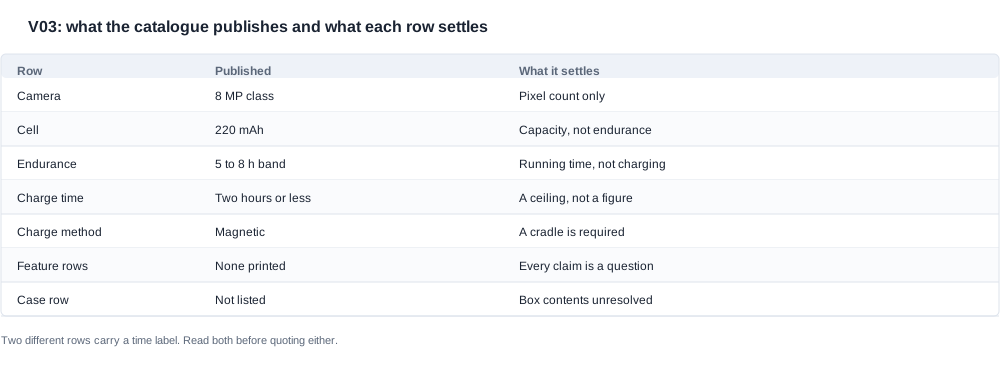
The V03's catalogue page is a page of numbers with no adjectives on it, and that is the whole of its character. It publishes an eight megapixel resolution class, a 220 milliampere-hour cell, a running time of five to eight hours, a ceiling of two hours or less for charging, and magnetic charging. It publishes no descriptive rows at all — no ergonomics line, no sound line, no removable frame, no ingress marking, no lens description and no colour list. It also publishes no charging-case row, which leaves the contents of the box unresolved in a way that has to be settled in writing before a purchase order is signed.
Two of those facts will be misread by a buyer working from a general impression of the camera range. The first is the label on the endurance row, which on this page reads as charge duration and in fact reports running time. The second is the emptiness underneath the rows, which looks like an omission and is in practice the largest single item on the page.
This is how to evaluate the model: as a specification with four settled numbers and one unresolved question about the box, and not as a thin entry in the catalogue.
What to check before ordering to know about V03 smart glasses: a magnetic charger and no case row
Here is what the page prints, row by row.
The camera is an eight megapixel class. This model is one of eight camera models in the range that sit in that class, the others being the MT6 and the CY03, the V03 Pro and the MT5, and the KY06 and the CY05, and the V06; the remaining three camera models sit in the thirteen megapixel class. The class counts pixels and settles nothing else. Nothing at all is published beyond that. Two items make the point: the angle the camera covers is absent, and so is the rate at which frames are written. The container is not named either, and neither is the storage behind it — and every one of these is absent behind the class for the other camera models as well.
The cell is 220 milliampere-hour, and the V03 Pro and the MT5 are the two other camera models that publish the same figure. What the cell settles is the size of the internal battery and nothing about how long the product runs. The three models that share it do not share an accessory trail, which is the practical consequence for anybody building a comparison.
The endurance is published as five to eight hours of running time. Four camera models publish that same band. A band is a range, and a range cannot be quoted in a listing without the conditions that produced it attached, because the conditions are not published for this model.
The charge time is two hours or less, and that is an upper limit rather than a measurement. Nothing is published about the condition the cell is in before charging, or about the level at which the unit is considered charged, so the figure cannot be used to plan a shift break or to promise a turnaround at a warehouse.
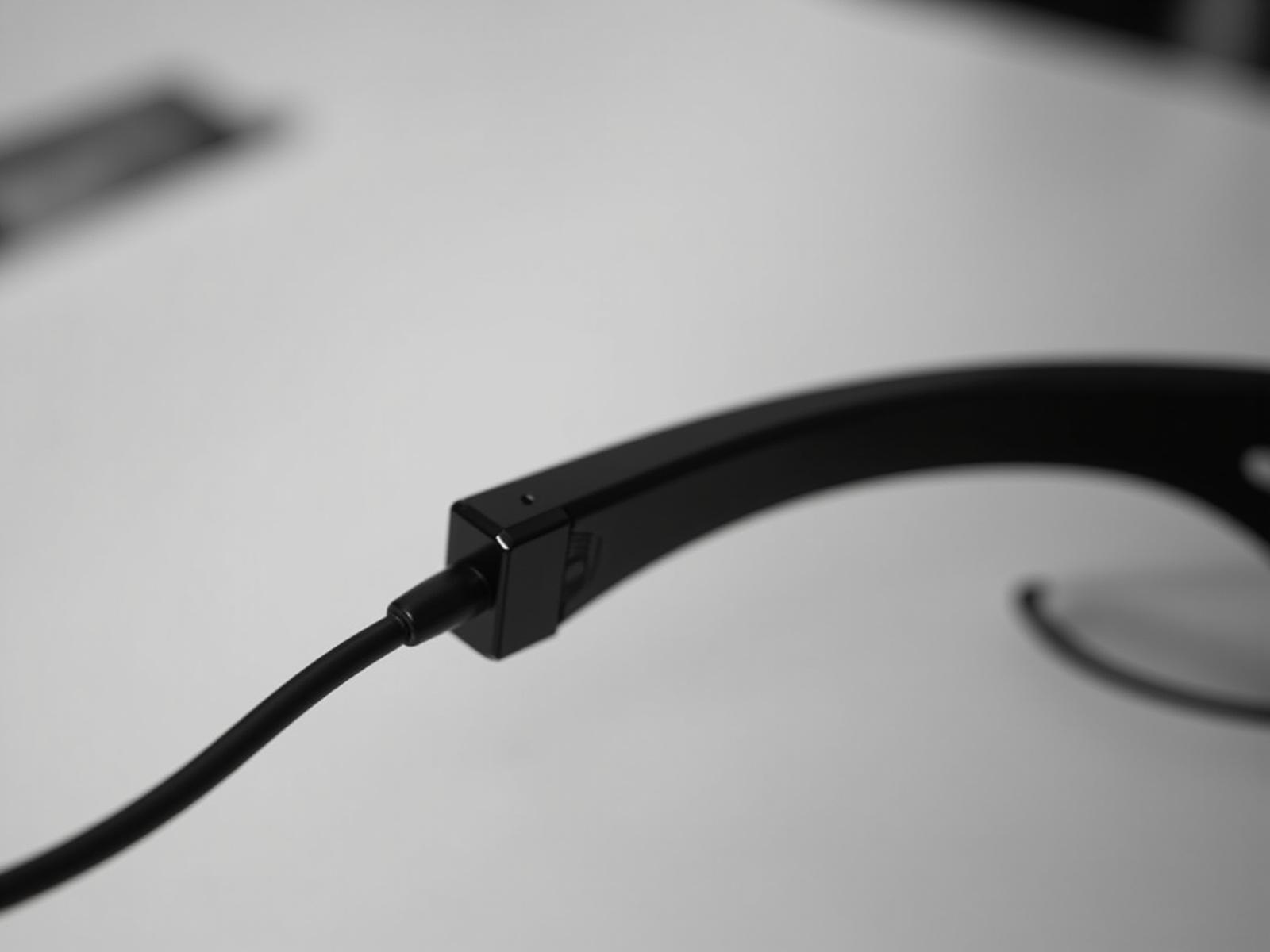
The charging method is magnetic. That is the one row on this page with an immediate operational consequence: magnetic charging means contacts and a cradle, so a cable by itself does not charge the unit. A model with a named interface ships with a cable; a model that charges magnetically ships with whatever holds the contacts, and what holds the contacts on this model is exactly what the page does not say.
That leads to the case, and the case needs care because three different answers are available in the camera range and this page gives none of them. The camera models divide into four positions: five of them publish a case with a capacity figure, two publish that a case exists without giving its capacity, one has no charging-case row, and three publish no case row at all. This model is in the third group. A blank row is not a statement that no case is supplied, and it is not a statement that one is. It is an unanswered question, and a buyer who treats it as a negative fact has made a deduction the catalogue never authorised.
The distinction matters commercially in three ways. The first is the box: whether a cable, a cradle and a case are in it decides the packing instruction, the parcel dimensions and the shipping weight, and therefore the freight cost per unit and the shelf allocation in the warehouse. The second is the returns path, because a returned unit with a case and a returned unit without one are different problems with different inspection steps and different refund decisions. The third is the accessory order, because a model that ships with a case has an accessory line and a model that does not has none. The way the box contents differ across the camera models, and what each of the four positions means for a picking list, is set out in the AI camera glasses box contents note.
So the criterion for this model is not whether the box has a case. It is whether the supplier has stated what the box has, in writing, against the model designation and the build. Until that statement exists, the four rows above are the entire published specification, and the packing list is an assumption.
There is one further item on the page that a buyer should not read into it. The cell capacity on this page is labelled with a phrase that is not the ordinary word for battery capacity; other camera pages in the range use the ordinary word. The label is a labelling inconsistency in the source document rather than a different kind of cell, and the number, 220 milliampere-hour, is the same figure the other two models publish. It matters for one reason only: a specification sheet built by copying labels across pages will pick up inconsistent terminology, and a quality control team reading that sheet later will spend time on a difference that does not exist.

The catalogue page that lists no feature rows at all
This model's page prints the standard specification rows and nothing descriptive beside them. There is no ergonomics row, no sound row, no removable-frame row, no ingress marking, no photochromic or lens row, no long-battery descriptor, no colour list and no radio version.
It is worth being precise about what that does and does not mean, because the tendency in both directions is the same error. It does not make this model the thinnest entry in the catalogue: several other models in the range also print no descriptive rows, and a blank page is common in a document that is organised around specification rather than marketing. It also does not mean that the product lacks the features other models name. It means that for this model, on this page, nothing is claimed, and a claim a channel cannot source from the catalogue is a claim it carries alone.
That is the practical position. Every descriptive sentence in a listing for this model has to come from somewhere other than the catalogue page, which in practice means it comes from the supplier, in writing, or it does not go in the listing. A channel that wants to say the product is comfortable, lightweight, weather resistant, plays music, has a removable inner frame or suits a particular activity is describing something the page for this model is silent about, and the silence transfers the whole burden of evidence to the seller.
The questions this raises are the ones a customer will ask first, and they are ordinary enough that a buyer should have the answers ready rather than improvised at the returns desk. Does the camera record video as well as stills, and at what resolution and frame rate? What is the field of view, and does it capture what a buyer expects to see rather than a narrow strip? How much footage can be stored, and what happens when the storage fills? Where does recorded footage go, and how is it retrieved? Is there a microphone, and what is the microphone specification? Does the product carry a radio, and which version? Is there a Bluetooth link, and does the camera range publish one? What are the frame dimensions, and is there any adjustment? What is the unit weight?
None of these is answered on the page. The buyer who wants to answer the customer has to request them, and the requests need to be phrased as questions with a named answer rather than as a wish list, because a supplier asked for a feature description will produce a feature description and a supplier asked for a specification will produce a specification, and only the second one is worth anything at a goods-in check.
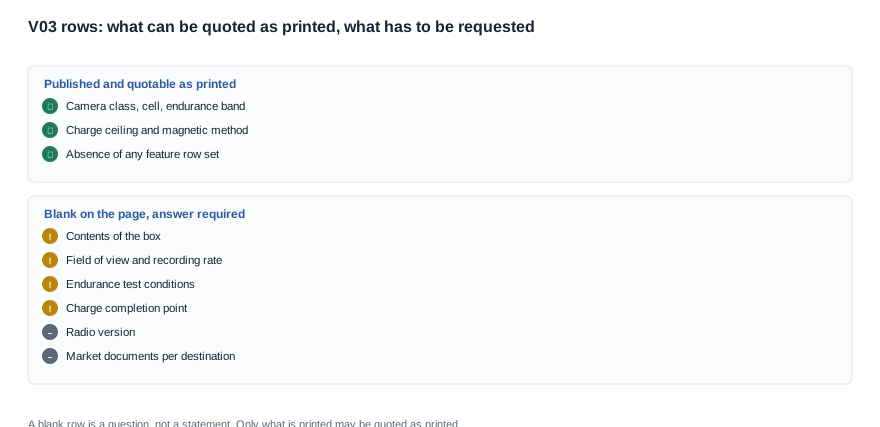
The criteria for turning a blank into a question are simple and reusable. A blank row becomes a question that asks for a measurement, a configuration statement or a document, never for an opinion. A request for "the weight" is a request for a number with a stated condition. A request for "what is in the box" is a request for a list. A request for "the certification position" is a request for documents that name the model and the destination market. Anything that cannot be phrased that way — anything that asks a supplier to describe a feeling, an occasion or a use — belongs in the marketing conversation and not in the purchase file, because it produces an answer nobody can check and a claim nobody can defend.
The commercial consequence of the empty page is worth stating plainly, because it is easy to underestimate. A model with descriptive rows gives a channel something to merchandise that a competitor's page does not have, and that is where most of the differentiation in this range lives. A model without them can still be sold, and the four numbers on this page are enough to build a specification around, but the selling has to be done on the numbers, on the box contents and on the terms of the quotation. Which means the channel's real work for this model is the file it assembles before the first order, not the copy it writes afterwards.
That is also why the questions to ask on this model need to be answered before the quotation rather than after it. The moment a buyer has a quotation in hand, the commercial conversation starts to dominate the schedule, and the specification questions get deferred to the sample. The specification questions are the ones that decide whether the sample is worth approving. A buyer who runs them in the wrong order ends up approving a sample against an assumption and then discovering, at the second order, that the assumption was wrong.
Reading a charging-time label that actually reports endurance
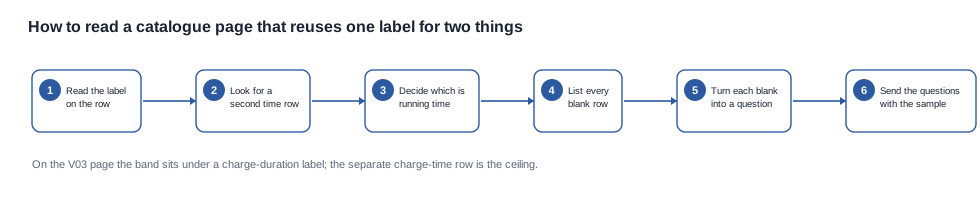
On this page the endurance figure of five to eight hours is printed under a label that reads as charge duration. The same page carries a separate row for charging time, capped at two hours or less. The same Chinese term therefore means running time on one row and would mean charging time on another, and the range uses the ordinary word for charging elsewhere.
This is the single most consequential item on the page for a buyer who writes specifications by copying rows. Copy the endurance row into a specification sheet as a charge time and the product appears to charge in five to eight hours. Copy it as an endurance figure and it is correct. Nothing on the page flags the difference, because on this page the label is doing two jobs at once and the second time row is easy to overlook.
The method that avoids the error is a rule a procurement team can apply to any catalogue page in this range without knowing which page it is on. Read the label, then look for a second row on the same page using the other word. If there is one, the first label is about running time and the second is about charging. If there is only one, the label is ambiguous and the figure has to be confirmed against the factory before it goes into any document. Applied here, the endurance row is a band of five to eight hours of running time and the separate row is the charge ceiling of two hours or less.
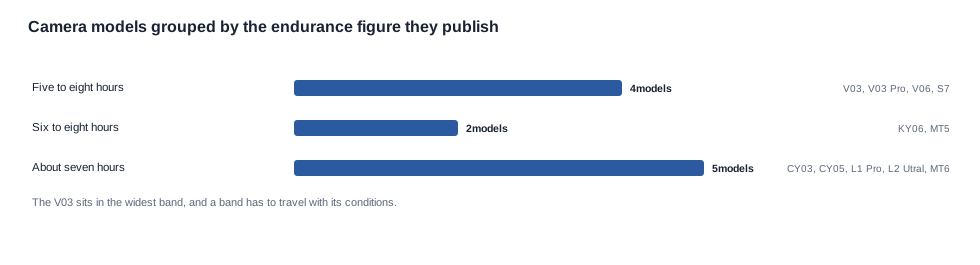
The band itself needs the same treatment. Five to eight hours is the widest band the camera models publish, shared with the V03 Pro and the S7, and the V06. The top of it is roughly sixty percent longer than the bottom, and the catalogue does not say which conditions produced which end — not the recording mode, not the volume, not whether a radio link was active, not whether a case was in use, not the ambient temperature. A channel can publish the band as the manufacturer's rating, which is what it is. A channel cannot publish five hours as a working figure and eight hours as a working figure in the same listing and expect both to be defensible, because the conditions that separate them are not published.
The charge ceiling has three separate gaps attached to it, and each of them is a question rather than a defect. What it covers is not stated: the frames alone, or the frames and a cradle, or the frames and a case. Where a case exists, the ceiling might describe a combined cycle; where the case row is absent, as here, there is a genuine ambiguity about whether the two-hour figure includes any dock at all. The starting state of the cell is not stated. The completion point is not stated — the catalogue does not say at what percentage the unit is considered charged, and a unit judged full at a different threshold from the factory's is a unit that fails a goods-in check for no reason other than a different convention.
The charging method raises a question that is specific to this model and that the case row would otherwise have answered. Magnetic charging requires a cradle that holds the contacts under pressure, and a cradle is a physical object with a supply chain behind it: it can be lost, it can be damaged, it can be duplicated at a cost, and it decides what a customer must have on a desk for the product to be usable at all. If the box contains a cradle, the channel can offer a replacement and can plan a spare-parts line. If the box contains only a unit with contacts, then the product as shipped is not chargeable by the customer, which is a different commercial proposition and probably a different listing.
The final point in this section is a discipline rather than a fact. A published number is a number, and the conditions that make it meaningful are usually absent. The correct response to an absent condition is not to substitute a typical value from elsewhere in the industry, which is a practice that quietly converts one manufacturer's rating into another manufacturer's number. The correct response is to ask, to write down the answer with its conditions attached, and to publish the number with the same qualifier the catalogue used.
The pre-order list that survives a quote negotiation
The list below is arranged in the order this model should be checked in. Every item is phrased as the request that closes it, and every one of them travels with the sample request rather than behind it, so the answers and the unit come back in a single round.
- Identity and build. What the unit and the packaging are marked with, and the build that the replies will be filed against.
- What the box contains. Every item, in writing, including whether a charging cradle and a case are supplied, and what the customer needs to charge the product.
- The charging interface. Confirmation that charging is magnetic, what the contacts mate with, and whether a cradle is supplied with every unit.
- The endurance row. A written statement that the five-to-eight-hour band is running time, and the conditions behind it — recording mode, radio state, and whether a case was in use.
- The charge ceiling. What two hours or less applies to, the cell state at the start, and the point at which the charge is treated as complete.
- The camera behind the class. Nothing beyond the resolution class appears for this model: not the sensor, not the angle the camera covers, not the frame rate, not the container the footage is written into, and not where a recording is kept.
- The radio version. Whether a radio is fitted to this model at all, and if it is, which version it runs; no camera model in the range publishes one.
- The descriptive features. The page names no capability at all, so every capability a listing might describe has to come from the supplier, and the question is which of them may be stated once the supplier has confirmed it.
- The physical details. The frame's dimensions, whether anything about it adjusts, and what the unit weighs — this model publishes no weight at all.
- The market file. What paperwork exists for this model and this build, which destination markets it was issued for, and which body issued each item; the catalogue provides no per-model certification row for it.
- The commercial terms. Minimum order quantity, lead time, unit price, packaging, warranty, defect policy, payment terms and incoterms, all to be stated in the quotation.
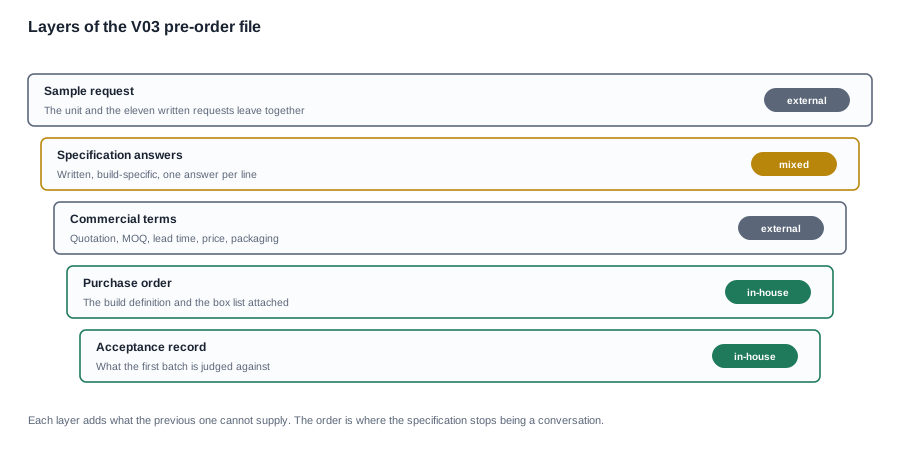
The last line is the one most often left out of a pre-order list, and it is the line that decides whether the list survives a negotiation. When a quotation arrives, the conversation moves to price, quantity and schedule, and the specification questions that were still open tend to be settled informally — in a meeting, in a message, in a sample approval email. That is how a channel ends up with a product whose box contents were agreed in a call and never written down, and the cost of that is not paid at the quotation. It is paid at the second order, when the order line has been rebuilt from memory and the factory has filled it the way it always does.
The way to protect the file is to attach the specification answers to the purchase order itself, so that the document that carries the commercial terms also carries the build definition. The trade-off is that it lengthens the order document and, occasionally, delays it, and the trade-off is worth it because the items that get lost are precisely the ones that are cheap to state and expensive to discover. If a number is not settled, it should be written into the order as an open line with an owner and a date, rather than left out of it.
There is a negotiation point that is specific to this model, and it follows directly from the magnetic charging and the missing case row. A buyer comparing two camera models on the published numbers alone will find the cells, the endurance bands and the charge ceilings similar, and the comparison will end at the accessories, where the pages are silent. The accessory difference is real and it is also where the total cost per unit actually moves, because a cradle or a case is a second manufactured item in the parcel with a second supply chain behind it, and it changes the freight weight, the shelf space and the returns handling. How to evaluate the two is therefore a question about the box and not about the table of specifications.
Two failure modes are worth naming. The first is a reply that answers for the camera range in general rather than for this model and build, because a buyer who accepts it will have written a file that cannot be pointed at anything specific when a shipment is questioned. The second is a box description that is written as a marketing sentence rather than a list, because a sentence cannot be checked at goods-in and a list can be checked item by item.
On this model, our position is straightforward. We publish the camera class, the cell, the endurance band, the charge ceiling and the charging method as they appear, and we do not publish a descriptive feature for it because the catalogue page prints none. We do not publish a price, a lead time, a minimum order quantity or a weight for the V03, and we will not estimate them for a buyer who asks. The signs that the file is genuinely closed are simple: every one of the eleven lines has a written answer attached to it, the answers name the build, the box list is an itemised list, and the configuration record on the file matches the unit that arrived. When to treat the file as closed is a commercial decision a buyer makes with a schedule in view, and the criteria for it are the same eleven lines.
Tell us which of these lines your own purchase order cannot be written without, and we will draft that line in the wording our documentation team files against a build and a colour.


