

The certification status of this model is not a single answer, and any article that gives one is either simplifying or inventing. There are three states a claim can be in, and a buyer needs to know which state each claim sits in before it appears on a carton. A conformity framework named at category level with nothing identifying it is a first state. A claim that is published with no document behind it is a second state. A claim for which nothing is provided at all is a third. The distinctions matter because only the first state can be printed without a qualifier, the second can be printed only with one, and the third cannot be printed at all.
For this model, the published record contains two rows that a buyer will be asked about before anything else. The feature rows carry an ingress marking of IP54 and a note that the inner frame is removable. Neither row is a document. The first is a claim about an assembly that has to be supported by a test report, and the second describes a part whose file does not exist in the published record. Everything else a buyer will need for this model — the radio evidence, the camera evidence, the substance declarations, the cell documentation — has to be requested, and the request has an order because the documents have different lead times.
This article sets out the evidence trail that this model needs, takes the ingress marking apart, works through what an accessory file for the removable inner frame has to cover, and is explicit about the point at which a compliance request for this product runs out of supplier-side answers and becomes a decision the buyer has to make.
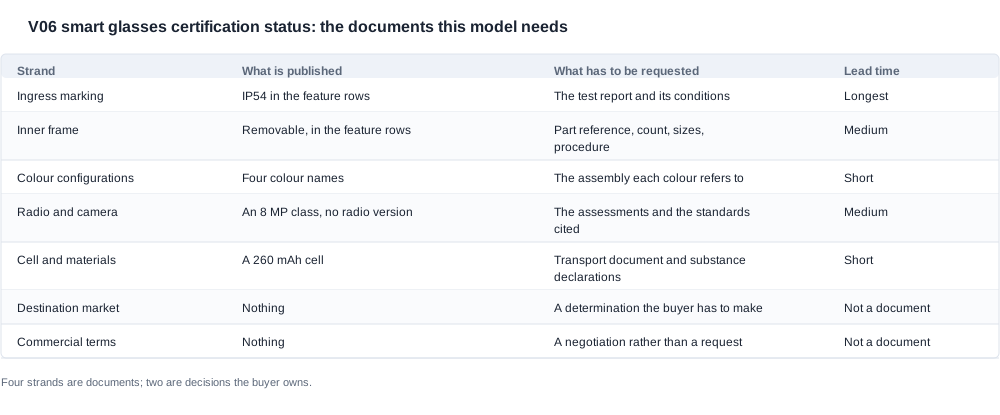
V06 smart glasses certification status: the evidence trail this model needs
The published specification for this model is short. It is a camera published in the eight-megapixel class, a cell of 260 milliampere-hour, magnetic charging, four feature rows, four colour names. The endurance figure and the charge ceiling are published as well, one as a five-to-eight-hour band and the other as two hours or less. The catalogue carries no radio version for the camera models and no charging-case line for the V03, the V06 or the S7, so there is no published row to cite for either.
Against that, the feature rows carry the two items that generate most of the compliance conversation. An ingress marking of IP54 appears as a published row. A removable inner frame appears as a published row. And the four colours — orange, white ice blue, black and black ice blue — are published as options, which means each of them is a configuration that a file, a label and a report have to be able to refer to.
The evidence trail for this model therefore has four strands, and they are of different lengths.
The first strand is the ingress report. A marking of this kind is meaningful only against a test, and the test is what sets out the conditions, the level and the configuration that were examined. The catalogue publishes the marking and does not publish the report, so the state of this claim today is a claim without a report in the record. That is a specific and useful thing to tell a compliance adviser, because it is different from a claim that has been withdrawn and different from a claim that has never been made.
The second strand is the accessory file for the removable inner frame. The row publishes the fact that the frame comes out. It does not publish a part reference, a count, a size range, a release procedure, or whether the frame can be bought on its own. A model whose product definition includes a removable part has a documentation consequence, because somebody has to be able to order the part, identify it, and say what it is.
The third strand is the configuration strand. Four colours and one removable frame together mean several assemblies rather than one. The ingress report has to state which assembly was tested. The accessory document has to state which frames accompany which colour. The label artwork has to carry the right configuration reference in each market.
The fourth strand is everything a file needs that is not about the two unique rows: the radio assessment and its cited standards, the camera evidence behind the eight-megapixel class, the material and substance declarations, the battery transport document for the 260 milliampere-hour cell, the packaging and label artwork, and the instructions in each market's language.
There is a criteria set behind the ordering, and it is worth stating separately from the order itself. The criteria for raising a document request against this model are, in order of weight: how long the document takes to produce, whether the document can be produced for the configuration the buyer intends, and whether the buyer is able to hold and file it. A request that fails the first criterion has to go in early, because there is no point arriving at week nine with a question that takes twelve weeks to answer. A request that fails the second is a request for the wrong thing, and it is the mistake that is easiest to make on a product with four published colours and a removable part, because the supplier will cheerfully supply a report for an assembly the buyer is not buying. The third criterion decides whether the request is worth issuing at all, and it is the one a buyer with a spreadsheet and no compliance adviser is most likely to skip.
The order in which these are requested is not arbitrary. The ingress report has the longest lead time, because a test on an assembly has to be scheduled and the configuration has to be fixed before it is run. The accessory file can be assembled in parallel, because it is a set of drawings and descriptions rather than a test. The configuration strand sits between them, because it defines what the test applies to. The commercial terms can be discussed while all of this is in progress, but they cannot be finalised before the scope is known, since the scope is what determines what is being bought.
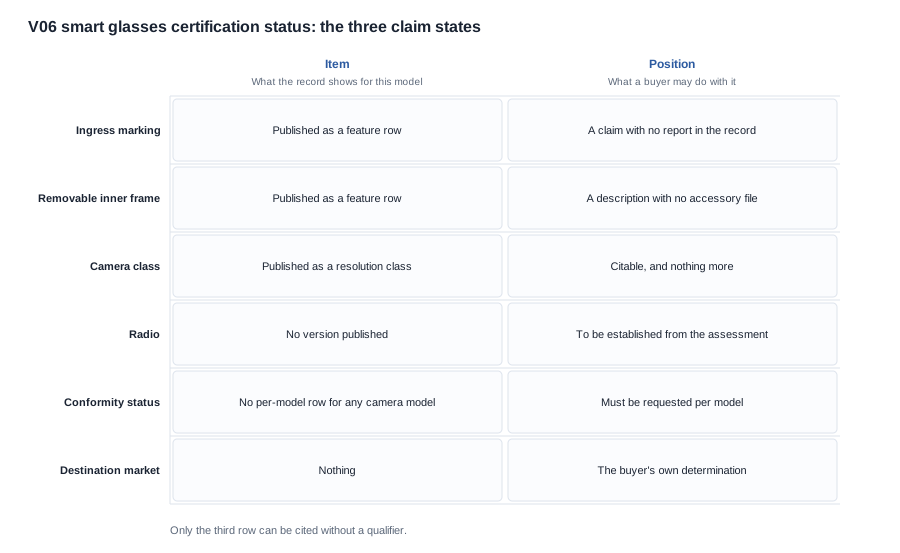

The IP54 row, and the report that has to stand behind it
The published row for this model reads as an ingress marking, and it is the row most likely to be copied straight onto a carton by somebody who has not asked where it came from. That is the single most expensive thing a buyer can do with this product, and the reason is worth stating carefully.
An ingress code names two conditions — a condition for solids and a condition for water — and each of those conditions is defined by a test with stated severity, stated duration, stated orientation and a stated acceptance criterion. The code itself is only a summary of that test. A buyer who has the code and not the test cannot print the code on a box, because a code without its test is a number whose meaning is undefined, and a market authority or a customer who asks what was actually tested will be told that the report is available on request. At that point the question becomes whether it is, and the answer is often that it is not.
So the first task is to establish the state of the claim, and the state of this claim in the published record is: the marking is published as a feature row, and no report reference is published with it. That is the second of the three states, and it is a specific position rather than an absence. A buyer who can say "the manufacturer publishes the marking, and the supporting report is not part of the published record" is in a different position from a buyer who says "the product is IP54" and is wrong, and from a buyer who says "the product has no IP rating" and is also wrong.
What the report has to contain, if one exists, is worth specifying because it is a short list and it is the list to send with the request.
- The report reference and the date, so that a document can be cited and its currency can be checked.
- The test standard or method applied, named with its edition, because a code means different things under different methods.
- The laboratory that performed the test, and the scope of that laboratory's accreditation for that method.
- The identification of the sample, in enough detail to establish that it was the product and the assembly that the buyer is buying.
- The configuration tested: which inner frame was fitted, and which colour, because the report applies to an assembly and not to a product name.
- The conditions and the acceptance criteria, so that the code can be read against them.
- Any exclusions or limitations the laboratory recorded, which are the part most often skipped and the part that determines what the buyer may actually say.
The fifth item is where this model is different from a product with one configuration. A removable inner frame means the assembly can be put together in more than one way, and a report that tested one of them does not automatically describe the others. The colour adds a further variable, because a colour is a different finish on the same product and a test may or may not have been run on each one. The sensible position for a buyer is to ask which configuration was tested, to record the answer, and to avoid making a claim that extends beyond it — not because the product is doubtful, but because the claim has to be true of the unit that was actually tested.
There is a related question that a buyer should put to the supplier rather than answer alone, and it concerns what happens after a frame is changed. A product whose assembly is altered by the user is in a different state from the one that was tested, and the question of whether the marking continues to describe the product is a question for the manufacturer, because it is a question about the design and the instructions rather than about the test. A frame release procedure that is not accompanied by any statement about the state of the product afterwards is a gap in the documentation, and it is the kind of gap that is far cheaper to close in writing before the first order than to answer in a support conversation afterwards.
Finally, the discipline for the buyer is the simplest one and the hardest to keep: the marking is not printed on the carton until the report is in the file. A business that prints a code it cannot evidence is making a statement about a product it has not verified, and the cost of that mistake is paid in whichever market asks the question first.

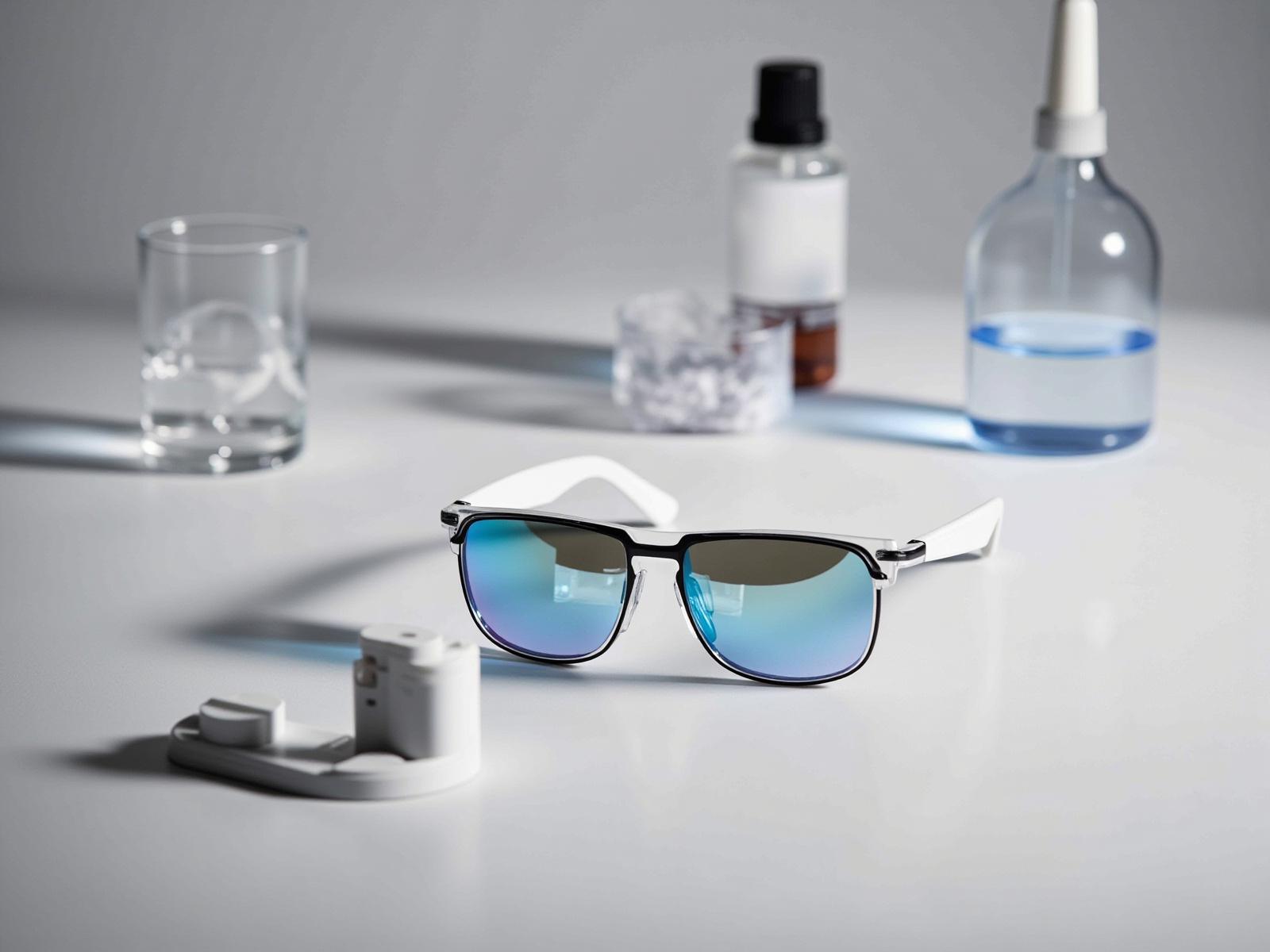
The detachable inner frame, and what an accessory file has to cover
The second published row that generates a documentation obligation is the removable inner frame, and it is a smaller obligation than the ingress marking but a more awkward one, because a removable part creates a parts business that somebody has to own.
What the catalogue publishes is the fact that the inner frame is removable. What it does not publish is everything a buyer needs in order to run the product: how many frames the box holds, whether those frames are identical to one another, which sizes the part comes in, how it is released, whether a replacement can be bought on its own, and whether a frame from one model fits another — a question that arises because that feature row is published on more than one model in the range. None of these can be answered from the catalogue.
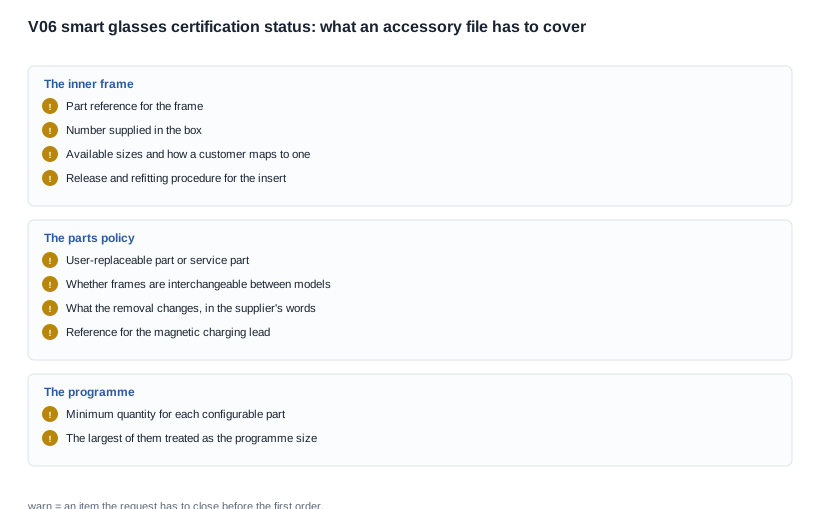
An accessory file for this product therefore has to cover at least the following, and the list is short enough to put into a request as it stands.
- The part reference for the inner frame, so that a replacement can be ordered, filed and traced.
- The number of frames supplied in the box, and whether the number varies by colour or by market.
- The available sizes, and how a buyer maps a customer to one of them, since no size chart is published.
- The release and refitting procedure, in a form that can go into the instruction insert, including what to do if a frame will not seat.
- Whether a frame is a user-replaceable part or a service part, which decides whether the buyer stocks it or the aftersales operation does.
- Whether frames are interchangeable between models, given that feature row is published on more than one model in the range.
- What the removal changes, in the supplier's own words, including anything about the ingress marking.
- The charging lead, which for this model is a magnetic contact and therefore a specific part with its own reference and its own stock.
The eighth item is where the two published rows meet. A product that ships with a proprietary charging contact and a removable inner frame has two configurable parts in the same carton, and the two have to be described consistently, because a customer who replaces one of them in the wrong state will report it as a fault. A single accessory document that covers both, rather than two documents that describe them separately, is the format that prevents that.
There is a commercial side to the same question, and it is the one that a buyer should settle before the first order rather than after. The minimum quantity for the inner frame as a spare part, the minimum quantity for the charging lead, and the minimum quantity for the packaging artwork are three different numbers, and the programme is bound by the largest of them. None of the three is published, and all three have to be requested, because a buyer who orders against one of them and discovers the others later has a range that cannot be reordered at the volume it was designed for.

Where a compliance request for this model stops
A request to a supplier can be answered in full for the four strands described above, and the answers will be documents rather than assurances. The request stops at a different point, and the buyer needs to know where that point is before the request is issued, because a request that appears to cover everything produces a reply that covers only the supplier's half of it.
Here is what a supplier can supply for this model, stated as a list.
- The ingress test report behind the published marking, with the seven items set out above.
- The accessory file for the removable inner frame, with the eight items set out above.
- The configuration reference for each of the four published colours, and the assembly each one refers to.
- The radio assessment and the standards cited in it, since no radio version is published for the camera models and the version therefore has to be established from the assessment.
- The camera evidence behind the published eight-megapixel class.
- The material and substance declarations, and the parts of the product each of them covers.
- The battery transport document for the 260 milliampere-hour cell.
- The packaging and label artwork, and the instructions in the language of each market.
Here is where the request stops, and what the buyer has to take on instead.
- The destination-market determination. Which requirements apply in a given market, and in which age band a product is being placed, is a determination made by the buyer's own compliance adviser, not a fact a factory can supply. The frameworks that a adviser works from once a product is classified — including the toy safety frameworks used in the European Union and the United States — apply according to how the product and its intended users are classified, and the classification itself is the buyer's decision.
- The responsible party in each market. Whoever places the product on a market carries the obligation in that market, and in many destinations that has to be named. A factory can supply the documents; it cannot appoint the buyer's party.
- The national approvals. Where a destination runs its own approval route for a radio product, that is a destination-level process with its own timeline, and it sits outside anything the supplier's file can shorten.
- The language and market coverage. How many instruction sets a business needs, and who maintains them, is a decision that follows from the markets, not from the product.
- The commercial terms. Minimum order quantity, sample quantity, delivery schedule, tooling, artwork quantities and warranty terms are not published for this model and are negotiated rather than quoted from a list.
The practical way to hold all of that in one place is a single file per model with a per-document status column, and a single question list that the buyer owns. The status column is what stops a document request from turning into a documentation project: a buyer can see at a glance which items are held, which are requested and which are decisions rather than documents, and that distinction is the one that determines how long the request will take.
Our own position on this model is narrow and we would rather state it than let it be assumed. What the catalogue publishes for the V06 is the specification rows, the four feature rows and the four colour names, and it publishes no document number, no report reference and no per-model conformity row for any of the camera models. The front matter of the catalogue carries a set of certificates reproduced as images, and what they document is the design protection of the products and one mechanism, which is a different kind of record from an assessment of a product against a market requirement. So the ingress marking in this model's feature row is a claim published by the manufacturer and not a report the buyer can hold, and that is the state this product is in today. We will not describe it as certified, and we will not describe it as uncertified, and we will not print the marking on a carton on the strength of a feature row.
The work that follows is a four-part request, in a defined order, and the order is set by the configuration rather than by the paperwork. Where a compliance request for this model is being prepared, the destination markets, the sales channels and the configurations intended for the first shipment determine which strand is requested first, and we will lay out that request and the sequence it should be issued in.


