
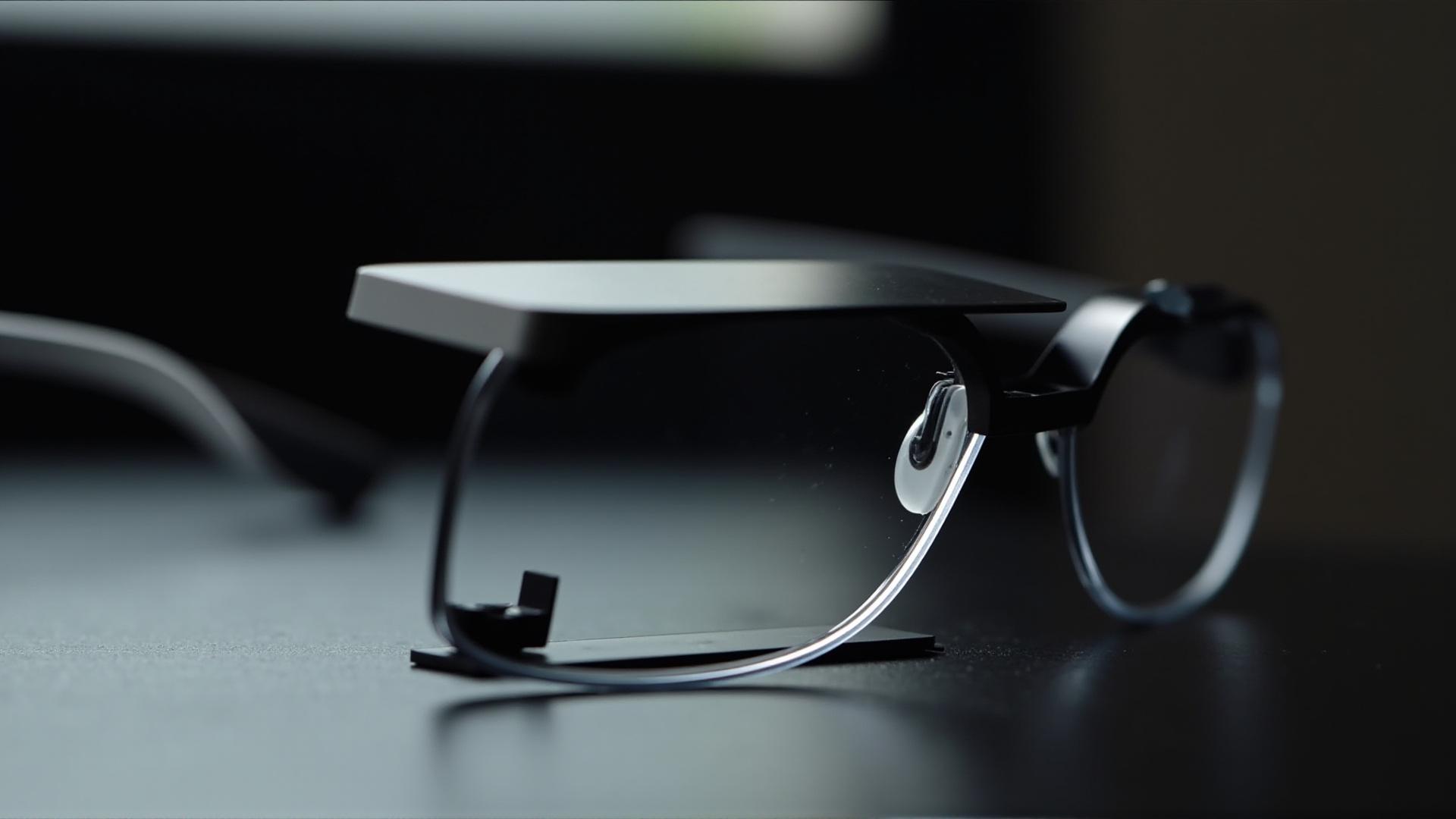
The published row set for the V06 is longer than the set most models in this catalogue carry. It runs to a camera in the eight-megapixel class, a 260 milliampere-hour cell, a rated endurance band running from five to eight hours, a charge ceiling of two hours, a magnetic charging contact, four feature rows, and four colour names. That is a longer published record than the rest of the range carries, and for a procurement team it is tempting to read length as completeness. It is not. Several of the most consequential things about this model are described by the absence of a row rather than by one, and a buyer who works only from what is published will build a specification file, a listing copy and a customer promise around gaps that nobody has been asked to close.
This model sits in the sport smart glasses section of the range, and this article works through those gaps and, for each one, says who can close it. That framing matters more than a list of complaints. Some gaps are the supplier's to close with a document, a number or a sample. Some can only be closed at the bench, on a physical unit, by a buyer who has asked the right question at the right moment. And some are not gaps in the product at all but decisions that belong to the buying business — the destination market, the classification of the product, the scope of the claim the business is prepared to defend in writing. Conflating the three is how a sourcing team ends up either demanding something the factory cannot supply or accepting something it never asked for.
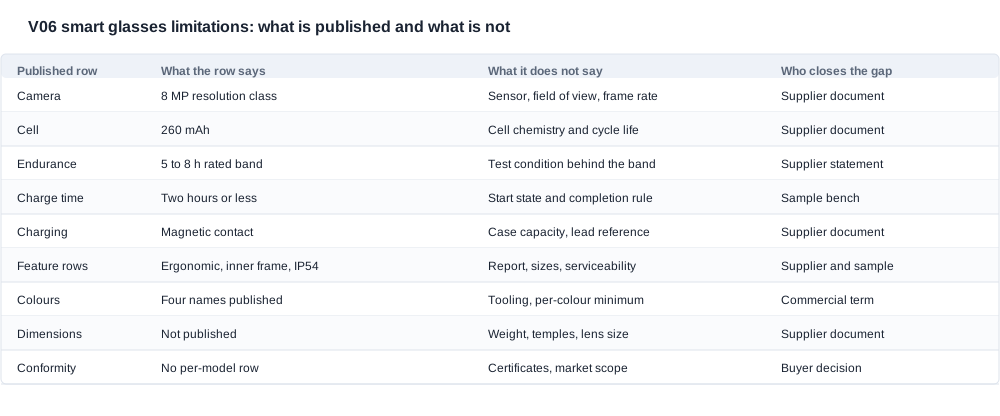
V06 smart glasses limitations: the gaps grouped by who can close them
The published specification for this model is short enough to recite, and every entry in it carries a limit that travels with it. The camera is an eight-megapixel resolution class and nothing more: no sensor model, no field of view, no frame rate, no video format, no storage arrangement. The cell is 260 milliampere-hour, which is a capacity and not a runtime. The endurance figure runs from five to eight hours, and the condition behind either end of it is not published. The charge figure is a ceiling of two hours, published without a starting state or a completion criterion. The charging method is magnetic, which means a proprietary contact rather than a cable the customer already owns. The four feature rows are descriptions rather than measurements: one states the ergonomics of the frame, one summarises the endurance in general terms, one describes a removable inner frame, and one carries an IP54 ingress marking. The four colours are orange, white ice blue, black and black ice blue.
Read that list carefully and the shape of the documentation is clear. It is a catalogue, not a specification file, and it was written to describe a product rather than to let somebody procure one. A buyer needs the second thing, and the distance between the two is where the V06 smart glasses limitations live.
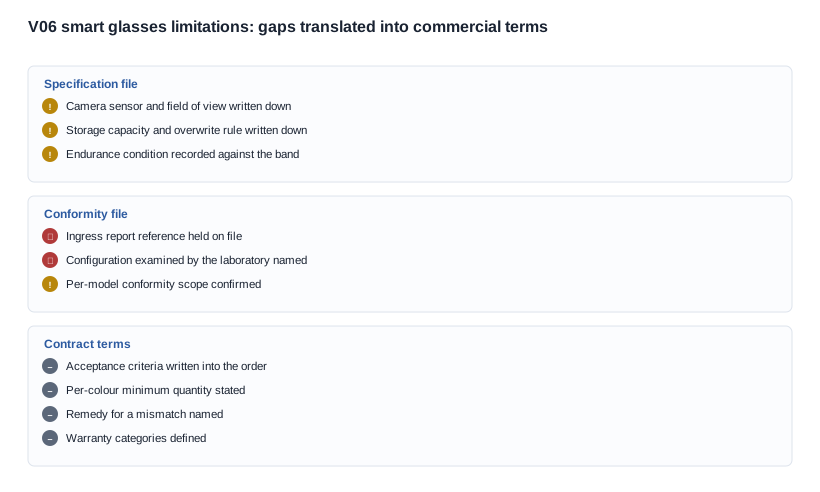
The first group is closed by the supplier, in writing. These are the gaps where a document, a number or a written statement exists somewhere in the supplier's own files and simply has not been published. The camera specification beyond the resolution class sits here: sensor model, field of view, frame rate, video format, low-light behaviour, stabilisation, storage capacity and file handling. The physical dimensions of the product sit here: frame weight, temple length, lens dimension, and the overall packaged size that determines the freight class. The inner frame size range sits here, together with the number of frames supplied and whether they can be purchased separately. The charging-case position sits here — and note the wording carefully, because three of the camera models in the range publish no charging-case line at all, this one among them, which is a row that is missing rather than a published absence of a case. The endurance test condition sits here, as do the per-model conformity documents that do not appear anywhere in the published text.
The second group is closed on the bench. Some things cannot be established from a specification sheet at all, no matter how willing the supplier is. Whether the magnetic contact seats reliably under a rushed placement is a bench observation. Whether removing and refitting the inner frame leaves the product in the same state is a bench observation. Whether the files produced by the camera fill a given storage arrangement in the way a customer expects is a bench observation. Whether the unit presents a legible state indication is a bench observation. A sample order is not a formality on this model; it is the only way several of these gaps get answered at all.
The third group belongs to the buyer. Which market requirements apply, how the product is classified in each destination, what warranty categories and remedies will be offered, what the per-colour minimum order quantity is, whether the business will print the ingress marking on a carton and on what terms, and whether the endurance band can be quoted in customer-facing copy at all. None of these can be answered by a factory, and none of them should be requested from one. They are decisions, they are made by the buying business, and the useful thing a supplier can do is make them easy to reach by supplying the inputs in a structured form.
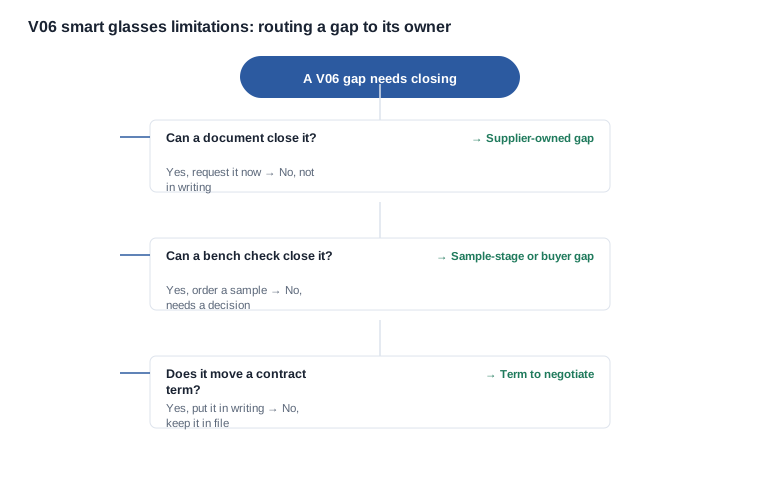
The practical value of grouping the gaps this way is that it converts a document request into a work programme. A request that lists thirty unanswered questions produces a reply that answers four and leaves the buyer with an unanswered feeling. A request that is organised by owner produces three lists — one for the supplier, one for the sample stage, one for internal sign-off — and each list can be tracked to a state.
It also produces the one distinction that matters most on this particular model. A gap that the supplier can close is a delay. A gap that only a sample can close is a schedule item, because the sample has to be ordered, shipped, inspected and reported on. A gap that the buyer must close is a decision, and the deadline for it is set by the printing date of the packaging artwork, not by the supplier's response time. Mixing these three up is how a programme ends up with artwork printed in week six against a compliance file that will not arrive until week eleven.
The camera gap, and the rows that do not describe it
Of all the limitations attached to this model, the camera gap is the one most likely to cause a commercial argument later, and the reason is a wording trap that buyers fall into repeatedly. For this product the catalogue publishes one camera figure and one only: the eight-megapixel resolution class. It does not publish a camera specification beyond that class. Those two statements are very different, and the second one is often written as though the first were missing — that this model has no camera row at all. It has one. It is simply a narrow one, and a narrow row is a perfectly good basis for a product description and a poor basis for a technical file.
What the catalogue does not publish for this camera is a long list, and the list is the useful output of this section rather than the absence itself.
- The sensor model. The resolution class says how many pixels a frame contains. It says nothing about the size of the sensor that collects them, and sensor size governs the light-gathering behaviour that a customer notices.
- The field of view. How much of the scene the camera takes in is a design decision that determines whether the product is usable for the activity it is sold into.
- The frame rate, whether moving subjects are captured in video as well as in stills, and in what format that video takes.
- The stabilisation behaviour, whether any is present at all.
- The low-light behaviour, which cannot be derived from a resolution class.
- The storage arrangement — how many images or clips can be held, where they are held, and what happens when the limit is reached.
- The file format and the overwrite behaviour, which together determine what a customer actually ends up with after a long session.
- The capture trigger, and whether the on-unit control and any remote are both available.
Two of these deserve more than a line each, because they are the ones that generate returns rather than questions.
Storage is the row that matters most on a sport product. A camera device that captures intermittently through a run, a ride or a shift is exactly the scenario in which a storage arrangement fills up. A customer who loses the second half of an activity to an overwrite has a bad experience that does not appear anywhere in the published data, because the published data does not include the overwrite behaviour. The commercial exposure here is straightforward: a return, a published review, and a claim that the product was misdescribed. The mitigation is equally straightforward and it has to be requested before the first order — what the capacity is, what happens at the limit, and whether the customer is told or simply loses files.
The claim boundary is the second one. An eight-megapixel class is a legitimate line in a listing. It is not a licence to write "high-definition camera" and imply a performance level, and it is certainly not a licence to write anything about video. Until the sensor model and the field of view are in the file, the honest sentence is that the catalogue publishes an eight-megapixel resolution class and nothing further about the camera — and that sentence belongs on the specification sheet, in the listing and in the customer-facing comparison material alike. A listing that has been written from a resolution class will lose to a competitor that has written from a field of view, and that is a positioning problem a supplier cannot fix after the fact.
The question set that closes this gap is short, and it is worth sending as it stands rather than as an open-ended request for camera details: which sensor is fitted; what the field of view is; whether the product records video and in what format; what the frame rate is; how many images can be held and where; what happens when that limit is reached; how the product behaves in low light; and whether any stabilisation is applied. Each of those has a supplier-side owner, and each of them either closes the gap or establishes precisely what the gap is, which is the second-best outcome and still a workable one.

One further point belongs here, because it is a limitation of the published record rather than of the camera. None of the camera models publishes a radio version, so the version fitted to this one has to come out of an assessment rather than out of a row. A buyer who writes "Bluetooth 5.4" onto a datasheet for this product from memory of an adjacent model will be wrong, and the correction will arrive at the point of a technical file review rather than at the point of a customer conversation.
The IP54 marking, and the report it needs before it goes on a box
The IP54 marking appears in this model's own feature rows. That placement is exactly why it is dangerous. Feature rows are the part of a catalogue that a merchandising team copies from, and a marking written next to "ergonomic design" and "removable inner frame" reads as a settled attribute rather than as an open item. The published record does not carry a report reference for it, and no third-party test report number is available for this model.
There is a second, quieter point about what the catalogue does contain. The catalogue front matter reproduces a set of certificates as images. Those images document the design protection of the products: ten certificates in all, split eight appearance designs against two utility models. A record of design protection is a different kind of document, and it does not assess a product against a market requirement. The published text contains no per-model conformity row anywhere, and none of the common conformity frameworks is named in it. So the position on this model is specific and it is worth stating precisely: the ingress marking is published by the manufacturer as a feature row, and no report behind it sits in the published record. That is different from a claim that has been withdrawn, and different from a claim that has never been made, and a compliance adviser needs the distinction.
The marking itself has a narrow meaning, and the narrowing is worth understanding before anyone argues about it. The first digit addresses solids and the second addresses water. A second digit of four describes a condition of splashing water from any direction — not immersion, not a sustained shower, not an extended period in heavy rain. For a product positioned for outdoor and sport use, that is a meaningful boundary to know, and it is a boundary that a marketing team is unlikely to state voluntarily. If the product is going into a channel where rain and sweat are the normal condition rather than the exceptional one, the gap between what the code covers and what the customer will experience is the gap that generates complaints.
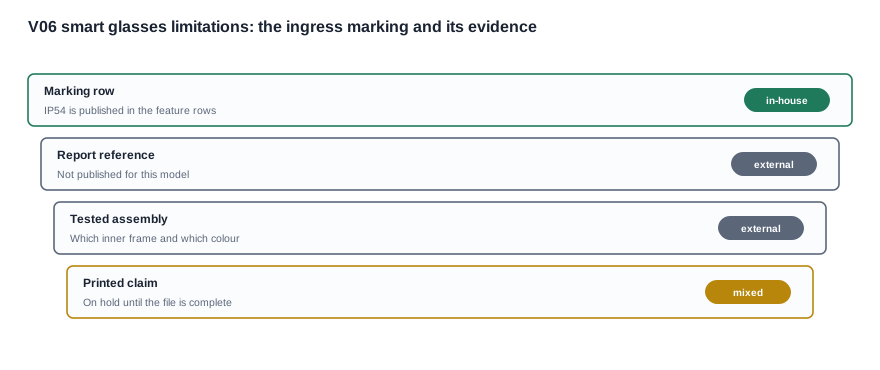
What a report has to contain, if one exists, is a short list, and it is the list to send with the request: the report reference and its date; the test standard or method applied, named with its edition; the laboratory that performed the test and the extent to which that laboratory is accredited for it; the identification of the sample in enough detail to establish that it was this product and this assembly; the configuration tested, meaning which inner frame was fitted and which colour; the conditions and the acceptance criteria; and any exclusions the laboratory recorded. That last item is the one most often skipped in a reply and the one that determines what the business may actually say afterwards.
For this model there is an additional variable that a single-configuration product does not have. The inner frame comes out, so the assembly can be built in more than one way, and the four colours mean the finish can differ. A report that examined one assembly describes that assembly. So the first question in the request is not "do you have a report" but "which configuration was tested, and does the report cover the configurations we intend to buy". A supplier will happily provide a report for an assembly the buyer has no intention of taking, and the buyer will not notice until the file is audited.
The third question follows from the removable part itself, and it is a design question rather than a testing question: what the state of the product is after a frame has been removed and refitted, and whether the marking continues to describe it. That answer belongs in the instructions, not in a laboratory report, and it is far cheaper to obtain in writing at the sample stage than to reconstruct later from support conversations.
The rule that follows is simple enough to write on the artwork approval sheet and hard enough to keep: the marking is not printed on the carton, the product page or the listing until the report is in the file. Printing a code that cannot be evidenced is a statement about a product nobody has verified, and that mistake is paid for in whichever destination asks the question first. Until then, the defensible position is a catalogue marking described as such — the IP54 marking appears in the published feature rows for this model, and the supporting test report is not published.
Where a gap becomes a commercial term, and who has to close it
The last group of limitations is the one that turns a documentation exercise into a commercial one, because each of these gaps has a cost attached to it and a clause that can carry that cost.
Four colours are four potential configurations. The catalogue publishes four names — orange, white ice blue, black and black ice blue — and a colour is a finish, and a new finish can involve new chemistry rather than a repaint. Nothing published states which of the four require new tooling, what each one costs, whether each is separately assessed, or whether the minimum order quantity differs per colour. A business planning to carry two or more of them is therefore carrying several production risks at once, and the mitigation is commercial rather than technical: put the per-colour minimum order quantity, the colour schedule and the artwork quantities into the purchase order, so that the range cannot be reordered at a volume it was never designed for.
The removable inner frame is ambiguous in a way that decides an after-sales programme. The catalogue says the inner frame comes out. It does not say whether it is a user-replaceable part or a service-only part, and the two readings differ by an entire operation. A business that stocks replacement inner frames sells a serviceable product and carries a spare-parts business, with a minimum order quantity and a stock line of its own. A business that cannot stock them runs a service operation that returns units to the factory, and that has a turnaround, a cost per unit and a customer-facing commitment. Neither reading can be inferred from the word "removable", and the answer decides which one the business is in.
The endurance band cannot be converted into a customer-facing promise. Five to eight hours is a three-hour bracket with no published condition, on a product where the camera is the power draw, and the general treatment of a rated figure without a stated test condition is set out in the battery life guidance. If the camera was inactive during the measurement, the band describes something closer to passive use. A listing that says "up to eight hours" has converted a rating with a stated condition into a marketing number without one. The commercially safe way to handle this is to publish the band as a rated band, and to keep the customer-facing claim at the lower end until the condition is on file.
The physical and logistics rows are absent. No frame weight, no temple length, no lens dimension, and no charging-case capacity is published for this model. The first three determine whether the product can be described by size in a channel that requires it and how it is packed. The fourth determines the packed weight, the freight class and the battery transport documentation that travels with the consignment. The camera models in this catalogue fall into three states on that last point, and naming all three is more useful than naming only the first: five models publish a case capacity, two publish that they have a case without publishing its capacity, and four publish no charging-case row at all, and this model is one of them. This model belongs to the third group, so the position is that no charging-case line is published for this model, and the carton contents have to be specified separately.
The commercial terms are all unpublished. Minimum order quantity, delivery schedule, tooling, artwork quantities, sample order quantity, warranty terms and certification handling costs are not published for this model, and they are negotiated rather than read from a list. The gap that carries the most risk is not the price but the acceptance criteria, because acceptance criteria are what determine whether a shipment that arrives is a shipment that is accepted. Putting them in the contract rather than settling them by email afterwards is the single highest-value clause a buyer of this model can add.
One piece of housekeeping is worth recording because a buyer auditing this documentation will find it. The catalogue's page annotation for this model sits in an unusual position among the surrounding entries, so a reader working from a page rather than from a product name can end up comparing this product against the wrong entry. It is a housekeeping matter for us rather than a fault in the product, and it costs less to sort out on our side than to account for later with a customer who was sent a different model from the one that was quoted.
The boundary we hold to on this model is narrow, and we would rather state it plainly than let it be assumed. We publish exactly what the catalogue records for this model: the specification lines, the four descriptive lines and the four published colour names. We do not describe the IP54 marking as a tested result, we do not turn the endurance band into a working day, we do not quote a weight, a case capacity, a size range or a certificate number that the documentation does not contain, and we do not resolve the inner frame question on the buyer's behalf. What this model offers a procurement team is a longer published record than its neighbours, a colour list that no other model in the sport section publishes, and a feature set that appears on two models only — the V06 and the S7, which differ on the camera class alone. What it needs from that team is a request list organised by owner and a contract that carries the acceptance criteria. The compliance dimension of the same product is set out separately in the V06 certification status record, and the general method for reading an ingress marking before writing it into a listing is covered in the certification checks material.


