

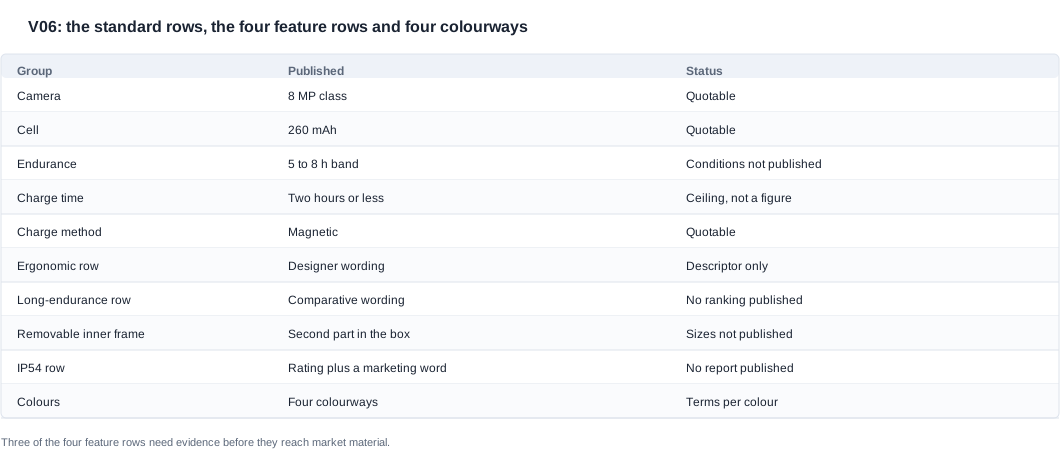
The V06's catalogue page carries more claim-bearing content than any other page in the camera group. Alongside the standard rows — a resolution class of eight megapixel, a 260 milliampere-hour cell, a five-to-eight-hour running time, a two-hour-or-less charging ceiling and magnetic charging — the page prints four feature rows: an ergonomic design row, a long-endurance row, a removable inner frame row and an IP54 waterproof row. It also publishes four colourways, and the catalogue publishes colourways for two camera models only.
Three of those four feature rows need something behind them before they can be written into market material, and the fourth one — the long-endurance row — sits beside a published band that complicates it. That is what makes this page the most rewarding and the most dangerous in the group to work from: the descriptive material a channel wants to use is exactly the material that has to be verified first.
The colourway list adds a second layer of work that a buyer should recognise early. Four colours are not four paint options on one box; they are four stock lines, four picking instructions, four packaging artworks and four sets of minimum order quantities, and they multiply the number of physical configurations that an ingress report has to cover.
V06 smart glasses: four colours and a removable frame
The colourways published for this model are orange, white ice blue, black and black ice blue. Two camera models in the range publish colours at all; the other of the two publishes three, so this page carries the only four-colour list anywhere in the catalogue. That is a genuine merchandising asset and it is also a set of commitments that no single row in the catalogue describes.
What a four-colour list commits a channel to is worth itemising, because each item becomes a separate question in a supplier request. There are four listings to write and keep accurate. There are four packaging artworks, which means artwork proofing four times rather than once and a version control problem that appears at the first re-order. There are four stock lines with four minimum order quantities, four production lead times and four reorder points, none of which are published and all of which belong in the quotation. There are four sets of packaging labels and four picking instructions at the bench. And there is a question that catches people out: whether the four colourways share a production line and a common set of components, or whether each one is a separate build with its own lead time — because a channel that assumes the popular colour can be reordered quickly will discover the answer when the reorder sits at the factory.
The removable inner frame is the second item on this page that behaves like a supply-chain decision rather than a feature. Two models in the range publish a removable inner frame, and this is one of them. The row means a second physical part travels in the box, and it has to be counted on the bench, identified when a unit comes back, and worked out by a customer in the first minute of using the product. The questions it raises are ordinary: which inner frame sizes exist for this model, whether they are supplied as a set or chosen by the customer, how a size is marked so a warehouse can identify it, whether a frame can be ordered separately as a spare, and what the packing instruction says the box contains.
The ergonomic design row belongs with these two rather than after them, because it describes the same assembly. An ergonomic design row is a statement about shape, and behind it the catalogue publishes nothing measurable: no dimensions, no adjustment range, no weight, and nothing a buyer could check a shape against. A channel may quote the descriptor as the manufacturer's word for the model. It may not convert it into a comfort outcome, a stability outcome or a claim about how the product behaves across a long session, because none of that is published for this model.
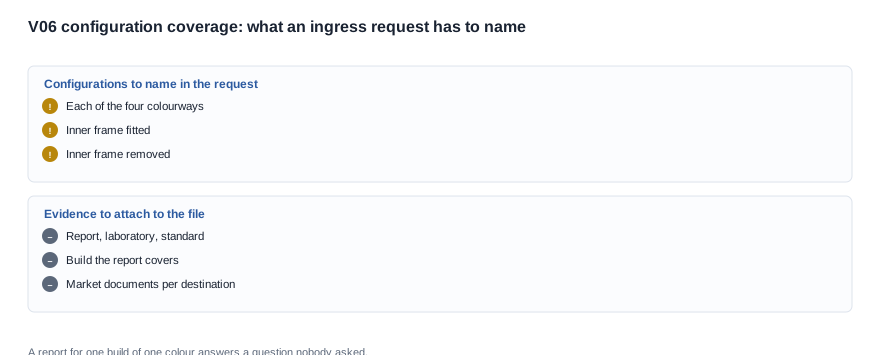
The way the three rows combine is the part that is easy to miss. A removable inner frame and four colourways together mean that the product exists in more than one physical configuration, and every one of those configurations is a candidate for the ingress question that the page raises. A report that was produced for a black frame with the inner frame fitted may not cover a white ice blue frame with it removed, and the catalogue gives no indication of which configurations were tested. The criteria for handling that are simple: the number of published configurations is the number of configurations the evidence has to cover, and the evidence request has to state the configurations rather than the model name.
So the question set for this model divides cleanly into two halves, and mixing them is what makes a pre-order list slow. The first half is the merchandising half, and it is settled by documents: the colour list, the packaging artwork per colour, and the commercial terms per colour. The second half is the evidence half, and it is settled by reports: the ingress marking, the camera details behind the resolution class, the certification paperwork covering the destination markets this order will reach. The first half belongs to a packaging and commercial conversation; the second belongs to a compliance conversation with a deadline attached. A buyer who asks for both in one request gets a slower answer on the first than it needed to be.
Where the S7 sits against this model, and the two questions that come out of that comparison, are set out in the S7 pre-order list.

The 260 milliampere-hour cell behind the long-endurance line
The cell published for this model is 260 milliampere-hour, and three camera models publish that figure, the other two being the KY06 and the S7. Across the camera models the published cell values run 220, 260, 265 and 290 milliampere-hour, and this model sits in the second of those groups with two company members.
The endurance published beside it is a band of five to eight hours, printed on this page under a label that means running time. The camera models publish three different shapes of endurance figure, and the shape tells a buyer how the number was arrived at. Four models publish a band of five to eight hours, two publish a band of six to eight hours, and five publish a single figure of about seven hours. A band is a measurement range that carries its conditions inside it; a single figure is a rated value that carries them outside it. Neither is more accurate than the other, and the difference decides how the figure can be quoted.
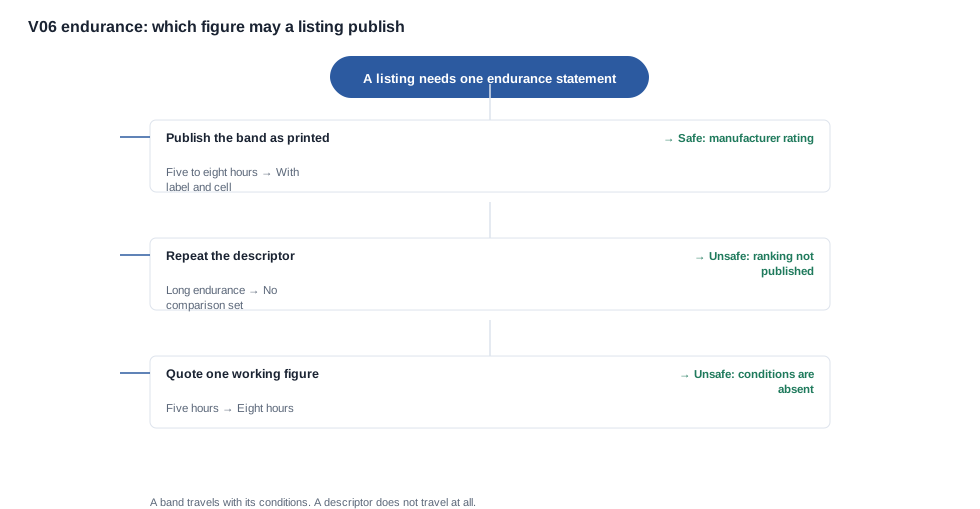
Which brings the row that sits directly above the specification on this page: the long-endurance descriptor. Read as a line of the catalogue it is fine. Read as a comparative claim it is not supported, and the reason is worth stating precisely, because it is the kind of line that ends up in a listing by accident. A comparative adjective only means something against a comparison set, and the catalogue does not sort the camera models by endurance. The single-figure models elsewhere in the range publish about eight hours, which is the same as the top of this band, and one of them publishes a longer figure still. So a channel that repeats the descriptor as a product claim has asserted a ranking that the source document does not make, and that a customer comparing two listings can check and find false.
The criterion that resolves this is the same one that resolves every other descriptor row in the catalogue: a published descriptor may be quoted as a descriptor, and a published figure may be quoted as a figure, and the two are not interchangeable. "Long endurance" belongs in a listing only with the band beside it — in effect, the descriptor is a summary of a five-to-eight-hour band, which is what it is. A stronger commercial position, and the one we take, is to publish the cell, the band and the label of the band, and to leave the adjective out of the copy altogether. The numbers sell better than the adjective because the numbers can be checked.
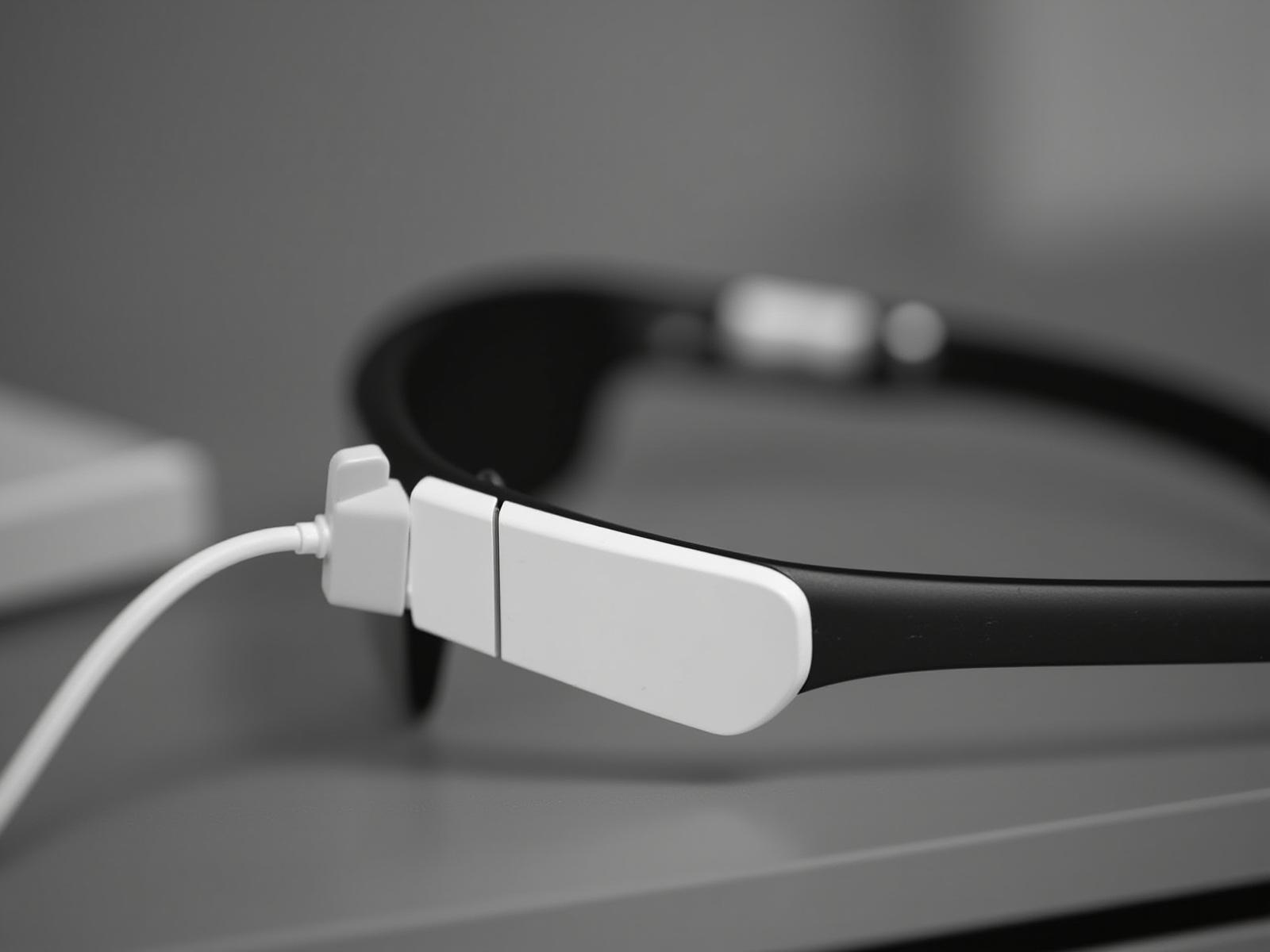
The charge ceiling of two hours or less carries the three gaps it carries everywhere in this range: what it covers is not stated, the state of the cell at the start of the charge is not stated, and the point at which the charge is treated as complete is not stated. What it covers is sharper for this model than for most, because the charging method is magnetic and the page publishes no charging-case row. Magnetic charging needs a cradle that holds the contacts, and whether a cradle is supplied, whether a case is supplied, and what two hours or less describes — the frames alone, the frames in a cradle, or a frames-and-case cycle — are three questions that all have to be answered before the ceiling can be used for anything. It is a ceiling in any case, and the correct way to state it is as two hours or less, never as under two hours.
The radio version is the other permanent gap on this page. No camera model in the range publishes one, so what this product links to stays on the request list rather than being carried over from the audio models, which do publish a version. The camera behind the resolution class is the remaining one, and this model publishes the class and nothing more. The five rows sitting behind it are not carried on the page: the storage capacity, the file format, the recording rate, the field of view and the sensor model. The field of view in particular decides whether the product is usable for the activity its catalogue name implies.
What to ask, then, for this section is short and specific. The conditions behind the five-to-eight-hour band, and the figure at the conditions the channel actually operates in. The criteria for deciding whether the endurance figure can be quoted are therefore written into the request, and the questions to ask come with them. What the two-hour ceiling covers, and from which cell state to which completion point. What the unit charges against, and what is supplied in the box for it. And whether the long-endurance descriptor has any published meaning beyond the band printed beneath it. The last of those is worth asking precisely because a supplier may well have an internal figure in mind that the page does not carry, and the answer will either give the channel a usable sentence or confirm that the sentence has to stay out of the listing.
The IP54 row, and the report that has to accompany it
The row on this page reads as an ingress rating followed by a Chinese word that reads as waterproof. Two separate problems sit inside that one line, and a buyer who treats it as a single item will get one of them wrong.
The first is that an ingress rating is a measured claim, and the catalogue publishes no test report behind it. Two models in the range carry an ingress marking on their page, and this is one of them; no other camera model in the range carries one, and no test report for either is published in the catalogue. A marking on a page states what the manufacturer intends. Whether any unit in a shipment has actually been tested is a separate question, and the two must not be merged: a marking can be printed, or it can be defended.
The second is the word attached to the rating. A rating of IP54 is a defined limit on two axes — the ingress of solid particles and the effect of water — and it does not mean immersion, does not mean heavy rain, does not mean a wash, and does not mean that the product is suitable for a wet environment. The rating and the adjective describe different things, and a box that carries the adjective while the file carries only the rating is a box making a claim the file does not support. How to evaluate that is a matter of copy discipline rather than engineering: the rating may be stated once it is evidenced, in the rating's own terms, and the adjective is not a licence at all.
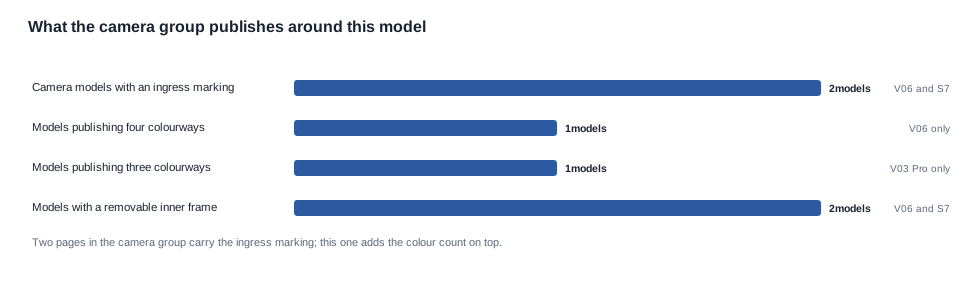
The configuration question is where this model becomes harder than its sibling. This model publishes four colourways and a removable inner frame, so the number of physical configurations it can be built in is larger than a single-colour model with a fixed frame. The request therefore cannot stop at the model designation. It has to ask which report supports the marking, which laboratory produced it, against which standard, whether it covers this model, and — the part that is specific to this page — whether it covers the assembled product in each published colourway, and with the inner frame fitted and removed. A report produced for one build of one colour in one configuration answers a question the buyer did not ask, and a channel that has it in hand will still not know whether it covers the unit in the customer's hand.
That is the second reason the marking has to arrive before the copy is written rather than after. Buyers in this category are asked about CE, FCC and RoHS by their own compliance and customs parties, and the catalogue's position is straightforward to state: it carries a company-level export certification page whose content is images rather than text, the catalogue text contains no reference to those standards, and there is no per-model certification row anywhere in it. Nothing about a model's certification standing can be read out of the catalogue; it has to be requested, and the request has to come back as documents that name the model and the destination market.
The three states a certification file can be in are worth keeping separate, because a buyer who treats them as one will either over-claim or under-claim. A claim with a certificate number that is confirmed is usable. A claim with a number that is asserted but unconfirmed is not usable, and the catalogue is in the second state for every model in it. A model with no documentation at all is not usable either, and for the purposes of this page the marking itself sits in the same position: printed, but not evidenced.
The cost of getting this wrong is not evenly spread, which is why the request should carry a date rather than a hope. A marking claimed without a report is a claim a distributor can challenge, a customs party can hold against, and a customer can return against. The cost of waiting for the report is a delayed listing and a delayed launch in the channel's own schedule, and the cost of the delay is known and bounded while the cost of a withdrawn claim is not.
So the criteria for this section are: no condition claim in any material until a report that names this model and the configurations it covers is in the file and has been read; the rating stated in the rating's own terms when it is; and the question left on the list, with an owner and a date, until it is answered.
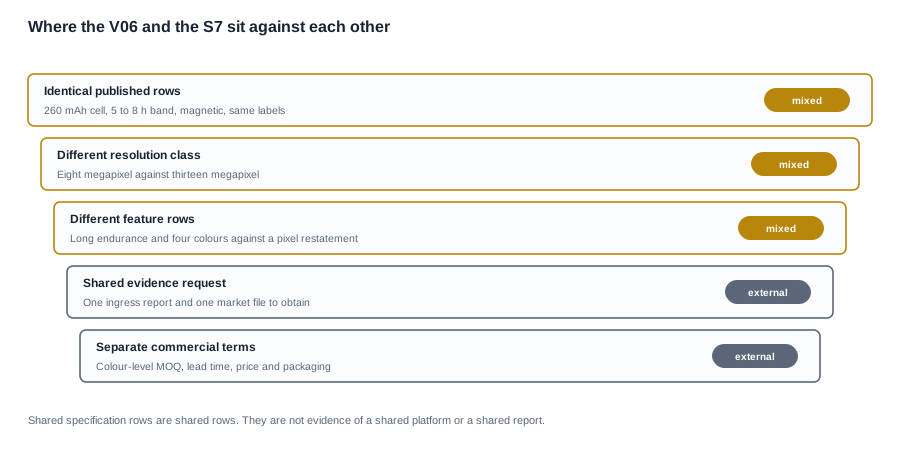
Where the V06 differs from the S7, and where it does not
These two models are the closest pair in the camera group, and a buyer who compares them line by line will find that most of the lines are identical. Both publish a 260 milliampere-hour cell. Both publish an endurance band of five to eight hours under the same running-time label. Both publish a charge ceiling of two hours or less. Both charge magnetically. Both print an ergonomic design row and a removable inner frame row. Both print an ingress marking. Neither publishes a charging-case row, and the catalogue publishes no radio version for either.
The differences are fewer and they are worth naming precisely, because a comparison that stops at the resolution class would misdescribe both models.
The first difference is the resolution class. This model is published in the eight megapixel class; the S7 is published in the thirteen megapixel class, together with the L1 Pro and the L2 Utral. That is a count of pixels on a sensor whose size and light-gathering are not published for either model. It is a different figure, and it is not a verdict. A resolution class is not a picture-quality claim, and a channel that treats the two classes as a quality ranking has made a comparison the catalogue does not make and cannot support with either model's data.
The second difference is in the feature rows themselves. This model prints a long-endurance row and publishes four colourways; the S7 prints a row that restates its own resolution class in Chinese and publishes no colour list. The third is the number of configurations each model can be built in, which follows from the second difference and from the removable frame. The fourth is the one that decides the commercial shape of the comparison: both models need the same evidence file, and neither model has it.
That last point is the one that changes how a buyer should approach the pair. If a channel intends to carry both, it is carrying one platform with two configurations and one shared evidence request — the ingress report, the market documentation and the camera details behind the class — plus one extra request for the colourway coverage that only this model raises. Whether the model pair shares an internal platform is not something the catalogue says, and a buyer should not infer it from shared specification rows. Identical rows are identical rows; they are not evidence of a shared bill of materials, a shared firmware branch or a shared accessory family, and the difference matters because a shared report covering one model does not automatically cover the other.
What a buyer should not do with this pair is exactly what the two models invite. There is no published price for either, so no price comparison can be made from the catalogue, and a quotation is the only place that comparison can happen. There is no published lead time for either, so the four-colour structure this model adds cannot be costed until the quotation arrives. There is no published weight for either. And there is no published certification file for either, which is why the evidence request is the same request.
The trade-offs in the request are therefore concentrated in two places: the colourway set, which multiplies the commercial terms the quotation has to state, and the ingress report, which has to cover the configurations the colourway set creates. Everything else is a question that a sample settles in an afternoon — the camera details behind the class, the geometry, the adjustment, the weight, the radio, the endurance conditions.
There are two red flags to name in the replies. The first is an answer that covers "the sport camera model" without naming which of the two models, or which build, because the two differ in resolution class and in configuration and the answer will be true of one and not the other. The second is an ingress report supplied for one colourway and one frame configuration and then treated as covering the range, which is the failure mode that the colour list creates and that a buyer has to guard against explicitly.
The request for this model is therefore written in the order below, and each line travels with the sample request rather than behind it.
- Identity and build. The name and version marked on the product and the carton, and the build the file will be held against.
- The colourways. Which of the four are available in which configuration, whether colour-level minimum order quantities and lead times differ, and whether the four share a production line.
- The removable inner frame. Which sizes exist for this model, how a size is marked so that the bench can read it, whether a frame is available on its own as a spare against which reference, and what the four published colourways do to the packing instruction.
- The ingress marking. The report behind the IP54 row: the laboratory that ran it, the standard it was measured against, and whether the result covers every colourway with the inner frame fitted and with it removed.
- The endurance band. What was running during the five to eight hours this page prints, whether the long-endurance descriptor printed above them carries any published meaning beyond the band itself, and what the figure comes out at under the conditions this channel actually works in.
- The long-endurance descriptor. Whether it carries any published meaning beyond the band printed beneath it.
- The charge ceiling. Whether the two hours or less covers the frames alone or the frames in whatever cradle the magnetic charging needs, the cell state at the start, and the point at which a charge is treated as complete.
- The camera behind the class. Not one further camera detail is published for this model — no sensor model, no lens specification, no angle, no frame rate, no container and no destination for the footage.
- The physical details. The size of the frame, whether it adjusts at all, and what the unit weighs with the accessory that charges it — no weight is published for this model.
- The market file. The certification file held for this model and this build: which certificates and declarations are in it, which destination markets each of them covers, and which body issued each one; the catalogue carries no per-model certification row.
On this model, our position is that the page is unusually well populated and unusually exposed. We will publish the resolution class, the cell, the endurance band, the charge ceiling, the charging method and the four colourways as they are printed. We will print the ingress marking as a catalogue marking and not as a tested rating, we will not present the eight megapixel class as a picture-quality claim, we will not collapse the five-to-eight-hour band into a single figure, and we will not repeat the long-endurance descriptor as a comparison against anything. No price, lead time, minimum order quantity or weight is published for this model, and the certification numbers are not published either. The signs that the file is genuinely closed are that every open row has a written answer naming the build, the ingress report is in the file and has been read against the configurations it covers, and the configuration record matches the unit that arrived. Deciding when the file is closed belongs to the buyer's own schedule, and the test for it does not change between the two models of this pair.
Tell us which of these rows your channel cannot launch a colourway without, and we will put that request in the wording our documentation team files against one colourway of this build.


