

What is the minimum you have to commit is a question with a genuinely useful answer, but the answer is not a number and it will not become one. Our position is that we publish no minimum order quantity, and the reason is not squeamishness about a commercial figure. It is that a minimum order quantity is not a property of a product. It is a property of a product in a configuration, at a volume, with a set of customisations, on a particular date — so a single published figure would misrepresent the mechanism it describes. Two buyers can ask the same factory for the same entry and receive two different minimums, and both can be correct, because one of them asked for a combination that is already running and the other asked for one that is not. This article sets out what actually sets a minimum, how a minimum behaves when an order is split across configurations, and how to ask a supplier for a number you can plan against rather than a number you have to take on trust.
The quotation itself needs reading in a particular way. A minimum quoted in the unit price block, with no separate line for it, tells you almost nothing, because a minimum embedded in a unit price cannot be separated from the price itself and therefore cannot be negotiated. A minimum quoted as its own line, beside the configuration it applies to, tells you the two things a buyer needs — where it applies and how large it is — and it is the form worth asking for. Where a supplier will not separate it, ask what happens to the figure if the configuration changes, because that answer identifies the driver even when the line does not.
The reason this matters more than it appears is that a minimum is not only a threshold. It is the smallest point at which a supplier's fixed costs are covered by your order, and it is therefore the point at which the commercial relationship starts to behave differently. Below it, the supplier is absorbing setup into the unit price or absorbing it elsewhere. Above it, the setup is amortised and the second order becomes cheaper. A buyer who treats the minimum as an obstacle rather than as a description of where the cost cliff sits will negotiate the wrong thing — usually pressing for a lower number instead of asking what the number is made of.
What is the minimum you have to commit, and why one number cannot answer it
A minimum order quantity answers a question that has four inputs: which configuration, how many of it, what customisations, and when. Change any one of them and the answer changes, sometimes substantially. This is not an accounting nicety; it is the reason two quotations for the same model can carry different minimums and both be honest.
The configuration is the largest variable. In this range an entry is not one thing to a factory. A single entry expands into four colour options and another into three. One carries two variant names alongside two case capacities, with no statement of which capacity belongs to which name. Four camera entries publish no charging-case row at all, so whether a case is part of the unit is an open question for each of them. How the unit is charged is published three ways across the range: magnetic on seventeen entries, Type-C on seven, and left open on four camera entries. A magnetic dock and a Type-C port are not interchangeable, so the distinction has to be settled before a dock is ordered. A factory that runs one of these combinations already has the material and the settings to run another; a factory asked for the third combination is starting something new.
The quantity interacts with the configuration. A minimum quoted for a single configuration at a single volume is a number about a very particular order. The same configuration at a different volume can carry a different minimum, because the underlying constraint is usually a cost-covering quantity rather than a technical one.
The customisations move it. A colour outside the standard set, a logo applied by a particular method, a printed carton rather than a generic one, a lens outside the standard set — each of these can carry its own constraint, and each of them can carry one independently of the others. A lens sourced outside the standard set in particular carries whatever its maker's own minimum batch is, not the frame maker's, because the two are different parties with different schedules.
And the date is not neutral. The same order placed into a different part of the schedule can have a different minimum, because the binding constraint is usually a component batch rather than an assembly step.
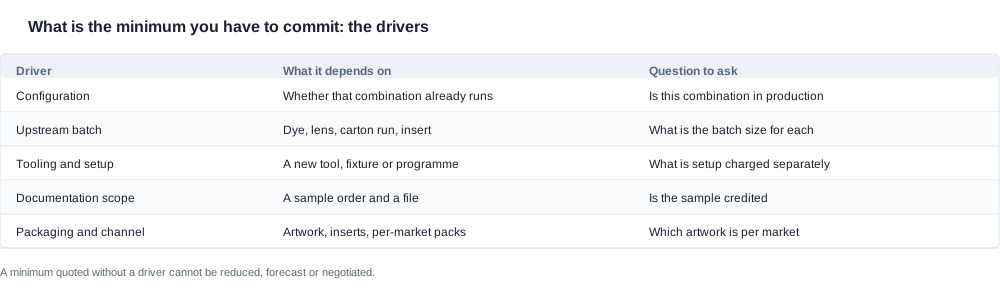
Read the table as a set of levers rather than as a set of obstacles. Each row has a corresponding question, and each question has an answer that either removes the constraint or tells you what it is made of.

The five things that set a minimum
Whether the configuration is already running. This is the dominant factor, and it is the one a buyer can usually establish before a formal quotation by asking whether a given combination is in production. If it is, the minimum is usually the cost-covering quantity for that combination. If it is not, the minimum is the sum of the setup and the smallest run that covers it, which is a different order of magnitude and is usually quoted as a one-off rather than as a per-unit threshold.
A physical input that carries its own batch minimum. A dye lot, a lens batch, a printed carton run, a mould insert, an accessory pack. Each of these is produced in a batch and each batch has a floor, and that floor is set upstream of the factory that assembles the product. This is the most common reason a total exceeds what a buyer expected from the per-configuration figure: the extra quantity was never in the assembly minimum at all.
Tooling or setup that has to be created. A new tool, a new fixture, a new programming set, a new packaging die. Where a design change is involved this is a hard cost that does not halve when the volume halves, and it is normally quoted as a separate line rather than folded into the unit price.
The documentation scope. A conformity file is produced against a batch and a sample rather than against a unit. A buyer who needs a test report, a declaration or a mark in a new position has two separate requirements: a sample order, and a production order. The sample is frequently not credited against the production order, and a buyer who assumed it would be has to fund it twice.
The packaging and the channel. Artwork minimums, label minimums, inserts, per-market packs and per-channel variants. Each of them is a print run and each print run has a floor, and a range that enters two markets with two artwork sets multiplies them.
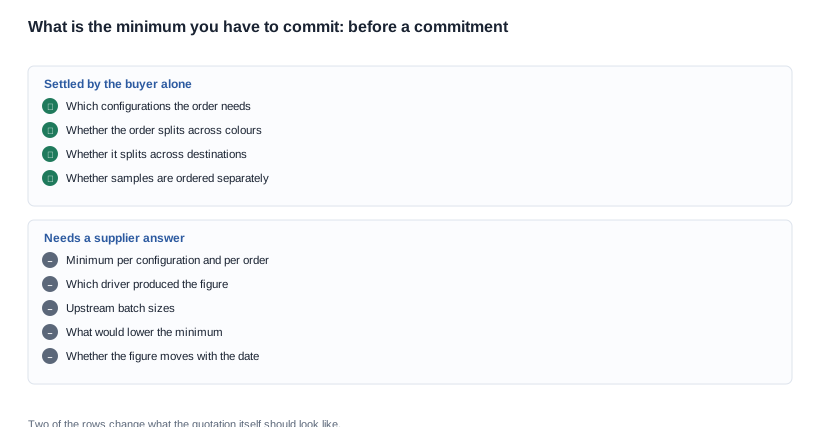
The checklist separates the items a buyer can settle alone from the items that need a supplier, and it is worth running it before the first quotation rather than after, because two of the rows change what the quotation should look like.
How a minimum behaves when an order is split
The most common reason a buyer's total does not match the per-configuration figure they were given is splitting. It happens in several ways, and each of them behaves differently.
Split across configurations. Two colours of the same entry are two configurations, and a factory that counts each configuration separately will quote a total that is the sum of two minimums rather than one. The buyer checklist on minimums covers the questions that settle this before an order is placed, and the one that matters most is whether the factory treats a configuration as a line in a schedule or as a separate setup.
Split across destinations. Two markets usually means two artwork sets, two documentation scopes and potentially two different packaging structures, and each of those is its own batch with its own floor.
Split between the sample and the production order. They are frequently separate orders with separate minimums, and the sample is not always credited. This is the split that surprises people most, because the sample was assumed to be part of the production commitment rather than a separate purchase.
Split between the product and the accessories. A case, a cable, a printed insert or a bundled accessory can carry its own minimum, and it is frequently a different one from the product's.
The way to avoid the surprise is to ask for two numbers rather than one. Ask for the minimum per configuration, and ask for the minimum per order, and then check whether the second is the first multiplied by the number of configurations or something else entirely. A supplier who answers both questions clearly has a counting rule; a supplier who answers only one has not.

How to get a number you can rely on
Six questions convert a quoted minimum into something a buyer can plan a purchase order against. They are written to be asked of any supplier, in any configuration, and they are written so that the answers can be compared.
- What is the minimum for this exact configuration, and which of the five drivers produced it? A number without a driver cannot be reduced, negotiated or forecast.
- Does the minimum apply per configuration or per order, and how is a split across configurations counted? This is the question that closes the gap between the figure you were given and the figure that arrives.
- Is the sample order separate, is it credited against the production order, and what is its own minimum?
- Which inputs carry an upstream batch minimum, and what is the batch size for each? Dye lots, lens batches, print runs and inserts are the usual four, and the answer tells you whether the number can move at all.
- What would have to change for the minimum to be lower? A specific answer — a different colour, a different artwork, a larger order on another configuration — is worth more than a refusal, because it tells you what the negotiation is actually about.
- Does the minimum move if the order is placed on a different date, and how does the schedule affect it?

The order matters more than it looks. The configuration question comes first because it decides which of the other drivers are even relevant; the split question comes before the negotiation question because a minimum that has been counted wrongly cannot be negotiated, only corrected; and the last question is the one that turns a figure into a schedule position.
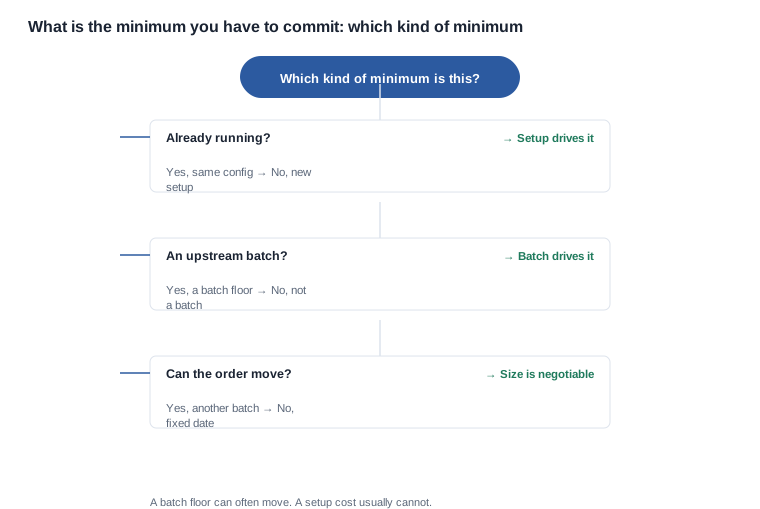
The decision chart is a triage rather than an outcome. It separates the two cases that behave most differently: a minimum that exists because a batch has to be covered, and a minimum that exists because a setup has to be created. The first can often be reduced by moving the order into a different batch; the second usually cannot be reduced at all without changing the configuration.
Two cautions close the section. First, a minimum quoted without a driver is a number to be verified rather than planned against, and it should be recorded as an open item until it has been explained. Second, a minimum that is comfortable at one configuration may be unworkable at another, so the number belongs to the configuration and has to be re-established whenever the configuration changes — which is a frequent occurrence during a launch, because the configuration that sells first is frequently not the one that was ordered first.
What a pilot order is actually for
A first order in this category is usually described as a pilot, and the word carries an ambiguity that matters commercially. A pilot order can be bought to find out whether the product sells, or it can be bought to find out whether the product can be built and documented properly. Those are different purchases, they have different minimums, and confusing them produces a commitment that was never sized for the question.
The engineering pilot. This one de-risks the configuration and the file. It exists so that the assembly sequence is proven, the firmware is loaded on a real unit, the documentation is assembled against an actual sample, and the mark is in the right position on an actual product. It does not tell you anything about demand, and a buyer who treats its results as demand data will have drawn a conclusion from a sample of one. The samples page covers the stage and the questions to settle at it.
The market pilot. This one tests demand, and it is the purchase most often made in the wrong size. It is only meaningful if the units offered reach the customer in a channel where the product can actually be found, which means the minimum for the market pilot is driven by the channel's depth requirement rather than by the factory's cost-covering figure. The two minimums are frequently different numbers, and the larger one is the one that has to be planned against.
The reason to separate them is cost. A market pilot bought at the engineering pilot's size buys almost no demand information, because the units do not reach enough of the channel to produce a meaningful result, while a market pilot bought at the market pilot's size adds the channel's depth requirement to a cost that was already going to be paid. Buyers who need both are usually best served by treating them as two orders with two sets of questions, because they have two different minimums, two different documentation scopes and two different schedules.
Where the published rows meet the minimum
The published rows let a buyer predict which drivers will apply before a quotation arrives, and that is worth more than it sounds because it converts a negotiation into a verification.
If the configuration is already running, the driver is the cost-covering quantity and the minimum will be modest. The published rows tell you whether it is likely to be running: a colour that is one of the published options on an entry, a charging method that is the one the entry publishes, a case state the entry publishes.
If the configuration is not running, the driver is a setup. In this range the combinations that are most likely to be new are the ones the catalogue leaves open — the four camera entries with no charging-case row, the entry that prints two variant names against two case capacities with no stated correspondence, and the charging method that four camera entries do not publish at all. Each of those is a question to put to the supplier before the order, and each is a candidate for a setup charge.
If a documentation scope is new, the driver is the sample. No per-model certification row appears anywhere in our catalogue, and the text names no CE, FCC or RoHS; our internal record holds a per-category certification position instead of a per-model one; the model designations and the certificate numbers are left open for the camera, audio and sport categories, and no certification information provided for the children's category. A buyer entering a new market with a new scope is therefore buying a sample and a file as well as units, and the minimum has to include them.
That is the practical value of the published rows for a commitment question. They do not give the number, and they are not intended to. They tell you which of the five drivers is going to produce it, and therefore which question is worth asking first.

The published position, and the questions that close it
What follows is where we come out on this, in the three-part arrangement used across this category.
Published. Across seven groups, twenty-eight entries, and four things on every one of them: the cell, how many of them, the runtime, the charge ceiling and the connector. Eleven of the entries are camera entries, and they add a resolution class — eight megapixels on eight of them and thirteen on three. Five of them give a charging-case capacity, two give a case without a figure, and four give no charging-case row at all. An ingress marking appears on two entries, a colour range on two, a remote-photo row on two, a removable part on three and a surround-sound row on five. fourteen publish a radio version, and one publishes a weight, that being the MT6 glasses body at 158 g excluding its foldable case.
Not published. Order minimums, minimum order value, a price, a price tier, a delivery time, warranty terms, tooling and mould charges, artwork charges, sample charges, the cost of certification and any certificate number. We publish no minimum order quantity because the figures we hold internally have not been reconciled to a single number, and because a published figure that is later found to be wrong costs more credibility than the absence of one.
What to ask. The minimum for the configuration, per configuration and per order. Which driver produced it. Whether the sample is separate and whether it is credited. Which inputs carry an upstream batch minimum. What would lower it. The standard OEM tier sets out the engagement structure the minimum sits inside, the OEM-ready platforms page covers the platform the order is placed against, the lead time section covers how the minimum interacts with the schedule, and the samples stage covers the order that usually comes before the production one.
The practical next step
Take the minimum you were last quoted, identify which of the five drivers it came from, and ask the supplier to confirm that driver in writing. If they cannot, you have a figure to verify rather than to plan against, and that distinction is worth more than the number itself. Then check the counting rule for a split order, because that is where most totals diverge from the per-configuration figure.
Send us the configuration, the destination market, the customisations you need and the volume band you are targeting, and we will reply with the catalogue rows for the entries that fit it, the drivers that will set the minimum for that configuration, and the questions to put to any supplier whose figure you want to rely on.


