

This page does not tell you who should buy an A05, and that is a deliberate choice rather than an omission. A verdict about who should buy a product means nothing until it is set against a requirement the buyer has written down in advance, and that requirement is the part a buyer brings and we do not have. What our catalogue can do is show which requirements the published rows for the A05 answer, which requirements they leave open, and which requirement they cannot answer at all — because the A05's published rows include six feature notes about fitted elements and indicators, and none of them supports a statement about what those elements do for a child. A buyer who needs the answer to "who should buy" can get it from the framework below, and the framework ends in questions rather than in a recommendation.
Who should buy A05 smart glasses: six catalogue lines, and the claim they do not support
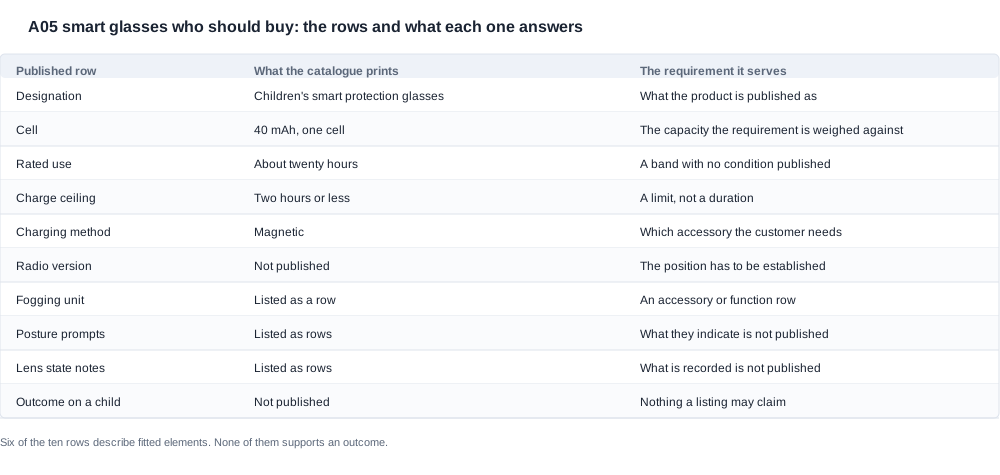
The A05 is published in our catalogue as 儿童智能防护眼镜, and its page carries the five standard rows — a radio version, a charge time, a cell capacity, a rated use and a charging method — together with six further notes that are specific to this model. The six are the interesting part, because they are the reason a buyer would look at this product at all, and they are also the reason a buyer has to be careful about what they say about it.
Those six notes are catalogue rows. They record what is fitted in the product and what the catalogue lists: a lens-based electronic item, a fogging unit, a correct posture-and-distance prompt, an incorrect posture-and-distance prompt, a lens clarity note and a lens fogging note. Read as rows, they tell a buyer that the product contains certain elements and that certain conditions are indicated. Read as claims, they would tell a buyer something about a child's eyesight, and that is the claim they do not support. Our catalogue publishes no measurement, no test method and no result for any of these elements, so the only statements a listing or a script can make are the statements that describe construction and indication.
That gives a three-way split that a buyer can use as a filter, and it is the closest thing to a decision framework that the published data supports. The first class is a requirement the rows answer: a buyer whose requirement is about the cell, the charging method, the charge time or the rated use has a published answer, and the answer is the row itself. The second class is a requirement the rows leave open: a buyer whose requirement is about weight, about the setup, about the control method, about what the prompts actually do, or about what the unit looks like on arrival has no published answer, and the correct response is a question to the supplier rather than a sentence in a listing. The third class is a requirement about an outcome — anything to do with a child's eyesight, comfort, concentration or development — and for that class the rows are not merely silent, they are actively misleading if they are read as support.
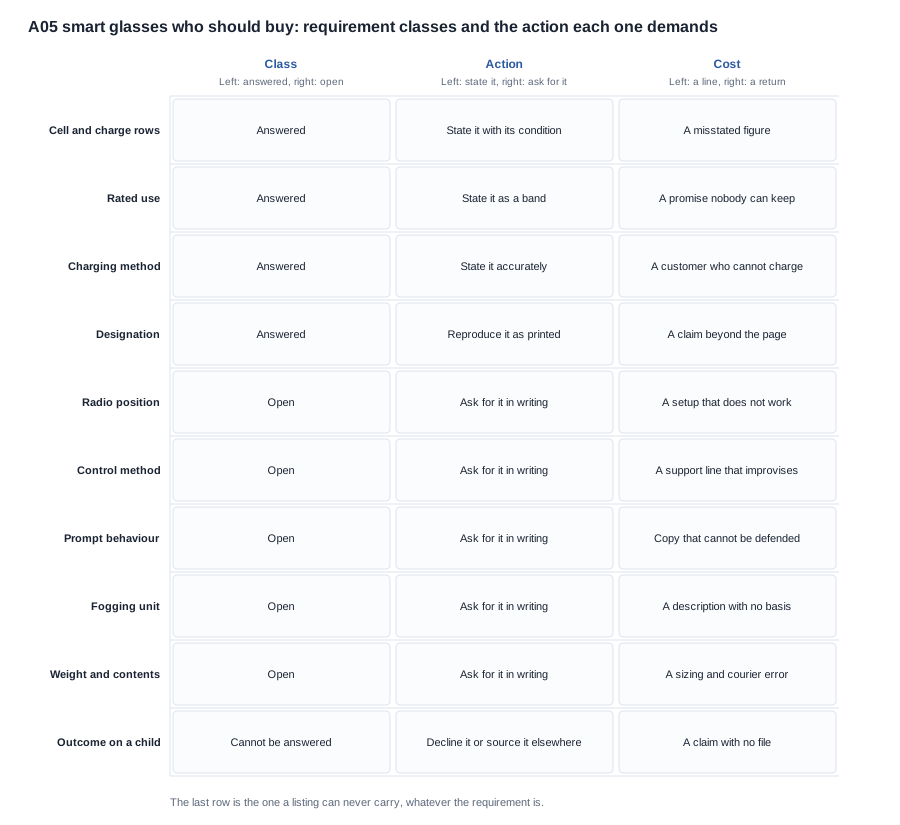

The matrix above is the working version of that split, and the column on the right is the one that matters commercially, because it tells a buyer what each row obliges them to do. A row that is printed obliges a buyer to state it accurately and to attach the condition that goes with it. A row that is absent obliges a buyer to ask, and to leave the corresponding line out of the copy until the answer arrives. And a requirement that no row can ever answer obliges a buyer to decline the requirement or to source the evidence from somewhere outside the catalogue entirely.
The three classes also behave differently commercially, and the difference is worth understanding before a request goes out. A requirement in the first class can be closed by a catalogue page and a supplier's confirmation of the build, and it costs a buyer very little. A requirement in the second class is a documentation cost: a request, a supplier's time, a review, and a line in the quality file that has to be kept current when the configuration changes. A requirement in the third class is a sourcing decision rather than a documentation one, because the evidence a buyer needs for it does not sit with the manufacturer at all. A procurement team that prices its programme on the first class alone and discovers the second and third classes late will find that its lead time and its total cost were both understated, and the correction arrives at exactly the point where the programme is hardest to change.
There is a fourth thing worth putting in the frame, and it is the one a sourcing team is most often asked about by a customer rather than by management: what happens when the requirement is about something the row does not describe. The honest answer is that the requirement has to be sourced as evidence from wherever that evidence exists, and that the catalogue's role is to say plainly that the evidence is not in the catalogue. That is a more useful answer than a reassuring one, because it tells a buyer where to spend the time, and a buyer who knows that a claim cannot be substantiated from the product documentation can go and look for a substantiation instead of writing the claim anyway. Which model to take forward, and on which criteria, is a decision a buyer makes afterwards; what the rows allow a buyer to write is a decision the rows make, and those are two different decisions and they are easy to confuse.
A buyer who wants a single sentence to work with will not find one here, and it is worth saying why rather than leaving it unexplained. The A05's published rows describe a configuration, and configurations do not decide procurement. What decides procurement is whether a buyer's own requirement, a customer's requirement and the published rows line up — and that alignment is a comparison a buyer performs against their own facts, not something the catalogue can perform on their behalf. What follows are the three requirement classes in detail, and then the questions that close the second and third of them.
The 40 milliampere-hour cell and the twenty-hour band
Two of the rows on the A05's page are the ones most often quoted and the ones most often quoted without their conditions. The cell is published as 40 mAh, a single cell rather than an arrangement, and the rated use is published as approximately twenty hours. Taken together they read like a straightforward specification, and that is exactly the reading to be careful with.
The twenty hours is a manufacturer rating, and our catalogue attaches no workload definition, no start state and no end criterion to it. That means the figure cannot be converted into a session length, it cannot be compared against another product's figure unless both carry their conditions, and it cannot be turned into a claim about how long a child will use the product before it needs charging. The cell value does not change any of that: the published rows are what they are, and a larger or smaller cell elsewhere in the catalogue does not tell a buyer what this number means. The honest phrasing on a product page is the published band, stated as a rating, and the honest phrasing in a conversation is that the conditions behind it have to be requested.
The charging row is published as two hours or less — a ceiling rather than a duration, and it has to be carried into a listing as one. A buyer who writes "charges in two hours" has turned a limit into a measurement, and a buyer who writes "under two hours" has made a stronger claim than the catalogue makes, because exactly two hours sits inside what is published. The wording that survives being checked is the ceiling itself.
The third of the five standard rows is the radio version, and this is a point that comes up repeatedly in this line: the A05's page prints no radio version at all. That is an absence of documentation, and it is not the same thing as a published position stating that the product makes no radio transmission. A buyer whose requirement involves connectivity therefore cannot resolve it from our material, and the requirement has to be put to the supplier as a question about what the product does and what the customer is expected to do with it. It is also the requirement most likely to be raised by a parent, because the first question about any connected product for a child is whether it connects to anything.
There is a practical consequence for the ordering decision that is easy to miss. If a buyer's requirement includes connectivity, then the A05's file is longer than its page suggests, because the supplier has to establish the radio position, the setup procedure and the interaction with the six feature notes before a product can be described accurately. A buyer whose requirement does not include connectivity is working with a shorter file. Which of the two applies is not a judgement about the product; it is a question about the buyer's own requirement, and it is the first thing to establish.

The fogging unit and the posture prompts, stated as catalogue rows
The six notes deserve a paragraph of their own, because they are the part of the A05's published material most likely to be read as something it is not. The catalogue lists a lens-based electronic item and a fogging unit, and the fogging unit in particular is an accessory or function row rather than a parameter of the lens itself. Four indications follow: one records a correct posture-and-distance condition, a second records the opposite condition, and the other two record a lens clarity state and a lens fogging state.
What the catalogue does not publish, and therefore what a listing cannot say, is what any of these do. It does not publish a measurement, a threshold, a reference, a reaction, or a result. It does not publish what happens when the incorrect condition is present — whether something is indicated to the child, to the adult, or to nobody, and whether the indication is visible, audible or recorded. It does not publish what the fogging unit acts on, and a buyer who wants to describe that has to ask. It does not publish the material, and a buyer who wants to describe the lens surface in a listing has nothing to describe it with.
The reason this matters commercially is that the gap between the rows and the claims is where a children's category's reputational risk sits. A channel that writes a factual description of the fitted elements has a narrow claim to defend. A channel that writes an outcome has made a claim that no document in our catalogue supports, and in a category where the subject is a child's eyesight, that claim is the kind that reaches further than the channel intended. The rule that comes out of it is simple and worth stating in the buyer's own words: describe what is fitted, state what the product is published as, and do not carry a claim that nothing behind the product supports.
There is a second reason the rows have to be handled in this order, and it is a practical one rather than a reputational one. The indication of an incorrect condition is the kind of thing a customer will ask about on the telephone, and a support team with a description rather than a specification cannot answer consistently. A buyer who obtains the missing behaviour before launch has a script that works; a buyer who obtains it afterwards has a script that changes mid-quarter, which is a costlier way to run a channel.
The rows to settle before the first buyer conversation
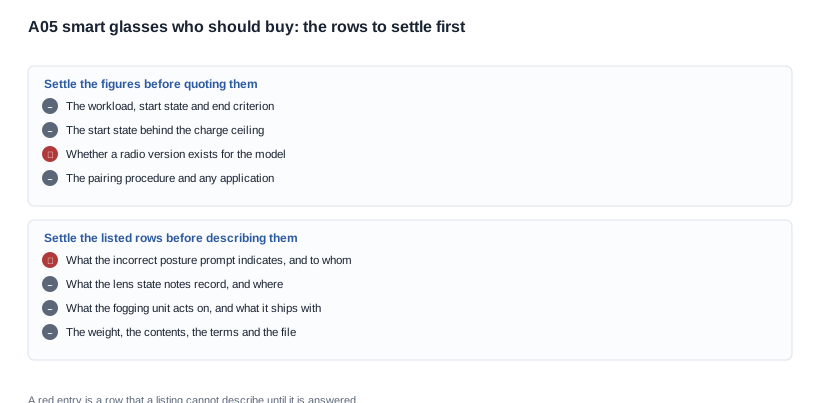
The request below is what a buyer needs in writing before the first conversation about this product goes ahead, and it is grouped by the requirement class it serves, because a buyer whose requirement falls into the first class needs very little from it. Every item can be answered from documentation the supplier already holds.
- The workload, start state and end criterion behind the approximately twenty-hour rating.
- The condition the two-hour-or-less charging ceiling was measured under, and the state a unit has to be in to reach it.
- The radio position for the model, given that the page prints no radio version.
- The pairing procedure, and whether an application is required.
- The control method, and what the wearer receives as confirmation.
- What the incorrect posture-and-distance prompt does, what it indicates, and to whom.
- What the lens clarity and lens fogging notes record, and where that record is held.
- What the fogging unit acts on, and what it is supplied with.
- The frame weight as shipped, and the packed weight.
- Whether an ingress marking exists for the model, and for which configuration.
- The contents of the box, item by item.
- The terms of the order itself: what a unit costs, what the smallest order is, how long production takes, how long the warranty cover runs, and how a sample is supplied.
- The transport documentation for the cell, and the conformity record for the configuration that will ship.
- How artwork is approved, and the route by which a file stays valid when the build moves.
Items one and two are the conditions attached to the two figures a buyer is most likely to quote, and a supplier that will answer them has answered the question that matters most about the published numbers. Item three is the one that turns an absent row into a position. Items six, seven and eight are the ones that decide whether the six feature notes can be described in a listing at all, and until they are answered the honest description stops at "the catalogue lists a fogging unit and a correct and an incorrect posture-and-distance prompt" — which is a sentence that can be printed.
Two entries on that list matter more than the others for anyone running a recurring programme rather than a single order. One of them is the route by which a supplier reports a change: a file that is valid for the build running today stops being valid for the build running next season, and a supplier who flags that change and a supplier who does not are two very different planning assumptions. The other is the sample order, and what it costs, because the sample is the only chance a buyer gets to check that the written answers describe the unit that actually arrives — a sample ordered with no answer list attached tests nothing but the sample. Both belong in the contract rather than in a folder, and both cost less to settle ahead of the first order than after the first complaint. What a documentation failure costs in this line is not a reprint; it is a channel that can no longer repeat itself, and that is the exposure a procurement lead is managing when a question list goes out instead of a brochure request.
The list is also a shortlist filter in itself, and it is worth using it that way. A buyer who has stated a requirement and cannot say which of these fourteen answers their requirement depends on has a requirement that is not yet specific enough to buy against, and the supplier who answers the question clearly is supplying a different service from one who does not. What to ask, then, is a question about the supplier as much as about the product, and how to choose between two suppliers is a matter of comparing the replies against the same list rather than the brochures against each other.
A buyer who has run that exercise once will find that the list pays for itself before the first order arrives, because the answers arrive in the supplier's own words and can be filed against the model rather than paraphrased into it.
One last point for the buyer who came here looking for a verdict. The A05 publishes a configuration, and a configuration is compatible with a range of requirements. Whether a particular requirement is in that range is a question about the requirement, and the only way to answer it is to write the requirement down and test it against the rows and against the list above. A buyer who does that gets an answer they can defend to a customer, a panel or a partner. A buyer who is given a verdict about the product instead gets a sentence that has to be withdrawn later, and the cost of that withdrawal lands on the brand rather than on the catalogue.
The relationship between the A05's published rows and the A06's is handled on the model page for the A06, and the same requirement-versus-row method is applied there: the twin designation and what a buyer has to establish to use it.
Send us the requirement you are actually buying against, together with the markets and the volume bands, and we will show which parts of it the A05's published rows already settle, where the page is blank, and which parts no catalogue is able to answer — then work out which questions to put to the supplier, and in what order they should be sent.


