

The A06 appears in our catalogue under the same designation as the A05, and with the same rows underneath it. That is the single most useful fact about this model for a buyer, and it cuts in a direction that is easy to get wrong: because the catalogue does not separate the two, any statement a buyer can make about the A06 is equally a statement about the A05, and a buyer who builds a range on the two of them has built it on a single set of rows. What our catalogue does not do is say why there are two designations, or what production configuration each one carries. That gap is where the procurement work is, and this page is about how to work it: which questions turn a duplicated specification into a documented one, and which questions about the A06 cannot be answered at all from a catalogue.
Who should buy A06 smart glasses: a page that matches the A05 line for line
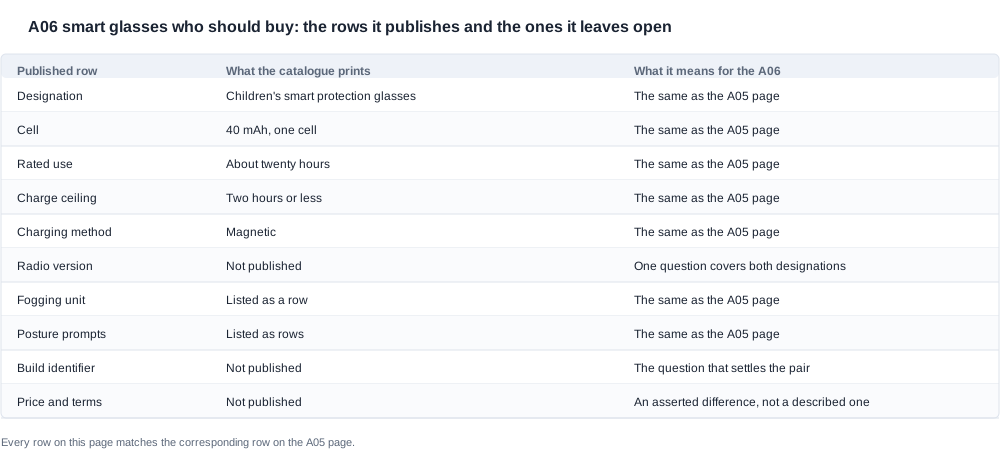
The A06's page carries the designation 儿童智能防护眼镜, a cell of 40 mAh, a rated use of approximately twenty hours, a charging ceiling of two hours or less, and charging by magnet. It carries no radio version. And it carries the same six further notes that the A05 carries: an electronic element on the lens, a fogging unit, an indication for a correct posture-and-distance condition, an indication for the opposite condition, a lens clarity note and a lens fogging note. Every line on the A06's page matches the corresponding line on the A05's page.
That is a fact with an unusual number of consequences, and it is worth taking them one at a time rather than treating it as a curiosity. The first is that a buyer cannot use the two model names to build a product comparison, because a comparison needs a difference and the catalogue publishes none. The second is that a listing, a product page or a script that describes one of them is equally a description of the other, so a channel cannot offer a choice between them on the basis of the published rows. The third is that a quotation for one of them is effectively a quotation for the other, and a buyer who treats two quotations as two products is comparing a difference that has not been established.
The fourth is the one that matters most for a procurement team, and it is the reason this page exists. If the published rows are identical, then the entire set of open questions is identical too — the same weight question, the same radio position question, the same questions about what the prompts do and what the fogging unit acts on, the same price, the same minimum order quantity, the same lead time, the same conformity file. A buyer who asks those questions once for the A05 has, in substance, asked them for the A06, and a buyer who asks them twice gets two sets of answers that may not agree with each other. Asking once, for the pair, takes one round of correspondence instead of two, and it is also the only way to find out whether the two designations are two configurations of one product or two products that happen to be printed identically.
That last question is the one to put first, and it is the one that has to be answered before a range, a sample order or a programme can be planned. Everything else follows from it.
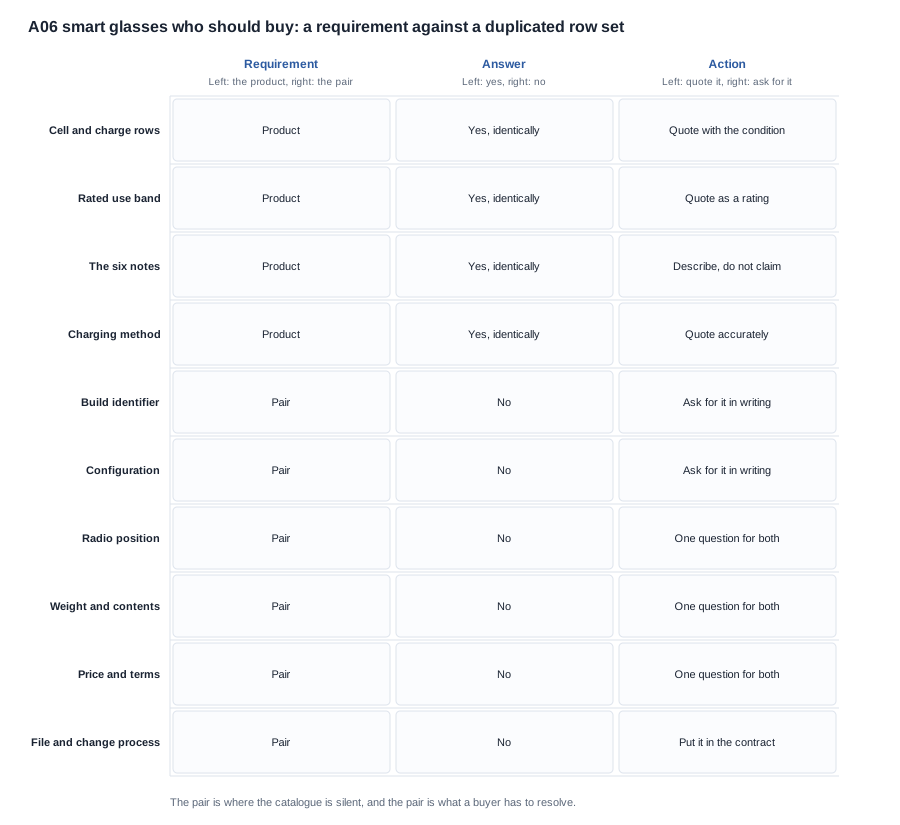
The matrix above is the working form this page offers in place of a verdict, and it is built around the twin fact rather than around the product itself. Where a requirement is about the electrical rows — the cell, the rated use, the charge ceiling, the charging method — the rows give the same answer for either designation, and the buyer's task is to attach the conditions rather than to choose between them. Where a requirement is about the six notes, the rows answer it identically as well, and the task is the same. Where a requirement is about how the two models relate to each other, the catalogue answers nothing, and the task is to put the question to the supplier in the form the answer can be filed against.

The 40 milliampere-hour cell, and the twenty-hour band it publishes
The two numbers a buyer will quote for this model are the 40 mAh cell together with the approximately twenty-hour rated use, and both of them need the treatment they would need on any other page, with one addition that comes from the twin fact: a buyer who quotes them for the A06 is quoting them for the A05 as well, and a comparison built on them is not a comparison.
The band arrives with nothing attached to it: no workload definition, no starting state and no stated end criterion. That means it cannot be turned into a session length, it cannot be read as a claim about how long a child has the product, and it cannot be set beside another model's figure unless both figures carry their conditions. The cell value does not repair any of that, and it is worth being explicit about why, because the temptation is to treat a published cell and a published band as a pair that explains itself. They do not. A cell capacity and a rated endurance are two separate published rows, and the relationship between them for any particular product is a question for the supplier rather than a calculation a buyer can perform.
The ceiling on charging is published as two hours or less, and it has to be carried into a listing as a limit rather than as a measured duration. The row is also the one that interacts with the twin fact most directly in a commercial sense, because a programme that carries both designations has to decide whether it is carrying one product or two, and the answer determines how many sets of artwork, how many minimum order quantities, how many transport files and how many case-by-case quality checks it is running. A buyer who has not settled that question will find out at the point where the programme's cost and the programme's complexity are both already committed.
The radio position is the other open row, and the twin fact is what makes it a single question rather than two. Because the A06's page prints no radio version, and because the A05's page prints no radio version either, a single question to the supplier covers both designations, and the answer applies to whichever of them is being built. The same is true of the weight, the contents of the box, the setup procedure, the control method, the ingress position and every commercial term: one enquiry, ten answers, two designations.
The practical consequence for a procurement team is that the twelve questions below have to be asked once and filed once, and that the file has to name the build each answer covers. A buyer building a range around the two designations should settle, before the sample order, whether the programme is one product with two names or two products, because the verification criteria, the incoming inspection checks and the artwork approval route all follow from that decision. Deciding it after the samples arrive means the quality file has to be rebuilt rather than completed, and the trade-off between a shorter enquiry now and a rebuilt file later is not a close one.
A fourth point belongs alongside the first three, and it is the one a buyer is most likely to miss in a range that is being planned quickly. If the two designations turn out to be one production configuration sold under two names, then the programme has one product and a naming decision, and the cost model, the artwork plan and the quality plan all simplify accordingly. If they turn out to be two configurations, the programme has two products and the catalogue will not tell a buyer which one is which, because it prints the same rows for both. Either way the file has to be built, and a file takes one pass to build rather than two, which is the practical argument for asking about the pair rather than about each model in turn.
A fifth point belongs in the same place, and it is about what the range looks like from the outside. Two designations that print identically make the range look wider than the published evidence supports, and a channel can quietly use that apparent width to present a choice to a customer that the underlying documentation does not distinguish. A buyer who has settled the configuration question has removed that possibility, and a range built on a documented difference is one a quality team can actually support.

Where the catalogue leaves the difference between the two models open
There are six places where a buyer will look for a difference and will not find one, and it is worth putting them side by side, because a buyer who has them in front of them stops searching the catalogue and starts asking the right question.
The first is the configuration. The catalogue prints a designation and a set of rows, and it does not print a build identifier, a variant name, a market marking or a revision. So a buyer cannot tell from the catalogue whether the two designations correspond to two builds.
The second is the feature notes. The six notes are the same on both pages, and the catalogue does not publish a note set that differs, so a buyer cannot tell whether the two configurations differ in the elements they contain, in the indications they give, or in neither.
The third is the label. What appears on the product, on the carton and in the documentation for each designation is not published, and a buyer who has written the copy before settling it has written copy against an assumption.
The fourth is the commercial position. Nothing on it is published for either designation — neither the price, nor the smallest order, nor the production lead time, nor the warranty term, nor the sample terms — so a buyer cannot infer a commercial difference from a catalogue page. And where a supplier offers separate terms for two designations whose published rows are identical, that difference is being asserted rather than described, which is a question rather than a fact.
A sixth place belongs in the same list, and it is the one that catches a buyer who has been given a two-model range and has not thought about what happens when a customer asks why there are two names. A channel cannot answer that question from the catalogue, because the catalogue prints the same rows for both, and a customer who is told that two products are identical and then finds a different price will not regard that as helpful. The answer has to be a documented one, and it is worth settling before the range is listed rather than after the first comparison email.
The fifth is the file. The conformity record, the transport documentation and the artwork approval route are all per-configuration matters, and the catalogue prints none of them for either designation. A buyer who has assumed the A06's file follows from the A05's will find out at the point where the file is requested.
There is a sixth, quieter point that belongs here. Two designations that print identically make the range look wider than the published evidence supports, and a channel can quietly use that apparent width to present a choice to a customer that the underlying documentation does not distinguish. A buyer who has settled the configuration question has removed that possibility, and a range built on a documented difference is one a quality team can actually support.

The questions that resolve a twin designation

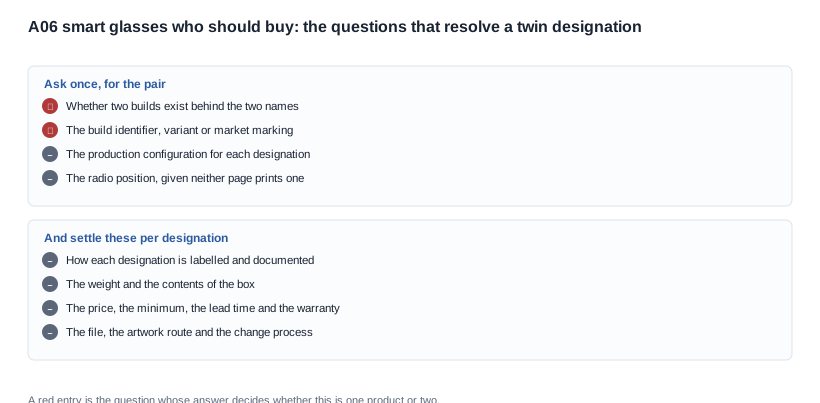
The request below is written for the pair rather than for a single model, because that is the only form in which it is answerable. Every item can be met from paperwork the supplier already holds, and each one corresponds to a decision a buyer has to make before a range is planned.
- Whether the two designations are two production configurations or one configuration sold under two names.
- The build identifier, variant name or market marking for each designation, and where it appears.
- The production configuration for each designation, stated against the published rows.
- The feature note set for each designation, and whether the two sets are identical.
- The designation as it appears on the product, on the carton and in the documentation.
- The radio position for each designation, given that neither page prints a radio version.
- The weight as shipped and the packed weight for each designation.
- Whether an ingress marking exists for each, and for which configuration.
- The contents of the box for each designation, item by item.
- The price, the minimum order quantity, the lead time and the warranty term for each designation.
- The transport documentation and the conformity record for each configuration.
- How artwork is approved for each designation, and the route that keeps a file valid when the build changes.
The first of those twelve decides most of the others, and it is worth asking it in a way a supplier can answer with a document rather than a summary. The useful question is not whether the two are the same, which invites a description, but what identifies each build and what the documented basis is for any difference. A supplier who answers that has given a buyer something they can file, quote and audit, and a supplier who does not has told a buyer that the two designations are a naming convention in a document rather than a difference in a factory — which is a legitimate position, and one that a buyer can plan around, but only if it is stated.
Two entries belong on that list for any buyer running a recurring programme rather than a one-off order. One is the route by which a supplier reports a change, because a file that is valid for the configuration being produced today stops being valid for the configuration being produced next season, and the difference between a supplier who notifies a change and one who does not is the difference between a planned refresh and an unplanned one. The second is the sample order and what it costs, because the sample is the first opportunity to verify that the answers on this list describe the product that actually arrives, and a sample ordered without a written answer list attached is an order of a product rather than a test of a specification. Both belong in the agreement rather than in a folder, and both are quicker to settle before the first order than after the first complaint. The cost of a documentation failure in this line is not a reprint: it is a channel that cannot repeat itself, and that is the risk a procurement lead is managing when they send a question list ahead of a brochure request.
The twelfth is the item most often deferred and most expensive to defer. Two designations whose published rows are identical are especially exposed to a configuration change, because a change to one build will not show up in the catalogue row that describes the other. A written change process is what turns that exposure into a notification, and it is the one item on this list that belongs in the contract rather than in the file.
A procurement lead presenting a range internally finds that the twin fact simplifies one part of the presentation and complicates another. The product sheet gets shorter, because one set of rows describes both names. The cost model gets longer, because the count of minimum order quantities, artwork sets, transport files and case-by-case quality checks all turn on how the first question is answered, and a budget built on the assumption of two products will be wrong in one direction or the other. One question in one email removes the uncertainty, and what that question costs to ask is a fraction of what it costs to plan a programme on the wrong side of it.
What to ask a supplier is a shorter list here than it is for a model with a published row set of its own, because most of the open items belong to the pair rather than to either name. The criteria a buyer applies to the replies should be unchanged: a named model, a named configuration, a document rather than a summary, and a date against it. A reply that names only one designation has not answered the question, however detailed the reply is.
There is a closing point for a buyer who has been reading these pages in the hope of a recommendation. The rows on the A06's page are the rows on the A05's page, and any product a buyer's requirement selects is selected by the requirement and not by the name. Which requirement a buyer is actually buying against is a fact about the buyer's own programme, and the useful output of this page is a way to test that fact against what the catalogue publishes and against what the supplier will document. The third model in this line is covered separately, and it is the one whose page carries a radio version where these two carry none: the A07 and the questions its page leaves open.
Send us what you are buying against, the target markets and the volume bands, and we will set out what the A06's published rows already answer, what the twin fact means for the range you are planning, and which of the twelve questions above must be closed before the first order — so that the range you build is one the documentation can support.


