
A verdict on who should buy a CY03 depends entirely on a requirement our catalogue does not have and you do, and this page will not supply one. What it will do is set out the published rows for this model, show which of them a buyer's requirement lands on, and name the questions that close the rest. The CY03 is an unusual page to work from, and the reason is specific and useful: it publishes a charging case with a stated capacity, and it does not publish the charging method at all. A model with a published case and an unpublished method is a model whose physical arrangement is partly described and whose operating behaviour is not, and a procurement team that has not noticed that distinction will plan the two halves of the product at the same time.
Who should buy CY03 smart glasses: a 290 milliampere-hour cell and no published charging method
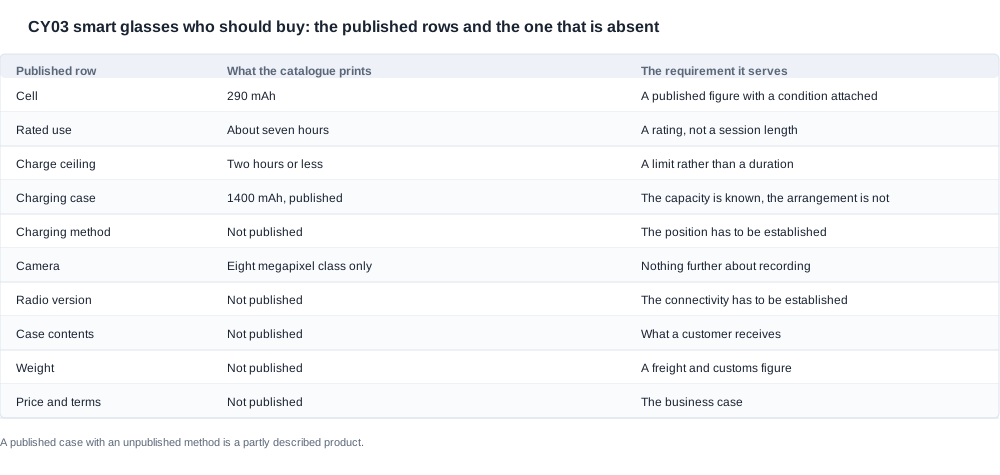
The CY03 is published in our catalogue as an AI camera glasses product, and its page carries five lines. A cell of 290 mAh. A rated use of approximately seven hours. A charge time of two hours or less. A charging case of 1400 mAh. A camera row that gives the eight megapixel resolution class and no detail beyond it. Beyond those five lines the page is silent on two subjects that matter: it publishes no radio version, and it publishes no charging method.
The absence of the charging method is the fact to start from, and it needs to be handled carefully, because a row that is not printed is easy to mistake for a statement that something is not there. Our catalogue printing no charging method for this model is an absent publication, and it is not the same statement as a published position that the product has no charging method. A listing that says "no charging method" is asserting something the documentation does not carry. A listing that says nothing about charging is accurate but incomplete, and a buyer who wants to complete it has to obtain the position from the supplier in writing.
That position, once obtained, decides several things at once, which is why it is worth putting at the top of an enquiry rather than in the middle of one. It decides the accessory line a channel stocks, because the charging method determines what a customer has to own. It decides the carton, because a method that uses a physical port and a method that uses a contact arrangement ask different things of the pack. It decides the charging point in a warehouse or a store, because the method determines where a unit can be put. And it decides what the support script says when a customer cannot get the product to charge, which is the first support contact a product of this kind produces.
The second thing this page is for is the case row, and the pairing of a published case with an unpublished method is unusual enough to be worth stating plainly. Our catalogue prints a charging case of 1400 mAh for this model. That is a published figure, and it is a substantial one next to the 290 mAh cell, which means the case is a real part of what a customer receives rather than an accessory that might be optional. What the catalogue does not print is how the product itself is charged, and it does not print the contents of the case. So a buyer knows the case exists and knows its capacity, and knows nothing about the arrangement inside it.
The third thing to set out is the camera row, because a camera product's page is usually read as a camera specification and this one has very little of it. The catalogue publishes the eight megapixel resolution class for this model and nothing beyond it — the imaging sensor, the angle of view, the frame rate, the recording format, how much can be stored, the stabilisation behaviour and the low-light behaviour are all absent from it. For a buyer whose requirement is about what the camera records, the page answers the resolution class and leaves the rest open, and the honest listing position is a resolution statement rather than a camera description.

The case row that is published, and the method that is not
The 1400 mAh case row is worth spending a paragraph on, because it is the one place in this product where a physical arrangement is documented and a behaviour is not. A buyer planning around the case has three things and not a fourth: the case exists, its capacity is 1400 mAh, and it is part of what the customer receives. What the buyer does not have is how the product is charged, whether the case is the charging path or simply a storage accessory, what else the case contains, and whether the two numbers — the 290 mAh in the product and the 1400 mAh in the case — describe a product that is charged from the case or a product and a case that happen to ship together.
That question is not a technicality. It decides whether the customer can be told to put the product into the case to charge it, which is a sentence a customer expects to find in the documentation, and which is a sentence a listing cannot publish until the supplier has answered. It also decides how the product is stored between uses, and whether the case is a carrying accessory or a powered one, and those are two different products with two different cost structures for a channel.
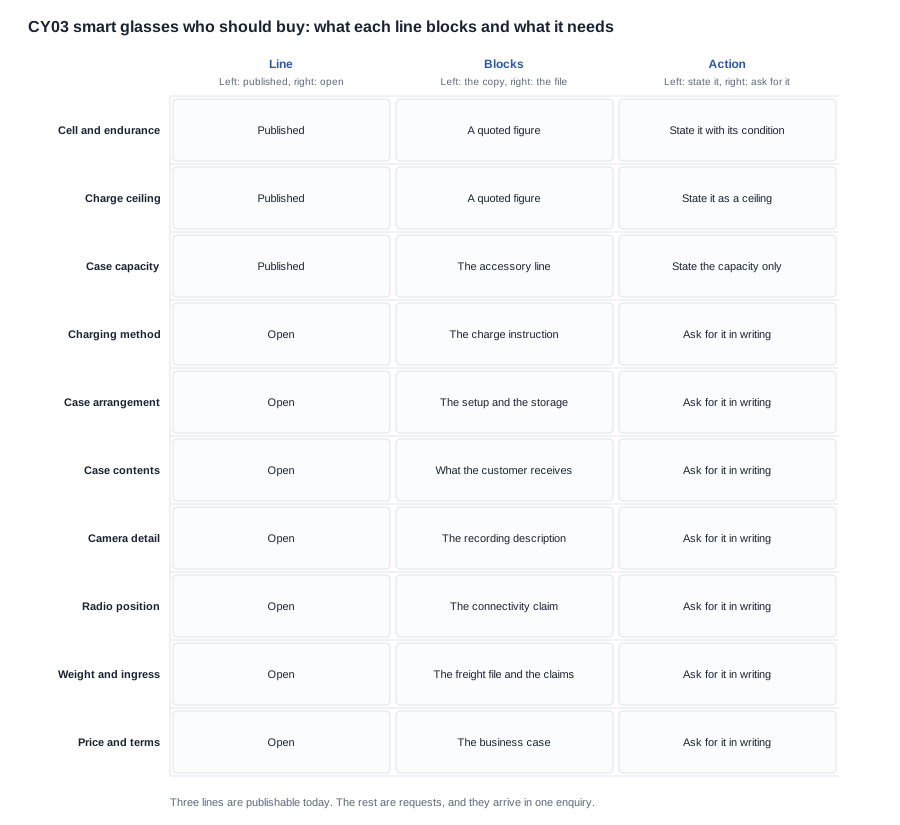
The matrix above is organised around that asymmetry, and it is the version a buyer should carry into a supplier meeting. The left-hand column is the row, the middle column is what the catalogue prints about it, and the right-hand column is what the buyer still has to establish before the row can be used in a listing or a script. Only three of the ten lines on this page are fully published, and the three are the ones that a buyer can write about today without a document: the cell, the rated use and the charge ceiling — each of them with its condition attached.
The fourth line, the camera resolution class, is published but narrow, and it sits in a category of its own: the buyer can state the resolution and cannot state anything about the recording. The case row is published in its capacity and open in its arrangement, which is the reverse position. The two are worth separating in a request, because a supplier answering "what does the case do" and "what does the camera record" may need two different documents, and a single question that mixes them tends to get a single vague answer.
A fourth consideration belongs with the case, and it is one a buyer should settle before the range is planned rather than after the first quotation. The case capacity is a published figure, which means it is the one number about this product that a channel is likely to build a business case on without checking anything, and it is the number that is furthest from a cost. A 1400 mAh case carries a replacement rate, a freight weight, a lead time longer than the product's own, a minimum order quantity, tooling and material — and none of them is published. The commercial consequence is that the accessory line can cost more than the product it accompanies, and a buyer who has structured the programme around the product and discovered the accessory cost afterwards has built a case on the wrong base. The question is simple and belongs in the first exchange: what does the case cost, what is its minimum, how long does it take, and what does it add to the shipped weight. Those four answers turn a published capacity into a costed accessory, and until they arrive the case is a number rather than a plan.
There is a fourth consideration that belongs with the case, and it is commercial rather than technical. A 1400 mAh case is a meaningful accessory, and accessories have a supply chain: a minimum order quantity for the case, a lead time that is longer than the product's, and a replacement rate that is set by how often a customer loses one. Our catalogue publishes none of those for this model or for any other, and a buyer who has planned the accessory programme on the case capacity alone has planned it on a number that describes how much energy the case holds rather than how many cases a factory will produce.

The seven-hour band, and what a first order has to pin down
The rated use of approximately seven hours is the figure this product is most likely to be quoted on, and it arrives on the page as a manufacturer rating with nothing hanging off it — no workload definition, no indication of the state the unit started in, and no criterion for when the measurement stopped. It cannot be converted into a recording session, it cannot be read as a promise about how long the product works between charges, and it cannot be set against another model's figure unless that figure carries its own conditions. The cell value of 290 mAh does not change any of that, and the temptation to read a published cell and a published band as two halves of one specification should be resisted. They are two separate rows, and how they relate on this product is a question for the supplier.
The one condition on this product that deserves particular attention is the one the charging method creates. If the product is charged in the case, then the figure a customer experiences depends on the charge cycle, on how long the case holds its charge, and on whether the case and the product are used together. If the product is charged over a separate interface, the case is storage. The same published band behaves differently under the two arrangements, and the difference is not in the rating at all — it is in what a customer is told to expect from a full charge.
The second thing a first order has to pin down is the camera, and this is where the published page is thinnest. A camera product bought on a resolution class alone is a camera product bought on one number, and the questions that determine whether that number is useful — what it records, for how long, where it is stored, and what happens when the storage fills — are exactly the ones the page does not answer. A buyer whose requirement is about recording rather than about endurance has a longer enquiry here than in a product whose page is fuller, and should plan for it.
The third is the commercial position, which is unpublished for this model in the same way it is unpublished across our range, and which is where the total cost of the programme actually lives. Everything a buyer needs to cost the programme — the unit price, the smallest order the supplier will take, the production lead time, the length of the warranty cover, the sample order terms and the landed cost — comes from a quotation, and none of it is in our published material. The one published figure that a buyer might expect to see a commercial counterpart to is the case capacity, and a buyer who pairs a published capacity with an unpublished cost is building a business case on the one number that cannot be costed from the page.
There is a fourth item, which is the one that a camera product in this range cannot skip, and it is the radio position. This page publishes no radio version, and a camera product with no published radio version is a product whose connectivity has to be established before a listing, a support script or a school deployment can be written. The question is the same one that applies to the charging method, and it belongs in the same request.

The rows to settle whichever buyer you are
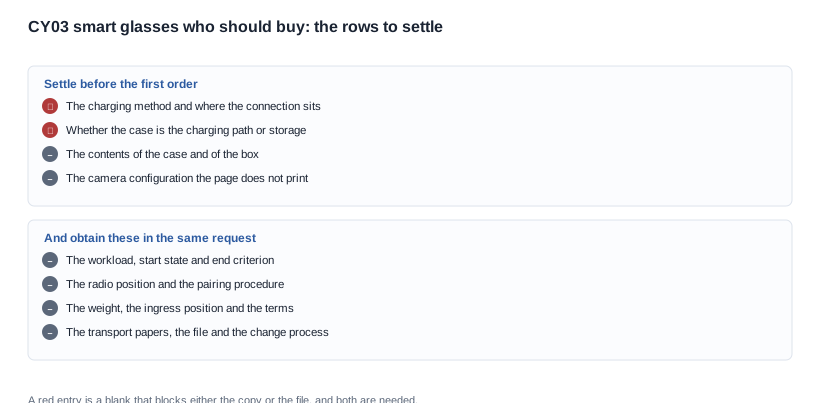

The list below is the practical output of this page, and it is grouped by what it is for rather than by which requirement it serves, because a buyer whose requirement is about the camera needs a different part of it from a buyer whose requirement is about the charge arrangement. Every item can be met from documents the supplier already holds, and every item corresponds to a line that the page either leaves open or answers only in part.
- The charging method for the model, whether it is a contact arrangement or a port, and where the connection sits.
- Whether the case is the route by which the product is charged, or simply storage that travels alongside it.
- The contents of the case, and what a customer receives alongside the product.
- The workload the seven-hour rating was taken under, the state the unit started in, and the criterion that ends the measurement.
- The condition behind the two-hour-or-less charging ceiling, and the state a unit must be in to reach it.
- Everything about the camera that the page leaves out: the imaging sensor, the angle of view, the frame rate, the recording format, how much can be stored, and the file format.
- The radio position for the model, and the connection routine if the model has one.
- The unit weight, the weight of a packed carton, and whether an ingress marking applies.
- The price, the minimum order quantity, the delivery lead time, the warranty term and the sample order terms.
- The transport file for the 290 mAh cell and for the case, together with the conformity record that covers the configuration actually shipped.
- How artwork is approved for this model, and the route that keeps the file valid when the build moves.
There is one more line worth adding for a buyer running a camera range rather than a single product: whether the supplier's answers hold for both designations or only for one of them, and whether a configuration change applies to one or to both. A supplier that answers for the pair because the pages are identical will produce a single set of answers that may or may not cover both builds, and the only way to know is to ask the question in that form. The cost of asking is a paragraph in the enquiry; the cost of not asking is a documentation file that covers half a range.
A buyer assessing two suppliers on this model should send both the same eleven questions in the same form, and mark the replies against one common set of criteria, because the replies will otherwise not be comparable. The criteria are simple: the reply names the model and the configuration, it is dated, it points to a document rather than a description, and it is consistent with the answer to the question before it. Picking between two suppliers is therefore a procedure rather than an opinion, and what the procedure produces is a set of documents rather than a set of brochures. The designation a buyer keeps, and the standard it is measured against, are settled by the requirement they brought — and the value of the enquiry list is that it tells that requirement what it can be asked.
The first three are the ones that change the product, and the fourth and sixth change the copy. The ninth and tenth change the business case and the file, and the eleventh protects both. A buyer who sends all eleven gets a model file that can be reviewed; a buyer who sends only the ones that appear on a product page gets a model page, and a model page is not a file.
It is worth adding a paragraph for a procurement team that is running a camera range rather than a single product, because the pattern on this page repeats across the range and the repetition is what makes it worth planning for. A camera product's page in our catalogue tends to publish the electrical profile, the resolution class and a case row, and to leave the charging method, the camera configuration, the radio position, the weight and the commercial terms unstated. The pages are not wrong; they are narrow. A buyer who has read one of them and assumed the others behave the same will get the assumption wrong somewhere, because the narrowness is distributed differently from product to product. The practical instruction is to treat every page as a separate enquiry, to ask the same eleven questions in the same order each time, and to file the answers against the model rather than against the range. That is a slower way to work than sending one request for the whole family, and it is the only way that produces a documentation file a quality team can audit when a customer asks where a particular unit came from.
There is a closing point, and it is the reason the title of this page is a question rather than an answer. A verdict about who should buy this product would have to be built on something our catalogue does not publish, and a verdict built on something that is not published is a sentence that has to be withdrawn later, usually in public and usually by a channel rather than by a catalogue. The framework on this page produces something a buyer can defend instead: a requirement written down, the published rows mapped against it, and a short list of questions that closes the gaps. Which model a buyer takes forward, and against which criteria, is a decision the buyer's own requirement settles — and the work above is the part that makes that decision safe to act on.
The relationship between the CY03's published rows and the CY05's is handled on the model page for the CY05, and the same requirement-against-row method is applied there: the twin designation and the question it raises.
The eleven questions fit inside one message, and the replies are short enough to file against a single model rather than a whole range.
Send us the requirement behind the CY03, the volume bands, the markets you intend to sell into and the copy you have drafted, and we will set out which parts of it the page already answers, which parts are blank lines, and which of the eleven questions above have to be closed before the first order — so that the listing you publish and the file you keep describe the same product.


