

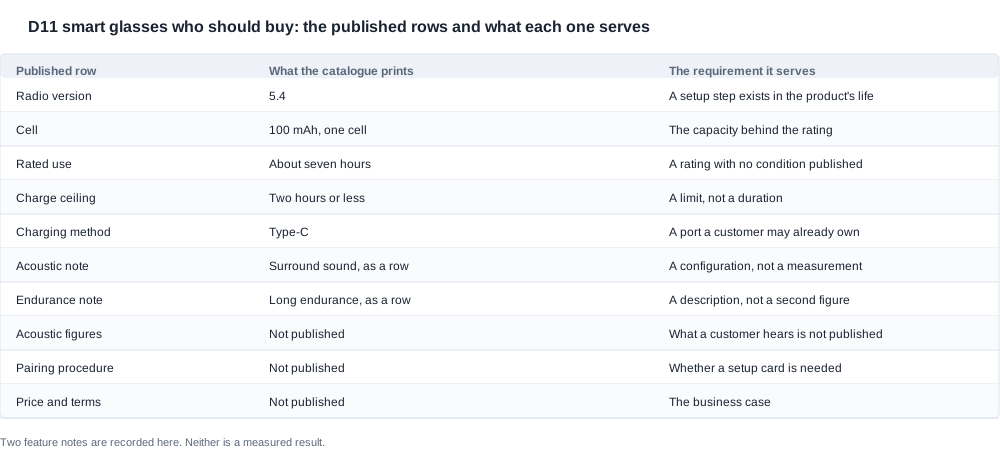
The D11 is published in our catalogue as an AI 蓝牙眼镜, and its page carries five standard rows — a cell of 100 mAh, a charge ceiling of two hours or less, a rated use of approximately seven hours, a radio version of 5.4 and a Type-C charging method — together with two further notes, an acoustic configuration and a long-endurance note. It is a short page, and a buyer who has come here for a verdict will not find one, because a verdict about who should buy a product is only meaningful against a requirement, and the requirement is the part a buyer brings. What the page does give a buyer is a clean set of published rows, two of which are the subject of the section below, and a short list of questions that close the rest of it.
Who should buy D11 smart glasses: the model whose feature rows are published
Two of the rows on this page are the ones that make the D11 worth a separate look, and they are the two feature notes. A catalogue row that records an element is a weaker thing than a specification, and a buyer who treats the two as interchangeable will end up with a listing that says something the documentation does not support. The rows here record what the catalogue lists about the product. They do not record a measurement, a test method, a result or a comparison, and the first job of a procurement team is to work out which of those a requirement actually depends on.
The framework that comes out of that is the same three-way split this page uses throughout, and it is worth stating in the terms a buyer will use. A requirement that is about the electrical profile — the cell, the endurance, the charge ceiling, the charging method — is answered by the printed rows, and the only work left is to attach the conditions. A requirement that is about how the product behaves in use — what it sounds like, how long it lasts in a particular pattern, what happens to the connection — is answered by nothing on the page, and has to become a request. And a requirement that is about a measured outcome has to be sourced from evidence held outside the catalogue altogether, which makes it a sourcing decision rather than a documentation one, with a lead time and a cost that the request list below does not capture.
There is a third thing about this model that a buyer should establish early, and it is a structural one rather than a spec. The D11's page is fuller than most pages in its line, and that fullness makes it a different kind of proposition from a page with five rows and nothing else. A channel building a listing from this page has two feature notes to work with, and a channel building one from a five-row page does not. That is a genuine difference in what a copywriter can write, and it is the difference between a listing that leads on a documented configuration and one that leads on a specification.
It is also worth saying what a buyer should not conclude from a fuller page. A page with more rows is not a page with more evidence, and two feature notes are not a performance record. The rows on this page make the product describable in a way a five-row page is not, and they do not make it comparable, measurable or certifiable in a way a five-row page is not. A buyer who has read this page and concluded that the D11 can be assessed on its own printed rows has taken the wrong lesson from it, because the two notes record configurations rather than results, and the results are exactly what a requirement about sound or about endurance actually depends on.
What the page does not do, and what no page in our range does, is rank this model against the others. There is no published figure here that says where this product sits, and a buyer who wants a shortlist of three will have to build it by comparing rows rather than by reading a verdict off a page.
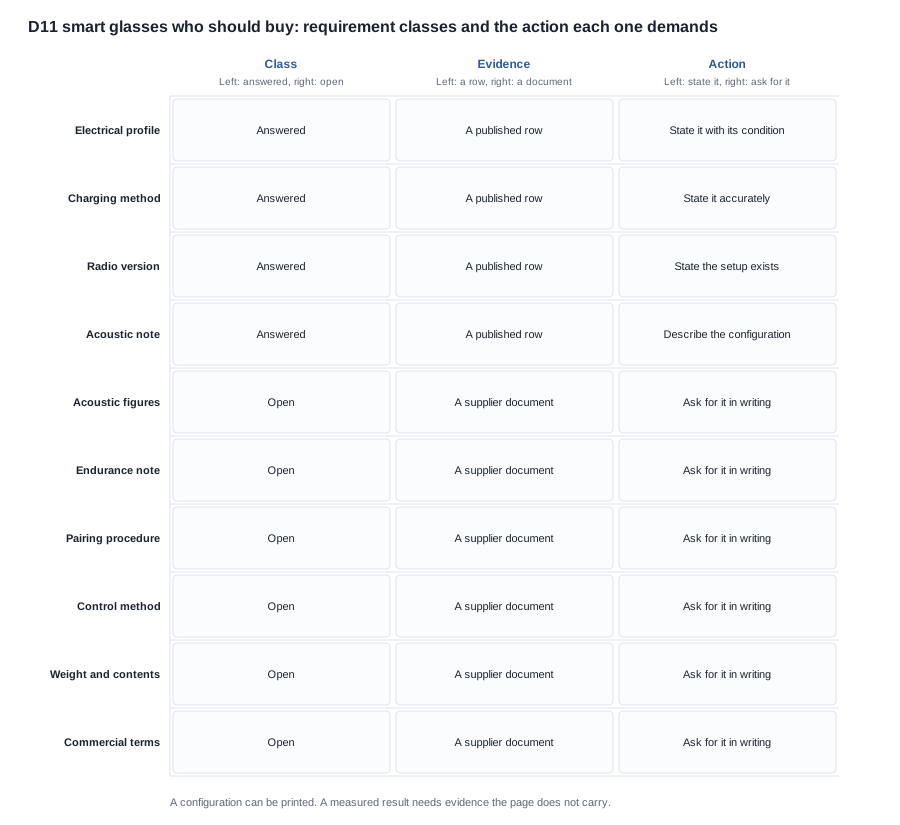
The matrix above is the working form of the split, and the right-hand column is what a buyer does with it. Where a row is printed, the buyer states it with its condition. Where a row is absent, the buyer puts a question and keeps the matching line out of the copy until the reply lands. Where the requirement is about a measured result, the buyer has to establish whether the evidence can be obtained at all, because a requirement that cannot be evidenced is a requirement that cannot be listed.

The 100 milliampere-hour cell, the Type-C interface and the radio version
The three rows that decide the physical and the operational picture on this page are the cell, the interface and the radio version, and each of them behaves differently from the same row on a model with a different configuration.
The 100 mAh is a single cell, and the rated use of approximately seven hours sits on the page as a manufacturer rating with nothing attached to it — no workload behind it, no starting state, no point at which the measurement stops. A number like that cannot be converted into a working session, cannot be read as a statement about how long the product runs between charges, and cannot be set beside another model's figure unless that figure brings its own conditions with it. The cell value does not repair any of that, and treating a cell and a rating as a pair that explains itself is the most common way a buyer ends up quoting a number they cannot defend.
The Type-C interface is the row that shapes the accessory question, and it shapes it in a buyer's favour more often than not. A Type-C product asks a customer for a cable that many customers already own, so the question "what does the customer need in the box" is a smaller one than it is for a product with a proprietary contact arrangement. It is still a question — whether a charging cable is supplied, how the port is described in the documentation, and what the customer is expected to do on arrival — but the cost of getting it wrong is lower and the answer is usually simpler. It also means the accessory line a channel stocks is thinner, which is worth knowing before the packaging is designed.
The radio version of 5.4 decides how much support work this product creates, and it is the one a channel's own customers will feel first. Because the radio version is published, the product's life contains a step that has to be carried out, which means a customer carries it out once, holding the device in one hand and a printed sheet in the other. The instruction sheet has to exist, it has to be in a language the customer uses, and it has to describe a procedure the supplier will support. Nothing is published about how a customer connects the unit and nothing about whether an application is involved, so both of those are requests, and both belong in the first exchange rather than in the second.
The three rows also interact in a way that is worth putting in the business case rather than the copy. Where a radio version is published, the current draw depends on the connection state, which means the condition attached to the published rating matters more here than it would on a page with no radio line at all. A programme scheduled against a rating taken in a different state is a programme planned against somebody else's number, and the cure is one question: which state the radio was in at the moment the figure was taken — idle and connected, connected and in use, or with no radio link at all.

The surround-sound line, and what it does not certify
The acoustic note on this page is the one that needs the most careful handling, and the reason is not that it is unreliable. It is that it is exactly the kind of row that turns into a performance claim the moment it reaches a listing.
What the catalogue prints is a configuration: a surround-sound line, recorded as a feature of the product. What that configuration produces is not published, and our catalogue carries no acoustic figure for this model — no driver size, no output level, no response curve, and no third-party test report. A listing may therefore state that the catalogue records a surround-sound configuration, and it may not state what a customer hears, how it compares with another product, or what it does in a given environment. A channel that wants the second kind of sentence has to obtain the figures and the report, and where it cannot obtain them, the sentence does not go on the page.
The long-endurance note next to it raises a smaller version of the same problem. It is a qualitative descriptor sitting beside a published rating of approximately seven hours, and a listing that prints both may be read as though the two are separate figures. They are not: the note is a description and the rating is a number with a missing condition. The workable line is the number with its condition attached, and the note either left out or reproduced as part of the published rows rather than as a claim of its own.
There is a third and more practical consequence of publishing two feature notes, and it is about what a channel can be asked. A customer who has read a page with a surround-sound line will ask what it means, and a support team with a configuration and no description has to improvise an answer on every call. A channel that has obtained the behaviour before launch has a script that works; a channel that has not is running a support operation out of a catalogue row, and the difference shows up in the first month. The questions to obtain are in the list at the end of this page, and they are the same questions a buyer would ask about the control method, the pairing procedure and the weight.
The honest summary of this model's position is therefore short. It is a product with a fully published electrical profile, a published radio version, a published charging interface, and two feature notes that describe configuration rather than performance. A buyer whose requirement is the configuration can work from the page today. A buyer whose requirement is the performance has to source evidence, and a buyer who has not decided which of the two they are buying against has not yet written the requirement.

A prior question you will need to answer anyway
Whatever the requirement turns out to be, there is one question that has to be answered before it can be tested, and it is a question a buyer often postpones because it feels like a marketing matter rather than a procurement one. The question is whether the requirement is a documented configuration or a measured outcome — whether "the product carries a surround-sound configuration" is what is being bought, or whether "the product delivers a measurable result in a given environment" is what is being bought. The two look identical on a product page and are completely different on a purchase order.
If the requirement is a configuration, the published rows answer it, the questions on this page are the right questions, and the programme can be planned inside a normal buying cycle. If the requirement is a measured outcome, then the buyer needs test data from a laboratory rather than a catalogue row from a factory, and the procurement project has a different shape, a different cost and a different lead time. Discovering that difference after the artwork is signed is what turns a packaging correction into a launch delay.
A third prior question belongs with these two, and it is the one a procurement team is most often asked by a customer rather than by a colleague: whether a product with a published configuration can be described in a way that a person holding it would recognise. A configuration row is a fact about the product, and a person holding the product cannot see the configuration, so the description has to be written rather than demonstrated. That is a writing constraint rather than an evidence one, but it has an evidence consequence: a channel that cannot write a line a customer would recognise is a channel whose listing will be read as though it were making a claim, which is how a configuration row becomes a performance claim without anybody deciding to make one. The check is simple, and it is worth running on the draft before the artwork is released.
There is a second prior question that belongs in the same place, and it is about the evidence base rather than the product. Our catalogue carries no per-model conformity record for any model, no cell documentation and no price for this model, and the two feature notes on this page do not change that. So the first thing to settle is not a specification but a file: which documents the supplier will produce, in which form, for which configuration, and by when. A buyer who has that list can then test the requirement against it. A buyer who has the requirement but not the list is planning against a document that does not exist yet.
A procurement lead who is running a range rather than a single model will want to know how this page's method scales, and the answer is that it scales to the number of models rather than to the number of pages. The same ten questions, asked in the same form, produce a comparable set of files for every model in a programme, and the comparison between suppliers is then a comparison between files rather than between responses to different questions. That is the main practical return from writing the requirement as rows, and it is the reason a buyer should send the list before the sample rather than after it.
The questions below are that list, in the order that gets them answered first, and every one of them can be met from material the supplier already holds.
- What the surround-sound row on the D11 page actually comprises, which figures the supplier will put in writing, and whether any third-party report accompanies them.
- How a customer completes the first connection on this model, whether an application is involved, and what the customer is told once the connection is made.
- The workload behind the seven-hour figure, the connection state at the moment of measurement, and the point at which the measurement stopped.
- The condition the two-hour-or-less charging ceiling was taken from, and the state a unit has to be in before the ceiling is reached.
- How the unit is operated, and what signal the wearer gets that an action has registered.
- Whether a charging cable travels in the carton for this model, what else the carton holds, and how the port is labelled.
- The shipping weight of one unit and of one packed unit, and whether an ingress marking has been applied to this model.
- The commercial terms on the order: what a unit costs, the smallest acceptable order, how long production takes, how long the warranty runs, and how a sample is supplied.
- The transport file covering the 100 mAh cell, and the conformity record covering the configuration that actually ships.
- How artwork is approved, and the process that keeps a file valid when the build changes.
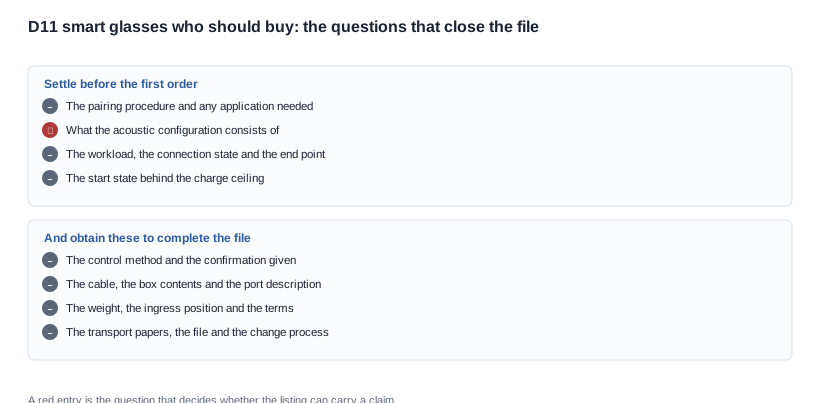

The order matters in one further respect that a buyer with a launch date will appreciate. The pairing procedure and the acoustic configuration both feed the setup material, the artwork and the support script, and the workload behind the rating feeds every quoted figure in the listing. All three therefore sit in front of the artwork release rather than behind it, because a carton or a product page that has to be reprinted after approval is the most expensive single mistake a packaging programme can make, and it is entirely avoidable by sequence.
The first two are the ones that change the shape of the project rather than its content, because they determine whether the programme is a buying exercise or an evidence exercise. The eighth and the ninth are the ones that turn a requirement into a cost, and the tenth is the one that protects the file once the programme is running.
Two suppliers answering the same ten questions produce two sets of replies, and the comparison between them is a filing decision rather than a preference. A reply can be filed against this model only if it names the model and the configuration it covers, is dated, cites a document rather than describing the product, and agrees with the reply to the question before it; anything short of that can be filed against the supplier, but not against the model. What a buyer ends up holding is therefore not the more persuasive answer but the one that can be attached to a shipment — the file that names the build it covers, the transport paperwork behind it, the artwork that travels with it, and the order the production run was released against. How to choose between two suppliers comes down to that: the criteria that decide it are the requirement the buyer brought with them, and the shortlist that survives is short because most replies fail on the same points. The use of this page is to tell that requirement what it can be asked, and to set out what a buyer should check before you commit to an order.
The model's close relative in this line is covered on its own page, and the comparison between the two is a question about rows rather than about this product: the model whose published rows match and whose page carries no feature note.
The ten questions are short enough to go out as a single message, and the answers are short enough to be filed against a model rather than against a range.
Send us the requirement you are buying against, the target markets, the volume bands and the copy you have drafted for the D11, and we will lay out which parts of it the published rows already answer, which parts are blank lines, and which parts cannot be answered from a catalogue at all — then put the ten questions above in the order that gets them answered first.


