
Smart glasses certification checklist work is decided by one question that has nothing to do with order size: are you the party that places the product on the market under your own name, or are you buying from a party that already does? The legal duty follows the duty holder, and the duty holder sets the size of the evidence file, the number of frameworks in play, and how often the file has to be reopened. Get that assignment right and the checklist either becomes two written requests or a quarter of a year of work, for reasons that have nothing to do with the quantity you are buying.
This article is for the buyer who is still deciding whether to commission that work. It replaces the usual "how much certification do I need" framing with a party-by-party assignment, because in this category the quantity of the order is close to irrelevant and the position in the chain is decisive.
Smart glasses certification checklist: the duty holder decides before the buyer does
The test: name the party that puts the unit on the market
Before any framework is discussed, write one line naming the party that places the finished unit on the market in your destination. Everything else follows from that line.
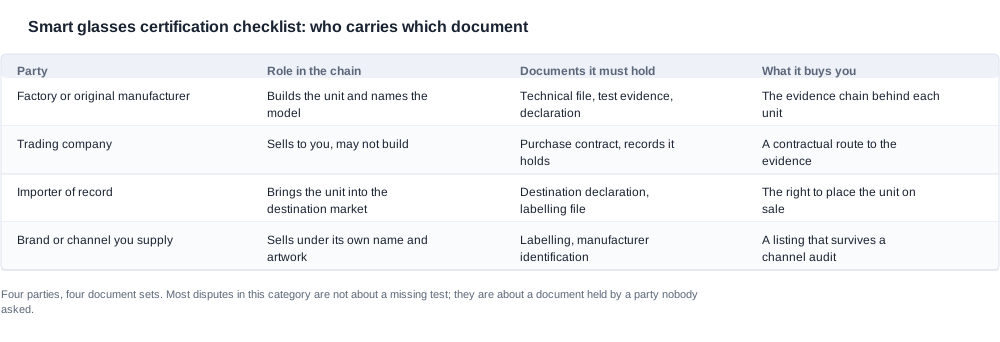
There are four positions, and a single programme can occupy more than one of them across different models or different destinations. A brand that imports into one country and supplies a retail chain in another may be a distributor in the first transaction and the manufacturer-facing party in the second, and the two roles carry different obligations.
- The party that builds and names the model. It holds the technical file and the test evidence, and it is the source of the declaration.
- The trading company between the builder and you. It may hold nothing except the contract and the records it received.
- The importer of record. It owns the destination declaration and the labelling file, and that document does not travel with the goods.
- The party selling under its own name. It owns the artwork, the claims and the consumer-facing instructions.
The checklist you build is the union of what those four parties must hold. A buyer who knows which of the four it is can skip the rest of this article; a buyer who cannot yet name all four is exactly the buyer for whom the checklist is worth building, because the document it produces is a map of who to ask.
Why the ranking of buyers is not a ranking of size
Two programmes can be identical in volume and completely different in conformity exposure. A large order for a single model into a single market through a distributor who already sells that model needs almost nothing: a verification that the distributor holds the evidence, and a copy of it for the file. A small order for the same model, sold under a new brand name into a market where the buyer is the importer of record, needs the labelling reviewed, the manufacturer identification settled, the responsible economic operator named, and every claim in the artwork traced to a document.
Volume changes what it costs to get one thing wrong; it does not change how many frameworks apply or how many model designations have to be justified. The buyer who plans three destinations and holds them for years has the largest running conformity exposure in this category, and is also the buyer most likely to have treated the work as a one-off task at the start of the programme, because the first market was easy.

What each party in the chain has to hold
The builder and the trading company are frequently different organisations
In this category the most common structural error is treating the organisation that signs the quotation as the organisation that builds the unit. They are often not the same, and the difference determines who can actually produce a technical file.
The way to settle it is a written question with three parts: who builds the goods, who holds the conformity evidence for the named model, and who signs the contract. A single organisation answering all three is a direct relationship and the simplest case. Two organisations answering means one of them controls the build schedule and the other controls the commercial relationship, and the buyer needs to know which. Three organisations means a trading company is in the middle, and every conformity request now has to be routed through it — which is exactly the situation in which a request becomes a promise rather than an answer.
The importer owns the destination declaration, and it does not transfer
The declaration that places the product on the market in a destination market belongs to the party established in that market, and it is signed by that party. It does not arrive in the carton, it is not covered by the supplier's quality records, and no supplier can issue one on the buyer's behalf.
In the European Union this includes the general product safety regime, Regulation (EU) 2023/988, applicable since 13 December 2024, which requires a responsible economic operator and manufacturer identification to be reachable from the product and from the paperwork. For a buyer placing goods on the market under its own name, that identification is a decision made before artwork goes to print, and a decision made afterwards is expensive.
For radio equipment, the directive number has to be right, because a mismatched number on a report is the single most common reason a conformity file fails a review. The correct reference for radio equipment is the Radio Equipment Directive (EU) 2014/53/EU. The electromagnetic compatibility directive is a different instrument, (EU) 2014/32/EU, and the harmonised EMC standards, such as the EN 301 489 series, are standards cited inside a conformity assessment rather than directives in their own right. A buyer who accepts a report without checking which instrument it cites has accepted a document that may not cover the product at all.
The brand and the channel own the labelling and the claims
The party selling under its own name owns the last and most visible layer: the artwork, the packaging, the listing and the claims. Two traps recur here.
The first is a claim outrunning the evidence. An ingress marking in this catalogue appears on two rows only, the V06 and the S7, and it describes resistance to water spray rather than immersion. A listing that generalises a marking published on two models across a range is making a claim the catalogue does not support, and the party that made it carries that exposure, not the factory.
The second is the model designation drifting between the report and the carton. Customised packaging, a changed bundle and a rebranded model number are the three most common causes. None of them changes the hardware, but each of them can change whether the report in the file describes the goods in the box — which is why the designation belongs on the purchase order as a controlled item.

What this catalogue publishes, and the one thing it does not
A company-level page is not a per-model certification row
The catalogue for this range covers 28 models and publishes a large amount of technical detail: cell capacity, charge time and run time for every model, a charging interface for 24 of the 28, a camera resolution class for the 11 camera models, and a charging-case capacity where one exists. Its front section carries a single company-level export-certification page presenting design-patent certificates. It carries no per-model certification row for any of the 28 models, and the text of the catalogue contains no CE, FCC or RoHS reference for any model.
That combination has a precise meaning, and it is the meaning a buyer should operate on. It does not mean the products are uncertified; it means the evidence is not published, so a conformity item is a request with an owner and a date rather than a line in a specification. A buyer who treats an absent row as a failed test has made a category error, and a buyer who treats an absent row as a passed test has made the opposite one.
The second category error is to read a company-level page as per-model coverage. A front-section page describing the company's export documentation cannot be pointed at a specific unit and reconciled against it. If the order includes the A05 or A06 children's models, the product rules that apply to children's products come on top of everything else, and a company-level page is not the answer to any of them.
How much of the range a technical file can be built from
The chart below shows how many models publish each row that a conformity file needs. The pattern is what matters: the technical rows are broadly published and the conformity rows are not published at all.
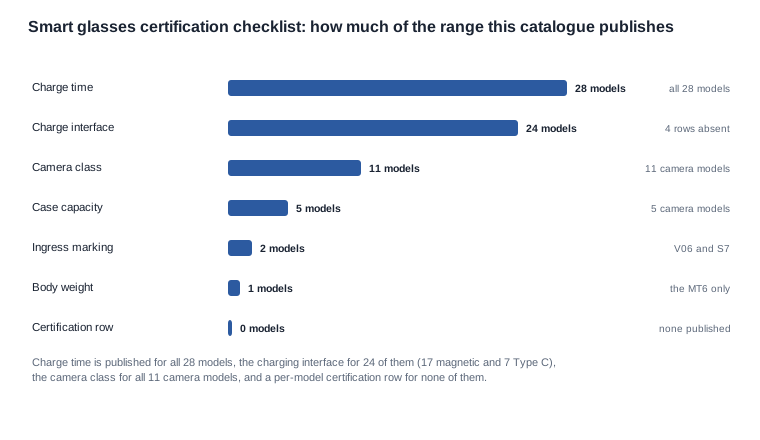
Three consequences follow for the checklist itself.
First, a technical file can be assembled from published rows for most of the range without contacting anyone. Model designation, cell capacity, run time, charge time and camera class are available; the camera resolution class splits into 8 MP for eight models and 13 MP for three — the S7 and the L1 Pro, and the L2 Utral.
Second, the rows a conformity file most needs are the ones the catalogue is silent on. The radio version is not published for the 11 camera models, so a file that needs the radio parameters has to ask for them. The ingress marking exists on two rows only. A body weight exists for one model only, the MT6 at 158 g for the glasses body including the 265 mAh cell and the camera and excluding the folding charging case, whose own weight is not published. Every other model in the range has no published weight.
Third, the rows that are absent are absent in a documented way, which is what makes a written request reasonable rather than rude. A buyer who asks for the interface on a model whose row is absent has asked for something the supplier also cannot read off the catalogue.

Working the conformity request as a dated sequence
Six steps, each with a completion test
A conformity request is a sequence, not a wish list. Each step below has a completion test that can be checked by someone who was not in the conversation.
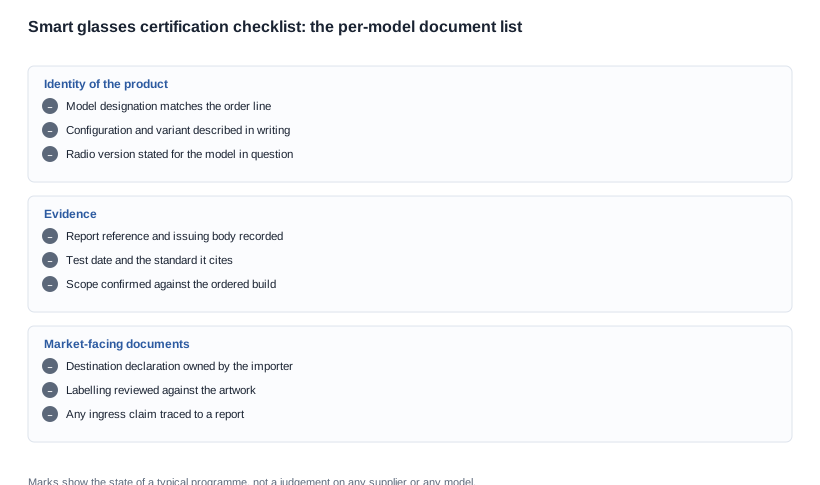
- Name the model and the configuration on one line. Completion test: the line exists as a single string that can be copied into a purchase order, an artwork request and a test request without editing.
- Identify the manufacturer, the trading company and the importer by name. Completion test: three names, each with a role, each attached to a document the party can actually produce.
- Request a reference rather than a document. Ask for a report number or designation, the issuing body and the test date. Completion test: a reply that contains all three, or an explicit statement that one of them does not exist.
- Check that the reference covers the ordered build. Completion test: the model designation on the report matches the designation on the purchase order, character by character, including the suffix.
- Compare the report model with the carton. Completion test: the artwork and the bundle are checked against the designation, and the result is recorded.
- File the evidence against the purchase order and freeze it. Completion test: the file is retrievable by order number without asking anyone.
The questions worth asking, and the answers to distrust
Five questions consistently separate a supplier who can produce a file from one who cannot, and they are worth asking in writing because the answers are quotable later.
- "For the model designation named above, which test reports cover this configuration, and what are their references and dates?" A supplier who answers with a general portfolio answer has not answered.
- "Which directive or regulation does each cited report assess, and does the report cite a harmonised standard within it?" A wrong instrument number is a signal, and it is fixable at this stage and expensive later.
- "Who is the economic operator responsible in the destination market, and who signs the declaration?" The answer may not be the supplier, and finding that out early is the point.
- "Does the report cover the configuration as packed, including any custom bundle?" Custom bundles are where coverage quietly ends.
- "What changes in the file if the cell or the radio module is substituted?" A supplier who cannot answer this has no change control, and a buyer who does not ask has no remedy.
Three answer types should be distrusted. A document with no reference and no date is a marketing asset. A report that names a sibling model rather than the ordered designation does not cover the goods. And a reply that asserts compliance without naming an instrument is an assertion, not evidence — regardless of how confidently it is phrased.
When the file has to be reopened
A conformity file is not a one-off artefact, and the buyers who get this wrong are the ones who treated a single market as the whole plan. Four events reopen it, and each one is cheap to detect and expensive to discover late.
- A component substitution. A cell, a radio module or a supplier of either changes. This is the event with the longest tail, because it is often not announced; it is a purchasing decision taken upstream of the buyer. The control is a written change notification on the purchase order, which is a clause and not a procedure.
- A new designation. Adding a suffix, a colourway or a bundle that carries the model name changes the identity of the unit on the carton. If the designation is controlled on the order, the file reopens automatically; if it is not, nothing happens until a reviewer notices the mismatch.
- A new destination. A framework that applies in one market does not apply in another. Adding a destination reopens the labelling and the declaration even when nothing about the hardware has moved.
- A renewal. Evidence has an age. A file assembled three years ago and never refreshed is a file with an unknown status, and nobody can tell from the outside when it stopped being valid.
The general rule is short: a file is reopened by a change to the product, the packaging, the destination or the evidence. A change in the order quantity is not on that list, which is one of the reasons the volume of an order has so little bearing on the size of the conformity task.

A reasoning case: one brand, two markets, two document sets
The following is a reasoning exercise, not a client project. No customer is named and no figures are claimed; the model, the quantity and the markets are assumed so that the reasoning can be followed.
A brand-side buyer has a single camera model in the 8 MP class and two destinations. Into the first destination it buys through an established distributor who already places that model on the market and already holds the file. Into the second destination it imports directly and sells under its own brand name with its own artwork. The same factory builds both orders.
The duty assignment splits the programme in two, and it does so before any framework is discussed.
For the first destination the brand is not the party placing the product on the market. Its obligation is verification, not production: it asks the distributor to confirm, in writing, that the evidence for the named model exists, that it is current, and that the designation in the file is the designation on the order. It asks for a copy for its own file. It asks no further questions about the declaration, because the declaration is not its document. The cost of this half of the programme is one request and one filing.
For the second destination the brand is the importer and the party selling under its own name, and the work expands accordingly. The manufacturer identification and the responsible economic operator have to be settled before artwork goes to print. The declaration has to be produced by the brand's own entity in the destination market. The labelling has to be reviewed against the artwork, with the ingress claim handled carefully because the marking is published on two models only. The radio parameters have to be requested, because the catalogue publishes no Bluetooth version for any of the 11 camera models. If the order includes a bundle, the designation on the carton has to be reconciled against the designation on the report before production, not after.
The interesting part of the case is that the two halves use the same factory and the same model, so the specification and sample work is shared, while the conformity work is not shared at all. That is the practical argument for the duty-holder test: it prevents a buyer from either over-building a file for a transaction where the duty is elsewhere, or under-building one for a transaction where the duty is theirs.
Two further checks are worth making at this point, and they are the same checks a buyer would make under either half of the programme. The first is whether the charging interface for the model is published; on four camera models in this catalogue — the L1 Pro and the CY03, and the CY05 and the MT6 — it is not, although all four do publish a charging-case capacity, so the question is a request with a date rather than a lookup. The second is the charge time, which is published for all 28 models: 26 as a ceiling of two hours or less, and the D17 and the ZH12 as about one hour. A ceiling of two hours or less is an upper bound and cannot be restated as "under two hours" and then compared with the faster pair as though the pair exceeded two hours.
The cost article, how to calculate smart glasses certification checklist, sets out the five inputs that determine the budget for the half of the programme that is the buyer's own. Hidden costs covers the rework that follows a failed test, and certification myths lists the assumptions buyers make without asking.
Where our own answer stops
It is worth being precise: the conformity position of every model in this range has to be established against the specific configuration and the specific destination, and the catalogue cannot be the source for it. The catalogue has no per-model certification row and contains no CE, FCC or RoHS reference for any model; it does publish the technical rows that a technical file is built from, and it does publish the gaps — the interface absent on four camera models, the radio version absent for all of them, the ingress marking present on two rows, the body weight present on one.
What we can do is tell you which rows exist for a named model, which are absent, and what to request to close each one. What we cannot do is issue a certificate number, an issuing body or a validity date for a model, because those are not in our published material, and we would rather state that than quote a figure you cannot reconcile against a unit.
One decision this article does not make for you is how a claim is worded. That belongs to the party that owns the listing and the packaging, not to the factory, and a descriptor that outruns the test report is a decision made downstream of everything described here.
For the framework itself, see the certification checklist. If you tell us the models, the destinations and the channels you are working with, we will tell you which of the four parties you are, and which parts of the file are yours to build.


