

The number that surprises buyers in this category is rarely the testing fee. It is that testing attaches to a model designation in a market, while the commercial plan attaches to a product line in a channel. A brand with three camera variants and two destination markets does not have one certification cost. It has up to six, and the second one is usually not in the budget.
The calculation is straightforward once it is decomposed into the three things that multiply. The first multiplier is the number of model designations the programme places on the market, including colourways, case variants and firmware configurations. The second is the number of frameworks each designation falls under in its destination market. The third is the documentation that travels with the goods rather than with the product, which scales with the cell configuration rather than with the order. Multiply the three, and you have a number you can plan against, divide it by the production runs you expect, and you have a per-unit cost that can go into a business case.
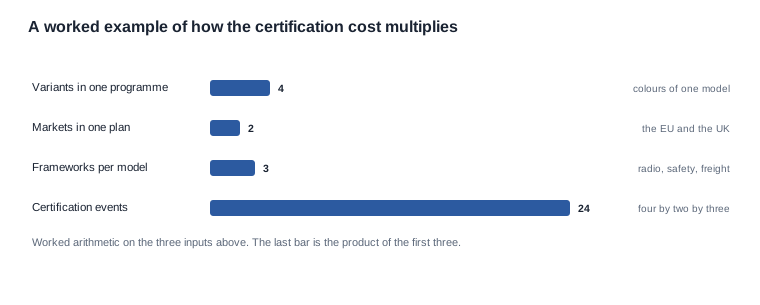
The worked example in the chart is deliberately simple: four colourways of one model, two destination markets, and three frameworks per radio model gives twenty-four certification events. A buyer who planned for one has a twenty-three event surprise. A buyer who plans the multiplication before the first sample has a number that can be defended in a budget review.
What follows is the method: which frameworks apply, how to build the budget, what evidence to collect so the cost is not being paid twice, and the part of the cost that is genuinely fixed.
Smart glasses certification checklist: one plan becomes six
The reason a single plan becomes several is that the unit of certification is the model designation, and a model designation is a much more specific thing than a product idea. Changing the charging interface, the cell configuration, the case, the radio module, the antenna or a firmware function can each require a new technical file or an amended one, depending on what changed and on how the change is documented. Changing the colourway usually does not. The problem is that a buyer does not know in advance which of their changes fall on which side of that line, so the safe assumption is that each configuration needs its own position.
The second multiplier is markets, and this is where a lot of the confusion comes from. Selling into the European Union and the United Kingdom is not one framework with two labels. The European Union route for radio equipment runs through the Radio Equipment Directive (EU) 2014/53/EU. The General Product Safety Regulation (EU) 2023/988 has applied since 13 December 2024 and adds traceability and the responsible economic operator on top of whatever the sector rules require, and it changes what has to be printed on the box. The United Kingdom has its own conformity route with UKCA marking and its own technical requirements, and it is a separate submission rather than a second sticker on the same approval. In the United States, FCC equipment authorisation is a separate route again, with its own applicant and its own technical content. North American buyers should also note that a battery-powered product carries transport documentation for the cell, which exists for shipping rather than for sale but is priced into the programme and has to be renewed against the cell actually fitted.
The third multiplier is the one buyers forget: the radio element. A product with Bluetooth, a camera or a connected application function is radio equipment under the European Union regime, and a wired product is not. A configuration that can be built without a radio function has a materially simpler and cheaper compliance position. That is a question worth asking before the feature set is frozen rather than after, because it is the one multiplier that can be designed out rather than paid for.

The frameworks a radio-equipped programme has to clear, and what each one multiplies
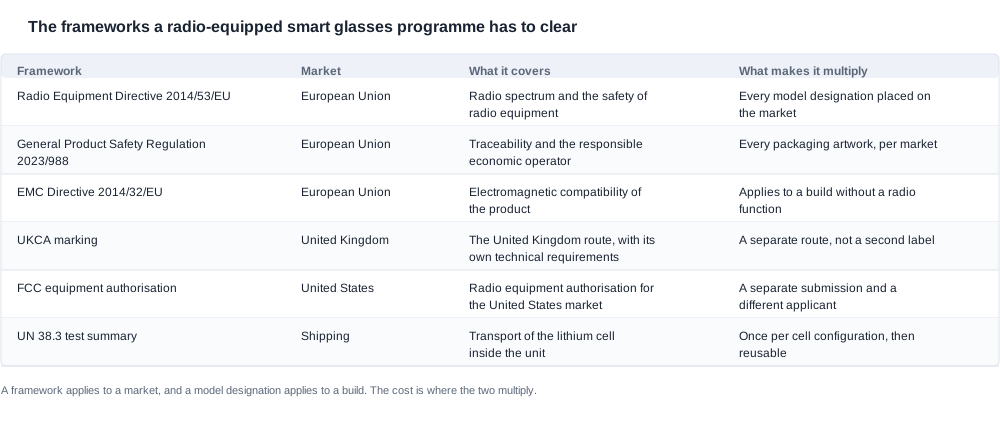
Each framework in that table multiplies a different thing, and the multiplication is what determines whether the framework is worth the cost it is being asked to bear.
The Radio Equipment Directive (EU) 2014/53/EU multiplies by model designation. Its scope covers the radio spectrum and the safety of radio equipment, and the technical file has to describe the radio, the essential requirements and how they are met. Every model designation you place on the market needs a position against it, and the question of whether two designations can share a file is a technical question that has to be answered in writing rather than assumed. This is the framework most often underestimated, because it is the one that reads as a single approval for a family.
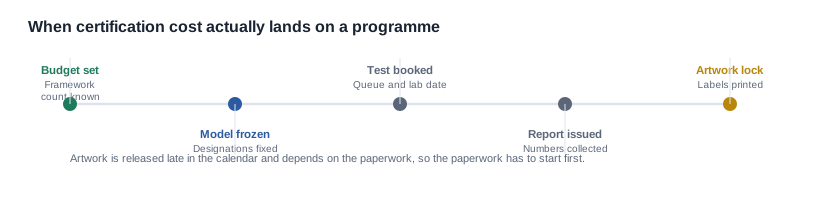
The General Product Safety Regulation (EU) 2023/988 multiplies by market and by packaging. Its requirements around traceability, the identification of a responsible economic operator and the information supplied with the product sit in the packaging artwork and the accompanying documents rather than in the electronics. That makes it a different kind of cost — artwork and documentation labour — and it is the one that arrives late, because it is usually raised after the artwork is nearly finished.
The EMC Directive (EU) 2014/32/EU multiplies by build. It is a different instrument from the radio directive and covers electromagnetic compatibility; the EN 301 489 series is a family of harmonised standards cited under the EMC regime, and a directive number and a standard number are not interchangeable in a technical file. For a product that has a radio, the radio route covers the radio; for a build without one, the EMC regime is the relevant route on its own, and the compliance position is genuinely simpler.
UKCA marking in the United Kingdom multiplies by market and by product. It is not a label applied to an existing European Union approval, and the technical requirements are its own. A buyer who plans the United Kingdom as a second label on an existing approval discovers at the submission stage that it is a second submission, with its own cost and its own lead time.
FCC equipment authorisation in the United States multiplies by market and by applicant. The United States route is separate from both European routes, and it has its own technical content and its own applicant questions, which matter when a private-label programme is involved and the applicant is not the manufacturer.
Battery transport documentation multiplies by cell configuration, not by model. A UN 38.3 test summary and the associated packaging and marking requirements follow the cell that is actually fitted, and they are reusable across the models that use it. They are also the documentation most likely to be quoted as a one-off and then re-bought, because a programme that changes the cell without realising the summary has changed will pay for it again.
A buyer who wants to evaluate which of these is worth its cost should ask how to verify a supplier's answer rather than how to reduce it, because the questions to ask a supplier are in certification verification checklist and the variables that move the number are in what affects it to know about smart glasses certification checklist smar.
Building the certification budget as a calculation rather than an estimate
The method is five steps, and each of them produces a number rather than a feeling. The order matters, because the first three are inputs and the last two are arithmetic.
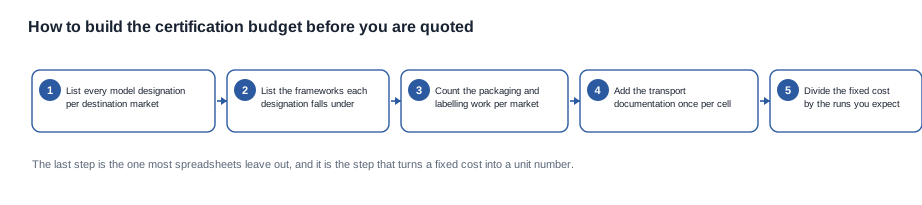
Count the model designations per market. Write down every designation you intend to place on the market, in every market, including the colourways, the case variants and the private-label configurations. Be conservative here: a designation you might launch in twelve months is a designation you will eventually need, and the difference between a plan that assumes one and a plan that assumes four is the difference between a budget and a surprise. In our own range, twenty-eight models produce a much larger number of designations than twenty-eight, because several models publish more than one configuration: the L2 Utral names either a 900 mAh or a 1400 mAh case, and the V03 Pro and the V06 publish multiple colour options.
Count the frameworks each designation falls under in that market. This is where the radio question earns its place. A camera model with Bluetooth, a case, a logo and three colours is one designation and, in the European Union, at least the radio route and the safety regulation, with the transport documentation counted separately because it follows the cell. Write the frameworks against the designation rather than against the product family, because a family-level entry is what produces an unpriced second and third event.
Count the transport documentation once per cell configuration. Not once per order, and not once per model. If several designations share a cell, the summary is shared. The one-off work is the packaging and marking arrangement, and both are reusable, which makes this the most over-counted line in most budgets and the most annoying one to unpick later if it was counted per model.
Count the labelling and packaging work separately. Traceability requirements changed what has to appear on the box, and packaging artwork is a one-off per market rather than a per-order cost. It is also the line that is easiest to forget entirely, because it belongs to a different team from the one that owns the electronics, and the two teams have different schedules.
Divide by the number of production runs you expect in the programme. This is the step most spreadsheets omit and the one that turns a frightening fixed cost into a per-unit number a buyer can plan against. The division is not exact, because a re-run may need a re-submission if the technical content changed, and that is precisely why the plan needs the number of runs in it.
The result is a budget that can be defended line by line, and a schedule that has a named owner for each approval route instead of one owner for all of them.
A worked example makes the method concrete. Assume a brand is planning a European channel launch with one camera model in three colourways, one audio model, and a second camera model in two colourways, shipping into the European Union and the United Kingdom in the first year and the United States in the second. The designations are therefore five in the European Union and five in the United Kingdom, and the same five in the United States, which is fifteen designations in total. The frameworks are the radio route and the safety regulation in the European Union, the United Kingdom route in the United Kingdom, and the radio route in the United States, with the transport documentation counted once because the three colourways of the first camera model share a cell. The budget that falls out is therefore fifteen product approval events plus one transport summary plus two packaging artwork sets, not the single approval the original plan assumed. The commercial consequence is that the colourway count, not the model count, is the largest single driver of the number, which is exactly the variable a buyer can reduce before the first test rather than after it. Working the arithmetic before the quotation is what turns this from a budget dispute into a plan.

Collecting evidence you can check later rather than claims you cannot
A large part of what buyers call certification cost is actually cost paid twice, and the way to avoid paying twice is to make the evidence checkable. A certificate number is a fact. A PDF attachment is a claim. The difference matters because a claim has to be trusted and a fact has to be verified, and a buyer who can verify does not need to re-buy.
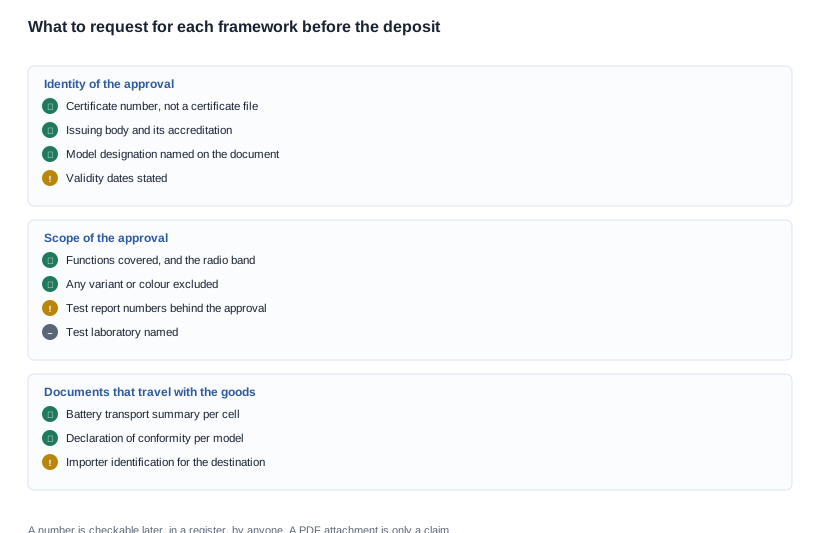
Three items carry most of the value. The identifier, the issuing body and the validity dates, in the body of an email, before the first sample ships. The model designation named on the document, so that it can be compared character by character with the designation on the purchase order. And the scope — which functions, which radio band, and which variants are covered — because a document that covers a platform does not necessarily cover a private-label configuration of that platform.
The test to apply to anything in the file is simple. Can a broker, a marketplace, a customs agent or your own compliance team check it later without asking the supplier? If yes, it is evidence. If it can only be checked by asking the supplier again, it is a claim, and it should be treated as a claim in the budget and in the risk assessment.
Both of these belong before the deposit rather than after the first shipment. First, ask for the identifiers before the deposit rather than after the first shipment, because the moment a shipment is held is the worst possible moment to discover that the paperwork names a different model. Second, keep the identifiers in a structured file rather than in an inbox, because the second and third orders will need them and the first order is not the only time the question will be asked.
The documents that travel with the goods are a separate category and are treated separately in the budget. The battery transport summary for the fitted cell, the declaration of conformity for each model designation, and the importer identification for the destination market. These are the documents a customs agent or a carrier will ask for, and they are the ones a buyer most often has to reconstruct at the moment of shipping.

Where certification cost actually sits, and which part of it is negotiable
Certification cost has a structure, and the structure determines what can be moved. It is not one number and it does not behave like one.
Fixed and non-negotiable. The testing itself and the laboratory queue are fixed per product family, and pressing on either produces a longer schedule rather than a shorter one. A re-submission after a technical change is a new cost, because the work has to be redone. The approval route for a new market is a new cost. And the time each of these takes is a fact about a third party, not about your supplier's willingness to work faster.
Variable and worth negotiating. The number of model designations placed on the market is the single largest variable, and it is entirely within the buyer's control: fewer designations means fewer events, and consolidating colourways into one orderable configuration with a colour change at fulfilment is a real saving. Whether two designations can share a technical file is a question worth asking early, because the answer changes the count. The reuse of transport documentation across configurations is a saving. The artwork round count is a saving. And the market list is a negotiation as much as a decision, because a channel served from markets where approvals already exist is worth a better commercial position than one that requires new testing.
The part that is usually mispriced. The cost of a design change after approval. It is not in the original budget because it is not in the original plan, and it is the line that turns a certification budget into a certification overrun. A buyer who freezes the configuration before the first test, writes a notice obligation into the order, and agrees a re-validation cost per change has moved that line from an unknown to a known.
The commercial clauses that follow from this are few. The exact model designations covered, written into the order. A notice obligation before any change to the radio, the cell, the charging interface, the antenna or the firmware, because each of those invalidates a position. A requirement that the documentation pack be reissued against the designation the units are shipped under. A requirement for the identifiers and their validity dates to be supplied in writing before the shipment. And a warranty written against a documented failure criterion rather than against a number of months.
What we publish about conformity, and what we will not estimate
Concretely, we publish the rows we hold, and where the record is a gap we say so rather than fill it with a plausible reference.
What our documentation does state is the configuration of every model in the range: the pixel tier for the camera models, the charge time, the rated runtime, the cell capacity, the charging method, the charging case configuration where one is named, the Bluetooth version where the row carries one, and the colour options where they are published. Those are the rows a technical file is built from, and they are the rows a buyer can use to decide whether two designations can share a file.
What we do not publish is the certification cost, the testing fee, the laboratory charge, the certificate numbers, the issuing bodies, the test report numbers and the validity dates. The export certification page in our product documentation is images rather than text, the document names no CE, FCC or RoHS, and there is no per-model certification row anywhere in it, and we will not print a reference that cannot be checked in a register by a third party. We also do not publish a cost, because a cost quoted without the configuration it applies to is a number that is wrong for most orders.
We will answer the questions that determine the calculation. Tell us the designations you intend to ship, the markets you intend to ship them into, and the cell configurations, and we will tell you which frameworks each designation falls under, which of our models differ in ways that are likely to matter to a technical file, and which items we hold evidence for. We will not tell you a number we cannot evidence.
The certification verification checklist covers what to request for each framework, the factory-side document trail is in factory audit documents to request, and the shipping documentation that travels with the goods is under battery transport.
Related reading
- What changes certification cost — the variables above in detail
- Factory audit documents to request — the paper trail
- Battery transport — the documentation that ships with the goods
- certification verification checklist — what to request for each framework
Send the model designations, the markets and the cell configurations, and we will tell you which frameworks apply and what the calculation has to carry.


