
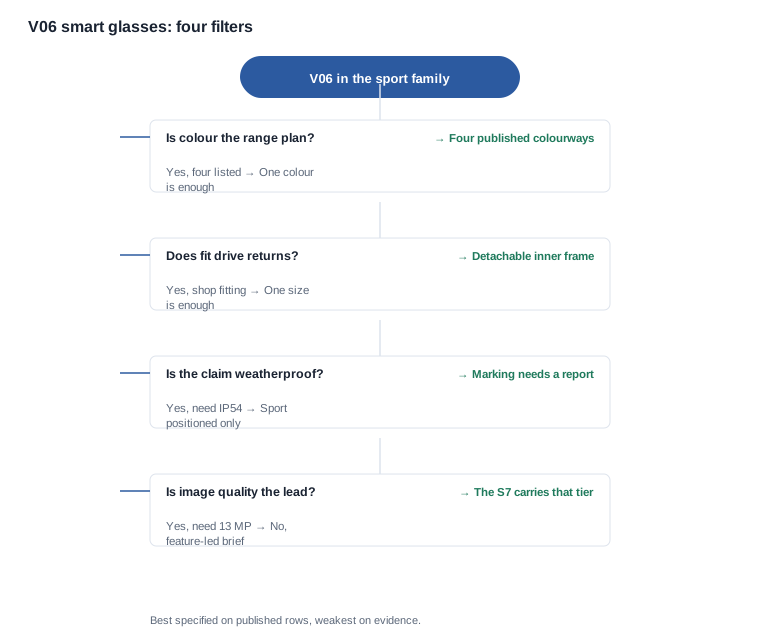
You need the V06 if your channel sells first-person recording, if colour choice is part of your range, or if a removable inner frame matters for the return rate. You need something else if your proposition leads on resolution, because the V06 is an 8 MP model. And you need to resolve the durability question before you make any weather claim, because the IP54 marking it carries has no published test report behind it.
V06 smart glasses are the best-specified camera model in this catalogue on published rows, and that is exactly why the durability gap is the one that decides the project. A buyer with a colour-and-sizing-led proposition can position this model easily. A buyer whose proposition includes rain tolerance has evidence to obtain, and the schedule for that evidence sits ahead of the first order. This page is written for the person deciding whether the model belongs in the range at all.
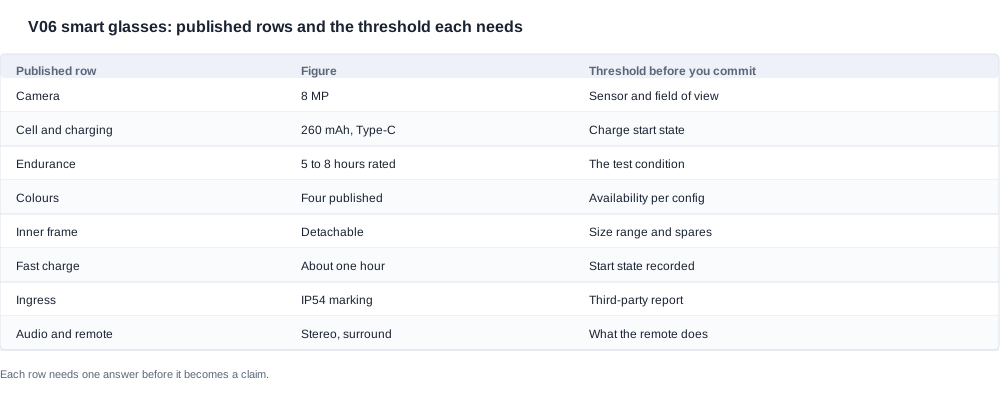
V06 smart glasses and the six published rows that carry a proposition
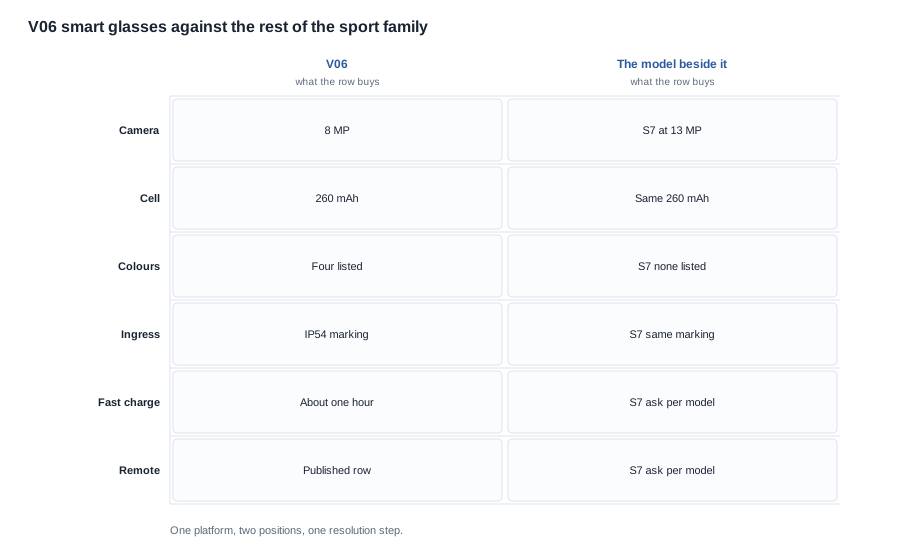
An 8 MP camera at the bottom of the camera tier. A mainstream content product at this resolution, with the S7 in the same platform at 13 MP. The gap between the two is one resolution step and nothing else, which is what makes them a natural pair with a price ladder between them.
A 260 mAh cell with magnetic charging and a rated endurance range of 5 to 8 hours. The all-day content proposition, on a cell shared with the higher model. The range is a range rather than a point figure, which is a better disclosure and also an admission that no test condition is published.
Four published colourways: orange, ice blue white, black and black ice blue. Enough to build a retail range without new tooling, and for a channel buyer a colour ladder is often worth more than a resolution step. The threshold is availability: which colours exist in which configuration, and what a new colour costs.
A detachable inner frame. This is the row that gets overlooked and should not be. On a sport product taken through movement, the ability to adjust or swap the inner frame reduces returns more reliably than almost any other single feature. The threshold is the size range and the spares route, because a sizing promise that cannot be serviced becomes a refund.
A Type-C fast charge at roughly one hour. Meaningfully better for a user who takes the product out twice a day, and unusual in the camera family. The threshold is the charge-time starting point, and the fact that Type-C is published for this model specifically rather than for a platform.
Stereo and surround sound, plus a remote shutter control. A feature row that is more defensible here than on an audio-only frame, because this model does have a camera. The threshold is what the remote actually triggers and how — a device button, an application, or a separate accessory — and that answer is not published.
How to evaluate this model against the one beside it
The comparison that matters is with the S7, not with the audio frames. The two camera models share a platform, a cell, an endurance behaviour and a protection marking, so the decision between them is a merchandising decision rather than a sourcing decision. What separates them is the resolution tier, and the question a brand has to answer is whether the resolution tier reaches its copy.
A buyer selling picture quality should take the 13 MP model and close the camera specification. At 8 MP with no sensor model and no field of view published, this model cannot support a quality-led claim, and a competitor's lower-resolution product can be shown to be better in low light. That demonstration costs a competitor nothing and costs a brand its listing.
A buyer selling colour, sizing and recording should take this model and close the mechanical rows. Four published colourways, a detachable inner frame and an audio row with a camera behind it is a fuller product page than the higher model currently supports, because the higher model publishes neither a colour list nor a documented fast charge.
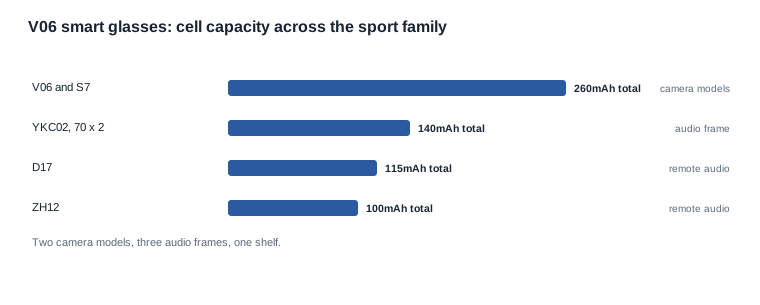
The audio frames are a different brief entirely. The D17 and the ZH12 are remote-and-fast-charge sport models on smaller cells, and the YKC02 is the endurance frame on a 70 mAh × 2 arrangement. None of them captures. If the brief is capture, they are not candidates; if the brief is long sessions without a camera, this model is not the answer either.
A buyer who needs all of it at once should be told no. There is no model in this catalogue that publishes a 13 MP camera, four colours, a fast charge, a remote and a weather rating together. A brief that assumes otherwise usually turns into a range plan with three SKUs rather than one, and that is a legitimate plan — it is just not a single-product plan.
And a brief that is decided by the specification table rather than by the customer. This is the most common way a model gets chosen badly, and it is worth naming because it is not obvious from inside the process. When the shortlist is built by sorting a catalogue by megapixels, the result is a model selected on the one row that carries no marketing value. Sort instead by the claims that appear on a shelf, and the same shortlist usually produces a different winner — this model wins on colour and adjustment, the higher model wins on resolution, and the audio frames win on nothing that a camera buyer is shopping for. A shortlist sorted by the specification table is a shortlist sorted by the least useful column.
The one gap that constrains everything else
The IP54 marking carries no third-party test report number. That is a marking, not evidence, and it is the constraint on this model's proposition. If your channel plans to claim sweat resistance, rain tolerance or outdoor durability, you need the report: the standard, the laboratory, and the sample batch the report covers. Without it, describe the product as sport-positioned rather than weatherproof.
What an IP54 second digit actually covers. Protection against splashing water — not immersion, and not full rain exposure. That distinction is covered in IP ratings and durability, and it is worth reading before a buyer assumes the marking means what they hope it means. It is also worth noting that a marking on a catalogue row is frequently a family-level entry that a model inherits rather than a result that was produced for that model.
What else is not published, and whether it matters here. Sensor model and field of view are unpublished, so no image quality claim is available beyond the resolution tier. No video resolution or frame rate is stated, so continuous recording at a stated quality should not be listed. Frame weight is not published. Certificate numbers are not published. For a colour-and-sizing-led channel proposition that set is tolerable. For a channel selling picture quality, it is not — and the higher model in the same platform exists for that brief.
Why one gap out of many is the one that decides. The other open rows are closed by a supplier answering a question, and the answer arrives in a week. A test report has to be produced, and production is a lead-time item with a laboratory and a batch behind it. Schedule risk is the reason this gap matters more than the number of open rows suggests, and it is why the question should be asked in the first written request rather than the fourth.

Six ways this model gets chosen or listed wrongly
The weather claim was published. Symptom: a customer returns the product after rain and the marking was the promise. Root cause: a catalogue marking treated as a tested rating. Prevention: obtain the report, or describe the product as sport-positioned and stop there.
The colour list was used to promise availability. Symptom: a colour in the listing cannot be ordered. Root cause: the published list assumed to apply to every configuration. Prevention: ask which colours exist in which configuration, and price a new one before it appears in any plan.
The 8 MP was sold as a picture quality claim. Symptom: a competitor's product is shown to be better indoors. Root cause: a parameter treated as an output. Prevention: hold samples and shoot the same scene at the same light level as the higher model.
The sizing promise was made without a spares route. Symptom: a customer cannot obtain a replacement inner frame and the channel absorbs the cost. Root cause: user-replaceable versus factory-only never established. Prevention: ask the question and price the answer before the listing promises the feature.
The endurance range was collapsed to a point figure. Symptom: a customer expects eight hours and gets five. Root cause: a range simplified for the sake of the copy. Prevention: publish the range with its condition attached, or do not publish a figure at all.
The remote was featured without knowing what it triggers. Symptom: a listing promises a shutter the product does not deliver in the way described. Root cause: a platform feature assumed to apply. Prevention: get the written answer before the copy is written, not after the first enquiry.
Verification steps and the criteria a shortlist should be scored against
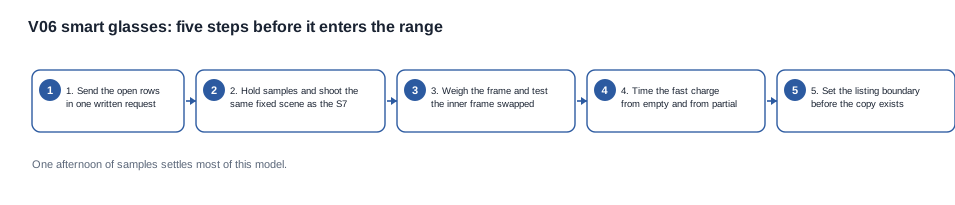
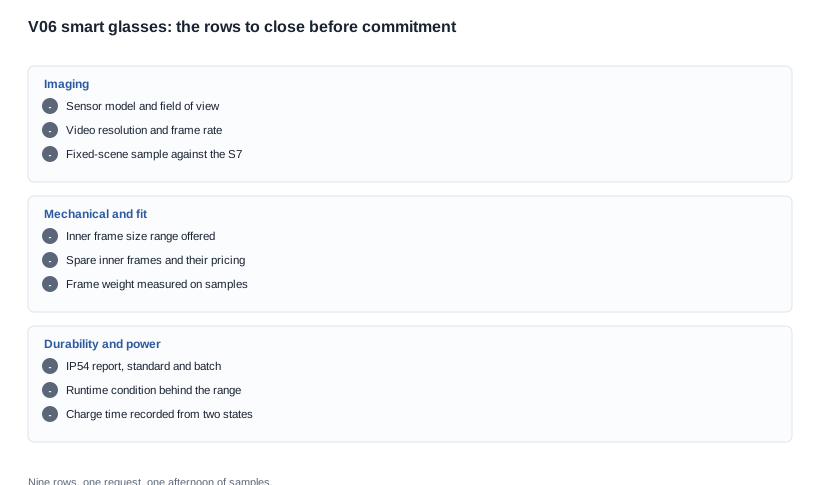
Send the open rows in one request and score the answers, not the promises. Sensor model and field of view. The ingress evidence. The inner frame size range and the spares route. The endurance test condition. The frame weight. The colour availability per configuration. What the remote triggers. And the certification position per market. Nine rows, one request, and a shortlist scored on which of the nine came back answered.
Hold a sample and shoot the same scene in the same light as the higher model. This is the only test that converts the resolution tier into an argument rather than an assumption. Record the light level and the delivery resolution, because a result without conditions cannot be repeated by the next person.
Weigh the frame and test the adjustment with the inner frame swapped. Both are closeable in an afternoon and both decide the return rate more directly than any specification on the row.
Time the fast charge twice, from empty and from a partial state. Record the starting point each time. A fast-charge claim that a customer measures at twenty minutes when the specification said sixty is a support contact, and a fast-charge claim that a customer measures at ninety when the specification said sixty is a returns process.
Set the listing boundary before the copy exists. Published rows you may print: the resolution as a resolution, the cell capacity, the charging method, the endurance range as a range, the colour list, the detachable inner frame, the surround sound row and the IP54 marking as a marking. Open rows you may not: the sensor, the field of view, the video specification, the weight, the ingress evidence and the runtime condition.
Run the sample inspection as an inspection, not as a demonstration. The sample order is the cheapest quality control instrument a buyer has, and it is wasted if it is used to decide whether the product is impressive. Decide in advance what the sample is being asked to prove: the camera tier against the higher model, the adjustment mechanism across several head sizes, the charge time from two starting states, and the declared weight against a calibrated scale. Record each result with the conditions attached, in the form your quality control team will use at goods-in inspection, so the same measurement can be repeated on a production tranche rather than only on the sample.
And put the same criteria into the factory audit, if one is happening. A factory audit on this model should check whether the ingress test procedure that produced the marking exists in the production file, whether the inner frame sizes on the packing line match the size range you were quoted, and whether the charge timing method is documented anywhere a line supervisor could follow it. Those three checks are the difference between a marking that describes the product and a marking that describes a sample. A supplier whose technical file cannot answer them is telling you something important about the depth of the documentation behind every other published row on the page.
Terms, and the position we take
What this model's position is worth commercially. The colour list and the sizing system are what a reseller can actually sell, and the camera tier is what a brand can build a ladder on. Because the V06 and the higher model share a platform, a cell, an endurance behaviour and a protection marking, the merchandising structure does not have to be rebuilt from the ground up for the higher model — which is the actual financial argument for putting both on the shelf.
Open to negotiation, and worth the time. Unit price and volume tiers across a bulk order; the accessory set with its minimum order quantities; the spare inner frames and their pricing, which is the line that decides whether the sizing feature can be executed; packaging specification per colour, which is four specification lines rather than one; delivery splitting; payment terms with nodes against inspection rather than against shipment; the warranty period with a stated response time; return terms; and the terms of a pilot order.
Quotable in the sense that the number exists but will not move. The cost of a certification and the time it takes are dictated by the schedule and by whoever runs the test. Tooling is frequently amortised across a first order while certification cost is per product family — ask which one you are being quoted, because the two are frequently bundled into a single line that hides which is which. Certification cost is not negotiable; the schedule around it often is, and on this model the schedule also contains the ingress test.
Clauses that belong in the agreement. The published rows for the configuration and colour ordered; the sensor and video specification; the ingress evidence or the explicit position that none exists; the inner frame size range and the spares route with their minimum order quantity; the endurance condition; the frame weight as measured; and the warranty period with a stated response.
Clauses that belong nowhere. Any weather claim without a report. Any image quality claim not checked on a fixed-scene sample. Any weight not measured. Any single-figure runtime drawn from a range. And any minimum order quantity stated per total units rather than per colour, which is the quiet way a four-colour range turns into an inventory problem nobody modelled.
The due diligence that matters before signing. Four checks, in the order they should happen. First, a technical file review: certificate numbers with their issuing bodies and validity periods, and a covered model schedule that names this model rather than the platform. Second, a factory audit with a written checklist agreed in advance, covering the charge timing method, the inner frame packing line and the inspection records. Third, a pre-shipment inspection against pass lines written before production rather than after it. Fourth, payment terms with nodes tied to that inspection rather than to shipment. A contract without pre-shipment inspection pass lines is a contract where the buyer absorbs the discovery risk, and on a model with a detachable inner frame and four colours, the discovery risk is mostly about variant mismatch rather than about workmanship.
The trade-off worth naming explicitly. Every one of these checks costs time and usually money, and the model is not expensive enough to justify all of them at a low order volume. The right response is to scale the diligence to the volume rather than to skip it: at a small first order, the sample and a written boundary carry most of the value; at a volume where the range is being built, the audit and the pre-shipment inspection are what stop a variant mismatch from reaching a warehouse. What should not scale is the listing boundary — that is free, and it is the difference between a defensible product page and a support queue.
Where we stand. Our position is that the V06 is the best-specified camera model in this catalogue on published rows, and that its one real constraint is a durability claim it cannot yet support. We will print the IP54 marking as a catalogue marking and not as a tested rating, we will not present 8 MP as a picture quality claim, and we will not estimate a weight. A channel that sells colour, sizing and recording will find it easy to position; a channel that sells weather resistance needs evidence we do not currently hold, and we would rather say so than let a buyer find out in a returns file.
Tell us your market, your channel and whether durability is part of your proposition, and we will tell you whether this model fits and what you would need from us to carry more. The sport range this model belongs to is on the sport smart glasses page, choosing a model by market rather than by specification is covered in selecting smart glasses by market, and the V06 specifications and features page is the honest baseline to send a supplier alongside your request.
Related reading
- The sport range this model belongs to — sport smart glasses
- What an IP marking actually establishes — IP ratings and durability
- Choosing a model by market rather than by spec — selecting smart glasses by market
Pass on the target market, the quantity and the required configuration, and we will report what is available and what is not.


