
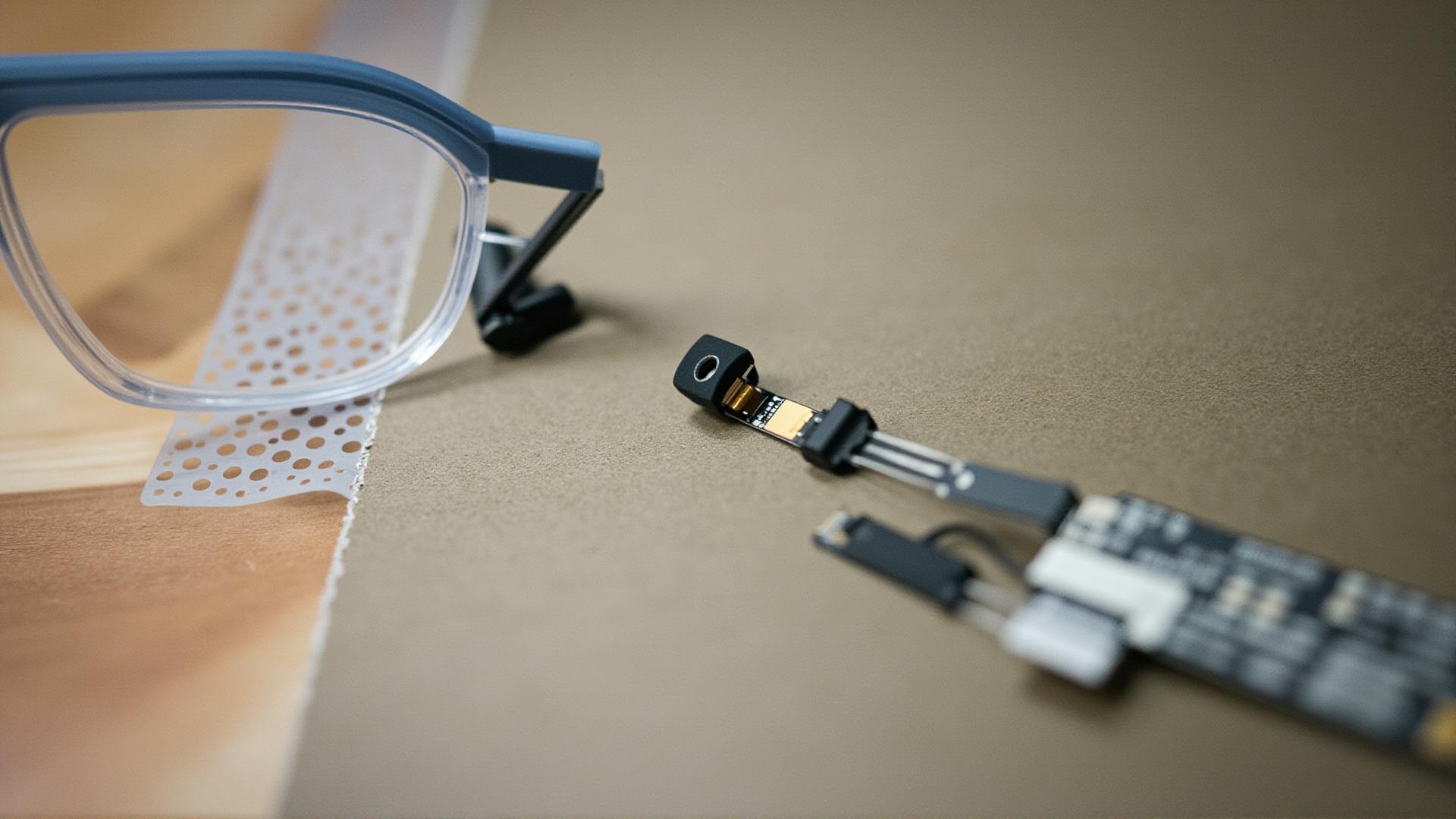
The V06 smart glasses specifications and features are published as a set of rows, and the rows do not all behave the same way when a procurement team tries to use them. Two of them carry numbers that can be quoted as they stand: a 260 milliampere-hour cell and an eight-megapixel resolution class. One of them is a band rather than a figure, and a band behaves differently in a quotation than a number does. Four of them are descriptions, and a description settles a question about what the product is rather than about what it measures. Four more are colour names, and a colour name is a configuration instruction rather than an attribute.
Reading the set row by row, and being explicit about which kind of row each one is, is what makes the difference between a specification file that can be worked from and one that generates three follow-up emails before it is finished. This article takes each row in turn, states what it settles, states what it leaves open, and turns each open item into the question that closes it. Nothing here is a performance claim, and nothing here converts a published row into a conclusion about which model a buyer should order — the catalogue publishes a spec sheet, and the decisions that follow from it belong to the business placing the order.
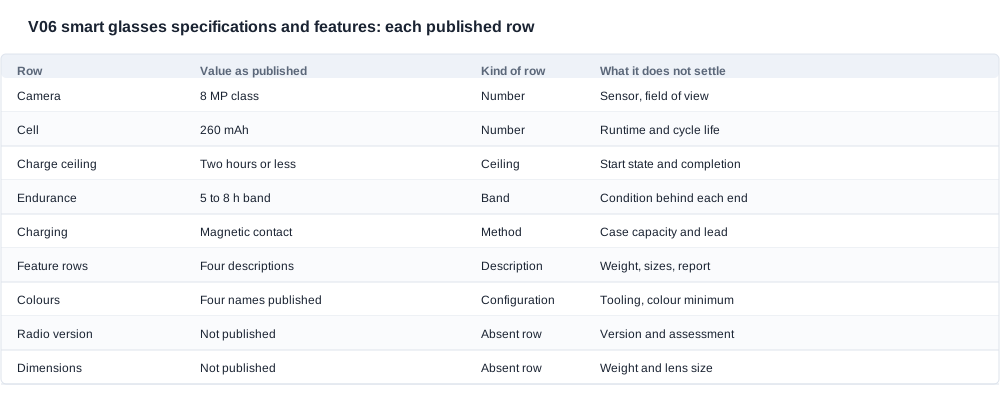
V06 smart glasses specifications and features: the rows and what they settle
The published row set for this model is short. It is a camera resolution class, a cell capacity, a charge ceiling, an endurance band, a charging method, four feature rows and four colour names. There is no radio version, no charging-case row, no weight, no dimension set, no size range for the removable inner frame, and no camera detail beyond the resolution class. Among the eleven camera models, three publish no charging-case line at all: the V03, this model and the S7. That silence means the row is missing rather than that the case is absent. No camera model in the range publishes a radio version, so the version fitted here has to be established from the assessment rather than from a row.
Those two facts matter for how the rest of the set is read. A buyer who has worked from a product page that lists a radio version and a charging case will look for both here, and their absence is informative rather than frustrating: it tells the reader that the row set has been assembled for a different purpose than a technical file.
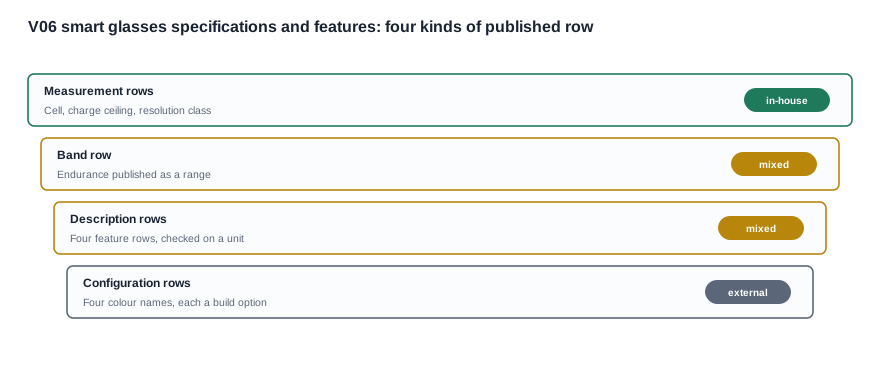
The row set falls into four kinds, and each kind has a different behaviour when it enters a purchase order, a listing or a customer-facing page.
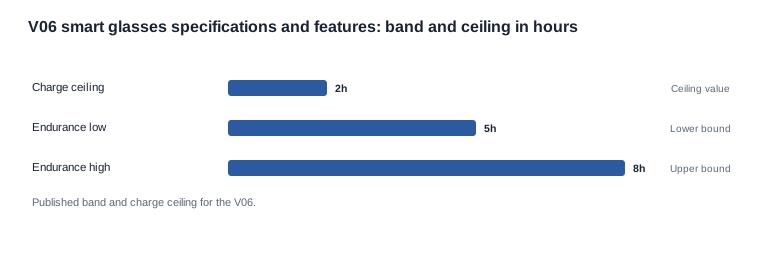
The numeric rows settle comparisons and nothing else. A 260 milliampere-hour cell is a capacity. It is a directly comparable figure, and it is the figure that determines whether two products can be lined up on the same axis. It does not tell anyone how long the product runs, how heavy it is, how many times the cell can be cycled, or what the chemistry is. The eight-megapixel resolution class is the same kind of row: it places the product on the resolution axis against the other camera models in the catalogue, and it says nothing about the sensor behind it, the field of view, the frame rate or the file handling. The charge ceiling of two hours or less is a third numeric row, and it is numeric in a way that is easy to misread — it is a ceiling, published without a starting state and without a statement of what counts as a completed charge.
The banded row settles a range and a condition. The endurance figure for this model is five to eight hours. It is a band rather than a point, which is better disclosure than a single figure because it signals that more than one condition was measured, and it is still not a specification until the condition behind each end is known. The method for putting that band under a magnifying glass is set out in the how to compare battery life procedure, and this section sets out what to request.
The descriptive rows settle what the product is. The four feature rows — an ergonomic design statement, a general endurance descriptor, a removable inner frame and an IP54 ingress marking — are statements about the design intent and the assembly. Each of them is checkable against a physical unit, and none of them is checkable against a document. That distinction is the whole of the argument in the third section below.
The colour rows settle a configuration, not a variant. Four names are published: orange, white ice blue, black and black ice blue. A colour that is published is a decision to be made about production, packaging, labelling and conformity, and the fourth section sets out what each one asks for.
One further note on the published material applies to anyone assembling a file from several models at once. The catalogue uses the same Chinese word for two different things on different pages: on some pages the endurance figure and the charge figure sit under labels that read as duration, while on others a duration label carries the endurance value and a separate row carries the charge time. A buyer cross-reading several entries will therefore move a number from one axis to another unless the page is checked row by row. This model is not an exception; it is the reason the habit is worth forming.
The 260 milliampere-hour cell, and the five-to-eight-hour band
The cell figure published for this model is 260 milliampere-hour. Three models in the catalogue publish that same figure — this model, the S7 and the KY06 — so the 260 figure places the V06 on the capacity axis without distinguishing it from either of those two. It is the right figure to compare on; it is simply not a distinguishing one, and a buyer who treats it as a distinguishing number will over-read it.
A capacity is not a runtime, and the conversion depends on the load. The same 260 milliampere-hour cell will produce a different number of hours behind a camera that is capturing continuously than behind one that is idle, and a different number again behind a camera in a bright outdoor scene than in a dim one. The published endurance band for this model is five to eight hours, which is the shape of figure a camera product publishes, and the width of that band is itself informative: it indicates that at least two conditions were measured and that the conditions differ.
What the catalogue does not publish, and what the buyer therefore has to request, is short and specific:
- The condition behind the lower end of the band, stated in full — what the camera was doing, whether the radio was connected, the volume if audio was in use, the ambient conditions, and the screen state.
- The condition behind the upper end, in the same words, so that the two ends can be compared rather than merely quoted.
- Whether the camera was active during either measurement, because a band that excludes the camera describes something a customer with a camera product will not experience.
- The starting state of the cell in both cases, since a figure measured from a full charge and a figure measured from a partial charge are not the same figure.
- The sample size and the number of units measured, because a band derived from one unit is a single observation.
- Whether the endurance figure is a rated value against a stated method or a catalogue summary.
Until those six items are answered, the commercially safe handling is to publish the band as a rated band, to use the lower end in any customer-facing claim, and to avoid the language of a working day. A band converted into a single number in a listing is the single most common way this kind of published figure turns into a return.
The charge ceiling has the same structure. Two hours or less is a ceiling: it allows a charge that takes exactly two hours, and it is not the same assertion as a charge that takes less than two hours. The published row carries no starting state and no statement of what counts as completion, so a buyer cannot use the figure to compute interruption time in a shift pattern or to plan a charging rotation across a fleet. It is worth noting where the catalogue does publish something tighter: two models — the D17 and the ZH12 — are published at about an hour, and every other entry in the catalogue carries the two-hours-or-less ceiling. Any comparison between this model and those two is therefore a comparison between a published ceiling and a published approximate figure, which is a weaker comparison than it looks and has to be written that way.
Charging is magnetic, and that is an accessory decision rather than a specification. A magnetic contact means the product in the carton needs either a cable with a proprietary contact, a pad, or a case with a cell in it. Since three of the eleven camera models carry no charging-case line at all, and this model is one of them, the carton contents for it are a specification the buyer has to write rather than a list that has been published. The questions that close it are the part reference for the contact or lead, whether a charger is in the carton, whether the interface accepts a power bank, whether a misaligned placement charges at all, and what happens to the contact surface over repeated use.
The cell also carries a documentation consequence that sits outside the product. A 260 milliampere-hour lithium cell travelling in a consignment is a transport document, and the document is prepared against the cell specification rather than against the product. A buyer moving this model across a border needs that file, and it needs to be requested early, because it is produced from the cell record rather than from the product record.

The four published feature rows, read one at a time
The four feature rows are the part of this specification that most often gets quoted as though it were four measurements. It is four descriptions, and each one has a different relationship to something measurable.
The ergonomic design row. This is a statement about how the product is put together. It is published on this model's row and on the row of one other model in the catalogue, the S7, and it is not published for the other camera models. Nothing measurable accompanies it: there is no frame weight, no temple length, no lens dimension, no material list and no dimensioned drawing in the published material. What a supplier can add is specific and finite — the weight of the frame itself, the temple length and the lens dimension, the materials used, and a drawing with tolerances. Until those are on file, the row can be reproduced in a product page as a description and cannot be turned into a sizing claim, and a channel that needs to publish a size guide cannot build one from it. The method for building that matrix from physical samples is set out in the sport fit and sizing material, and the joint that has to survive the service cycle is covered in the durability testing record.
The long battery life row. This is a descriptor string, and it is the row most likely to be copied into customer-facing copy verbatim, because it reads as a benefit rather than as a number. It is also the row that has to be checked against the band rather than alongside it. The band of five to eight hours is a rating without a published condition; the descriptor is a summary of that rating. If the condition behind the lower end of the band turns out to exclude continuous camera use, then the descriptor does not describe the product in the way a customer will use it. The discipline is to treat the descriptor as a headline for the published band and never as a substitute for it, and to keep it out of any specification that has to survive an audit.
There is a structural observation here that is worth a buyer noticing, because it shows that feature lists are written per page rather than generated from a template. The parallel model in this catalogue, the S7, publishes an ergonomic design row, a removable inner frame row and an IP54 row — and its fourth row is a numeric one, the thirteen-megapixel camera class. On this model's page the fourth row is a descriptor instead. The two feature lists therefore differ in kind, not only in value, which means that "the two models publish the same feature set" would be wrong and "the two models publish the same rows" would be wrong in a different way. They publish three rows in common, and their fourth rows describe different things.
The removable inner frame row. This is the most operationally consequential of the four, because it is the one that changes what the product is once it reaches a customer. The row publishes the fact that the inner frame comes out. It says nothing about the number of frames in the box, about whether those frames match one another, about the sizes the part is produced in, about how it is released, or about whether a replacement can be bought separately — which is a live question because this row appears on more than one model in the catalogue.
Two answers to that last question have very different commercial consequences. If the inner frame is a user-replaceable part, the business can stock it, sell it, and put a replacement service into its own catalogue, and the part becomes a revenue line with its own minimum order quantity. If it is a service-only part, the business runs a return-and-refit operation, and that carries a turnaround time, a cost for each unit and a commitment to the customer. Nothing published distinguishes the two, and the word "removable" does not distinguish them either. The question is worth putting in writing at the sample stage, because the answer determines the shape of the aftersales operation rather than a detail within it.
The IP54 ingress marking row. The marking appears in the feature rows of this model, published without a report reference. That is a specific position rather than a general one, and it carries a hard rule: the marking is a published feature row and not a tested result, and it is not written as a water-resistance guarantee on a carton, a product page or a listing until the supporting test report is on file. What the code covers and what it does not cover is explained in the sport water resistance record, and the documentary side of the same question is handled in the certification checks material.
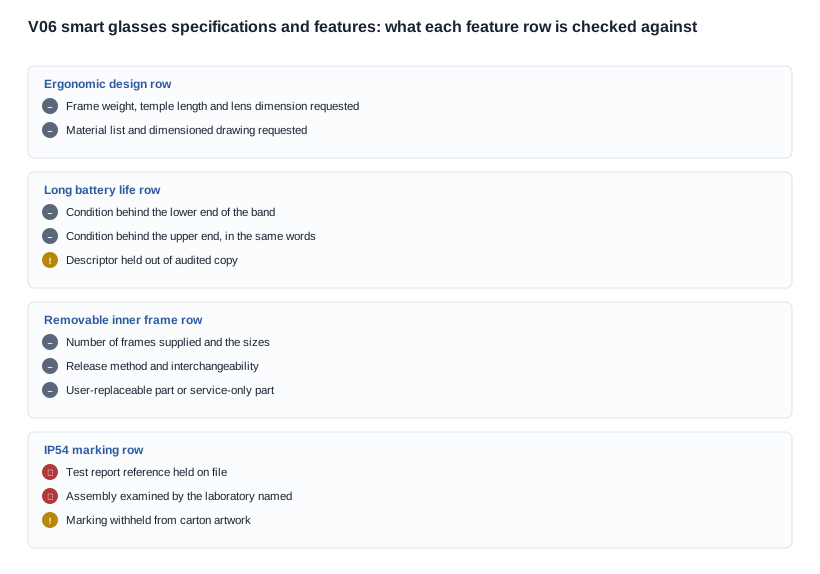
What the four rows are worth in a procurement file. Each one can be converted into a set of questions, and each set of questions has a supplier-side owner. The ergonomic design row becomes a dimension and weight request. The long battery life row becomes a request for the endurance conditions. The removable inner frame row becomes an accessory and sizing request. The IP54 row becomes a test report request with seven items in it. That conversion is the practical value of reading the rows one at a time rather than as a marketing list, and it is what turns a published description into a scheduled action.
The four colours, and the configuration each one implies
The catalogue publishes four colour names for this model: orange, white ice blue, black and black ice blue. That is a lot of published colour for a single row, and it is worth placing in the catalogue's own context, because the context is narrow and it is a structural fact rather than a ranking claim. Exactly two models in the catalogue publish a colour row at all — this one, with four names, and the V03 Pro, with three. The other nine camera models publish no colour row, and neither do the audio or sport entries outside the camera section. So the fact to hold is that the V06 is one of two models with a published colour row, and that it publishes the larger of the two sets. It is not the case that this model is the best-specified product in the range, because the specification set and the colour set are different things and only the second of them is being described here.
Each published colour is a potential configuration. A colour is a finish, and a finish can involve a different material, a different coating process and a different colour tolerance from the one beside it. Nothing published states which of the four share a process, which of them require separate tooling, or whether each one is separately assessed for conformity. That is the costing question and the conformity question, and both of them sit inside a commercial term rather than inside a product feature.
The practical consequences for a business that intends to carry more than one of the four are these.
- Minimum order quantity per colour. Not published. The programme is bound by the largest of the per-colour minimums, so the range has to be designed around the highest one rather than the average one.
- Tooling and artwork quantities per colour. Not published. This is a fixed cost divided across fewer units in a small programme, which is why it belongs in the decision to carry a colour at all rather than in the decision to reorder it.
- Packaging and label artwork. A colour in the carton is a separate label artwork and a separate packaging configuration reference. The mechanics of carrying that are set out in the sport packaging options record.
- Conformity of the finish. Whether an ingress assessment covers a colour, and whether the inner frame is part of the assessed assembly, are questions for the test record, not for the colour row.
- Whether a colour can be added later. A model whose colour row is fixed at four names is a model whose range has to be planned up front, because adding a fifth finish later is a different conversation from ordering a fourth.

The colour interacts with the removable inner frame, and the catalogue does not say how. A published colour may cover the outer shell only, or the whole product including the inner frame, and the distinction is not documented. If it covers the inner frame as well, then each colour exists in more than one assembly, and the number of configurations a business has to plan for rises with the number of sizes the inner frame turns out to come in. If it covers the shell only, the inner frame remains a single part across the four colours. The two readings produce different packaging counts, different stock lines and different label artwork, and the question — which parts does the colour name cover — is one line in a request list and the difference between a workable range plan and a rework.
The published rows for the parallel model are worth reading alongside these, because the two models share the cell, the charge ceiling, the endurance band, the charging method, the removable inner frame row and the ingress row, and differ on the resolution class and on the fourth feature row. The S7 specifications and features record sets out that model's rows in the same order, and the V06 how it compares piece places this model on the axes of the wider range so that a buyer can see which of these rows are distinguishing and which are shared.
How to work with this row set in a shortlist. The rows support a selection process rather than a verdict, and the criteria a buyer applies to them are the same whatever the requirement is. Does the figure arrive with a condition attached? Does the comparison sit on a single axis, so that two models are being measured the same way? Can the figure be reproduced on a unit from a sample order? A buyer who applies those three criteria to this model will find that it offers four numeric rows that can be quoted without qualification and one band that cannot, that the only rows available for a colour programme are the four colour names and the per-colour minimum quantity, and that a documented fit system has exactly one published row behind it and no size range. The questions to ask are the ones listed above, and the checklist that results is short enough to send in one message to a supplier and to keep in the due-diligence file afterwards. Two red flags are worth naming in advance, because both are easy to miss and expensive to find late: a band quoted as a single figure, and a published marking treated as a tested result.
The limits of our own statements about these rows are narrow, and we set them out here rather than leave them to be assumed. We publish the rows as the catalogue records them. We do not convert the band into a single figure, we do not print the ingress marking as a tested result, and we will not quote a size, a weight, a case capacity or a certificate number the documentation does not contain. The four colours are published as four options rather than as a claim about merchandising. What the V06 smart glasses specifications and features give a sourcing team is an unusually complete set of numeric rows for a product in this section, four descriptions that each convert into a specific request, and a colour row that is a real configuration instruction. What they need back is the answers to those requests, in writing, before the artwork is approved.


