
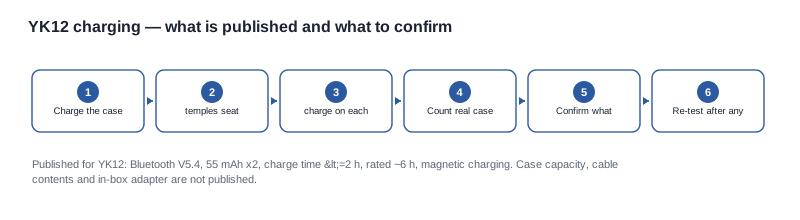
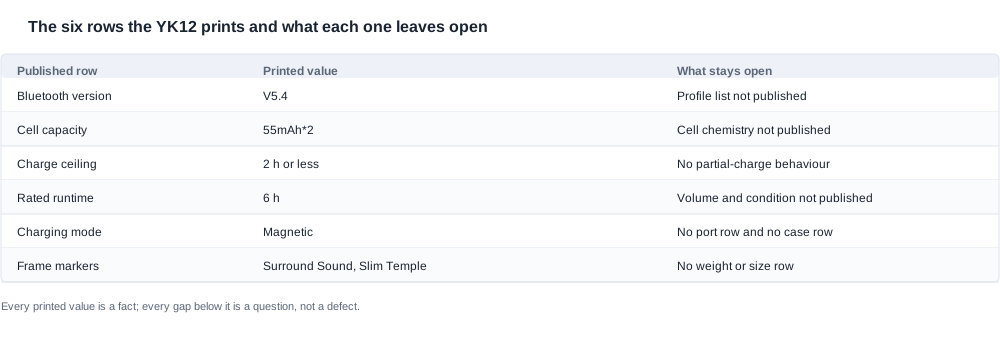
The YK12 publishes six charging-relevant values: Bluetooth V5.4, paired 55 mAh cells, a ceiling of two hours or less, a rated runtime near six hours, magnetic charging and two frame markers. That is the whole published charging picture. What is absent matters as much: the case capacity, what ships in the box, whether a faster option exists, and what may travel by air.
What the published rows say
Magnetic charging. The temples seat on a case rather than plugging in. Convenient, and alignment-dependent — a temple seated slightly off can appear to charge while progressing very slowly, which is the most common early support contact with this design and needs one line in a quick-start guide.
55 mAh per temple. The lowest per-cell figure printed in the audio range, and the same configuration the G07 and the LC-105 series use.
Two hours or less to charge. Overnight charging is sufficient.
Roughly 6 hours rated. The lower end of the published range, with no stated condition. Note that the LC-105 series uses the same 55 mAh paired cells and rates 8 hours, so capacity does not explain the outcome. See smart glasses battery life.
The six rows the YK12 prints
The catalogue page for this model carries six values, and they are worth reading in the order the page prints them. The Bluetooth version is V5.4. The cell configuration is 55 mAh times two, one cell per temple. The charging ceiling is two hours or less. The rated runtime is roughly six hours. The charging mode is magnetic. The two frame markers are Surround Sound and Slim Temple.
That is the complete published charging picture, and its shape matters as much as its content. Three of the six rows describe the radio and the cell. Two describe time, and they describe two different kinds of time — a ceiling and a rating. One describes the charging mode. Nothing in the list names an input for the device itself. Nothing in the list names a charging case. Nothing in the list gives the volume or the condition behind the six hours.
A buyer who knows this product class will recognise the pattern. The catalogue is strongest on the numbers that describe the unit on the shelf and thinnest on the numbers that describe the carton around it. That is not a criticism of the catalogue. It is a statement about where a procurement file has to supply the missing half itself, and this article is organised around that split: what the six rows settle, what has to be requested in writing, and what a sample has to demonstrate before anyone signs.
What "magnetic charging" does and does not settle
The charging mode row reads magnetic charging, and it is easy to read more into that phrase than the catalogue puts there. It tells a buyer that the charging contact on this model is a magnetic one rather than a plug. It does not tell a buyer what the magnetic contact mates with. Two things would answer that — a named input and a named case — and the page prints neither for this model.
That distinction matters, because magnetic charging covers more than one physical arrangement and the arrangements behave differently once the unit reaches a customer. Where the temple seats against a powered dock or a case, alignment becomes part of the charging act: a temple sitting slightly out of position can still show a charge indication while progressing slowly, and that is the mechanism behind a large share of the early support contacts this design generates. Where the charging happens against a pad or a cable end, the same seating question appears in another form. The catalogue does not say which arrangement this model uses, and a buyer who intends to publish a quick-start guide cannot write one without it.
The mode row also leaves the charger itself untouched. A magnet removes the port from the device; it does not remove it from the box. Something still has to accept mains power, and that part is a separate item with a separate failure mode and a separate place in the carton. This is why the case question is asked before the interface question in the next section, and why neither is answered here with an assumption.
The paired 55 mAh cells in the range
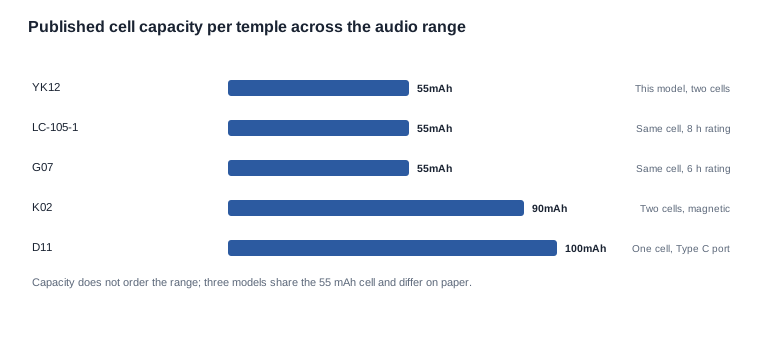
Per temple, fifty-five milliamp hours is the smallest cell figure printed anywhere in the audio range, and this model does not hold it alone. The LC-105 series and the G07 are printed with the same 55 mAh paired cells. What separates them on paper is the runtime row: this model is rated at roughly six hours, the LC-105 series at roughly eight, and the G07 at roughly six. So the range contains two models with identical cells and identical ratings, and a third with identical cells and a different rating.
None of that can be turned into a performance conclusion, because none of the three pages states the volume, the content or the condition behind its figure. A rating without a condition is a number on a page, and a number on a page is exactly what should not be multiplied by a duty cycle. The two things that do travel — the cell configuration and the charging mode — are identical across all three, which means the charging path here cannot be separated from the cell path at all: the same charge cycle, at the same ceiling, has to serve the same cell.
The chart below sets the published capacity figures side by side. It is worth reading for what it does not show as much as for what it does. The bars order capacity, and capacity is not the variable that separates these three models.

The four items to confirm

Case capacity. The catalogue prints no charging case row for this model — not a capacity figure, and not a statement that a case is supplied. The row is simply absent from the page. Several models elsewhere in the range do print a capacity, which is why the question is worth asking. See charging solutions.
Cable and adapter contents. Not published. A magnetic case needs a cable to charge the case itself, and whether one ships is a packaging cost and a market-compliance choice.
Is there a faster option? Two models in the sport audio range publish a roughly one-hour Type-C charge. Neither this model nor most of the mainstream audio range states an interface at all. If turnaround matters to your channel, ask what this model actually supports.
Air freight charge level. Not published. A lithium cell raises transport requirements, and the permitted charge percentage constrains ecommerce fulfilment directly. See battery transport.
Case capacity, and the difference between no row and no number
The four items in this section are open, but they are not open in the same way, and the first one carries a trap. The catalogue prints no charging case row for this model. Not a case row with a capacity on it, and not a row stating that no case is supplied — the row is absent from the page.
That is a third case, and it is worth separating from the other two because it changes what a request should say. Across the catalogue, five camera models publish a charging case capacity, two more camera models state that they come with a case but publish no capacity figure, and one model publishes an explicit statement that no case is supplied. A model with a published capacity can be modelled directly. A model with a case and no capacity can be modelled the moment the capacity arrives. A model with no row at all cannot be modelled until someone confirms whether a case is part of the package in the first place.
So the request is not "what is the case capacity". It is "does a case or dock exist for this model, and if it does, what is its capacity and what does the charger itself take". One written line, asked in that order, returns an answerable question. Asked the second way, the most likely reply is a number that describes a case which may not ship with this model at all.
The same distinction applies to the audio range as a whole. No page in that section of the catalogue prints a charging case row, which is a statement about what the catalogue records rather than a statement about what the hardware does. The rows that do print one sit on camera models. Treat the absence as a question to be closed, never as a figure to be estimated.
What ships in the box, and why the carton decides the listing
Cable and adapter contents are not published for this model, and that is a packaging cost decision as much as a compliance one. A magnetic charging arrangement needs something to take mains power, and whether a cable is included, whether an adapter is included, and whether the buyer is expected to source one, all change the retail carton. Each of those is also a line on a marketplace listing, and each is a support contact later if it is wrong.
The reason this item sits above the interface question is that it determines the tolerance for the interface. A box that includes a cable can be supported by a written manual that names the cable. A box that includes nothing needs a listing that says so in the same sentence as the charging mode, because the two are otherwise read together by the customer and the mode is the one that gets quoted in a review.
For a procurement file, the practical instruction is short: itemise what physically ships, and make that itemisation a checked deliverable rather than an assumption carried from the previous programme. The sample protocol below turns it into a count.
The interface question behind a faster charge
Two models in the sport audio range publish a roughly one-hour Type-C charge, and neither this model nor most of the mainstream audio range states an interface at all. That gap is the reason "is there a faster option" is a real question rather than a rhetorical one.
A faster charge is never a free improvement. It changes the cell, the charger, the thermal envelope, or the power source in the carton, and each of those has a cost that does not appear on a product page. Asking the question in the right form makes it answerable: not "can it charge faster" but "what charge times are achievable for this model, what does each require in the carton, and which of them are available for my volume". The answer, if there is one, arrives as a specification with a consequence attached.
The same discipline applies to the two-hour ceiling. It is printed as an upper bound, not as a typical figure, and no other model in the catalogue publishes a shorter ceiling except the two that publish roughly one hour. Treating a ceiling as a typical figure is the most common arithmetic error in this category, and it is the reason the sample timing in this article is done on both temples separately rather than averaged.
Air freight and the permitted charge percentage
Air freight charge level is not published for this model, and a lithium cell raises transport requirements that apply directly to ecommerce fulfilment. The permitted charge percentage constrains what can be shipped in a consignment, and the constraint is set on the cell, not on the finished unit — so a model that is comfortable to sell individually can still be awkward to move in a large parcel.
This is the item most often left to the logistics team as a late surprise, because it surfaces when a booking is made rather than when a model is chosen. The practical sequence is to ask the transport position before the purchase order, and to ask for it per market rather than once, because the requirement is a property of the destination.
For a range that includes several audio models with different cell configurations, the sensible approach is to treat the transport position as a line item on the model register rather than a question asked per order. The chart above lists the confirmed items in the order they should be requested; the transport question is last there for a reason, because it is the one that changes the parcel rather than the unit.
Where this model sits for charging purposes
Against the D11 and D12, both of which state Type-C at two hours or less: if your supply chain is standardised on Type-C, those are the models with a published interface.
Against the D17 and ZH12, both publishing a roughly one-hour Type-C charge: if turnaround between uses is the priority, those are faster on paper.
Against the G07 and the LC-105 series, the cell configuration is identical and only the published runtime differs — which, given the absent test conditions, is not a reliable basis for choosing.
So the charging choice in this range really comes down to interface and turnaround, not capacity.
The comparison in full, side by side
Read the four comparisons above as one table and the structure of the range becomes plain. This is how to compare the range on charging alone, and it is worth doing before the shortlist is drawn, because the four groups fail in four different ways. The two models with a published interface in this comparison — the D11 and the D12 — are single-cell models that print Type-C alongside a two-hour ceiling and a seven-hour rating. The two faster models — the D17 and the ZH12 — print roughly one hour against a Type-C mode. The models sharing this model's cell configuration, the LC-105 series and the G07, print a magnetic mode and no interface at all.
That produces a clean split with one awkward edge in it. Anything downstream that needs a named input has to be built around the Type-C group, and anything downstream that needs a two-hour ceiling and a magnetic mode has to be built around the magnetic group, which includes this model. A range built to a single interface therefore cannot include this model without a stated exception, and a range built to a single charging mode cannot include the Type-C group either.
The awkward edge is the runtime, because it is the only row that looks like a tiebreaker. It is not, for the reason in the next section: the rating is printed without a condition, and a conditionless figure cannot be ranked against another conditionless figure when the two use different labels for the same idea.
One label, two meanings, and why it matters when comparing pages
The comparison above is only safe if the same row means the same thing on every page. In this catalogue it does not.
On this model's page the ceiling is printed under the label 充电时长, at two hours or less, and the runtime sits under 续航, at roughly six hours. On the V03, the KY06 and the MT5 pages the same label 充电时长 carries the runtime — five to eight hours on one, six to eight on another — while the ceiling is printed under a different label, 充电时间. Across the range the runtime itself appears under three different labels: 使用时长 on some pages, 续航 on others, and 充电时长 on the three camera models that pair it with a 充电时间 ceiling.
The consequence is precise and it is entirely a transcription risk. If a comparison table is assembled by scanning every page for whichever label mentions charge time, two of the rows will be runtime figures on models that never print a runtime under that name, and the table will rank endurance against recharge time. Nothing published is wrong. The error would be introduced by the spreadsheet.
The defence is procedural rather than clever: read each label together with the neighbouring row on the same page, and record both the label and the unit in the working table. A table that carries the page label beside the figure survives the handover to a colleague who has not read the catalogue, and it survives the moment when someone asks why one row says two hours and the row above it says eight.

What to check on a sample, in order
Charge the case before the temples. Verify both temples seat squarely and charge at the same rate. Time a full charge on each side. Count how many case recharges the case actually delivers — the arithmetic from the frame cell suggests a figure, but the real number depends on where you cut off and at what level. Then itemise what physically ships.
The seating check, before anything is timed
The first step costs nothing and tells the most. Before any clock starts, charge the case or dock to a known state, then seat each temple in turn and watch what the indicator does. A contact that shows a charge indication while making no measurable progress is a seating fault rather than a cell fault, and it is the single most useful piece of evidence to hold when a customer reports that a unit will not charge.
The check has to be repeated deliberately rather than performed once, because a magnetic contact that seats correctly on a bench can still be seated wrongly in a customer's hand. Three red flags are worth recording explicitly: an indicator that lights without measurable progress, a temple that charges noticeably slower than its partner, and a contact that needs a second attempt after the unit has been moved. Ten seating cycles, alternating temples, with the result recorded each time, produces a far more useful record than one successful charge. If the first four seatings succeed and the fifth does not, that is a tolerance figure, and a tolerance figure is something that can be written into a quick-start guide or a leaflet.
The same protocol run on a second unit of the same model turns a tolerance figure into a consistency figure. Two units that both pass ten cycles say something different from one unit that does, and the second reading is the one a procurement file should carry.
The charge log that produces a comparable figure
Once seating is proven, the timing runs. Time a full charge on each side separately rather than on the unit as a whole, because a two-cell model in a shared dock can hide a slow temple behind a fast one. Record the starting state, the ending state and the clock for each temple, and note whether the run was interrupted at any point, since a partial charge followed by a restart is a different event from one continuous cycle.
Then the case arithmetic, with the cutoff stated rather than assumed. The acceptance criteria for the whole protocol should be written down before the sample arrives, not after the numbers do. The frame cell suggests a number of recharges, but the real figure depends on where the cutoff sits and at what level the cells are left afterwards. Write the cutoff into the log. A recharge count without a cutoff is not a measurement, and it will not reconcile with anyone else's.
Finish by itemising what physically ships, as the previous section requires, and by photographing the carton contents before anything is unpacked. The photograph is the cheapest part of the whole protocol and it settles the box contents question permanently.
Where CYNRIN stands on the YK12 charging
The charging story here is coherent and incomplete, and the case capacity is the single row most worth requesting because it changes your unit economics. We will not estimate a capacity we have not been given.
Tell us your market and volume and we will tell you which of these four we can confirm today.
What we will confirm in writing
The charging position for this model is coherent and incomplete, and the four items in the second section are the whole of the incompleteness. The case row is the one most worth requesting first, because it decides the carton, the accessory line and the freight weight, and because several models elsewhere in this range do publish the figure that would settle it. The interface question comes second, the box contents third, and the transport position last — not because it matters least, but because it is the one that changes the parcel rather than the unit.
Given a destination market and a volume, we can return the items that can be closed today and name the ones that cannot, in a single written response. Before you order on this model, the due diligence is short and specific: close the case row, confirm the interface, itemise the carton, and put the transport position in writing. What we will not do is fill a blank with an estimate. An estimated case capacity in a quotation becomes a specification in a purchase order, and a specification nobody can source is a dispute waiting for a shipment.
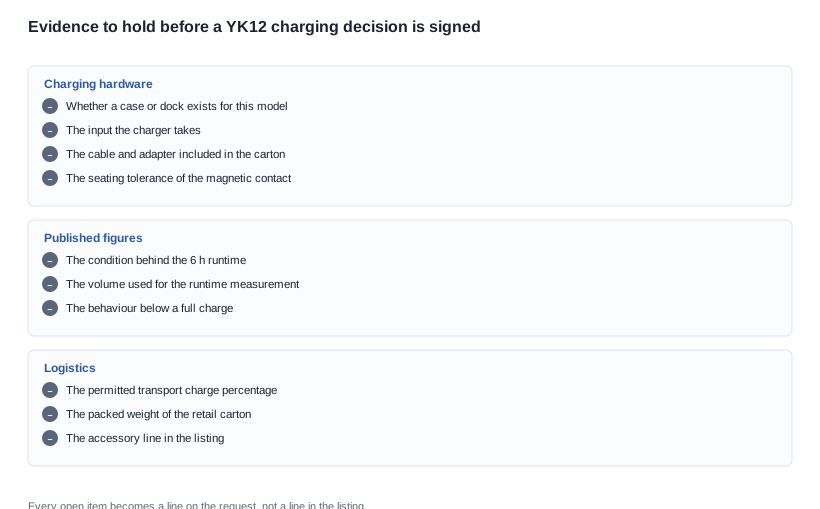
The checklist below is the evidence set we would expect to hold on this model before a charging decision is signed. Each open line belongs on the request register with an owner and a closure date, rather than on a product listing.
Related reading
- How case capacity affects landed cost — charging solutions
- Battery transport before you book freight — battery transport
- Why runtime figures do not compare — smart glasses battery life
Give us the target market, the quantity and the required configuration, and we will reply with what is available and what is not.


