
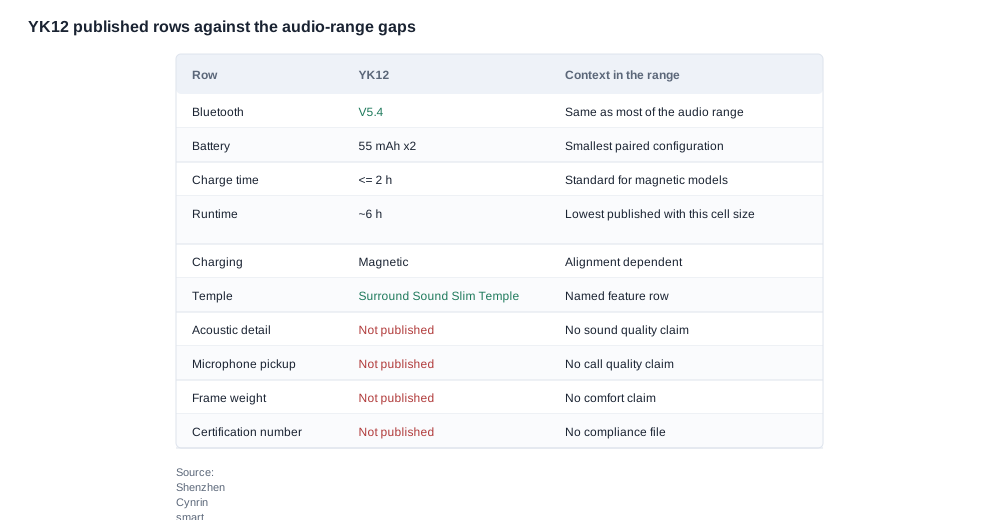
The YK12 smart glasses specifications and features list is short: Bluetooth V5.4, paired 55 mAh cells, charging in two hours or less, roughly 6 hours of rated use, magnetic charging, and a named Surround Sound Slim Temple. The temple is the distinguishing row. Everything else either matches the mainstream audio models or is absent — no acoustic detail, no microphone pickup figure, no frame weight, no certification number.
What the published rows tell you
Bluetooth V5.4 places it with the current radio generation, alongside the D11, D12, G07 and the LC-105 series. It supports a compatibility statement, not a performance one — no codec list, connection stability figure or multi-point behaviour is published. See bluetooth connectivity.
Paired 55 mAh cells are the smallest cell configuration in the audio range, shared with the G07 and the LC-105 series.
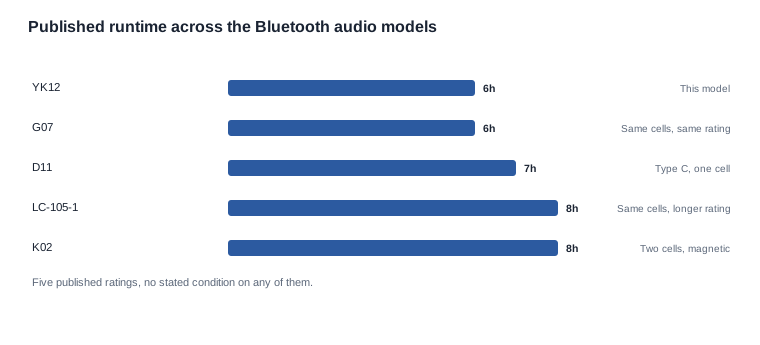
Roughly 6 hours rated is the lower end of the published range. Note the inconsistency worth understanding rather than repeating: the LC-105 series uses the same 55 mAh paired configuration and rates 8 hours, and the G07 uses it and rates 6. Capacity does not explain the spread, and no test condition is published for any of them. See smart glasses battery life.
Magnetic charging states the interface but is alignment-dependent, which means it can appear to charge while progressing slowly if a temple is seated incorrectly. That generates support contacts and needs a line in any quick-start guide.
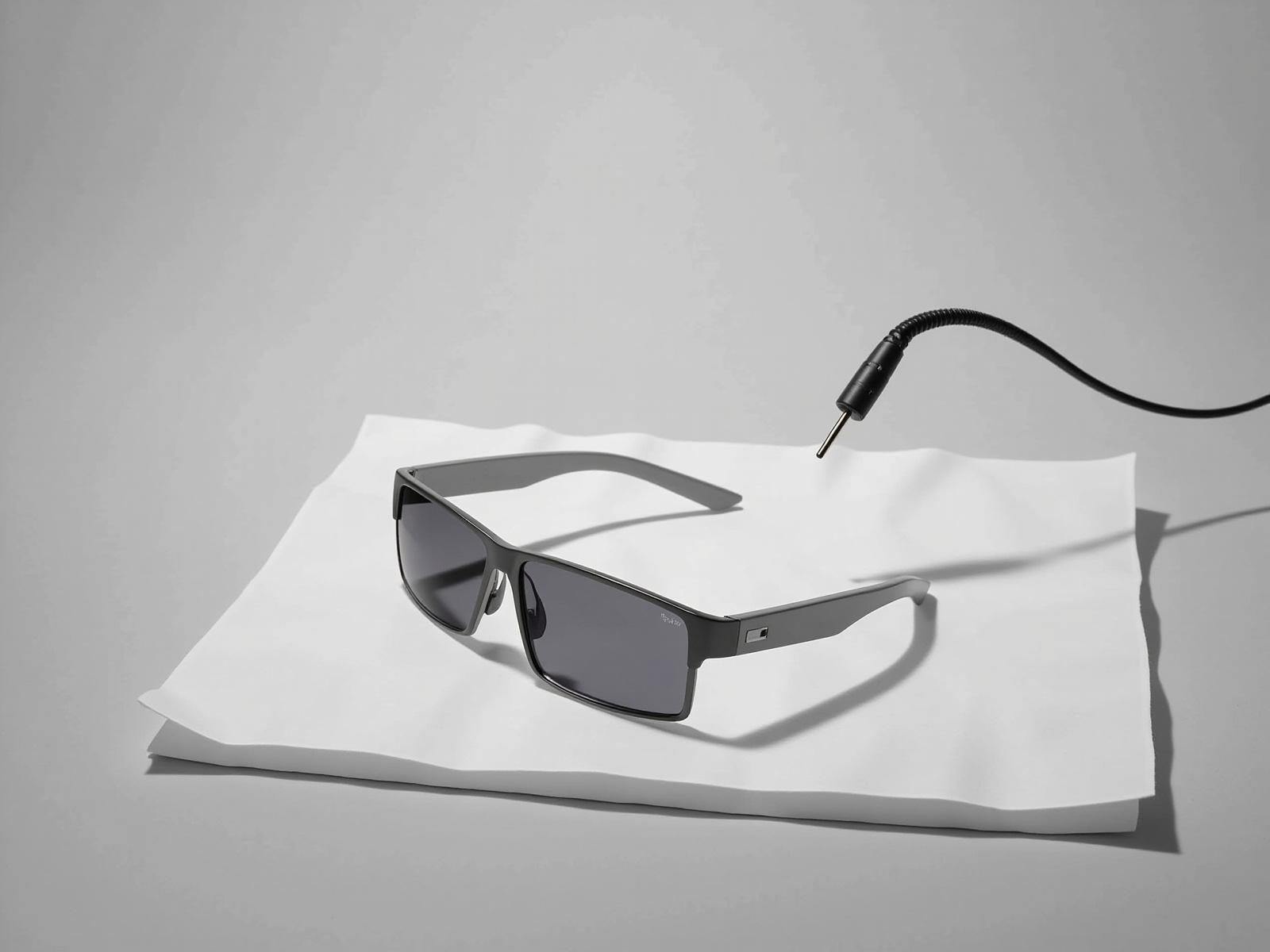
The Surround Sound Slim Temple is a catalogue designation, and it is this model's one distinguishing row. A named design feature is useful in a listing because it is concrete and photographable. Note what it is not: no acoustic figures accompany it, so it supports a design statement and not a sound quality one.
The seven rows, read in the order the page prints them
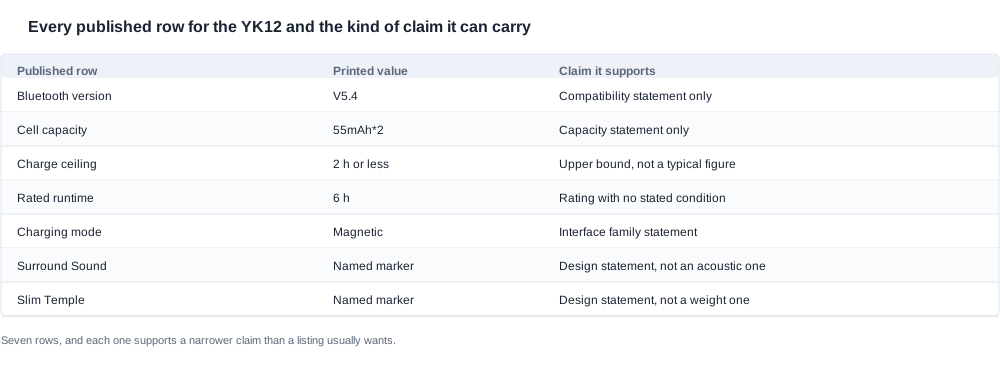
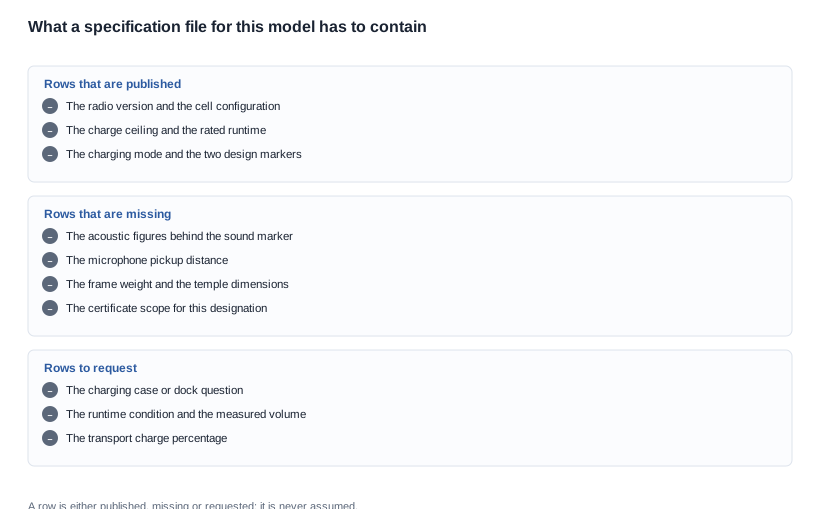
The page for this model prints seven things. In the order they appear they are: a Bluetooth version of V5.4, a cell configuration of 55 mAh times two, a charging ceiling of two hours or less, a rated runtime of roughly six hours, a charging mode of magnetic, and two frame markers named Surround Sound and Slim Temple.
Seven rows for a model is a thin file by any measure, and the way to read it is not to count what is there but to sort it. Two rows describe the radio and the cell. Two rows describe time, and they describe different kinds of time — a ceiling and a rating. One row describes how the unit takes power. Two rows name a design feature.
Everything a specification sheet normally carries for an audio product sits outside that list. There is no driver size, no frequency response, no leakage figure, no microphone pickup distance, no frame weight, no temple dimension, no ingress rating, no certificate number and no input port row. A reader who expects a specification file and finds seven rows is looking at a catalogue entry, not a data sheet, and the difference matters whenever the file has to support a claim on a listing.
The Surround Sound Slim Temple, and what a name is worth
Two of the seven rows name features rather than figures, and together they are this model's entire reason for existing as a separate listing. That is worth examining closely, because a named feature is a genuinely useful thing to sell and a genuinely dangerous thing to lean on.
What a name gives you is specificity. A buyer can photograph it, a customer can see it, a channel can segment on it, and a listing can point at something concrete. Surround Sound and Slim Temple are both visible properties of the frame, which means they survive translation into a product page better than a figure would, and they can be shown in a listing image without a measurement.
What a name does not give you is the underlying performance. No acoustic figure accompanies the sound marker, so the phrase cannot be read as a description of how the model performs, only of how it is designated. No weight accompanies the temple marker, so it cannot be read as evidence of a light frame. Both are designations in the catalogue, and a designation tells a buyer what the row is called, not what the hardware does.
The distinction is where the exposure sits, because the two readings differ by one word in a listing and by one returned unit in a channel.
What a specification file has to say next to each row
Each published row has a natural claim it can carry, and the discipline is to state the row and the claim in the same breath. A radio version supports a compatibility statement and nothing about connection quality. A cell figure supports a capacity statement and nothing about how long the unit runs. A charge ceiling supports an upper bound and nothing about typical behaviour. A rating supports the figure as printed and nothing about the condition it was measured under.
A file that does this has three columns where most have one: the row as printed, the claim it supports, and the condition it omits. The third column is what stops the first two from being stretched later by whoever reads the page.
For a procurement team this is the difference between a specification that can be quoted into a purchase order and one that has to be re-verified at every handover. A row plus its claim can be written into an RFQ as a fixed line. A row without its claim becomes a question every time it is quoted, and those questions do not stop at the first order.
The table that follows sets out the seven rows against the claim each one carries. It is deliberately narrow — narrow enough that a listing can be written from it without adding a single word the catalogue does not support. The pitfalls here are predictable and they are all the same kind: a row that is read as more than it is. Knowing how to evaluate a row against its neighbours is most of the work.

The four absences, and what each one blocks
No acoustic detail — driver size, frequency response, leakage. No sound quality claim, which for an audio product is the central gap. See open-ear audio technology.
No microphone pickup distance. No call quality claim. For open-ear designs this is where the criticism usually lands, so the absence matters more here than in a conventional earbud category. See noise control and microphone pickup.
No frame weight. No claim about how the frame sits, and nothing on paper to pre-screen that with. A slim temple invites the inference of a light frame; nothing published supports it. See materials and ergonomics.
No certification numbers. Claimed at company level with no number, issuing body, validity date or model coverage. See certification checklist.
The absence that decides the listing: acoustic detail
The first of the four gaps is the one that shapes the listing, because it is the gap a customer will test. No driver size, no frequency response, no leakage figure is published for this model, and the sound marker that appears on the page carries no numbers behind it. For an audio product that means the central performance claim simply cannot be made from published data.
This is not a gap that a buyer can close by looking harder at the catalogue, and it is not a gap that a competitor's listing resolves either. It is a property of what the manufacturer has published. The realistic options are three: ask for the figures in writing, sell the model on what is published and accept the constraint, or leave the acoustic claim to the customer and let the specification carry the weight.
What to avoid is the middle route that feels safe — a listing that gestures at sound quality without stating a figure. A phrase like "premium sound" or "immersive audio experience" is not a measurement, but it will be read as one by a customer and by a marketplace reviewer, and it creates a claim that has to be defended later. The published route is stronger: name the designation as a designation. Surround Sound is a row on the page. It is a real, concrete, photographable property of the frame, and stating it accurately is more defensible than borrowing a superlative.
Weight, dimensions and the drawing that would settle it
The third gap is smaller in text and larger in practice. No frame weight is published, and no temple dimension is published either, which means a specification file cannot carry a size. That has two consequences, and both of them land on procurement rather than on marketing.
The first is shipping. Packed weight feeds freight cost, and packed weight is derived from unit weight plus packaging. Without either number, a landed-cost model for this model is built on the packaging assumption alone. The second is returns. A frame that does not suit the wearer comes back, and the rate of that return is a function of geometry that nobody has published for this model.
The obvious fix is a sample and a scale, and that is a cheap request compared with a shipping model built on a guess. A technician can weigh the unit, measure the temples and record both in a single line, and a drawing with two dimensions answers most of what a specification file needs. What the drawing cannot do is substitute for a published figure in a listing, because a sample is one unit rather than a range.
There is a trap in the Slim Temple row that is worth naming here. A slim temple invites the inference of a light frame, and light frame invites comfort language, and comfort language is a consumer signal rather than a procurement one. Nothing published supports the chain. The designation says the temple is slim. The inference beyond that is a reader's, not the catalogue's.
Turning four missing rows into four questions
The useful move at this point is to stop treating the absences as a list and start treating them as a request. The question of what to ask becomes easy once each gap has been tied to the party that can close it. Each missing row becomes one question, each question gets an owner, and each answer is written on the register with a date against it. Four rows produce four questions, and a request of that size is short enough to answer in a single reply.
The questions are worth ordering. Acoustic figures and microphone pickup come first, because they decide what the listing may say. Weight and dimensions come second, because they decide what the shipping model may assume. The certificate scope comes third, because it is the one that has to be answered per market rather than once. The charging case question sits alongside them rather than after them, because it changes the carton rather than the unit, and the transport position comes last because it changes the parcel.
This ordering is also the cheapest way to find out who closes which row. The acoustic figures and the pickup distance are properties of the hardware and can only be answered by the factory. The dimensions and the weight can be answered by a technician with a sample and a tape measure. The certificate scope is a document question with an external issuer behind it. The case question is a packaging decision with a cost attached. Four rows, four different owners, four different closure times — which is precisely why a request written as a single open question comes back as a single vague answer.

Where the YK12 sits in the range
Against the G07, the closest comparison: same cells, same charge time, same published runtime, same interface. The G07 publishes an ultra-thin detachable temple; the YK12 publishes a Surround Sound Slim Temple. So the choice between them is a design choice, and it turns on which feature suits your channel.
Against the D11 and D12, the YK12 is smaller-cell and shorter-rated but carries a named design row those models do not.
Against the LC-105 series, the YK12 shares their cell configuration and charge time but rates an hour shorter — a difference the data cannot explain.
The Bluetooth audio glasses range covers the full set.
Three models that share the cell, and one that does not
Three models in the audio range are printed with the same 55 mAh paired cells: this one, the G07, and the LC-105 series. Their published runtimes differ, and the differences do not track the cells, because the cells are identical. The G07 shares this model's runtime, the LC-105 series is printed two hours longer on the same cells.
The more useful comparison is with the G07, because every technical row on the two pages matches. Same radio version. Same cell configuration. Same charge ceiling. Same rated runtime. Same charging mode. What differs is the name printed against the temple: the G07 carries an ultra-thin detachable temple, this model carries a Surround Sound Slim Temple.
That is a genuinely narrow gap, and it has a direct consequence for how a shortlist is built. If the two models are technically indistinguishable on published data, then a range carrying both is carrying two different stories about the same hardware, and the only evidence a buyer can use to separate them is the designation. There is no measurement to arbitrate. A buyer who wants a defensible reason to list one rather than the other has to either get figures that differentiate them, or make the designation itself the product.
It is also worth noting which models this one does not share rows with. The D11 and the D12 are single-cell models with a Type-C mode and a seven-hour rating. The K01 and the K02 are printed with a 90 mAh paired configuration and an earlier radio version. The YKC02 shares the Surround Sound marker but carries a 70 mAh paired configuration and an eight-hour rating. So the comparison set is not a set of close variants; it is one almost-identical model and a set of clearly different ones.
Where the design marker actually decides the choice
When the technical rows do not separate two models, the choice becomes a channel question rather than a specification question, and it should be written as one.
The published designations available in this range are worth listing because they are what the pages actually give a buyer to work with: a surround sound marker on this model, on the YKC02, on the D11 and on the D17; a stereo surround marker on the ZH12; an ultra-thin detachable temple on the G07; a detachable inner frame on the V06 and the S7; and a flexible temple and a photochromic lens on the V03 Pro.
That is the whole menu. Each of those is a designation rather than a measurement, and each describes a visible property of a frame, which is why they translate into a product page so directly. What none of them describes is performance.
So the criteria for this model are simple and should be stated plainly: if the channel sells on a visible frame property, this model qualifies and the G07 does not carry the same one. If the channel sells on a measured specification, this model has the thinnest file in its comparison set, and that is the honest way to position it. The mistake to avoid is presenting a designation as though it settled a performance question, because a customer will settle that question with a return rather than with a review.
Where CYNRIN stands on the YK12 published rows
The YK12 is a design-led audio model whose value proposition is a named temple rather than a measurable performance. That is a legitimate basis for a listing provided it is stated accurately, and it becomes indefensible the moment a listing implies sound quality or ergonomic figures we have not published.
What we will publish, and what we will not
We will publish the seven rows as they are printed, with the label that carries each one, and we will publish the design markers as designations. We will not publish a sound quality figure, a microphone pickup distance, a frame weight or a certificate number for this model, because none of them exists in our published record. A number that appears once in a listing and cannot be traced back to a source becomes a specification within a week, and it becomes an argument within a month.
We will also state the absences rather than leaving them to be noticed. A specification sheet that lists seven rows and says nothing about the rows it does not carry reads as complete. The same sheet with an explicit absence list reads as honest, and it is far easier to answer a buyer who asks what the driver size is than one who asks why no driver size is listed.
There is a commercial reason to say this plainly as well. A model with a complete file can be quoted by any channel without the manufacturer, and the questions stop there. A model with a documented set of absences sends those questions back to the factory, and the answers are where a relationship is built. That is not a reason to publish less. It is a reason to publish the gaps in the same document as the figures, so that nobody has to guess which of the two kinds of silence they are looking at.
The request register that goes with this model
Any channel that takes this model forward will generate a request register within a week, whether or not one was planned. The entries come from the listing, from the first sample, from the first quotation and from the first freight booking, and each one carries the same four or five rows.
The register should have a fixed shape. Each line names the row, the owner, the date the answer is due and the market it applies to, and each line is closed by a document rather than by a conversation. A telephone answer closes nothing. A written answer closes a line.
For the rows this model leaves open, the owners are known before the question is asked. The acoustic figures and the pickup distance belong to the factory. The weight and the temple dimensions belong to a technician with a sample. The certificate scope belongs to the document holder and varies by market. The charging case question belongs to the packaging decision, and the transport position belongs to the logistics plan.
Knowing the owner in advance is what makes a register work rather than a list of complaints. Before you order on a model with a thin file, the due diligence is short and the answer is in three columns: which rows are already closed, which are requested and with an owner, and which nobody owns yet. A row that nobody owns is the one that arrives as a dispute at the point of shipment, and on a model with this few published rows there is always at least one.

Related reading
- The audio range this model belongs to — Bluetooth audio glasses
- What is known about open-ear audio — open-ear audio technology
- The gaps that decide call quality claims — noise control and microphone pickup
Tell us the model, the market and the rows your channel needs, and we will tell you which of them can be closed this week.


