
The yk12 smart glasses vs lc-105-2 form factor comparison runs on one published row and a sample. No frame dimensions, no temple length, no bridge specification and no frame weight is published for either model — and in this whole audio range the only published weight belongs to the MT6 at 158 grams, which is a different product on a different platform. So a form factor comparison here has to be built out of a catalogue name, a caliper and a sample unit, and the honest version of this page says that at the top rather than filling the gap with plausible dimensions.
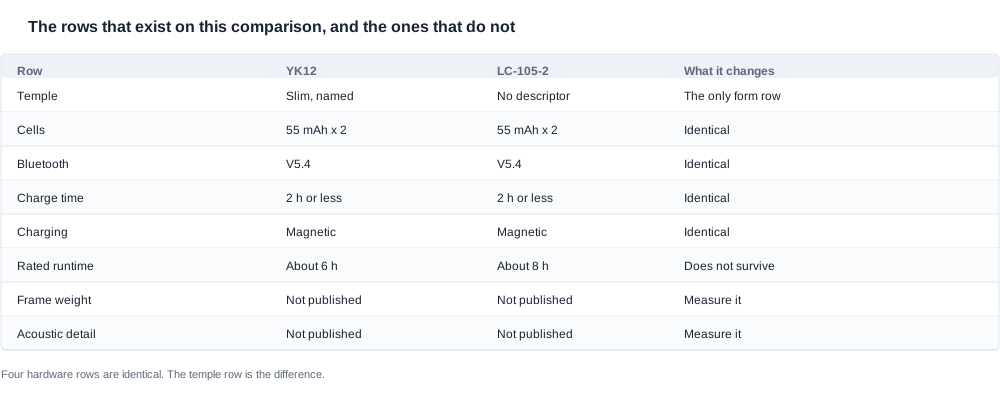
The hardware underneath is unusually close. Same cells, same charge time, same charging interface, same radio. That closeness is what makes the comparison hard: two models that differ on one merchandising row and on nothing else require a different kind of argument from the one buyers usually prepare.
YK12 smart glasses vs LC-105-2: what one published row can actually settle
Who is choosing, and what they are defending. A brand owner is deciding whether design differentiation is worth carrying a second SKU for, and the honest answer depends on a single catalogue row. A procurement manager is holding two quotations on near-identical hardware and needs to know whether the price gap is buying anything at all. A channel buyer is writing the copy, and neither model gives them a weight, a dimension or a head-size range to write from.
The decision in one line. If the named temple is your differentiator, take the YK12. If it is not, the published data does not separate these two models, and what a worn sample decides will decide the outcome.
That conditional shape matters more than the conclusion, because it tells the buyer where to spend the next hour. If design differentiation matters to the proposition, the comparison is already resolved by a row that exists in writing. If it does not, the buyer has nine open rows and no way to close any of them from a catalogue page.
The rows that are identical, and the one that is not
| Row | YK12 | LC-105-2 | What it changes | The threshold or the question |
|---|---|---|---|---|
| Temple | Publishes a Surround Sound Slim Temple | No temple descriptor at all | The only form-related row in the comparison | There is no temple length, no cross-section figure and no weight attached to it. You may say this model has a named slim temple; you may not say what that means in millimetres |
| Cells | Paired 55 mAh | Paired 55 mAh | Identical — the smallest configuration in the audio range | The cell for the configuration ordered |
| Bluetooth | V5.4 | V5.4 | Identical | The customer's platform, checked against the version quoted |
| Charge time and interface | Two hours or less, magnetic | Two hours or less, magnetic | Identical | The charge-time starting point, and the indicator behaviour |
| Rated runtime | Roughly 6 hours | Roughly 8 hours | The one row that differs, and it does not survive scrutiny | The test condition, in identical words on both |
| Acoustic detail, microphone pickup, frame weight, ingress rating, certificates, colours, stated interface | Not published | Not published | The rows that decide fit, call quality and market entry | Each one, or an explicit statement that it is not published |
Four of the five comparable hardware rows are identical. Cells, radio, charge time and charging method all match exactly. The models are close enough on paper that the temple name is the only differentiator the data offers, and every other line in the table above is an absence rather than a value.
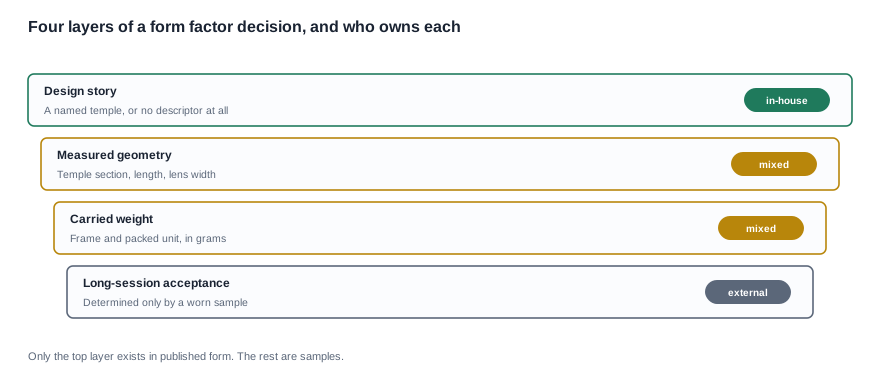
The one row that carries a name is not a measurement. A named temple is a catalogue designation. It supports a design statement in a listing and it does not support a dimension, a weight, a pressure figure or a security claim. In a category where almost nothing is published, one concrete row is worth something — it is simply worth less than a millimetre, and a buyer who needs the millimetre has to produce it.
The runtime row, which does not survive scrutiny. The YK12 rates roughly 6 hours; the LC-105-2 rates roughly 8, on identical cells. That two-hour spread recurs across this range — the G07 uses the same cells and also rates 6 — so capacity does not explain the outcome. Amplifier efficiency, firmware behaviour or inconsistent measurement are the likelier causes, and none is documented. Treat both figures as untested upper bounds and do not use them to choose. See smart glasses battery life.
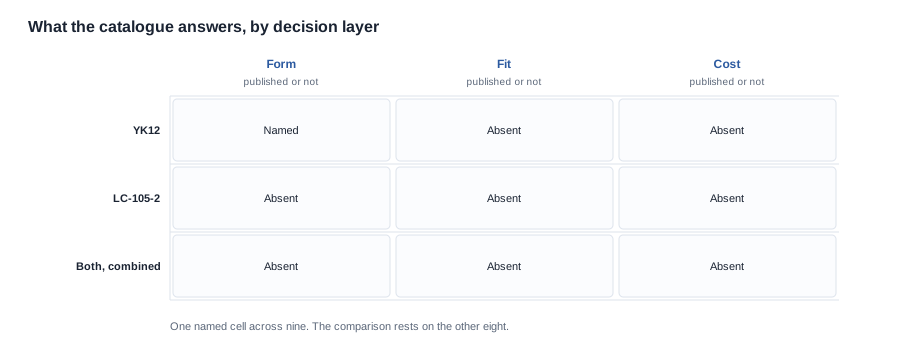
How to evaluate a table like this one. The useful habit is to mark each row in one of three states — identical, different, or absent — and refuse to let an identical row contribute anything to the decision. Two models that publish the same cell, the same radio and the same charging method have already told you that the electronics are not the argument. A buyer who scores identical rows as ties has manufactured the appearance of a balanced comparison out of an absence of information.
What an absent row costs you, concretely. Each absence is a decision deferred to a sample, a supplier question or a freight forwarder, and each of those has a different price. A missing frame weight becomes a weighing, which is free but requires the unit in your possession. A missing temple dimension becomes a caliper measurement on a sample, which is free and requires the same unit. A missing packed weight becomes a freight quotation you cannot finalise, which costs money because the forwarder will quote you twice. A missing certificate reference becomes a market-access delay that can stop a shipment rather than a listing, and that is the only absence on this list with the power to stop goods.
The one measurement worth making before you write any copy. Weigh the frame with the cells fitted, and weigh a packed unit including the dock. Those two figures between them decide the freight class, the parcel economics and the long-session acceptance argument, and neither exists in the catalogue for either model. Once you hold them, the comparison stops being a naming exercise and becomes a data exercise — which is the only form this kind of one-row comparison should ever have taken.
The designation question, and why it comes first
Two models that publish identical rows are not necessarily two options. The catalogue does not say what separates the LC-105-2 from the LC-105-1, and two designations sharing a number with no stated difference is a question rather than a finding. The honest shape of this comparison is therefore conditional, and the condition is worth stating plainly.
If the LC-105-2 is a distinct product, then the YK12's named temple is the only row separating the two, and the decision is a design decision. In that case the comparison is legitimate, thin, and defensible in a review meeting.
If the LC-105-2 is the LC-105-1 renamed, then the YK12 is being weighed against a model whose identity is unresolved, and the naming question has to be closed before the form comparison is worth running at all. Two SKUs carrying one product is not a range — it is a duplicated accessory line, a duplicated inventory line and a second product page, with nothing customer-visible to show for either.
Either way, a written confirmation and a worn sample are what close it. A question about a model designation costs a message to answer; a question answered by a delivery costs a freight forwarder, a customs entry, a warehouse receipt and a return or a write-off. That asymmetry is the whole argument for asking first, and it is why the designation request should be the first line of the enquiry rather than the fifth.
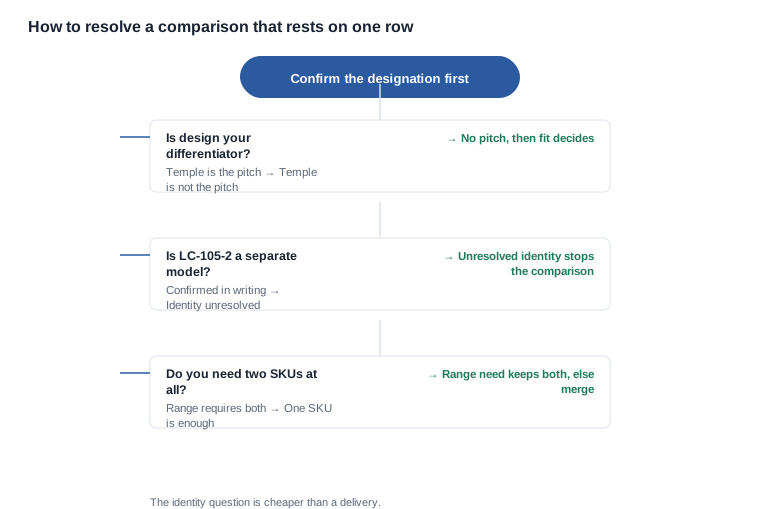
Three red flags to watch for in the answer. If the supplier replies with a confident description of features without confirming whether the designation is distinct, the answer is an evasion. If the answer is that the two are the same product, ask what the second SKU is for before proceeding. And if the answer is that the designation is being updated and the paperwork will follow, treat the delivery date as unknown until it arrives in writing, because a rename that lands after your packaging is printed creates a compliance mismatch on the box rather than a naming inconvenience.
What neither model publishes, and why each absence changes a decision. Acoustic detail — leakage, driver size, frequency response — decides whether the product can be sold on sound. Microphone pickup distance decides whether it can be sold for calls. Frame weight decides both long-session acceptance and the parcel weight, and therefore the freight class on an incoterms basis. An ingress rating decides whether an outdoor channel can claim anything about weather. Certificate numbers decide whether the product can clear market access at all. The design context sits in open-ear audio technology, and the measurement approach for a frame in the hand sits in materials and ergonomics.

What to ask before you commit, and what to measure on a sample
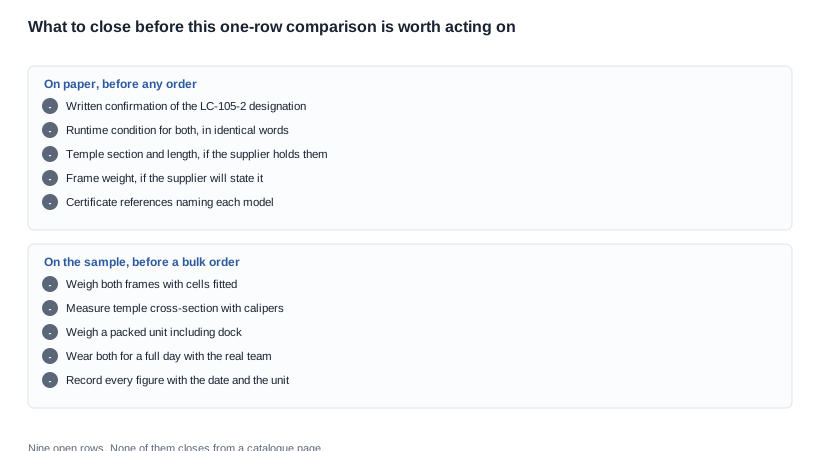
The questions to ask, in order of cost to close them. In order: the designation confirmation, the runtime condition, the temple geometry, the frame weight, and the certificate references. The first two are a message each. The third and fourth need a caliper, a scale and a sample. The fifth is a document request that should have been available already, and a supplier who cannot produce it is telling you something worth hearing before you commit.
Confirm the LC-105-2 designation in writing, before anything else. State the question as a request for a document rather than as a doubt: ask the supplier to confirm in the quotation whether the LC-105-2 is a distinct model designation or an alternative designation for the LC-105-1, and ask for the answer to appear on the quotation itself.
Ask the runtime condition for both, in identical words, in the same message. A condition asked on one model and not the other produces a comparison that cannot be defended in a contract, and it produces an asymmetry that a reader will notice.
Hold a sample of each, weigh them, and wear them for a full day. With no frame weight published for either, long-session acceptance is the variable most correlated with returns in this category, and it is invisible in the data for both. Weigh with the cells fitted, because a frame weighed without cells is not the frame a customer receives.
Measure the temple cross-section yourself with calipers. The YK12's slimness is published as a name rather than as a measurement, so measuring it and holding it against the LC-105-2 produces a figure the catalogue does not contain. Record the result with the date and the unit, and quote your own measurement rather than the catalogue name when you write the listing.
Set the listing boundary before the copy exists. Published rows you may use: the named temple, the cells, the radio version, the charge time, the charging method and the rated runtime. Rows you may not use without evidence: the dimensions, the weight, the temple profile in millimetres, the acoustic figures, the ingress position, the certificate coverage and the runtime condition.

Five ways a one-row comparison misleads a buyer
The model designation was assumed rather than confirmed. A delivery arrives carrying a different designation from the one on the order sheet. Root cause: two designations publish identical rows and nobody asked. Prevention: confirm it in writing before the order, and put the confirmation on the quotation.
The runtime row decided the comparison. The LC-105-2 is chosen for a longer day, and the two figures turn out to have been measured differently. Root cause: a figure with no condition was read as a product property. Prevention: set the row aside until both conditions are documented.
The named temple was read as a measured dimension. A listing quotes a temple figure that nothing supports. Root cause: a catalogue designation was treated as a measurement. Prevention: describe the temple, and measure it yourself if you need a number.
The slim temple was read as a light frame. Comfort complaints arrive on a product positioned as slim. Root cause: a design word was read as a weight claim. Prevention: weigh the sample and quote your own figure rather than inheriting an adjective from a catalogue.
The two models were listed on separate pages with separate stories. A customer compares them and finds nothing to compare, because the range was planned from model names rather than from published rows. Prevention: one of the two should carry the platform, unless the temple row genuinely justifies both — and if it does, say why on the page.
The signs that the comparison has been done properly are simple. The designation is confirmed on the quotation. Every open row is labelled as absent rather than filled. The runtime figure appears with its condition or not at all. And the buyer can state in one sentence which row decided the outcome. If any of those four is missing, the decision rests on something softer than it appears to.
The price gap, and what it is actually buying
On near-identical hardware, the price gap is buying the temple name — or it is buying nothing. That is the question worth answering before the order. If the design row is not what your channel sells on, and if the LC-105-2 turns out to be the LC-105-1, then two SKUs are carrying one product while the accessory and inventory costs double with nothing customer-visible to show for it. That is the scenario in which the second SKU is not a range decision but a duplicated cost.
The trade-off worth naming explicitly. A second model in the same family buys breadth in a range, a second line for a distributor to sell, and a second product page for a marketplace. It costs duplicated tooling if tooling is per model, a duplicated accessory minimum order quantity if the dock differs, and a duplicated compliance scope if the certification is per designation. The breadth is worth having if the channel asks for it; it is not worth having by default.
Worth the negotiation time. Unit price and volume tiers, the accessory set with its minimum order quantities, packaging specification, delivery splitting, payment terms with a deposit structure, the warranty period with a stated response time, and the terms of a pilot order. The designation question is the one worth closing before any of them, because a model that does not exist cannot be quoted against.
Where the quotation has no room. The cost of a certification and the time it takes are worked out by the programme and by whoever runs the test. Tooling is often amortised across the first order while certification cost is per product family — ask which one you are being quoted, because the two are frequently bundled into a single line that hides which is which. Packed weight, and therefore freight class, cannot be quoted until a weight exists, so treat any freight figure on this comparison as provisional.
The quality control line that closes most of the risk. Ask whether the factory will hold a defined inspection point before the balance is released, and ask whether the inspection items can be written to name this comparison: the designation on the unit against the designation on the purchase order, the cell configuration, the firmware version, and a sample of units measured against whatever runtime protocol you have agreed. That single clause converts every open row on this page from a hope into a remedy, and it is the cheapest due diligence available to a buyer signing a first order in this category.
The clauses to include. The published rows for the configuration ordered and the confirmed model designation. The rated runtime with its condition, or an explicit statement that it is a manufacturer rating and unverified. The temple configuration as measured and agreed. The frame weight and dimensions as measured. The warranty period with a stated response time, and the certificate references naming each model for each destination market.
What to leave out. Any weight, dimension, temple profile or runtime claim that is not published or not measured for the specific configuration ordered.
This comparison is one named temple and a sample, and saying so is more useful to a buyer than filling the page with plausible dimensions. We will not fill a weight, a dimension or a temple profile with an estimate, and we will not present a runtime difference that identical cells contradict. If the temple is your differentiator, take the YK12; otherwise the data does not separate them and a worn sample will.
Tell us whether design differentiation matters to your proposition, and we will narrow this to one model and name the rows you would still need evidence for. The range both models belong to is on the Bluetooth audio glasses page.
What to do next.
- Confirm the LC-105-2 designation in writing, on the quotation.
- Ask the runtime condition for both models, in identical words, in the same message.
- Hold a sample of each, weigh them, and wear them for a full day with the real team.
- Measure the temple cross-section yourself and record it with the date.
- Set the listing boundary before the copy exists, and put the pass lines in the agreement.
Related reading
- The audio range both models belong to — Bluetooth audio glasses
- What an open-ear frame gives up — open-ear audio technology
- How to measure a frame once you have it — materials and ergonomics
Tell us the target market, the quantity and the required configuration, and we will come back with what is available and what is not.


