
Eight hours is the longest rated runtime published anywhere in our audio range, and this model reaches it on two of the smallest cells we publish. That is the headline, and it is also the first thing a careful buyer should question — not because it is wrong, but because a runtime claim that outperforms its own nominal capacity is a claim whose conditions decide whether a customer is satisfied with the product they received.
This page breaks ykc02 smart glasses battery life into the parts a procurement team can actually check, and states plainly which of them we can answer from documentation and which have to be closed on a sample order.
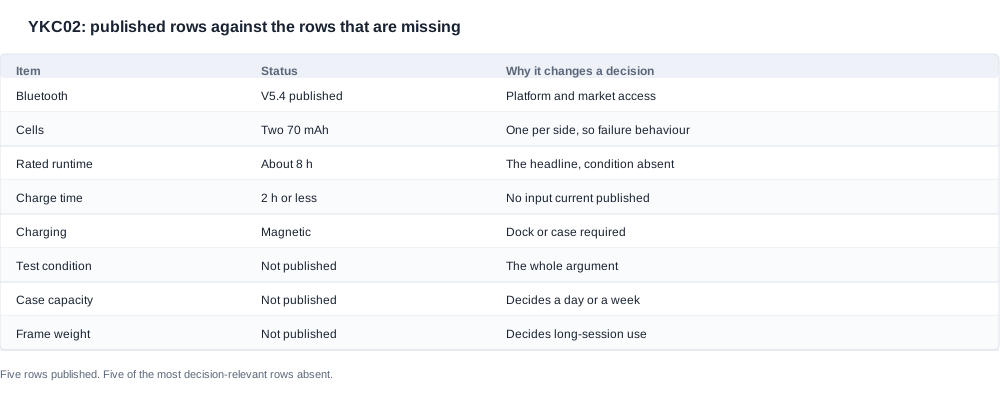
The published configuration is short: Bluetooth 5.4, two 70 mAh cells, a charge time of up to two hours, roughly eight hours of rated use, magnetic charging, and a surround-sound description. Five rows. The conditions that would tell you whether those rows describe your customer's day are all absent, and the absence is the substance of this article.
YKC02 smart glasses battery life: the arithmetic, and what it cannot prove
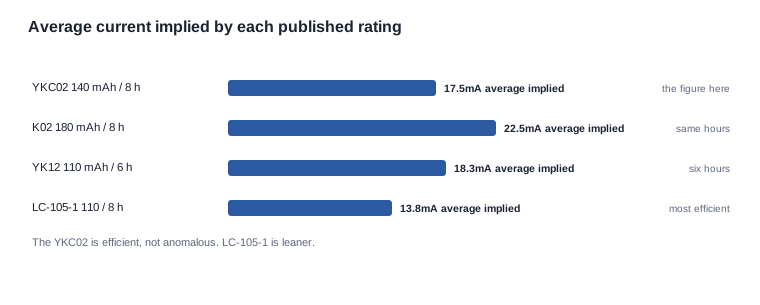
Two 70 mAh cells give 140 mAh of nominal capacity. Spread across roughly eight hours, that is an average draw of about 17.5 mA for an open-ear Bluetooth frame with transducers on both sides. For context, models carrying 90 mAh per cell or a single 100 mAh cell are published at seven to eight hours.
The useful comparison is not against the cell size — it is against the implied current. Divide each published capacity by each published rating and the picture changes. The K02 and the K01, at 180 mAh across eight hours, imply about 22.5 mA. The YK12, at 110 mAh across six hours, implies about 18.3 mA. The LC-105-1, at 110 mAh across eight hours, implies about 13.8 mA.
That last figure is the one that reframes the question. If a 110 mAh configuration can be published at eight hours, then this model's 140 mAh across eight hours is not an outlier at all — it sits between the leanest published configuration in the range and the heaviest. What the arithmetic actually tells you is that runtime in this catalogue is governed by average power draw, not by capacity, and that power draw is a firmware and platform property which no model in the range publishes.
So there are two explanations for the eight hours, and only one of them is about the hardware.
The platform explanation. A newer chipset, a more efficient amplifier path or a lower-power acoustic design can genuinely do more from a given cell. If that is what is happening, the number is real, defensible and worth putting at the top of a listing — provided the condition travels with it.
The measurement explanation. The figure may have been produced at a low volume, at close range, in a favourable codec, or as a best case rather than a mean. In that case the number is also real, but it describes a scenario rather than a typical day, and a listing built on it is a listing waiting for a correction.
You cannot separate those two from the documentation. That is why the test condition is not a detail in this article; it is the article. Everything else below is either a way of asking for that condition or a way of coping without it.
Five variables that would move the published figure
Playback volume. The single largest variable and the least often disclosed. A figure produced at low volume is not a figure a customer experiences on a train, on a street or in an open-plan office. Because open-ear frames require more drive to reach a given perceived level than a sealed pair does, the same unit can produce a 40% swing in runtime across a volume range — which is why "one volume setting" is not a protocol.
Codec and connection distance. A phone on a desk and a phone in a pocket are different radio conditions, and the radio is not idle in either case. In an outdoor product the second one is the realistic case, and a codec with more processing per frame draws more current than a simpler one.
Whether the surround-sound mode is engaged. This model carries a surround-sound description, which makes the mode state a specific and checkable question rather than a general one. If the measurement was taken with the mode off and your customer runs it on, the published figure does not describe their use. This is the single most valuable question in the list, because it is binary, easy to answer and directly changes the headline number.
Temperature. A cell in a temple beside a warm face in summer is not the same cell as one in cold air in winter. Seasonal variation is normal, physically expected and undisclosed in every datasheet in this category. A buyer shipping into a summer market should treat a summer measurement as the conservative case rather than the generous one.
Acoustic coupling and how the unit sits. On an open-ear frame, the seal against the side of the head determines how hard the amplifier has to drive for a given perceived level. Two people using the same unit in the same room can get different runtimes from it. This is the reason frame geometry and runtime are connected at all, and it is another argument for measuring rather than quoting.
What is published, and what is missing
Published for this model: Bluetooth 5.4, two 70 mAh cells, a charge time of up to two hours, roughly eight hours of rated use, magnetic charging, and a surround-sound description.
Not published — and each of these changes a decision:
- The test condition behind the eight hours — volume, codec, distance, surround mode state, sample size, and whether the figure is a mean or a best case.
- The case capacity and whether a case is included, which decides whether this figure describes a day or a week.
- The input current and voltage, without which the two-hour charge figure is not reproducible by the buyer and will become a customer review rather than a technical issue.
- Frame weight and temple dimensions, which decide long-session acceptance and your return rate.
- The rated cycle life of the cells and the single-side failure behaviour, which decide the warranty cost you carry for the first year.
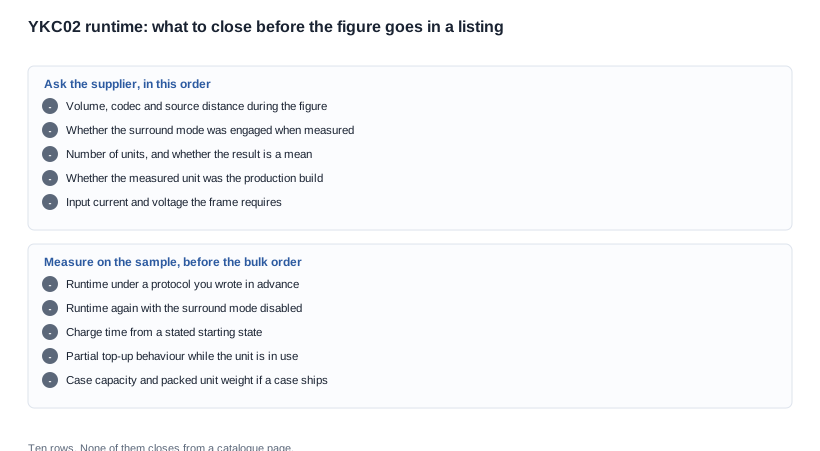
The order of those five matters. The test condition is first because it decides whether the headline number is usable at all. The case capacity is second because it can multiply the effective endurance by a factor none of the published rows capture. Everything below those two is a cost input rather than a claim input, and can be settled while the first two are still open.
A sixth row that is not on the model specification but belongs on your checklist: the battery paperwork. A lithium cell moving across a border needs its own documents, independent of anything about the runtime. The cell test summary has to cover the specific cell fitted to this model, the declared watt-hour rating has to be stated, and the packing instruction that follows from that rating has to be reflected in the shipment. A runtime conversation and a transport conversation are separate conversations, and a buyer who merges them discovers the transport requirement at the freight forwarder rather than at the supplier. The battery transport compliance notes set out the route, and the certificate references that name this model rather than the family are covered in the certification status for this model.
What to put in the purchase order. The rated runtime with its condition, or an explicit statement that it is a manufacturer rating and unverified. The measurement protocol you intend to verify against, so that a later dispute has a reference point. The case inclusion and capacity, if one ships. The single-side failure behaviour and how a warranty claim on a twin-cell unit is settled. The input current and voltage the frame requires. The certificate references naming this model for each destination market. And the frame weight as measured on your sample, because a weight agreed at inspection is a weight you can hold the supplier to and a weight quoted in a catalogue is not.
A measurement protocol for the eight-hour claim
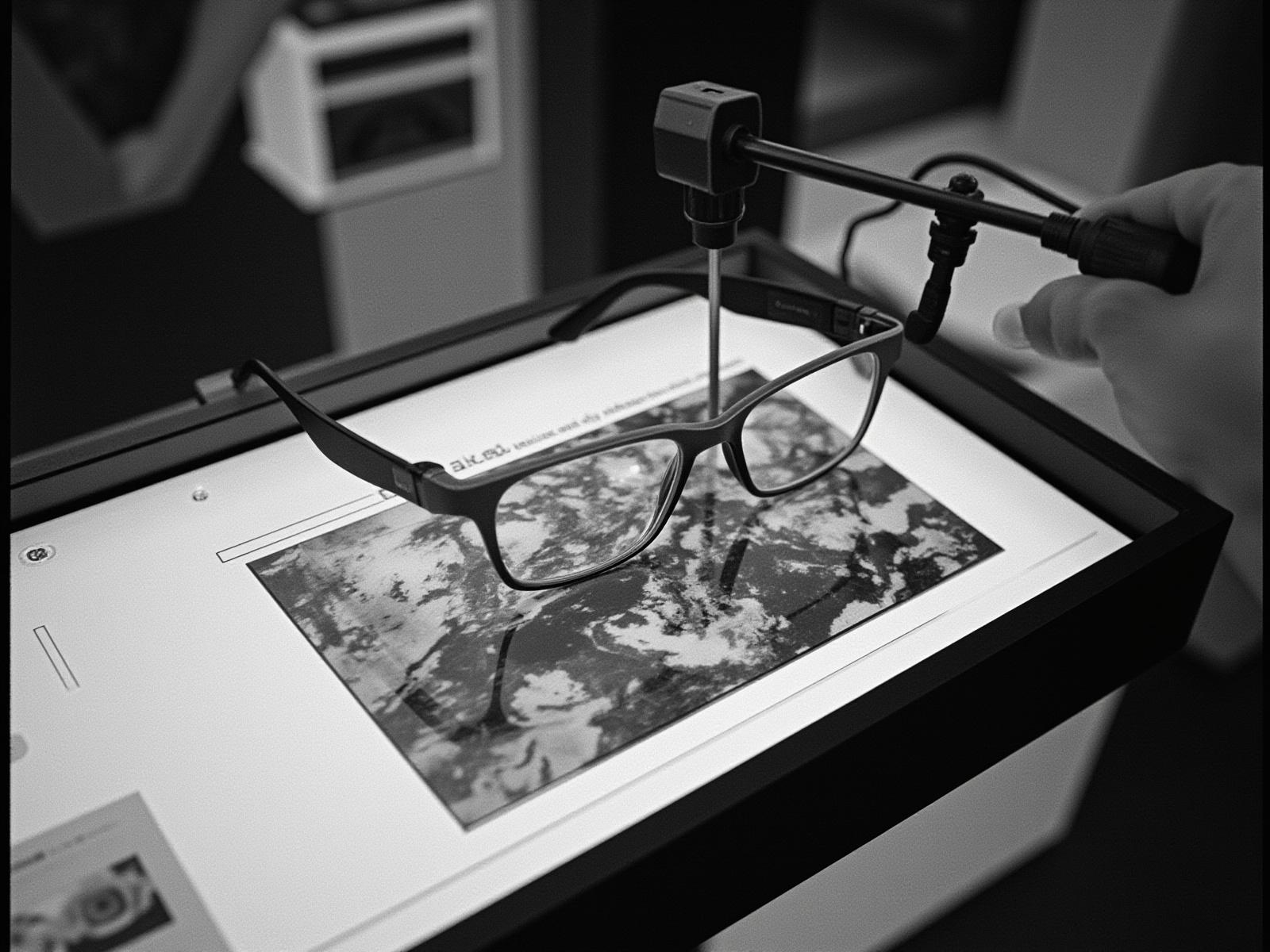
Because no condition is published, the sample order has to produce one. A measurement run without a protocol agreed in advance produces a number you cannot use in a specification, in a listing or in a conversation with a customer who measured something different.

- Fix volume as a percentage, not as a description. "Half volume" is not a protocol; 50% on a named source device is.
- Name the codec and fix the distance. Keep the source stationary and record the distance in metres. Radio conditions are part of the measurement.
- Record the mode state before each run. Surround engaged or disabled is the variable most likely to explain the difference between your result and the published one.
- Run at least three units and take the mean. A single unit is an anecdote and a best-unit result is a marketing number. Record the spread as well as the mean, because the spread tells you whether your customer will have a bad day.
- Repeat at a second volume. One point describes a condition; two points describe a slope, and the slope is what predicts your customer's experience at the volume they actually use.
- Attach the protocol and the date to the figure everywhere it appears — in the internal specification, in the listing copy, in the support script and in the purchase order.
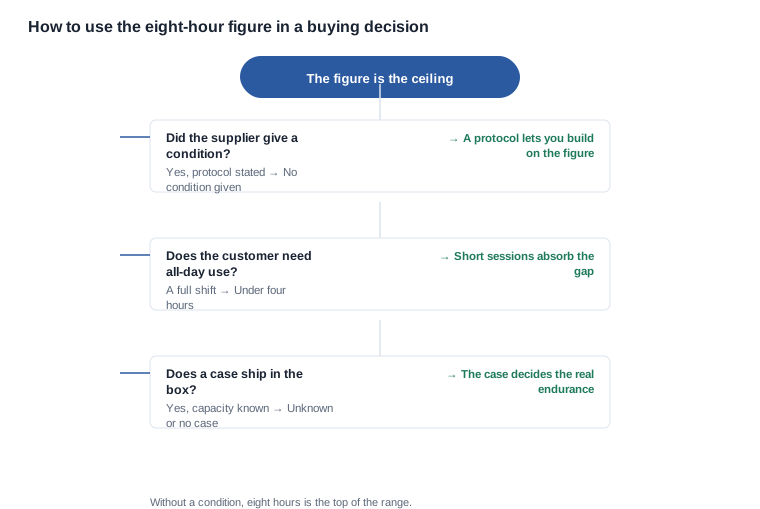
What to do with the result. If your measurement lands close to eight hours, you can quote the published figure with confidence and put the protocol in the technical file. If it lands materially lower, you have discovered the condition under which eight hours holds, which is more useful than either number alone — because it tells you what to write and what not to write. If the two disagree sharply, that is a conversation to have with the supplier before the bulk order rather than after it.
How to evaluate the supplier's answer before you commit. The protocol question can be answered in four ways, and they are not equally useful. A stated protocol with a date and a unit count is evidence. A description of typical use is an assurance. A promise to supply the data later is a delay. And a restatement of the eight-hour figure is nothing at all. Which of the four you get tells you how you should treat every other specification the supplier publishes, because a supplier that will not attach a condition to a runtime rating will not attach one to an acoustic claim either.
The negotiation consequence. If the supplier will produce a protocol on request, ask that it be supplied as a standing document with each quotation rather than as a special favour on the sample order. It costs them nothing and it moves the whole conversation from a dispute about numbers to a documented baseline that both sides can audit. If the supplier will not, then the runtime row should be excluded from the specification entirely, and the purchase decision should be made on the shared platform rows, the case economics and the delivered unit cost — which is a legitimate basis, provided the brand knows that is what was done.
Writing the runtime into a specification, a listing and a warranty
In an internal specification, state the rating as a rating and record the condition separately. "Rated about 8 hours; measured condition unverified; own sample measurement to follow" is a specification that a planner can use. "8 hours" is a promise that a planner will eventually be held to.
In a listing, the published figure with a stated condition is more persuasive than a larger unqualified number, and it is safer. A customer who measures five hours against an honest "rated about 8 hours under the stated conditions" has a question about the product. A customer who measures five hours against an unqualified "8 hours" has a question about the seller, and that is a different and more expensive conversation to have in public.
In the support script, give the agent the protocol and the mode-state dependency. The single most common support question on a runtime claim is "why does mine not last", and the answer is almost always one of the five variables above rather than a defect. An agent who can name the variable has resolved the ticket; an agent with a catalogue number has escalated it.
In the warranty, two rows decide the cost. First, whether a warranty claim on a twin-cell unit is settled by replacing the unit or the single cell, because that halves the provision if the second option is available. Second, where the failure is expected to cluster: on a tight configuration the clustering tends toward months four to six, which is inside the period a brand offers and often outside the period a factory stands behind. Ask both questions in writing before the first order.
The commercial question behind all of it. Whether a case ships in the box decides whether this is a one-shift product or an all-week product, and published case capacities elsewhere in our catalogue run from 900 mAh to 1400 mAh. That is a wide range of real products sitting behind one unpublished number, and it changes the accessory minimum order quantity, the packed weight, the freight class and the customer's routine all at once. It is the first question to ask and the first to close.
On total cost, the runtime figure is rarely the deciding line. In a product with two 70 mAh cells, magnetic charging and no published weight, the lines that actually move the landed cost are the accessory minimum order quantity, the packed weight that determines the freight class, the payment terms and deposit structure, and the warranty provision. A buyer who negotiates hard on unit price and never asks about the case has negotiated the smallest part of the quotation. The lead time on the sample order and on the first bulk order are worth stating separately as well, because a runtime that cannot be verified before the season closes is a runtime the brand cannot claim in its launch material.
The risk red flags worth naming before you commit. A supplier who quotes the eight hours without being asked what the condition is. A supplier who cannot say whether the surround mode was engaged during the measurement, when the model publishes a surround description. A supplier who answers the case question with "it depends on the quantity" and will not put the threshold in the quotation. And a supplier who offers the certificate references but not a cell test summary covering the fitted cell. None of those is disqualifying on its own; together they are a pattern, and the pattern is the same one that shows up late in a shipment rather than early in a quotation.
The boundary we will and will not cross on this figure
We publish the figure the catalogue gives — roughly eight hours — and we tell you plainly that it sits above what the nominal capacity alone would predict, which is exactly why the condition matters rather than being a footnote.
We will not quietly downgrade the figure to a number we can defend more easily, because a silently reduced number is harder to audit than a published rating with a caveat. We will not defend it as a measured average without the data. We will not attach a volume, a codec or a distance to it that nobody has supplied. And we will not present the LC-105-1's efficiency as evidence about this model, because two different suppliers' rating conventions are not a measurement.
What we will do is tell you precisely what has to be true for the figure to hold in your customer's hands, and give you the protocol that establishes it. Send us the channel, the target retail price, the quantity and the wear session your customer actually has, and we will tell you whether this model covers it — and whether the case question changes the answer.
A closing note on how to use the two-hour charge figure. It is published as "up to two hours", which is a ceiling rather than a typical value, and "up to" is doing real work in that sentence. The figure depends on the input current the charger supplies and on the starting state of the cells, and neither is published. Ask for the input current and voltage the frame requires, then compare it against the adapter your customer already owns — a customer who plugs into a phone adapter that supplies less current will see a longer charge time, and will experience that as the product not working as described. The same question applies to the case, if one ships: it has its own input requirement, and a case that charges more slowly than the frame changes the routine the customer has to learn.
And a closing note on what a bulk order does and does not change. A first order on a platform like this establishes the production build, the firmware version and the quality control baseline, and it is the point at which most of the open rows on this page become closable — because from that build onwards you can measure rather than quote. It does not change the published specification, and it does not convert a rating into a tested figure on its own. Buyers who treat the first bulk order as the end of due diligence have skipped the step that actually produces evidence; buyers who treat it as the beginning of it get a defensible specification by the third order.
How the case changes the product is covered in smart glasses battery life, the range this model belongs to is on the sport smart glasses page, and testing a sample rather than reading a datasheet is covered in sample evaluation.
Five questions to close before you commit
- What measurement protocol produced the eight-hour rating, and was the surround mode engaged?
- Is a case or dock included at our quantity, and what capacity does it carry?
- What input current and voltage does the frame require, and what does the case require?
- What is the single-side failure behaviour, and how is that settled on a warranty claim?
- What is the frame weight, measured with the cells fitted?
Related reading
- How the case changes the product — smart glasses battery life
- Which product line this model is in — sport smart glasses
- Testing a sample rather than a datasheet — sample evaluation
Send the wear session, the channel and the quantity, and we will tell you whether the figure covers it.


