

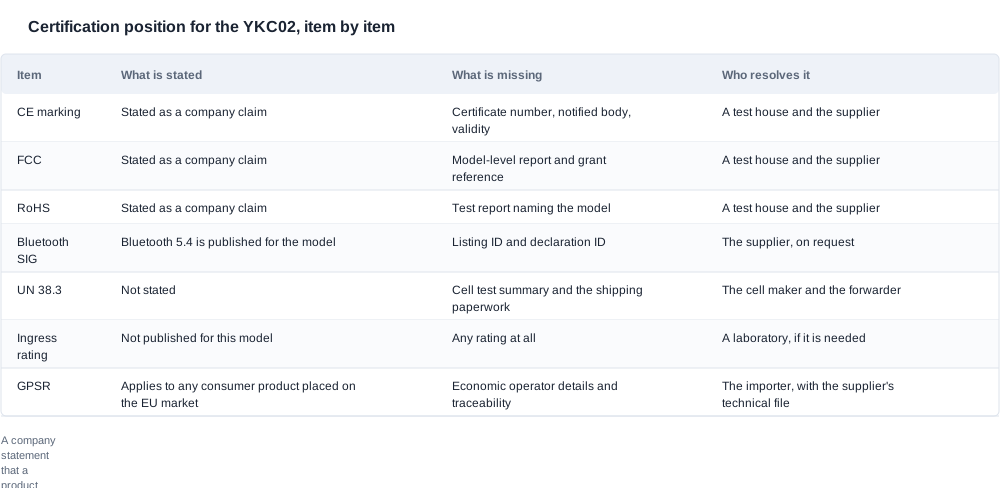
The certification position for the YKC02, stated honestly, is that a company claims CE, FCC and RoHS for the product family, that Bluetooth 5.4 is published for this model, and that no certificate number, test report reference, laboratory name or validity date is published for this specific model. That is not an unusual position for a Chinese manufacturer and it is not a disqualification. It does mean the paperwork is a deliverable you have to request rather than something you can rely on.
This page is for the importer or brand owner who has to place the product on a market and defend its compliance, and it sets out what is claimed, what is missing, who resolves each item and — most usefully — which gaps block a listing and which ones block a shipment.
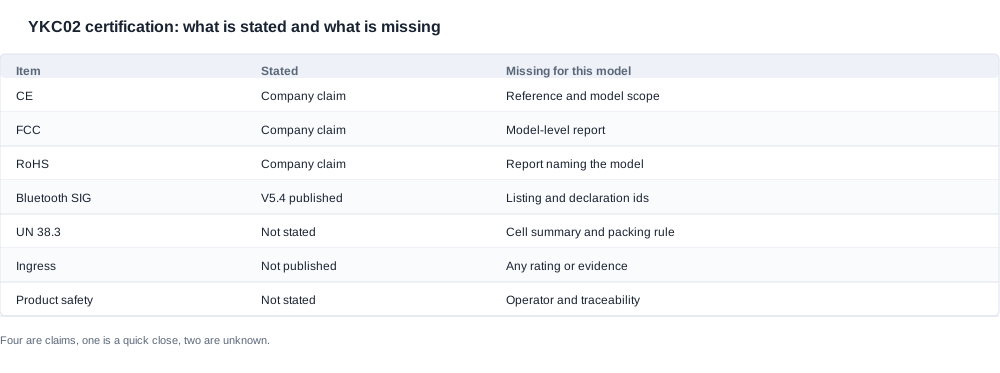
YKC02 certification status: the seven items and who resolves each one
1. CE marking. The company states CE conformity for the range. What is missing for this model is the certificate number, the notified body, or — if the product is self-assessed — the technical file reference, and the validity. Note that the YKC02 is a Bluetooth audio product, so the relevant regime is the radio equipment framework, and a product with radio and a battery carries obligations on both sides of that. The route to the missing detail is the supplier's technical file.
2. FCC. Stated as a company claim. The missing item is a model-level report and grant reference. The distinction matters more here than anywhere else on the list: a grant issued for one product does not cover a different product, and a supplier who cannot produce a report naming the YKC02 has told you something important about how this model was tested.
3. RoHS. Stated as a company claim. The missing item is a test report naming the model, with the substance declarations that accompany it.
4. Bluetooth SIG. The model publishes Bluetooth 5.4, so a listing should exist. The missing items are the listing identifier and the declaration identifier. These are quick to obtain and quick to verify, and they are the cheapest of the seven to close — which is why they belong at the front of your request rather than the back.
5. UN 38.3. Not stated at all for this model, and it is the one that will stop a shipment rather than a listing. The cell test summary has to cover the specific cell fitted, and the packing instruction has to reflect that cell's watt-hour rating. The battery transport compliance notes set out the route.
6. Ingress rating. Not published for this model. If you need a water claim, it comes from a laboratory, and the IP rating testing notes explain the question to ask. A category-level marking cannot be attributed to a specific model, and that mistake reaches a marketplace listing and stays there.
7. GPSR and the general product safety framework. This applies to any consumer product placed on the EU market, whatever the radio. The economic operator details, the traceability arrangement, the technical documentation and the responsible-person designation on the packaging are obligations that sit with the party placing the product on the market. That is your side of the file, and it is worth having it structured before the first shipment rather than during the first customs query. It is also the only item on the list that does not depend on the supplier at all, which makes it the one to start while you are waiting on the documents above.
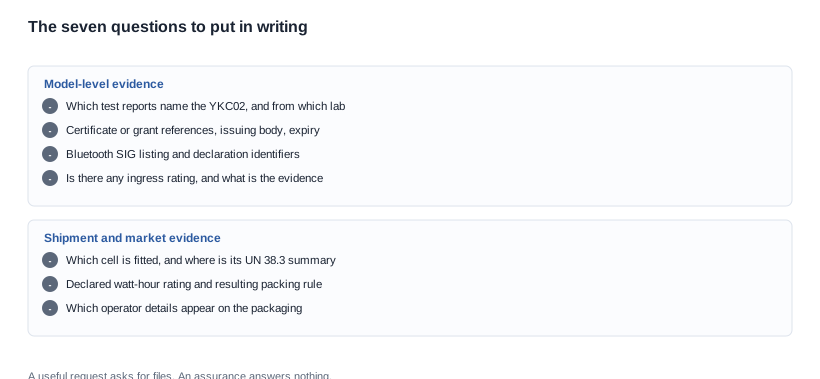

How to structure the request so it can actually be answered
Ask for the file rather than for assurances. A useful request reads like this: send us the complete conformity documentation for the YKC02, including the test reports that name the model, the certificate or grant references with their issuing body and validity, the Bluetooth SIG listing identifiers, the cell test summary referenced by the battery marking, and the technical file index. If any of those do not exist for this model, say so in writing.
The reason to ask this way is that both answers are useful. A supplier who answers "yes, we are CE certified" has told you nothing and you are back where you started. A supplier who cannot produce a document naming the YKC02 has told you that this model was never separately tested — and that is a product decision, not a paperwork delay.

Five habits that make the difference between a reply and an answer. Name the model rather than the family, because a family reference is the single most common reason a request comes back incomplete. Ask for identifiers as well as reports, because identifiers can be verified in minutes and reports can only be taken on trust. Ask what does not exist, because a supplier who volunteers a gap is giving you the most useful sentence in the exchange. Sequence the request so the fast items come first, which builds the momentum that gets the slow ones answered. And record every answer in the technical file before the deposit, because the moment you have paid is the moment your leverage on this conversation changes.
The one to not skip. Asking what does not exist. Most suppliers will happily send you a family-level conformity statement and call the request satisfied. The question that surfaces reality is: which of these documents exist for the YKC02 specifically, and which exist only for the platform? It is an uncomfortable question to ask and it is the one that determines whether you find out now or at a customs query.
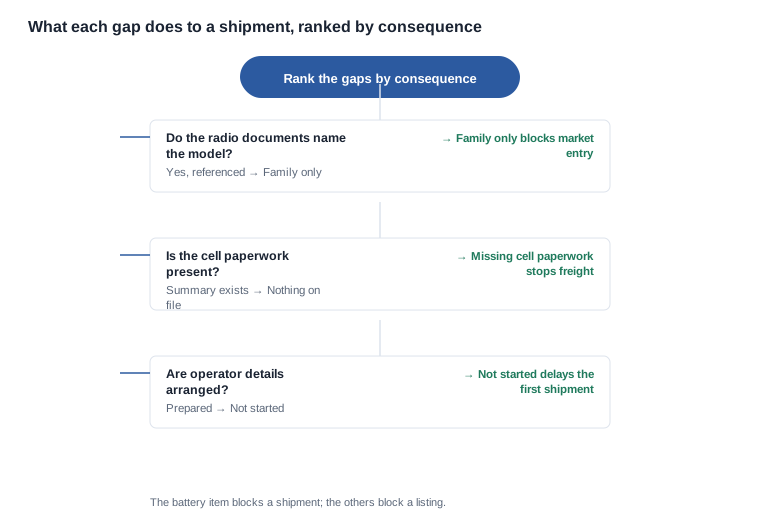
What the certification position means for the model
The YKC02 is a sport frame with two 70 mAh cells, Bluetooth 5.4, magnetic charging and about 8 hours of rated use, and it is published without an ingress rating. The compliance surface is therefore narrower than a sport camera product's would be, because there is no camera, no recording and no data question. In a category where camera-equipped products attract a different level of scrutiny, that is a real reduction in exposure, and for a brand entering a new market it is a genuine argument for this model over the V06 or the S7.
The narrower surface does not remove the radio, the battery or the general consumer product obligations. It just means the list above is the whole list. A competent supplier should be able to answer all seven, and if they answer six, the seventh is the one to ask about on the next call.
What the compliance gap costs in practice. It is worth being concrete about the commercial consequence, because buyers often treat certification as a checkbox rather than as a schedule risk. A missing model-level radio report does not stop a listing; it stops market access, and it stops it at the point where a platform or an authority asks for the reference. A missing cell summary does not stop a listing at all; it stops the freight forwarder, which means the shipment does not leave. Both failures arrive late, and both are cheaper to prevent in an email than to resolve in a warehouse.
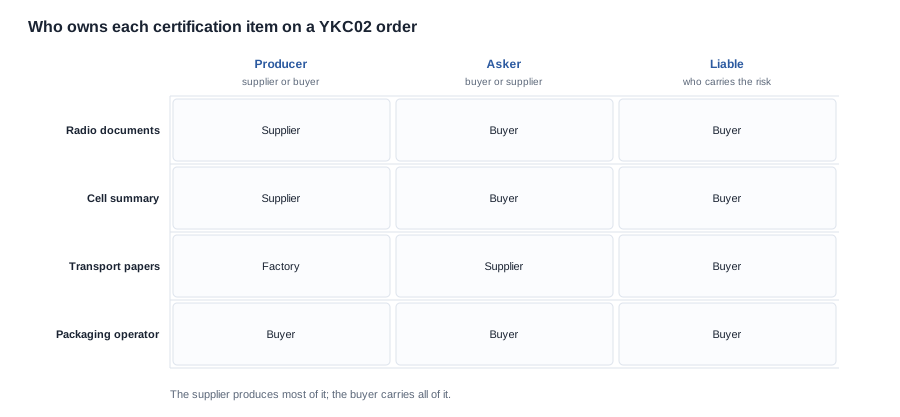
Who carries the risk, plainly. The supplier produces most of the documents. The buyer must ask for all of them. And the buyer carries the liability, because the party placing the product on the market is the party the framework holds responsible. That asymmetry is why the request should be made in writing, why the answers should be filed, and why a family-level reference should never be filed as a model-level one.
What to put in the purchase order. The certificate and grant references naming this model, with issuing body and validity, for each destination market. The Bluetooth listing and declaration identifiers. The cell fitted, its test summary and its declared watt-hour rating. The packing instruction that follows from that rating. The warranty period with a stated response time. And the warranty and compliance clauses that name this designation explicitly, so that a future supply from a different factory is still covered by the agreement you signed.
The commercial lines that belong in the same agreement. Certification cost and lead time, which follow the process and the testing body rather than the negotiation — ask which line you are being quoted, because these costs are frequently bundled with tooling into a single figure that hides which is amortised across the first order and which is per model. The lead time on any outstanding testing, stated separately from the production lead time. The payment terms, with the balance node tied to receipt of the model-level references. And a notification clause for any change of cell, amplifier, transducer or test body between orders, because a substitution that changes the compliance basis of a product already listed is a different event from a substitution that changes its cost, and only one of them gets communicated.
What to leave out of the agreement. Any representation that the model is certified where the reference names only a family. Any ingress rating where no test report exists. Any statement that the documents will be "arranged" without a date attached. And any warranty period that is not stated as a period with a response time, because a duration without a response standard is not a commitment a channel can sell.
Auditing the file before you commit
Receiving a conformity file is not the same as having a compliance position, and the difference is where most importers discover they have a problem. The test is not whether a document exists — it is whether the document names this model, this cell and this destination. Three references can sit in one file and answer three different questions, and a file that looks complete can still leave the shipment exposed.
The audit, in order. Take each item from the seven and ask four questions of it: does the document name the YKC02; does it carry a reference number rather than a name; does it carry an issuing body and a validity date; and does it cover the destination market you are actually shipping into. A document that fails the first question is evidence about a platform, not about a product, and it should be filed separately so that nobody downstream mistakes one for the other.
What to do with a platform-level document when that is all that exists. File it as what it is, and pair it with a written statement from the supplier that this designation is within the scope of that testing. That statement is not a certificate and will not satisfy a market-access authority, but it does establish that the supplier considers the model covered, and it is the starting point for either a new test programme or a different model. The mistake to avoid is promoting a family reference into a model reference because the paperwork was needed quickly — that is how a product reaches a market with nothing behind it, and how the problem surfaces at the worst possible moment.
The criteria for deciding whether to proceed. Four questions, in this order. Do model-level radio references exist for this designation? Is the cell paperwork present for the cell that will actually ship? Are the packaging operator details arranged, with a responsible person in the destination market? And is there anything in the list you would be willing to explain to a customs authority in writing? If the answer to the last one is no, the commercial decision has already been made, whatever the quotation says about lead time and unit price.
The red flags worth naming. A supplier who sends a family-level declaration when asked for a model-level report, and does not say so. A supplier who answers the ingress question by pointing at the category description. A supplier who offers to "arrange" the certification after the first order rather than before it. And a supplier who is vague about which cell is fitted, because the cell determines the transport paperwork and the transport paperwork is the item that stops freight. None of these is fatal on its own; all four together describe a supplier who will make the problem visible to you rather than hiding it, which is at least a workable relationship.
The negotiation that follows from an incomplete file. This is worth raising early, because the cost of the remedy varies enormously. Ask whether the missing documents are a scheduling question — a test booked, a report in progress — or a scope question, meaning the work was never done for this designation. The first has a lead time you can put in the purchase order and a certificate reference you can hold the balance against. The second has a cost, a lead time and possibly a different model. Knowing which of the two you are dealing with before you sign is the entire purpose of the request.

Consequences by shipping mode, and how to sequence the work
The same seven items land differently depending on how the goods move and where they land, so the request should be built per lane rather than per product.
Air freight and a direct commercial sale is the lightest lane. The commercial documents travel with the goods and the buyer usually holds the compliance file, so a family-level reference is more likely to pass unchallenged. That is not a reason to relax; it is a reason to understand that the exposure sits with the buyer rather than with the freight forwarder.
Sea freight and a distributor adds a layer. The distributor becomes the party placing the product on the market in their territory, which moves the economic operator and responsible-person obligations to them. Your request should therefore include the packaging operator details explicitly, because they are the item a distributor will ask you for first and the one you are least likely to have prepared.
Air courier and a marketplace listing is the strictest on presentation and the loosest on evidence. A marketplace may ask for a test report reference and accept a family-level answer, which means a listing can go live on evidence that would not survive a customs query. Do not let the marketplace's tolerance set your standard, because the same listing will eventually be compared against one that has model-level documentation, and the difference becomes a question from a customer rather than a request from a platform.
How to sequence the work for a first shipment. Send the request for the fast items — the Bluetooth identifiers — in the first message, because they usually come back within days and they establish that the supplier answers requests rather than deflects them. Send the request for the model-level reports in the same message but expect them to take longer. Ask the cell question separately and early, because the answer determines your freight booking rather than your listing. Arrange the packaging operator details in parallel, since they depend on your own structure and not on the supplier. And ask the ingress question last, because it is the one you are most likely to decide you do not need.
What to hold until the answers arrive. Do not release the balance on a purchase order whose compliance conditions are open. Tying the final payment node to receipt of the model-level references is the standard mechanism and it costs nothing to ask for, because a supplier who intends to supply them has no objection to the clause. A supplier who objects to a compliance-linked payment node is telling you something about the file, and that inference is usually more valuable than the argument you would win by pressing.
The boundary we will not cross on certification
A company statement of conformity is the start of a conversation rather than the end of it, and the only useful test of a supplier's certification readiness is whether it produces documents that name the model. We will not publish a certificate number we have not seen. We will not state a certification status for the YKC02 that our own documentation does not support. And we will not present the CE, FCC and RoHS claims as verified, because a claim is not a verification and a buyer who is told otherwise discovers the difference at their own expense.
If you would rather not run this file yourself. Some importers buy from a supplier who holds the compliance position and takes a declaration instead, which is a legitimate model provided the declaration names the model, carries references you could verify and comes with a warranty that transfers the liability. What does not work is buying on a family-level assurance and assuming the risk sits with the supplier, because the party placing the product on the market is the party the framework holds responsible, and that party is you.
The sport smart glasses buying guide covers the commercial side of the same conversation, and the export documentation checklist covers the paper that travels with the goods.
Seven questions to put in writing
- Which test reports name the YKC02, and from which laboratory?
- What are the certificate or grant references, the issuing body and the expiry date?
- What are the Bluetooth SIG listing and declaration identifiers?
- Which cell is fitted, and where is its UN 38.3 test summary?
- What is the declared watt-hour rating, and what packing instruction follows from it?
- Which economic operator details and traceability arrangements will appear on the packaging?
- Is there any ingress rating for this model, and if so what is the evidence?
Related reading
- The catalogue rows for this model — YKC02 smart glasses specifications and features
- The general checklist for this range — sport smart glasses certification status
- The paper that travels with the goods — OEM ready platforms export documentation
Send us the destination market and the shipping mode, and we will tell you which of the seven items are on the critical path for that lane.


