

Most buyers arrive at the YKC02 with a question shaped by the category rather than the datasheet. They have seen a sports-category smart glasses line, they carry a mental picture of what a wearable of this kind should weigh, how long it should run, and whether it survives a rain shower, and they want a supplier to confirm that picture in one email. The trouble is that the YKC02 catalogue entry is unusually narrow, and the gaps between what it publishes and what a procurement file needs are exactly where cost surprises live. This article works through the published specification first, then the unpublished fields one at a time, then places the model inside the sport category against its two siblings, and closes with the questions we will put to a supplier before a purchase order is raised.
The framing matters, because the most expensive mistake in this category is not choosing the wrong model. It is choosing a model and then discovering, halfway through a launch cycle, that the fields you assumed were settled were never published and never asked about. Assumptions in this category do not fail loudly. They fail on a warehouse receiving dock, in a retailer compliance review, or in a customer review that says the product did not do what the listing promised.
The published rows behind the YKC02
The published YKC02 record is short, and it is worth describing its shape precisely because everything else in this article flows from what it contains and what it does not.
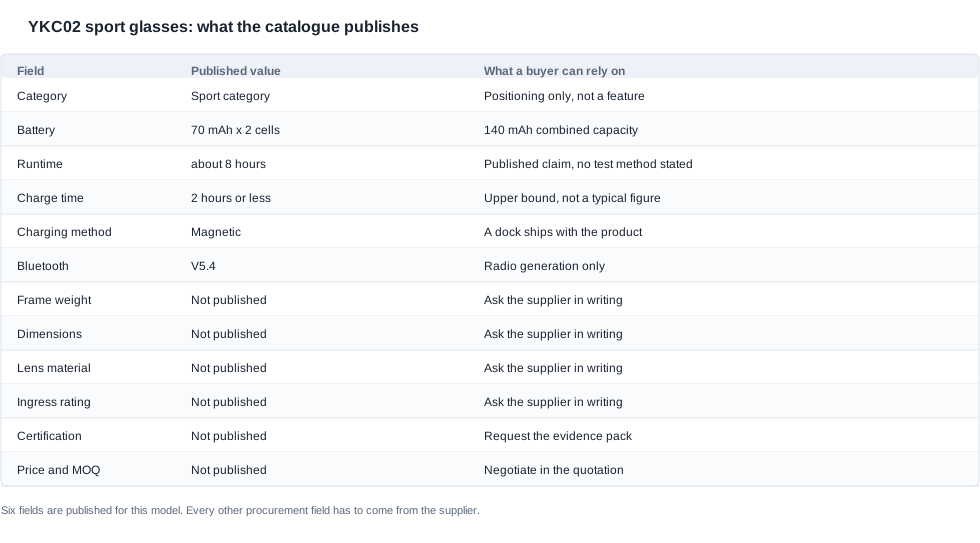
The catalogue places the model explicitly in the sport category. It carries two 70 mAh cells, giving a combined capacity of 140 mAh, and the published runtime is about 8 hours. Charge time is published as 2 hours or less. The charging method is magnetic. The Bluetooth version is V5.4. Alongside those six specification rows the catalogue lists two feature descriptors for this model: surround sound, and a long-endurance row. That is the whole published record — six specification fields and two feature names, with nothing measured behind any of the sound or endurance wording.
Three of those published fields deserve a note before anyone builds a quotation around them. The two-cell arrangement and the magnetic interface are published side by side, and a buyer will assume the interface was chosen to suit the cell layout. We will treat that as an engineering inference rather than a catalogue statement, and it is exactly what a supplier has to confirm in writing: whether the dock charges both cells together or in sequence, and whether the cradle ships in the box as a separate physical item that has to live somewhere in the retailer's fixture. The runtime of about 8 hours is a published figure rather than an independently measured one, and no test protocol, screen state, or audio state accompanies it. The charge time of 2 hours or less is an upper bound rather than a typical value, and that distinction matters when you are scheduling a promotion, a trade show floor, or a staff rotation, because the number that governs your logistics is the worst case rather than the average.
The V5.4 radio is the fourth field, and it is the one most often over-read. A published Bluetooth version tells you the pairing stack a buyer should expect and roughly which device-generation behaviour is available. It does not tell you the range, the latency, the number of devices held in the paired list, the codec, or whether the firmware supports multipoint or a dual-device state. None of those are published for this model, and we will not substitute a value borrowed from a neighbouring product that happens to share the same radio standard. If you are building a compatibility claim for a retailer, treat the radio version as a fact and everything built on top of it as an assumption to be tested on a sample.
What the specification sheet does do is set a floor. A buyer can treat the runtime, the charge cycle, the charging interface, and the radio generation as firm, because they are on the record. Everything else in this article concerns the fields that are not on the record, and about how to convert those unknowns into questions that a supplier can answer in writing, preferably in the same document that carries the commercial terms.
One clarification about the runtime figure is worth making explicit, because it is the single most compared number in this category and it is compared carelessly. About 8 hours of runtime for a sports-category model is strong in absolute terms, but the comparison only holds if the competing models are measured the same way. The two nearest siblings publish their own runtimes, one at about 7 hours and one at about 8 hours, and neither publishes the test conditions. When you compare runtime figures across models, you are comparing marketing claims until somebody shows you the test method. We will ask for the test method before we let a runtime figure appear in a listing we control, and our broader notes on how these numbers are typically produced sit in the battery life reference.
What the catalogue does not publish about the YKC02
Here is the uncomfortable part. The catalogue publishes no frame weight, no frame dimensions, no lens material, no colour options, no ingress protection rating, no certification status, no price, no minimum order quantity, no lead time, no sample policy, and no warranty term for this model. Each of those is a field a procurement file closes. When none of them is on the published record, the buyer has three honest options: ask, assume, or negotiate a pilot order under assumptions that are written down and agreed.
We will treat the unknowns as unknowns throughout this article, and we will not fill them with values borrowed from a neighbouring model in the same catalogue. It is tempting to infer the frame weight from the sport category, or the ingress rating from a sibling model that does publish one, and it is tempting to price the model from a price list that covers a different tier. Each of those inferences is a guess with a quotation attached to it, and a guess that reaches the purchase order becomes an unfunded commitment.
Some of these gaps are ordinary for a catalogue at this level of detail, and a competent supplier will close them in a single reply. Frame weight and dimensions are the most commonly supplied, because they are physical facts with a tape measure and a scale behind them. Lens material and colour availability usually arrive as a table. Ingress protection is the one field that requires a laboratory report rather than an opinion, and if the supplier cannot produce a report, the honest answer is that the model has no published rating. The mechanism behind these ratings, and why two different protection codes are not interchangeable in a retailer review, is set out in the ingress protection reference. Certification evidence is the other field that demands a document rather than a conversation; if the catalogue body carries no certification claim for this model, then the responsible approach is to request the evidence pack through the same route we use for any supplier review, and to treat the absence of a response as the absence of the evidence rather than as a delay in paperwork.
Commercial fields follow a separate logic. Price, minimum order quantity, lead time, incoterms, tooling, packaging, spares, warranty, and sample policy are not product facts at all; they are the terms of a relationship, and they belong in a quotation rather than on a datasheet. The reason we list them here as not published is that a first-time buyer frequently assumes the catalogue carries a reference price, and then builds a margin model on a number that was never a commitment. That number then moves silently through a spreadsheet until someone tries to place a real order against it. We will ask for a written quotation that states the minimum order quantity, the lead time from purchase order to shipment, the incoterms offered, any tooling or customisation charges, the packaging specification, the spares ratio, the warranty term, and the sample terms, including whether samples are paid and how they are credited against a first order.
Two absences deserve emphasis because they are the most common reasons a deal in this category stalls. The first is ingress protection. The catalogue publishes IP54 for only two models, and the YKC02 is not one of them, so the model has no published ingress rating at all. A buyer who plans to sell a sports-category product into outdoor retail will assume, plausibly and incorrectly, that a sports model carries a splash rating, because that assumption is reasonable and because it is what competing listings imply. If the model genuinely has no rating, then the packaging copy, the retailer's own compliance checklist, and the end customer's expectation all have to align to that fact, and that alignment work costs far more than a single question would have cost.
The second is certification. No certification status is published for the YKC02, and we will not assert one in any listing, packaging copy, catalogue page, or sales deck. What we will do is request the evidence pack, review what arrives against what it claims, and describe the model accurately. A claim that cannot be produced on request is a liability that scales with your order volume, because every retailer, marketplace, and distributor you sell through will ask for the same document, and the answer will not improve the second time. The certification checklist for procurement is the reference we use to structure that request so that nothing important is skipped.

Where the YKC02 fits in the sport category
The sport category is not large. It contains exactly three models: the YKC02, the D17, and the ZH12. Understanding where the YKC02 sits among those two siblings is the fastest way to place it in a line card, because the category is small enough to reason about completely rather than approximately.
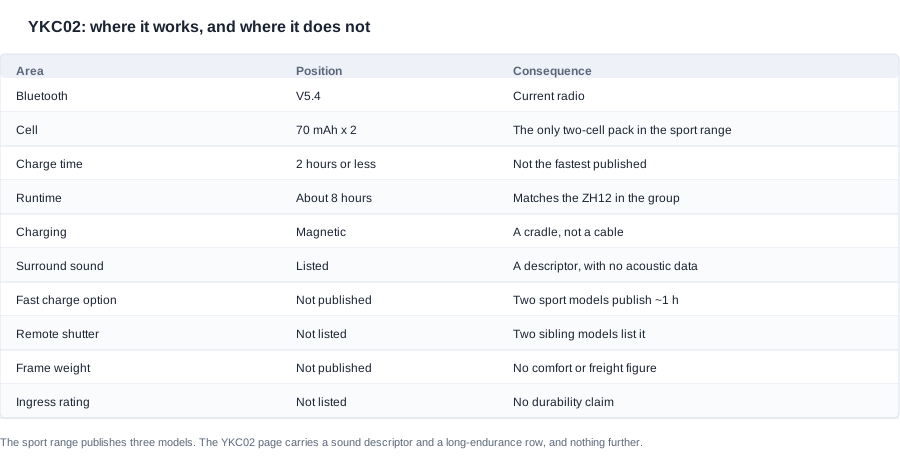
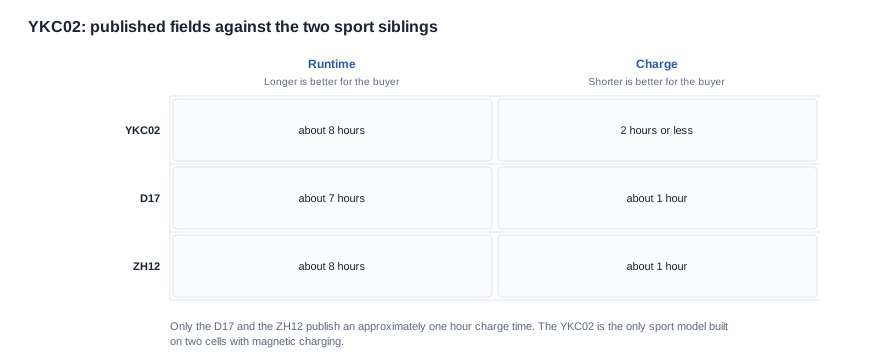
The YKC02 is the only member of the three that uses two cells. The D17 uses a single 115 mAh cell, and the ZH12 uses a single 100 mAh cell. The YKC02's combined 140 mAh is larger than either of the two single-cell siblings, but it is the only configuration in the category that needs a magnetic dock rather than a wired USB-C connection, and that is a mechanical and packaging consequence before it is an electrical one. It also means the retailer's charging display has to accommodate a cradle rather than a cable, which is a merchandising detail that shows up in fixture plans and in checkout counter space.
On runtime, the YKC02's about 8 hours matches the ZH12's about 8 hours and slightly exceeds the D17's about 7 hours. On charge time, the YKC02 sits at 2 hours or less while both the D17 and the ZH12 publish about one hour. That is the sharpest differentiator in the group, and it deserves the most careful procurement treatment, because it is a difference a buyer can feel in the field and a retailer can feel in reviews. Two models in this catalogue, and only these two, publish an approximately one-hour charge time, and both of them publish it alongside a wired USB-C interface. The YKC02 publishes a magnetic interface and a longer charge cycle. If your channel partner's argument for the D17 or the ZH12 is "one hour charge", that argument is on the published record, and you should treat it as true rather than as sales positioning.
On features, the split is clean, and it is worth being precise about which part of it is a naming difference and which part is a capability difference. All three models publish a sound descriptor: the D17 publishes surround sound, the ZH12 publishes stereo surround sound, and the YKC02 publishes surround sound alongside its long-endurance row. What the YKC02 does not publish is a remote control shutter, and that row appears on only the D17 and the ZH12 in the entire catalogue, so its absence from the YKC02 is a genuine omission rather than a phrasing difference. A second discipline applies to placement rather than to capability: the audio tier of this catalogue is exactly eight models, the YKC02 is not one of them, and no listing, comparison chart, or bundle proposal should place it inside that group just because it names a sound descriptor. The open-ear audio reference sets out how that tier is structured and where the YKC02 sits outside it.
The practical consequence for a channel buyer is straightforward. If your plan is to sell a sports line where the phone stays in the pocket and the glasses handle capture, the D17 and the ZH12 are the models that publish that workflow. If your plan is to sell the published runtime it shares with the ZH12, with a simpler capture story, the YKC02 is the model, and you should make your listing copy match what it publishes rather than what the category implies. Buyers lose margin on the second occasion when a customer returns a product because it did not do what the category suggested it would.
There is a second order effect worth naming: the sport category is three models wide, all three of them name a sound descriptor, and none of them sits in the eight-model audio tier. Buyers frequently assume that a sound descriptor means audio-tier membership, because the inference is natural and because the category label invites it. We will keep the enumeration separate in all of our material, and we will not place the YKC02 inside an audio list in any comparison table, because doing so would misrepresent both the model and the category, and because a channel partner who spots the error will start checking the other claims on the page. The full sport smart glasses category page is where we place the model for buyers who want the whole line at once.
For the broader published context across the catalogue, worth keeping in mind while you read this model: the catalogue covers 28 models, split into 8 audio models, 3 sport models, 11 camera models, 3 kids models, and 3 models with no model number, covering smart AR glasses, electrochromic glasses, and bone conduction products. Bluetooth version is published for 14 models and is not published for the 11 camera models or for several other entries. An 8 megapixel sensor appears on 8 models and a 13 megapixel sensor on 3. Charging is magnetic on 17 models and USB-C on 7, with the method not published for 4 entries. A charge time of 2 hours or less is the upper bound for 26 models in total, with only the D17 and the ZH12 publishing approximately one hour. The only published weight in the whole catalogue belongs to the MT6, at 158 grams for the glasses body, excluding its folding case.
None of those figures is a YKC02 figure, and we mention them only to make one point: the catalogue publishes a great deal for many models, which makes the YKC02's narrow record look like a deliberate choice rather than an oversight. That is a hypothesis worth testing with a supplier, not a conclusion to carry into a business case. Either way, the operational consequence for you is the same, which is that the YKC02 needs a supplier conversation that a better-documented model would not need.
YKC02 questions to put to a supplier
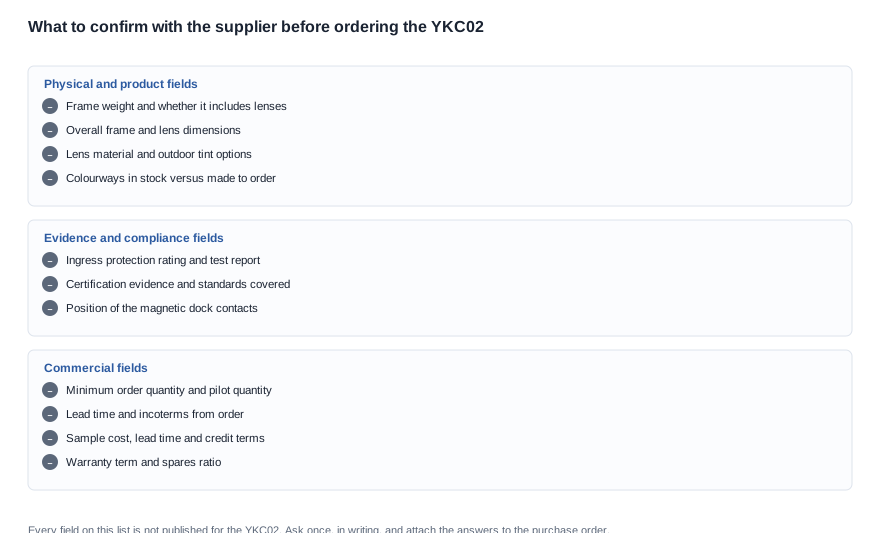
We will ask the following in a single structured message, and we will expect answers in writing, because a quotation that answers half of these in a follow-up call is a quotation we cannot safely pass to a customer.
- What is the frame weight of the YKC02, and does that figure include the lenses?
- What are the overall frame and lens dimensions, and is there a size range or a single size?
- What lens material is used, and is there an option for a polarised or tinted lens for outdoor use?
- What colourways are available, and which are in stock versus produced to order?
- Does the YKC02 have an ingress protection rating? If yes, please supply the test report and the standard used; if no, please confirm that in writing.
- What certification evidence can you supply for this model, and which standards does it cover?
- What is the minimum order quantity, and how does it change for a pilot order?
- What is the lead time from purchase order to shipment, and what incoterms are offered?
- What are the sample terms, including sample cost, sample lead time, and whether a paid sample is credited against the first purchase order?
- What is the warranty term, and what spares or replacement ratio do you recommend for this category?
- Are there tooling, moulding, or customisation charges, and how are they amortised across repeat orders?
- What is the packaging specification, and does it accommodate the magnetic charging dock?
We will also ask how the two 70 mAh cells are arranged inside the frame, because that question determines where the magnetic dock attaches, whether the temple balance is affected, and whether the charging cradle needs its own shelf space in a retail display. The answer is a design detail that a buyer who has already committed to a retail fixture would want to know before the first shipment rather than after.
On certification specifically, we will be careful in how we ask. The catalogue body for this product line carries no certification claim for the YKC02, and we will not assert one in any listing, packaging copy, or sales deck. We will request the evidence pack, and if the evidence pack arrives we will summarise it in the terms the report actually supports, which may be narrower than the report title. If it does not arrive, we will describe the model without a certification claim, which is a decision that costs less than a claim that cannot be defended. That is the whole argument for running the checklist rather than negotiating from instinct.
On the sample, we will ask for it first and the pilot order second, in that order, and we will treat them as answering different questions. A sample answers what a datasheet cannot: how the magnetic dock behaves in a pocket, how the runtime behaves across a long outdoor session, how the frame sits on different face shapes, how it carries its weight over a full session once the supplier has told you what that weight is, and whether the controls can be operated one-handed without a remote shutter. A pilot order answers a different question, namely whether the supplier can repeat what they did once, at the same quality, in the same lead time, in the same packaging. Both are cheap relative to a landed cost built on an incorrect assumption, and both belong inside the commercial terms we negotiate before the first purchase order.
A useful negotiation habit here is to separate the trade-offs explicitly rather than letting them blur into a single discount discussion. The trade-off between a magnetic interface and a faster charge cycle is real, and it is a product design trade-off rather than a supplier performance issue. The trade-off between the narrow published record and the commercial certainty we need is also real, and it is a documentation trade-off. We will negotiate the second one hard, and we will accept the first one once it is explained and documented. Mixing the two into one argument is how buyers end up paying a premium for a discount on a field that was never the problem.
The recurring theme across all of this is that a published specification is a floor and a commercial quotation is a floor too, but the two floors do not meet in the middle. The YKC02 publishes enough to define its position in the sport category: two 70 mAh cells, about 8 hours of runtime, a charge cycle of 2 hours or less, magnetic charging, Bluetooth V5.4, and a surround sound descriptor. It publishes nothing about the physical product beyond that, and it publishes nothing about the commercial terms, which means a buyer has to source every one of those fields from the supplier rather than from a page. The buyers who handle this best are the ones who treat the missing fields as a structured question list instead of a reason to walk away, and who close that list before the purchase order rather than after the first shipment.


