
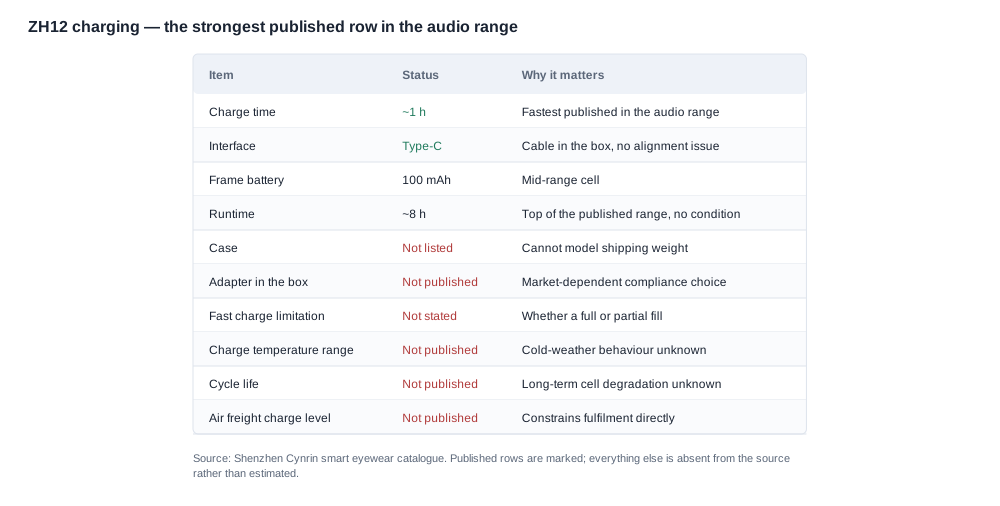
Buying a pair of smart glasses on a spec sheet is easy. The ZH12 sport model publishes a short, clean set of charging numbers, and on the surface it looks like the best-charged model in the whole range. A single 100 mAh cell. About eight hours of runtime. A charge time of about one hour. USB-C.
Then you start reading the same catalogue for the other twenty-seven models and you realise that "about one hour" is not measured against a uniform lab protocol. Every other model in the range publishes a ceiling, not a figure. If you are a brand buyer, a channel partner, or an e-commerce seller preparing a purchase order, that gap is where your margin quietly disappears: in the returned units, in the counter demo that dies halfway through, in the marketplace listing that has to be corrected after a competitor publishes a tighter number.
This article breaks the ZH12 charging row down into what is actually published, how it compares with the rest of the catalogue, what the row deliberately leaves open, and the exact questions to put to a supplier in writing before you commit.
What the ZH12 charging row publishes
The ZH12 sits in the sport category of the catalogue, which contains exactly three models: YKC02, D17, and ZH12. It is important to state that plainly, because "sport smart glasses" is sometimes read as an audio product or a camera product. The ZH12 is neither. It is published as a sport model with two named features: remote control photo, and stereo surround sound. There is no camera resolution row for the ZH12 in the catalogue, so no one should describe it as a camera model in a listing, a comparison chart, or a tender document. If your competitor's copy calls the ZH12 a camera, that is a claim they cannot evidence, and it is worth knowing before you answer their listing.
The charging row for the ZH12 publishes four things and no more:
- Cell configuration: a single 100 mAh cell.
- Runtime: about eight hours.
- Charge time: about one hour.
- Charging method: USB-C, published in the catalogue under its Type C designation.
- Bluetooth version: V5.4, published alongside the battery fields as part of the same connectivity grouping.
The catalogue name is ZH12 sport smart glasses. That is the string that should appear on your purchase order, your packing list, and your product title. Catalogue naming is the cheapest form of specification control there is: if the name on your purchase order matches the name in the supplier's catalogue row, there is nothing to argue about later. We will insist on that exact string in every document we sign, because the cheapest way to avoid a dispute about which unit was shipped is to never let two names exist, and we will not accept a shortened variant on the packing list.
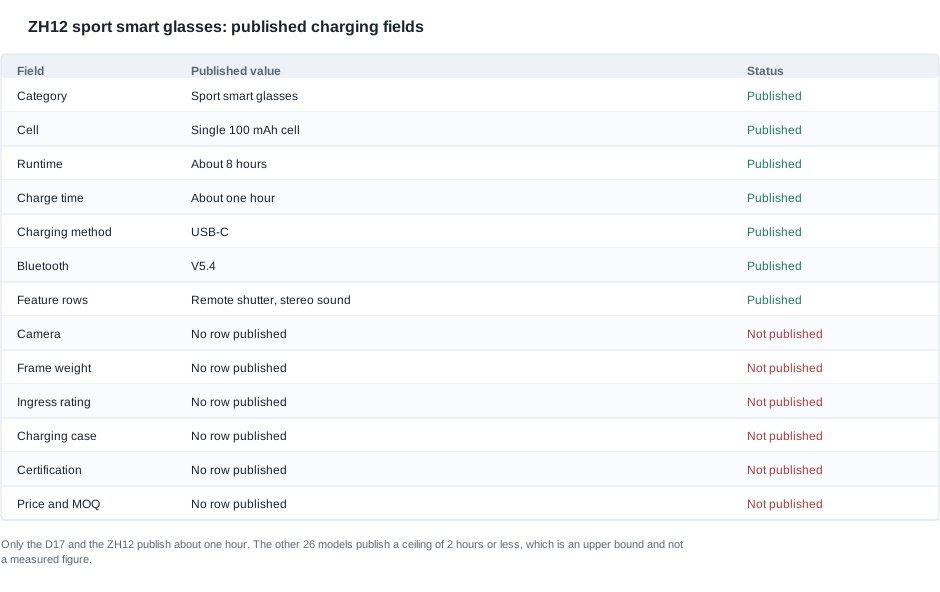
Note what is not in that list. No charging case capacity. No case at all is published for the ZH12, and the catalogue rows for a case are explicit elsewhere, so the honest formulation is that no case is published for this model, not that a case exists and not that a case does not exist. If the supplier quotes a case with a ZH12 package, that is an add-on to be negotiated and priced, and it should appear as a line in the purchase order rather than an assumption in your copy.
Also absent from the charging row: frame weight, dimensions, lens material, colours, ingress protection rating, certification status, unit price, minimum order quantity, lead time, sample policy, warranty, and battery capacity for any accessory. Each of those is not published. In a procurement file, "not published" is a valid and useful status: it tells the reader where the evidence is missing, and therefore where the purchase order has to do the work. A buyer who writes "not published" into a comparison table has protected themselves; a buyer who fills the blank with a guess has created a liability.
There is one more absence that matters for sport positioning: no capacitive-touch row and no translation row appear anywhere in the catalogue. The ZH12 therefore cannot be described as touch-controlled, and its remote control shutter is the published control method. When you build the product page, the interaction story is the remote shutter plus stereo surround sound. Anything beyond that is an invention, and inventions become returns.
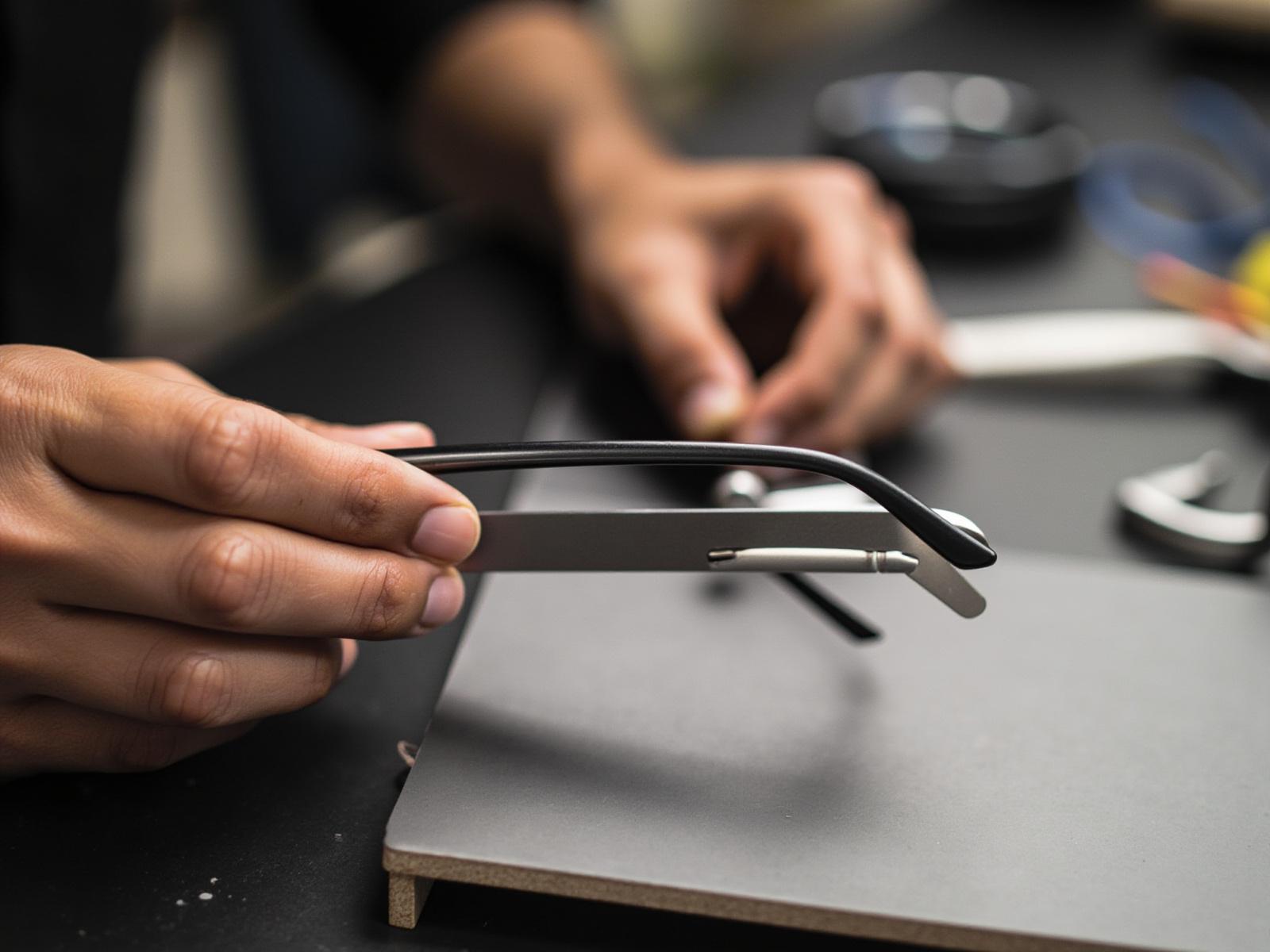
How the one hour charge time compares for the ZH12 charging options
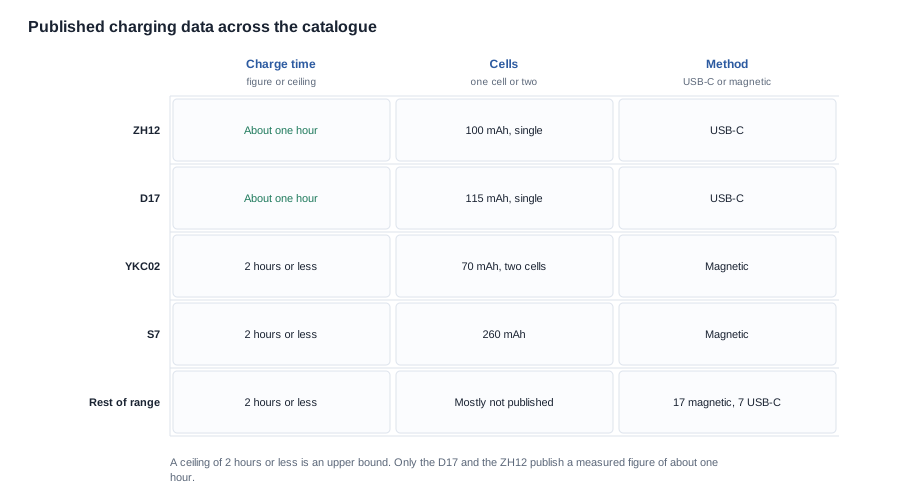
Here is the detail that matters most for anyone forecasting a product launch. Twenty-six of the twenty-eight catalogue models publish a charge time of "2 hours or less". Only two models publish a figure of about one hour: the D17 and the ZH12. The D17 publishes a 115 mAh single cell, about seven hours of runtime, about one hour of charge time, USB-C, and Bluetooth V5.4, with the same two named features — remote control photo and surround sound.
So when the catalogue says "2 hours or less", read it as an upper bound. It is a ceiling the supplier commits to, not a measurement. It does not tell you whether the unit charges in forty minutes or in one hour and fifty-five minutes. For the ZH12 and the D17 you get a specific figure of about one hour. That is a genuinely better data point, and it is the single strongest argument the sport category has over the rest of the range for a channel partner who cares about device turnaround at a counter. We will use it, but we will use it as a comparative statement about published data quality, not as an absolute claim, because one catalogue cannot be compared with itself.
The three sport models also separate on one hard fact: cell architecture. The ZH12 and the D17 each run a single cell — 100 mAh and 115 mAh respectively. The YKC02 runs two 70 mAh cells and uses magnetic charging, with a charge time of "2 hours or less" and about eight hours of runtime.
Read the magnet decision the way an engineer would. A single-cell USB-C device with a one-hour charge time and a roughly eight-hour runtime is a clean, serviceable architecture: one cable, one connector, no alignment, no dock to lose, no second cell to age unevenly. A dual-cell magnetic device with a two-hour ceiling is a different product logic — a shorter charge time is traded for a smaller cell count and a magnetic dock that has to be in the box, in the warehouse, and in the customer's hand. Buyers who run a shared charging station at a counter, a gym, or a store will find that trade-off worth discussing explicitly rather than assuming the catalogue row resolves it. The trade-off is not free: magnetic charging buys convenience for the user and creates a packaging, spares, and counter-logistics problem for the channel.
The wider catalogue context is worth one more paragraph, because it tells you how much of the range is decided by architecture rather than by marketing. Charging method breaks down as magnetic on seventeen models, USB-C on seven, and not published on four — the MT6 and the CY03, and the CY05 and the L1 Pro. So USB-C is the minority choice in this range, which means the ZH12's charging story is a differentiator against the magnetic majority, not a default. On charge time, twenty-six models sit at the "2 hours or less" ceiling while only the D17 and the ZH12 publish about one hour. Only two models in the entire catalogue publish an IP54 ingress rating — the V06 and the S7 — so the ZH12 carries no published ingress protection and should not be described as weatherproof, splashproof, or outdoor-durable in any channel material.
On cell size and cases, five models publish a charging case capacity: the CY03 and the CY05, and the L1 Pro — each at 1400 mAh, the L2 Utral at 900 or 1400 mAh, and the MT6 with a 1200 mAh folding case. Two more have a case with no capacity published, the KY06 and the MT5, and three rows have no case at all — the V03 and the V06, and the S7, with the V03 Pro explicitly stating no case. For a sport model positioned on stamina, the absence of a published case for the ZH12 is a real merchandising decision you should test in the field rather than argue about on paper.
Two catalogue-wide facts close the charging discussion before it becomes a promise. First, the only public weight figure anywhere in the catalogue is the MT6 at 158 grams, measured on the glasses body and excluding its 1200 mAh folding case. The ZH12 weight is not published, so any endurance argument that depends on wearing comfort has to be raised as a sample-verification item, not settled by argument. Second, certification markings such as CE, FCC, RoHS, RED, and EN 18031 appear zero times in the body of the catalogue. Never claim a certification status for the ZH12. What the catalogue does offer is an export page rendered as an image showing ten patent certificates — eight design patents and two utility models — with no per-model certification rows attached. A patent certificate is not a conformity assessment, and the distinction matters the moment a customs broker or a retailer compliance team asks.
It is also worth being honest about what the one-hour figure is worth commercially, because it is easy to overstate. In a channel where every model in the range publishes a ceiling, the ZH12 and the D17 give a buyer something narrower to attack. A retailer cannot say the unit takes two hours when the catalogue says otherwise, and a marketplace listing built on a real number outperforms one built on an approximation. But the buyer who quotes "one hour" to a customer and the buyer who verifies "one hour" under a stated protocol are two different buyers, and only one of them can survive a complaint. The published figure is the marketing asset; the written protocol is the liability control. We will hold both, and we will not let the marketing asset become a warranty obligation by accident.
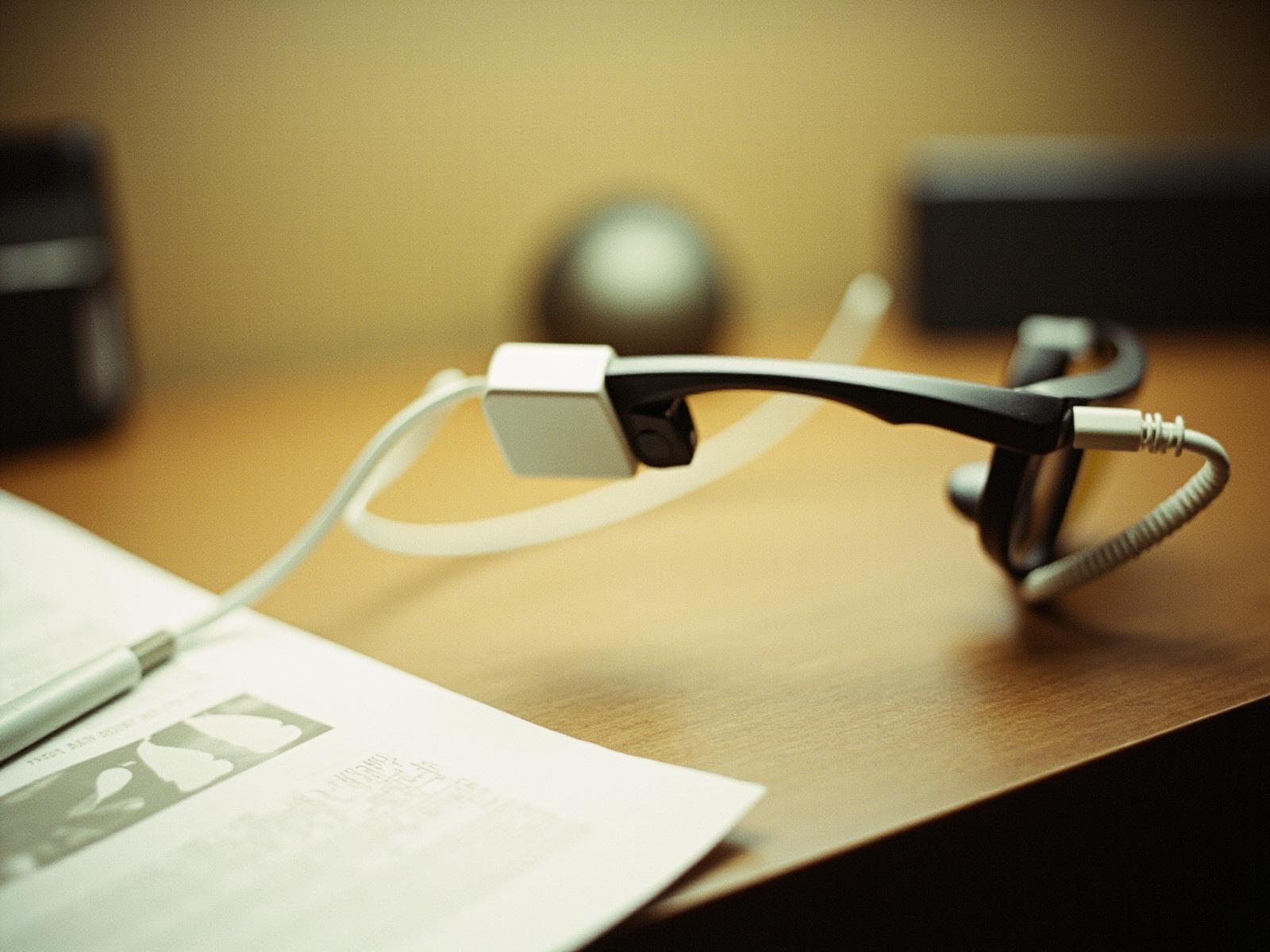
What the charging row leaves open
An open charging row is not necessarily a bad one. It is an invitation to ask precise questions, and it is much cheaper to ask them before the purchase order than to discover the answers during a first production run.
The first open item is the case. No charging case is published for the ZH12. If the supplier's quotation includes a case, you need the cell capacity, the case charge time, and whether the case ships as a standard or optional item. If it does not include one, confirm that the USB-C cable in the box is the intended daily charging path, and decide whether a spare cable should be included in the packaging spec.
The second open item is the endurance protocol itself. "About eight hours" and "about one hour" are approximate on their face, but the terms are undefined: at what volume level, with which codec, with the phone connected over Bluetooth or disconnected, with the remote shutter idle or active, and at what ambient temperature? For a sport model sold on stamina, a one-hour charge claim that is not tied to a stated test condition is a marketing number rather than a warranty number. We will ask for the test conditions in writing and, where the answer is not precise, we will treat the claim as a design intent and write our own acceptance threshold into the purchase order instead of relying on the catalogue.
The third open item is regulatory and transport documentation. A device that ships a lithium cell inside a wearable has a document trail that sits outside the marketing catalogue entirely: the cell's rated capacity and chemistry, the battery safety data sheet, the UN 38.3 test summary, and the packaging and marking arrangements required for the lane you will use. None of this appears in the published charging row. The transport rules are the part of the charging story that stops a shipment, so we treat it as a hard gate on the first purchase order rather than a paperwork exercise afterwards. Our working assumption is that the supplier already has a cell qualified for export, but a working assumption is not a document, and we will not ship on an assumption. The battery transport compliance requirements that apply to a lithium cell shipped inside a wearable are the checklist we work from, and the ZH12's own dossier should be reviewed against them before the first consignment is booked.
The fourth open item is the commercial side of the charging promise. A one-hour charge time is worth very little if the unit cannot be recharged between shifts, or if the supplier ships a USB-C cable that is not the same standard as the port, or if there is no spares strategy. Ask what to ask the supplier about replacement units, about spare parts for the charge port, about whether a spare unit ships with a full charge so the channel can start selling on day one, and about whether a spare cable should be a standard line in the packaging rather than a courtesy. The battery life behaviour you should expect in the field is worth reading alongside this: a published runtime that is measured under ideal conditions is a target, and the difference between the target and the customer experience is where the return rate comes from.
There is a fifth open item that is easy to skip because it sounds administrative, and it is the one that most often turns a good charging spec into a dispute: what the charge time actually means for the first unit off the line. A brand that is preparing a launch has no stock in the channel on day one, and if the first batch arrives with cells that were shipped at a partial state of charge, or with units that were never given a full charge cycle before packing, the demonstration units on the counter will not behave like the specification. Ask whether the units are shipped with a full or a partial charge, whether a full charge cycle is part of the production test, and whether the packaging declares the state of charge on the box. It is a small question with a large operational answer, and it costs nothing to ask before the first production order is released.
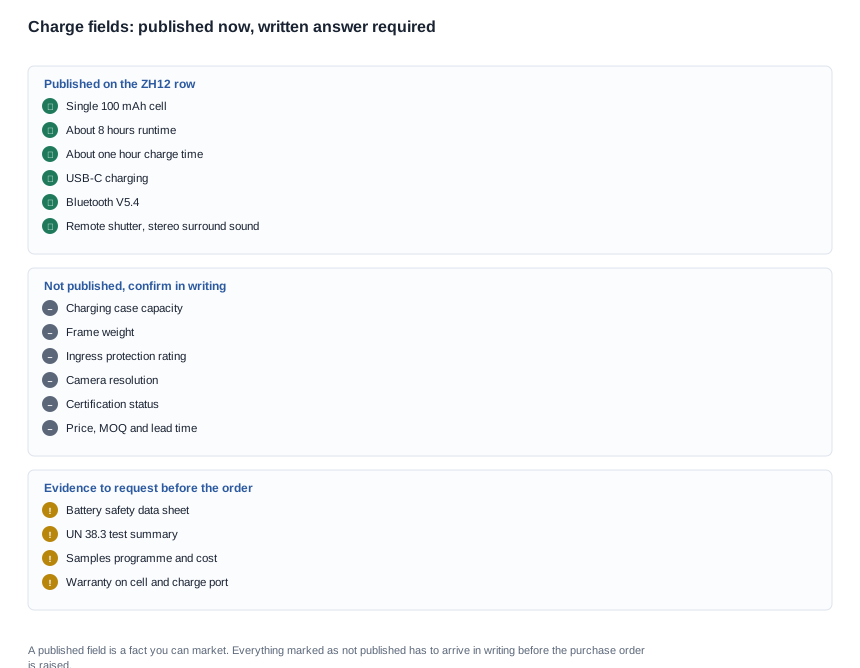

What to ask a supplier before ordering the ZH12 for charging options
Put these in writing, on the quotation, before the purchase order is raised. A phone call leaves nothing to hold a supplier to, and a quotation you can quote back later is what makes a claim actionable. We will send the list as a single document and expect the answers returned in the same format, so that a missing answer is visible as a missing answer rather than buried in a paragraph, and we will treat a blank answer as an unanswered field rather than as agreement.
- Confirm the exact cell configuration for the ZH12 — single 100 mAh cell, no second cell, no case cell — and confirm whether a charging case is a published part of the package or an optional add-on, with its capacity and charge time if it exists.
- Confirm the charge time under a stated protocol: from what battery state, at what ambient temperature, and with the device idle or active. Ask whether the about one hour figure is a measurement or a design target.
- Confirm the runtime protocol in the same breath: volume level, codec, whether the paired phone stays connected, and how the remote shutter affects the drain.
- Ask for the battery safety data sheet, the UN 38.3 test summary, and the cell specification sheet, and confirm they cover the exact cell going into your order, not a generic cell from the same supplier's range.
- Ask for certification evidence for the finished ZH12 as it will be shipped in your market, and for the underlying test reports rather than a declaration covering a different model.
- Ask for the samples programme: the cost of samples, the samples lead time, what is refundable against a first production order, and whether the tooling or customisation cost is separately quoted and separately owned.
- Ask for the quotation to separate the unit price, the packaging cost, the accessories, the certification cost, and the freight, so that a negotiation on any one of them does not move the others.
- Ask for the MOQ per colour or configuration, the lead time quoted for the first production order and for reorder, and the incoterms the price is based on, so the comparison against any other offer is like for like.
- Ask for the warranty terms on the cell and the charging port specifically, and confirm what the spares arrangement looks like for a device that is expected to be charged every day.
- Ask what the pilot order looks like — the minimum quantity that lets you validate the charging behaviour in the field — and how a failing pilot order is handled in the contract.
That is the whole argument. The published charging row for the ZH12 is better than most rows in the range — a single cell, USB-C, about eight hours of runtime, and a charge time of about one hour that only two models in the catalogue match. But it is four numbers, not a specification. Everything a procurement team needs to make a defensible decision lives in the gaps, and the gaps are cheap to close before the purchase order and expensive to close after it.
The wider charging solutions available for this range and the sport smart glasses product line are worth reviewing at the same time, because the charging method is a product decision that has to survive the packaging design, the accessory list, the shelf price, and the freight lane you end up using. A one-hour charge is a real advantage on paper. Getting it into the box as a working, documented, and compliant experience is the part that decides whether the advantage survives contact with a customer.


