

A ZH12 smart glasses vs YKC02 price positioning question usually reaches a buyer with a ladder already attached to it: one model is said to sit below the other, and the gap is said to be justified by a feature, a cell or an interface. None of that ladder is published. Our catalogue prints specification rows, and for these two sport models it prints the same kind of rows it prints for every other model in the range.
That is not a gap in the documentation, it is the design of it. What the published rows do support is more useful than a verdict. They tell a procurement team what the cost of each configuration is made of, which of those cost elements are blank, what to ask about each blank, and how two quotations can be placed on one sheet so that they can be compared at all. This article does those four things and stops there, because a position on a ladder is a commercial decision that has to be made by the buyer against figures the buyer has seen, and a paragraph on a product page is not a substitute for a quotation.
Zh12 smart glasses vs YKC02 price positioning: what the two published rows can carry
The rows both models publish
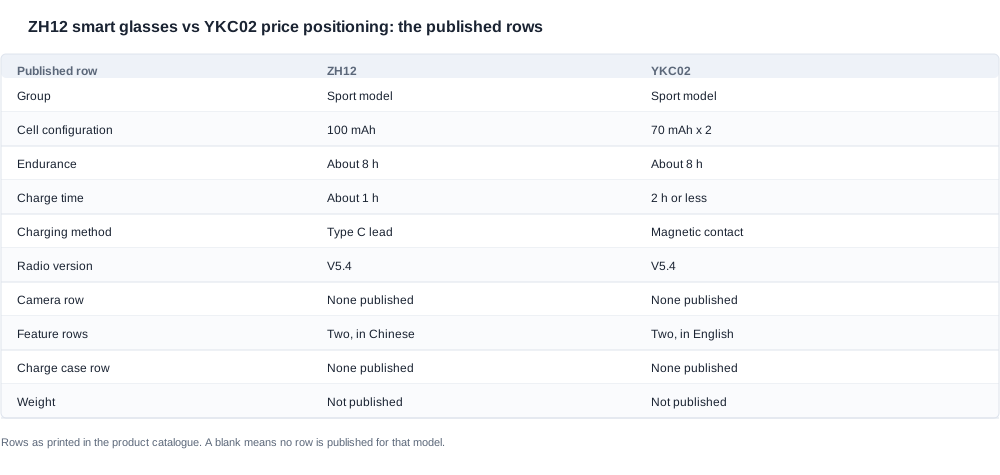
Both sit in the sport group, which has three models: the YKC02, the D17 and the ZH12. Both publish a cell configuration, an endurance figure, a charge bound, a charging method and a radio version. Neither publishes a camera row, a colour line, a charging-case row, a weight or a per-model certification row.
The cell configuration. A single hundred milliampere-hour cell on the ZH12; two seventy milliampere-hour cells on the YKC02. The catalogue prints the cell value and the cell count, and it prints them that way for every model that carries more than one. We do not add the two cells together in a table, because a total is our arithmetic and not the catalogue's figure. Where a total is useful in a conversation it has to be labelled as a derived number, and where it matters to a decision it has to be asked for as a published figure with the arrangement described.
The endurance figure. About eight hours on both. Same headline, different architectures underneath, and no test condition published for either model. The pair therefore gives a buyer a figure to write and no basis on which to write it differently for the two, which is a specific problem when the two units appear in the same listing or the same range plan.
The charge bound. About an hour on the ZH12 against two hours or less on the YKC02. Both are bounds, and the shorter one belongs to a pair of sport models rather than to a product on its own. What the row does not publish is the condition the cell starts in, how much the interval puts back, or what counts as finished. A bound without those three is a line on a specification sheet and nothing more.
The charging method. Type C on one side, a magnetic contact on the other. This is the row that reaches into the packing, the accessory programme and the freight model, and it is the row a comparison tends to drop first because it is not a performance figure.
The radio version. Bluetooth 5.4 on both, so the radio row does not separate them for a buyer writing a compatibility line.
The feature entries. The ZH12 publishes two entries, written in Chinese on its catalogue page: a remote photo function and a surround sound function with an extra qualifier. The YKC02 publishes two entries in English: surround sound and long battery life. The remote is the published functional difference between the two models, and one other sport model publishes it as well, so a specification that leans on it describes something the buyer's own range may also contain.
The criteria a buyer should set before the rows are read
The rows above are inputs, not criteria. A buyer who reads them first tends to let the rows choose the product, which is the wrong order of operations for a purchase that will carry freight, service and accessory costs. Setting the criteria first costs one paragraph and saves the rest of the exercise.
Write the criteria as a sentence a colleague could repeat. A criterion such as "the unit must charge from a lead the customer already owns" is usable, because it can be checked against a quotation and disagreed with. A criterion such as "good value" is not usable, because it cannot be checked against anything. The criteria that survive a review are the ones that name a condition, a document or a number.
Decide which criteria are negotiable before the quotations arrive. A procurement team that has decided in advance which criteria are hard and which can move reads a quotation quickly, because it knows which lines it may trade and which it may not. A team that decides afterwards is negotiating with itself.
Select on the criteria, and record the criterion each decision used. A shortlist that records the reason for each inclusion can be audited and handed to a second buyer. A shortlist without reasons is a list of preferences, and it cannot be defended when a supplier asks why something was excluded.
Check the criteria against the published rows before they go into the request. Any criterion the catalogue already answers can be struck out and replaced with a question, and any criterion that no published row can answer at all has to be marked as a question for the supplier rather than left in the request as though it were a requirement. This is the step that stops a buyer from asking a supplier to confirm something that is already in the document, which is a request that costs time and signals that the buyer has not read it.
The third sport model, and what it does to a quotation
The sport group has a third member. The D17 shares the Type C interface and the roughly one-hour charge bound with the ZH12, carries a hundred and fifteen milliampere-hour cell against the ZH12's hundred, and publishes about seven hours of endurance against about eight. It publishes the remote entry and a surround sound entry too.
That third model has a practical consequence for anyone building a quotation. A request for a quotation naming one model does not cover the other two, and a request that names two of the three leaves the third unpriced at the same time. Any cost model that has one line per model is therefore carrying an assumption that only one of the three will be ordered, and that assumption should be stated rather than made quietly. The published ZH12 specification list is the baseline for the first of them, and it is worth reading against the others before the request goes out.
Why no ladder is drawn in this article
Three reasons, and all three are facts about the record rather than judgements about the products.
The prices are not published. Our catalogue carries no unit price, no minimum order quantity and no lead time for any of the twenty-eight models, so no gap between any two of them can be stated, and none is stated here.
The configuration is not settled. A price belongs to a configuration — a model, a cell arrangement, an accessory set, a packing specification, a destination market. The rows that fix those things are the rows this article shows as blank, so a price quoted against the wrong configuration is not a price at all.
The position is the buyer's to take. Where a channel decides to sit in a market, what margin to hold, and what to charge, is a commercial decision taken with figures the buyer has seen. A comparison that handed that decision over would be handing over a conclusion that the underlying record cannot carry.

One cell or two, and what the difference changes on a purchase order

What the cell arrangement decides, and what it leaves open
One cell against two is the structural difference between the two products, and it reaches into three places on a purchase order.
It reaches the accessory programme. A one-cell product charges through a single interface, and the interface row on the ZH12 says what that interface is. A two-cell product raises a question the catalogue does not answer: whether the cells charge together through one contact, whether they are replaced as a pair, and whether a spare pack or a spare cradle exists at all. Those are questions about the supplier's design, and each of them changes what a channel has to buy, hold and describe.
It reaches the spare-parts story. A single cell is one item to think about. Two cells are two, or a pair, or a sealed pack, and the difference decides whether a service desk can replace something or whether a whole unit returns to the supplier. The catalogue publishes nothing about either model's cell arrangement in that respect.
It reaches the specification line. A quotation, a spec sheet and a tender response each need the cell configuration written the way the supplier writes it, which for the YKC02 is the value and the count together rather than a total. A buyer who writes a total has quietly written a figure the supplier has never published, and a buyer who then compares that total against a single-cell figure is comparing an arithmetic result against a published one.
What the charging interface changes in the packing and the freight model
The interface row is the most consequential published row for the cost side of this pair, and it is worth taking in pieces.
What a Type C lead means for the parcel. A lead is a commodity item that a customer can already own, and for a channel the question is whether one goes in the box, whether it is a branded item, and what its length and specification are. None of that is published for the ZH12, and the catalogue prints the method rather than the object, so the object is a question rather than an assumption.
What a magnetic contact means for the parcel. A contact implies a supplied object: a pad, a cradle, a dock, or a case with a contact in it. Those are four different things to pack, photograph for a product page, replace and explain to a customer, and the difference between them is a difference in the accessory programme and in the freight model. The catalogue publishes the method and not the object for the YKC02, so the same question applies.
What neither model publishes, and why it dominates the landed cost. Packed dimensions and shipping weight are not published for either model. Until they are, the freight element of a landed cost cannot be calculated from the catalogue, and a landed cost quoted before they exist is a figure assembled from assumptions. This is the single largest blank on the cost side of the comparison, and it is also the cheapest one to close: a sample of each model, weighed and measured in its packing, settles it.
What to write in the meantime. A quotation request that asks for the packed dimensions and the shipping weight of each model in the configuration being quoted closes the freight line before the order, and it does so with a question rather than an assumption.
The two rows that decide the order rather than the specification
Two rows sit above the specification in a purchase order, and both are blank in different ways.
The order quantity and its conditions. Minimum order quantity, the quantity breaks available, whether a sample order can precede a bulk order and on what terms, and what happens to a mixed order across models. These are commercial terms that belong on a quotation sheet and in an agreement, and they are not published for any model in the range.
The payment and delivery milestones. What is paid when, what triggers each payment, and what the agreed delivery point is for the first order and for a repeat. These lines decide the cash position of a procurement programme, and they belong in the same document as the unit price rather than in a separate conversation.
A buyer who treats the published rows as the specification, the blank rows as the request for quotation, and the two commercial blocks as the agreement gets three documents instead of one blurred conversation, and each of the three can be checked by someone who did not attend the meeting.

The cost elements that are published, and the ones that are blank
The cost elements a figure exists for
Three of the published rows carry numbers, and each of them decides something a procurement team has to plan around.
The cell configuration. It tells a buyer what is fitted inside the product, and it is the row that determines whether a replacement part is one item or two.
The endurance figure. It tells a buyer what the supplier is willing to be associated with, which is why it is the row that appears on listings first and the row that needs a condition attached before it is quoted.
The charge bound. It tells a buyer how long the unit is out of service during a recharge, which is the number that shapes a returns desk, a demo schedule and a customer instruction.
The remaining published rows — the charging method, the radio version and the feature entries — carry no numbers but they are not idle. They decide what has to be bought alongside the product, what can be said about it, and which parts of it are configuration items on an order line.
The blank rows, and the question each one becomes
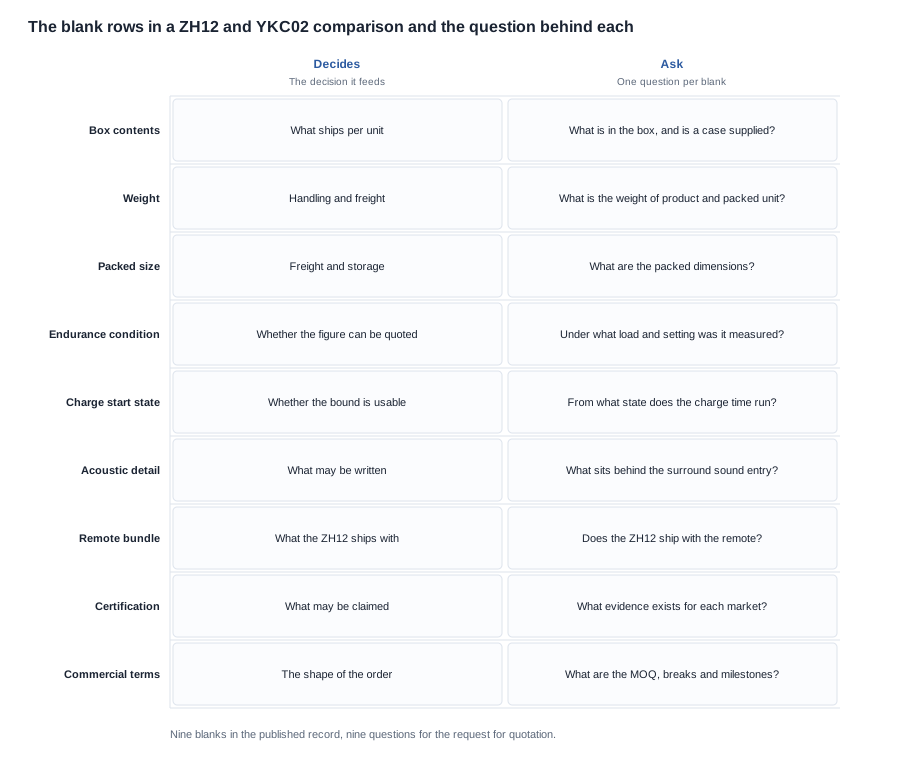
Every blank below is turned into a question rather than filled in with an assumption. The blank and the question are the same item in a request for quotation, and the third column is the decision the answer feeds.
| Blank row | What it decides | The question to put in writing |
|---|---|---|
| Charging case and box contents | What ships per unit and what the customer owns | What is in the box for each model, and is a charging case supplied? |
| Weight | Handling, packaging and the shipping figure | What is the weight of each product and of each packed unit? |
| Packed dimensions | Freight and storage | What are the packed dimensions of each configuration? |
| Endurance test condition | Whether the eight-hour figure can be quoted | Under what load, volume and setting was the figure measured? |
| Charge start state and finish criterion | Whether the charge bound is usable | From what state does the charge time run, and what counts as complete? |
| Acoustic and microphone detail | What may be written about surround sound | What sits behind the surround sound entry, and what is the microphone specification? |
| Remote bundle and connection | What the ZH12 ships with | Does the ZH12 ship with the remote, what does it connect to, and is it bundled? |
| Certification evidence | What may be claimed in a market | What written certification evidence exists for each model in each destination market? |
| Commercial terms | The shape of the order | What are the minimum order quantity, the quantity breaks, the lead time and the payment milestones? |
The table is the working part of this comparison. Nine blanks, nine questions, and each answer has a place it goes: the freight model, the specification, the listing copy or the agreement.
The certification position, and how to ask about it
Our catalogue holds a company-level export certification page, and its content is images rather than text; the surrounding text names CE, FCC and RoHS nowhere. There is no per-model certification row in the document, and there is no record of a certificate number waiting for confirmation against a model.
Two things follow for a buyer, and they point in the same direction. First, the certification position of either model in this comparison is not something that can be read from the catalogue, for either product, in either direction: it cannot be used as supporting evidence and it cannot be used as a warning. Second, because it is the same position for both models, the certification question is not a differentiator between them and should not be carried as one.
The question that belongs in the request is specific: what written certification evidence exists for each model, for each destination market, and in what form it can be supplied. A certificate number without a document behind it is not usable in a customs file, and a document without a number is not usable in a listing.

Putting two configurations on the same quote sheet
One quotation per configuration, and the lines it has to name
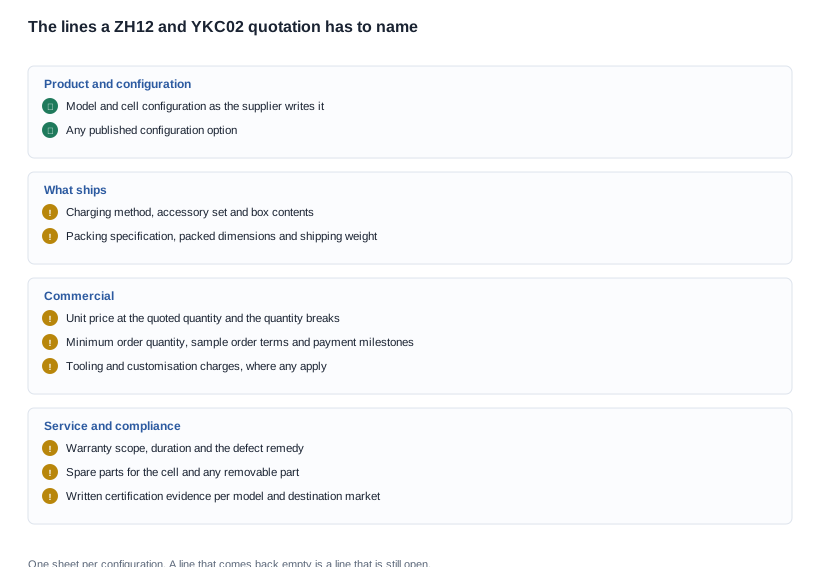
A quotation that covers one product in one configuration is a document that can be checked. A quotation that covers a range of products is a list of assumptions. The request should therefore be per configuration, and each request should name the following lines so that the answer arrives in the same shape as the request.
Product and configuration. The model, the cell configuration as the supplier writes it, and any configuration option that is published.
What ships. The charging method, the accessory set, the box contents, the packing specification, the packed dimensions and the shipping weight.
Commercial. The unit price at the quoted quantity, the quantity breaks, the minimum order quantity, the sample order terms, the tooling and customisation charges if any apply, the payment milestones, and the agreed delivery point.
Service and compliance. The warranty scope and duration, the defect remedy, the spare-parts position for the cell and any removable part, and the certification evidence available for the model in the destination market.
Each of those lines is a place where a silent omission produces a later dispute, and each is cheap to request. A buyer who requests them by line, rather than by paragraph, gets answers that can be pasted into a comparison sheet.
The alignment that makes two sheets comparable
Two quotations can only be compared after eight things have been aligned, and the alignment is a paragraph of work that saves a week of argument.
Currency and trade terms. The same currency, the same delivery point, the same party bearing the freight beyond it. Two unit prices under different terms are two different numbers.
Quantity. The same order quantity on both sheets. A price quoted at one quantity and a price quoted at another are not a gap, they are two prices.
Configuration. The same cell arrangement, the same accessory set and the same box contents on both sheets, because the accessory set is a cost element that sits inside the unit price.
Freight basis. The same packed dimensions and the same shipping weight basis, whether or not the figures have been supplied yet. If they have not, mark them as missing on both sheets rather than estimating one side.
Warranty scope. The same duration and the same scope on both sheets, because a warranty that covers a cell and a warranty that covers a unit are not the same obligation and they do not carry the same cost.
Certification scope. The same destination markets and the same evidence requirement on both sheets.
Payment milestones. The same schedule on both sheets, so that the cash position being compared is the cash position being paid.
Delivery point. The same point in the supply chain, so that one sheet's lead time and the other sheet's lead time mean the same thing.
None of the eight requires a new document. They require the two sheets to be laid out in the same order with the same headings, and they are the reason a request for quotation should carry a template rather than a paragraph.
A verification checklist to run before the order is placed
Two supplier sheets arrive, they look comparable, and the order is placed. This is where a large share of the avoidable cost in a programme like this originates, and a short verification routine catches it.
Verify the configuration line on each sheet against the published rows. The model, the cell configuration and the charging method are the three lines that must match what the catalogue prints. If they do not match, the sheet is for a different product, and every price on it belongs to a different product.
Verify the quantity, the terms and the delivery point. A price quoted at one quantity against a price quoted at another is not a gap between two products; it is a gap between two order sizes. This is a red flags item that recurs in supplier comparisons, and missing it is expensive.
Assess the freight and the accessory set together. The packed dimensions and the shipping weight decide the freight element, and the accessory set is usually already inside the unit price on a sheet. Both are blank in the catalogue today, which means both have to be answered before a landed cost means anything.
Evaluate the warranty scope against the defect remedy, not against the number. A long warranty with a narrow remedy is a different commercial position from a short warranty with a clear one, and the duration on the sheet is only half of what was agreed.
Work the total cost rather than the unit price. The unit price is one line of the total cost, and the total cost is what a procurement team signs. If a sheet does not carry the freight, the accessory set, the payment milestones and the warranty scope, then it does not carry a total cost either, and it should not be set against a sheet that does.
Record the due diligence position on certification evidence before the order is placed. The request asks for written evidence per model and per destination market. If what comes back is a statement rather than a document, the marketing copy and the customs file each carry an open item, and that item belongs on the record rather than in someone's memory.
Put the unresolved lines on the order record with an owner against each one. Every gap that survives the verification has to be visible to the person who signs the purchase order. A gap that lives in an email thread is a gap that gets rediscovered at the first audit.
The questions that go out with the request
Ten questions, written to be answered rather than acknowledged.
- What is the cell configuration for each model, and how is it written in the published specification?
- What is in the box for each model, and is a charging case supplied?
- What are the packed dimensions and the shipping weight of each configuration?
- What is the weight of each product and of each packed unit?
- Under what load, volume and setting was the endurance figure measured?
- From what state does the charge time run, and what counts as complete?
- What is the unit price at each quoted quantity, and what are the quantity breaks?
- What are the minimum order quantity, the sample order terms, the tooling and customisation charges, and the payment milestones?
- What is the warranty scope and duration, and what is the defect remedy?
- What written certification evidence exists for each model in each destination market?
Each of the ten is a blank from the table above or a commercial term, and each of the ten is answerable. The ones that come back with a figure can be written into the specification and the agreement; the ones that come back with a description stay as descriptions and are recorded as such. What must not happen is a quotation that arrives without the ten lines, because a quotation that omits them will be compared against another quotation that omits the same ten, and the difference between the two will then be attributed to the products rather than to the omissions.
What this comparison leaves with the buyer
The published rows for these two models support a cost structure, a list of blanks and a request for quotation. They do not support a gap, and this article does not state one. What a buyer can take from it is a decision framework: the two rows that decide a purchase order, the nine blanks that carry the real cost, and the alignment that makes two supplier quotations comparable once they arrive.
The immediate next step for a procurement team is not a product decision. It is a request for quotation that names the ten questions above and asks for one sheet per configuration. When those sheets come back, the comparison that this article sets up is the comparison that can actually be made, and the position on the ladder that the market expects will be visible in them rather than asserted here.


