
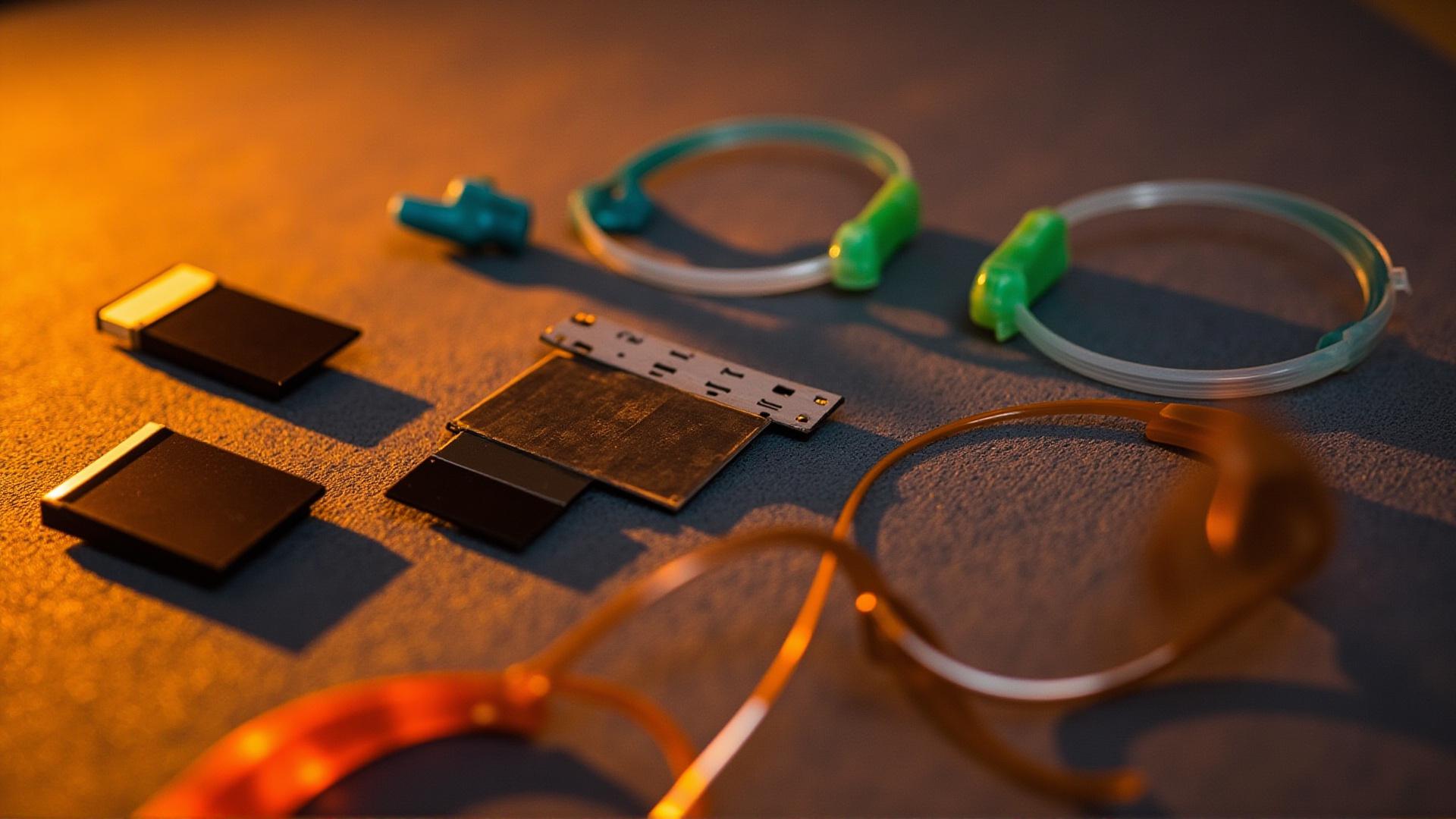
The ZH12's catalogue page publishes the tightest charging figure in the whole range. Twenty-six of the twenty-eight models in the catalogue publish a charge time of two hours or less; this model publishes about one hour, and it is one of only two that do. That single row is the reason a buyer should read this page carefully rather than skim it, because a charge figure that stands apart from everything else is either a genuine product advantage or an artefact of how the measurement was taken, and the catalogue does not say which.
The rest of the page is short: a 100 milliampere-hour cell, an endurance of about eight hours, Type-C charging and Bluetooth version 5.4. It also carries two feature rows, and both of them are printed in Chinese — a remote-photo row and a stereo surround-sound row. Those two rows are where this model is genuinely unusual, and they are unusual in a way that is easy to miss: an English-language search of the catalogue finds neither of them.
The page also carries nothing about conditions, weight, geometry or the box contents, so the number of open rows on this page is larger than the number of published ones.
ZH12 smart glasses: the one-hour charge row
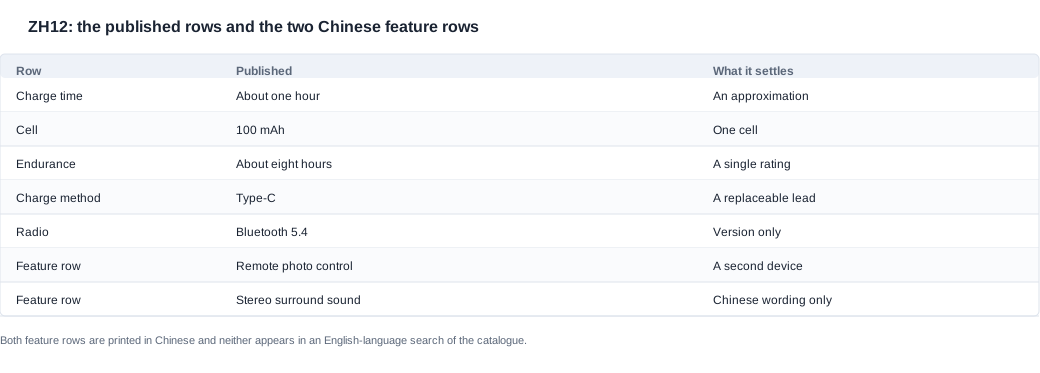
These are the rows printed on the page.
The charge time is about one hour. The cell is 100 milliampere-hour. The endurance is about eight hours. The charging method is Type-C. The radio is Bluetooth version 5.4. The feature rows read as remote photo control and as stereo surround sound.
The charge figure deserves the attention, and there are three separate things about it that a buyer has to keep apart.
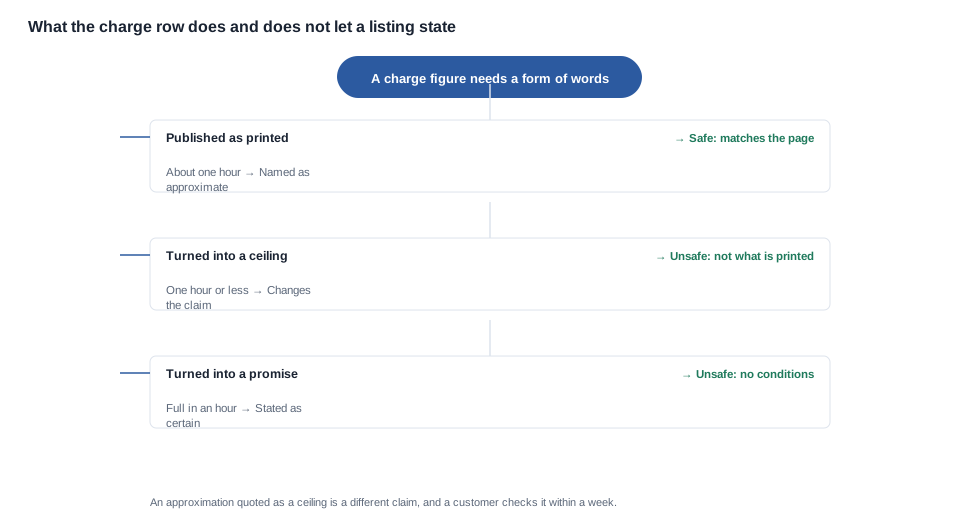
The first is that it is an approximation rather than a ceiling. Twenty-six models publish two hours or less, which is a limit — it permits a charge that takes exactly two hours. This model publishes about one hour, which is a nominal figure and permits a range around it. A channel that quotes it as a ceiling has changed what it says; a channel that quotes it as a nominal figure has to say that it is nominal, because a customer who measures a charge at seventy minutes has not been given a false figure.
The second is that it stands apart. Of the twenty-eight models in the catalogue, twenty-six publish a two-hour ceiling and two publish about an hour. This is one of those two. That is a genuine and checkable fact about the range, and it is the kind of fact a channel can put in market material — with the number, and with the observation that the catalogue publishes no start state or completion point behind it.
The third is what makes the figure commercially consequential, and it is not visible from the page alone. The catalogue publishes no charging-case row for this model, so there is no second powered component in the box to explain the figure, and no published capacity for a case that might be the thing being charged. That means the about-one-hour figure almost certainly describes the frames themselves, and a buyer can plan around it — but "almost certainly" is a reading, and the reading has to be confirmed in writing, because a charge time that quietly includes a case changes the turnaround at the warehouse and the customer's own experience of topping up.
The Type-C interface is the other half of this section, and it is doing more work than the charge figure. A Type-C port is a commodity interface, and the three consequences of that are immediate for a channel. The accessory line is cheap and universal, so a customer who loses the lead replaces it themselves and a channel can offer a spare without carrying a specialist part. The customer never has to return to the seller for a proprietary charger, which removes one of the commonest reasons a customer contacts a supplier about a working product. And the unit can be charged from a supply the customer or the channel already owns, which is the basis for bundling a spare cable into a shipment rather than shipping one in every box.
Compare that with a model in the same group that charges magnetically, where the customer needs a specific cradle and the replacement is a specialist accessory. The comparison is a fact about the published interfaces and nothing more: no published figure describes how either unit performs, and a channel cannot turn a published interface into a claim about charging experience.
There is a third thing about this row that only appears when it is compared with the range as a whole, and it is the most useful thing a buyer can learn from it. The catalogue publishes twenty-eight charge figures and they fall into two groups: about one hour for two models, and two hours or less for the rest. There is no third group, and there is no model that publishes no charge figure at all. That means the charge column is complete, and a buyer can use it as a hard filter — which is unusual in a catalogue where most of the interesting rows are partial.
But completeness is not the same as comparability, and this is where the row has to be read with care. A ceiling of two hours or less and an approximation of about one hour are different kinds of statement, and neither says from what state the charge starts or at what point it is treated as finished. Two units can both be charged from empty to full and still differ in elapsed time by an hour, and the catalogue does not tell you which of these two figures includes a warm battery, a partial charge or a rested cell. So the honest use of this row is to separate models from one another and to plan around the gap, and the dishonest use is to quote it as a customer-facing turnaround without the qualification.
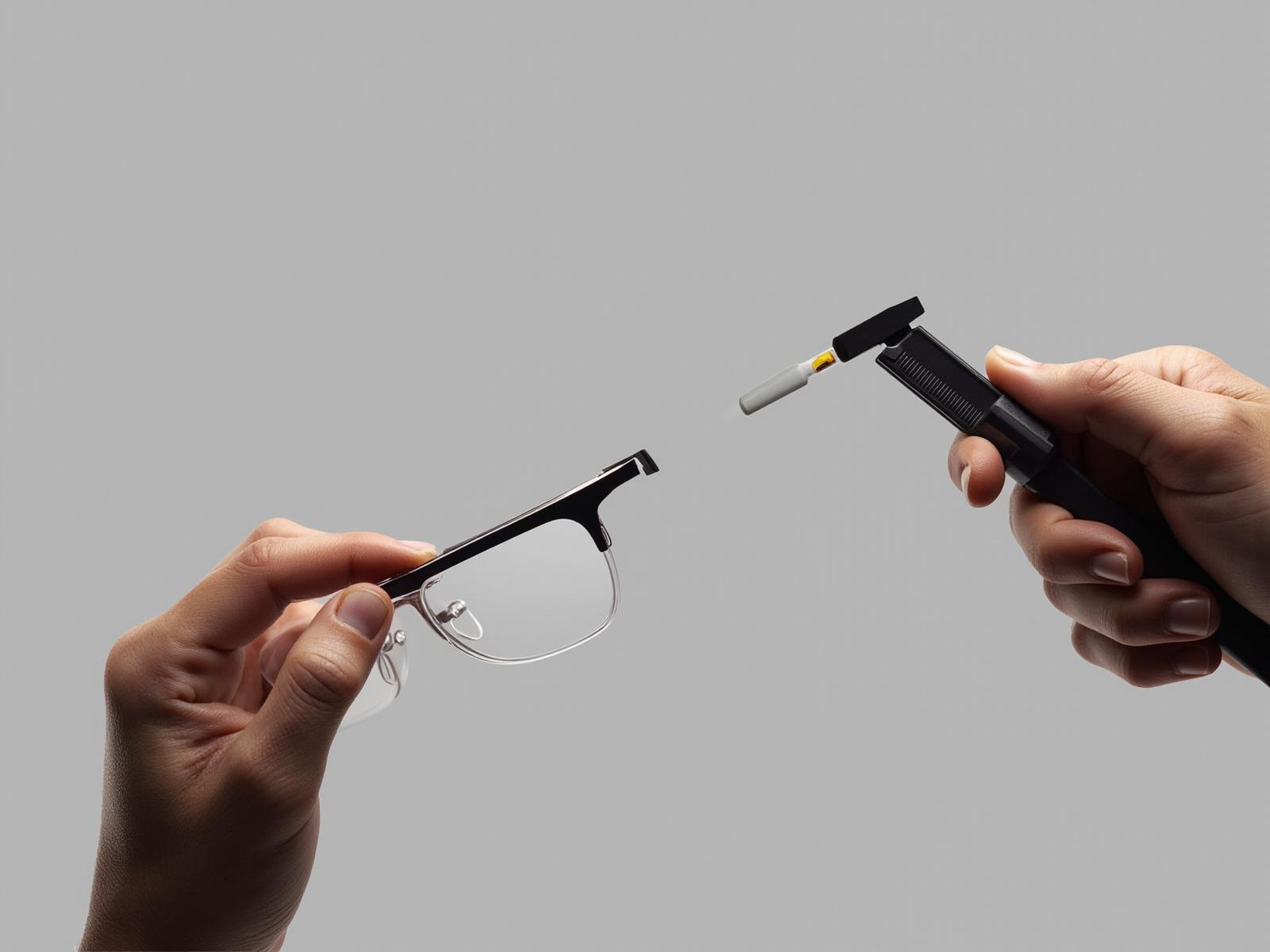
The 100 milliampere-hour cell, and the Type-C interface
A single 100 milliampere-hour cell, an endurance of about eight hours, and a Type-C interface. Three rows, and they behave differently from one another.
The cell value first. The catalogue publishes 100 milliampere-hour on several models, and one of them is a children's model with a very different endurance figure, so the number on its own means little. What makes this model's cell interesting is what happens when it is set against the closest comparisons in the range.
Set it against the D17, which is the other sport model that publishes about one hour for the charge. The D17 publishes 115 milliampere-hour — a larger cell — and about seven hours of endurance. This model publishes 100 milliampere-hour and about eight hours. So the smaller cell publishes the longer running time. Set this model against the two audio models that share its cell value and its interface: the D11 and the D12 each publish 100 milliampere-hour, Type-C charging and about seven hours. So across four models sitting within fifteen milliampere-hour of each other, the published endurance figures are seven, seven, seven and eight hours.
That pattern is the single most useful thing this section can tell a buyer, and it cuts against an assumption that procurement teams make constantly. A published endurance figure is not a function of the published cell capacity, because the two figures are measured under conditions the catalogue does not state, and those conditions move the result by a seventh or more. The practical consequence is a rule about how to use capacity in a comparison: it is a real specification and it is worth publishing, but it is not a proxy for running time, and a shortlist built by sorting models on cell capacity will not produce a shortlist sorted on endurance.
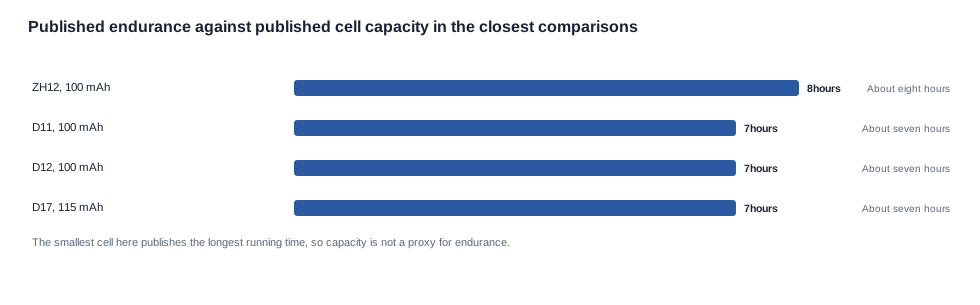
So the questions about the eight hours are the ones that have to be asked, and they are the standard ones with one addition specific to this model. What was running during the measurement, at what volume, with the radio link in what state, and whether calls were part of the run. And, because this model carries a remote-photo row, whether the remote was connected during the measurement — a linked accessory has its own power consumption, and a runtime measured with one linked device and a runtime measured with none are different numbers that happen to look the same on a page.
The Type-C interface is settled and, settled, it is the easy part of this section. A named interface tells a channel what goes in the box and what a customer replaces, and it does so without a single request to the supplier. What it does not tell the channel is whether a lead is supplied at all, of what length, whether the unit accepts charge from any Type-C source or only from a supplied one, and — the question worth asking — whether the port is the charging port alone or shares a housing with something else, which is a question about how the unit is sealed rather than about how it charges. None of that is published, and all of it is settled by a look at the sample.
The pairing of the two rows is where the planning value is. A single cell that reaches about eight hours and a charge that takes about an hour produce a duty cycle with a short recovery, and for a channel that sells into fixed-duration use this is the most commercially attractive thing on the page — provided it is real. The check on it is the same as for every other figure here: the eight hours needs its conditions and the hour needs its start state and completion point, and the combination is only as good as the weaker of the two documents behind it.
What about the interface as a category? Seven models in the range publish Type-C, and the sport group is split: this model and the D17 publish it, the third sport model publishes magnetic charging. That matters for a channel carrying more than one model from the group, because a mixed range means either two charging accessories in the box or a deliberate decision to standardise on one. The decision has a cost and a benefit that the buyer can calculate and the catalogue cannot.
The remote-photo and surround-sound rows, and what they ask about
Both feature rows on this page are printed in Chinese. The remote-photo row reads as remote shutter control; the acoustic row reads as stereo surround sound. Neither row appears in an English-language search of the catalogue, and that has a consequence that is worth stating plainly to a buyer who has already built a comparison sheet: a model that appears to have no acoustic descriptor may have one, written in a language the extraction did not handle.
That is not a curiosity. It is the reason this model has a feature its closest sibling also has and that the difference is invisible in the source data. Two models in the range publish a remote-photo row, and this is one of them. Two of the sport models publish it; the third does not. So a buyer who assumed the third sport model had the same remote-photo capability as the other two would be wrong, and a buyer who assumed this model did not have the remote-photo capability because a search found nothing would be wrong in the other direction. Both errors come from the same place, which is a catalogue that mixes two languages in the same field.
The remote-photo row is a functional claim with an accessory attached to it, and that is what makes it worth a section of its own. A remote shutter means a second device. What is not published is almost everything about it: whether a remote is supplied in the box, how the remote links to the glasses, how long that link takes, whether the remote itself carries a cell and how it is charged, what the remote can operate, whether it works with the camera or with something else, and whether the camera is included in the product at all — because this page carries no camera row, and the row names a photo function without the page describing a camera.
The consequences for a channel are concrete. A second device is a second item in the box, a second line in the picking instruction, a second thing to count at goods-in, a second thing to identify when a customer returns the product, and a second consumable or spare if the remote carries a cell of its own. A channel that bundles the remote as a separate product line has a different freight profile and a different returns procedure from one that bundles it in the box. A channel that does not bundle it has to describe the product accurately without it.
And the acoustic row, which reads as stereo surround sound, is a description with nothing measured behind it: the driver size, the response curve, the output level, the microphone specification, the codec and any comparison with a competing product are all absent. What may be written is that the model is published with a stereo surround-sound row. What may not be written is anything about how the sound is delivered, how it compares with a competing product, or what a customer should expect to hear.
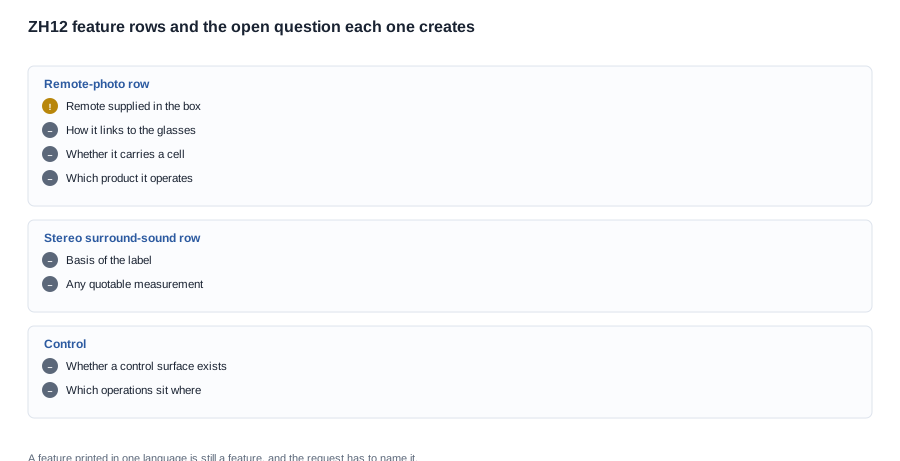
The two Chinese rows also carry a documentation risk that a buyer should plan for rather than discover. If the catalogue states a feature in one language, the internal records, the test evidence and the packaging artwork for that feature may exist in another, and the packaging for a market that reads Chinese may not match the packaging for a market that does not. That is a question about consistency across the documentation set, and it belongs in the same request as the measurement questions rather than in a separate conversation.
One open row remains, and it is the control surface. No model anywhere in the range has a touch row printed, and the only entries in the catalogue that describe a control surface sit on a different product — an AR model with an indicator light and a button control. So how this product is answered, muted, paused or adjusted is a question — and on this model it becomes a sharper one, because the remote-photo row implies that some operations happen from the remote rather than from the unit, and a channel cannot describe an operating arrangement it has not confirmed.

The checks worth making before the first order
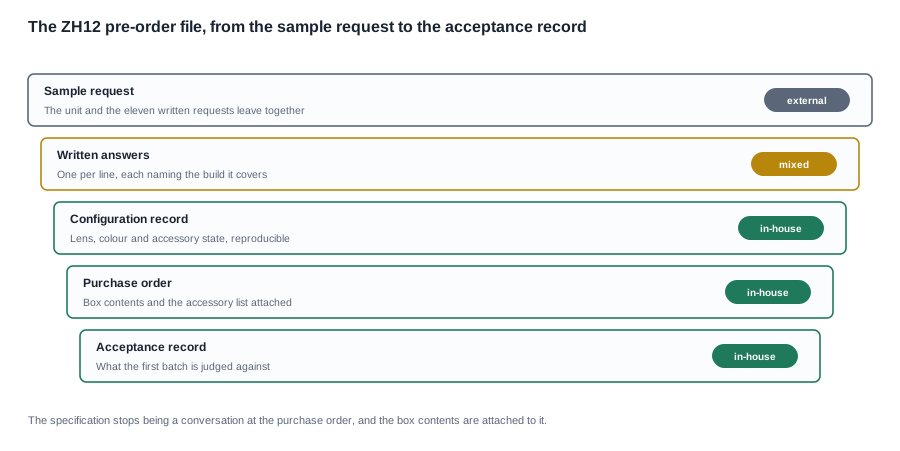
The checks below are arranged in the order they should be made on this model, each line phrased as the question that closes it. They go out together with the sample request.
- Identity and build. The designation on the product and on the packaging, and the build that the answers below are given against.
- The charge figure. What about one hour covers, the cell state at the start, the point at which the charge is treated as complete, and confirmation that the figure describes the frames rather than any accessory.
- The eight hours. What was running while the published figure was measured, and what the same unit produces under the conditions this channel actually works in.
- The remote. Whether one is supplied, how it links to the glasses, whether it carries its own cell and how it is charged, and what it operates.
- The acoustic row. What the stereo surround-sound label is based on, and whether any measurement exists that could be quoted.
- The interface. Whether a lead ships in the box at all, how long it is, and whether the frames take a charge from any Type-C source or only from the one supplied.
- The control surface. Whether the product has one, how it is configured, and which operations are on the unit and which are on the remote.
- The physical details. The dimensions of the frame, whether anything on it adjusts, and the weight of the unit and of any accessory that goes with it — this model publishes no weight at all. The sport weight comparison sets out why a figure borrowed from another category cannot be used in a landed-cost calculation.
- The condition evidence. No ingress marking appears on this page, so no claim about water, sweat or rain may be made for this model until a factory statement exists.
- The paperwork for the destination. The certification documents the factory holds for this build, the destination markets each document covers, and whether any of it is supplied inside the box; no per-model certification row appears in the catalogue, and the export certification page is a page of images with no reference to CE, FCC or RoHS in the text at all.
- The commercial terms. What the minimum order quantity is, how long production and delivery take, what the unit price is, what the packaging specification says, how warranty and defect handling work, how payment is structured and which incoterm applies — all of it to be written into the quotation.
The order of those lines matters more here than it does for a model with a longer page, because the two rows that stand apart from the range are also the two that a buyer is most likely to over-claim. The one-hour charge and the remote-photo capability are both worth having, and both are the kind of feature a channel will put at the top of a listing before the conditions behind them have been confirmed. So the criteria for those two lines are stricter than the criteria for the rest: nothing about either appears in market material until the written answer names the build and states the conditions.
Two red flags are worth naming, and both are specific to this page. The first is an answer that covers the sport range generally, or that covers the model in the second language the internal records use, without the specifics this build needs. The second is a quotation or a listing that states the one-hour charge as a fixed promise rather than as the approximation the catalogue prints, which is the error a customer will find first because charging is the one thing every customer does.
The criterion that closes the file should be written down before the request is sent. For this model it is: a written reply against each of the eleven lines, naming the build it applies to; a written statement of the charge conditions and the endurance conditions; a written statement of what the remote is and whether it is supplied; the documents for every market the shipment will reach; and a build record that a repeat order can be matched against.
On this model, our position is that the charge figure is the most interesting thing the page publishes and the easiest to misuse. We publish the cell, the endurance rating, the charge figure, the interface and the radio version exactly as the catalogue prints them, and we will state about one hour as an approximation rather than as a promise. We will not quote the remote-photo row without the accessory that goes with it, and we will not present the stereo surround-sound label as an acoustic specification. We do not publish a weight, a geometry, a case capacity or a certificate number for this model, and we will not put a figure on them for a buyer who asks. The file is closed when every one of the eleven lines carries a written answer naming the build, the unit that arrived matches the configuration record, and the listing states no more than the page states. When to treat the file as closed is a commercial call the buyer makes, and the test for it is those same eleven lines. Those eleven lines are also the criteria a buyer uses to judge whether the first order can be repeated, and the questions to ask in writing are the ones that close them.
Tell us which of these checks your own purchase file is still missing, and we will write that request in the form our documentation team would file against a build.


