
The content gap
Great ride footage rarely gets made with a second camera
The cycling content economy runs on authenticity: the descent the rider actually took, the gravel sector, the city-limit sprint, the ambassador’s morning loop rather than a crew’s staged b-roll. Yet the tools work against that material. A helmet or bar camera has to be mounted, angled, charged and remembered; its framing drifts with the mount, and by the time a real moment appears the camera is often off or in a pocket. A phone means stopping, a selfie arm and footage that reads as filmed, not ridden.
The deeper problem is frequency. A rider who must set up a camera captures test days; a rider wearing a camera captures ordinary rides — and ordinary rides, filmed from inside the experience, are exactly what audiences and brand feeds are starved of. The decisive feature of camera eyewear is not image supremacy but frictionlessness: the camera is already at eye line when the moment happens.
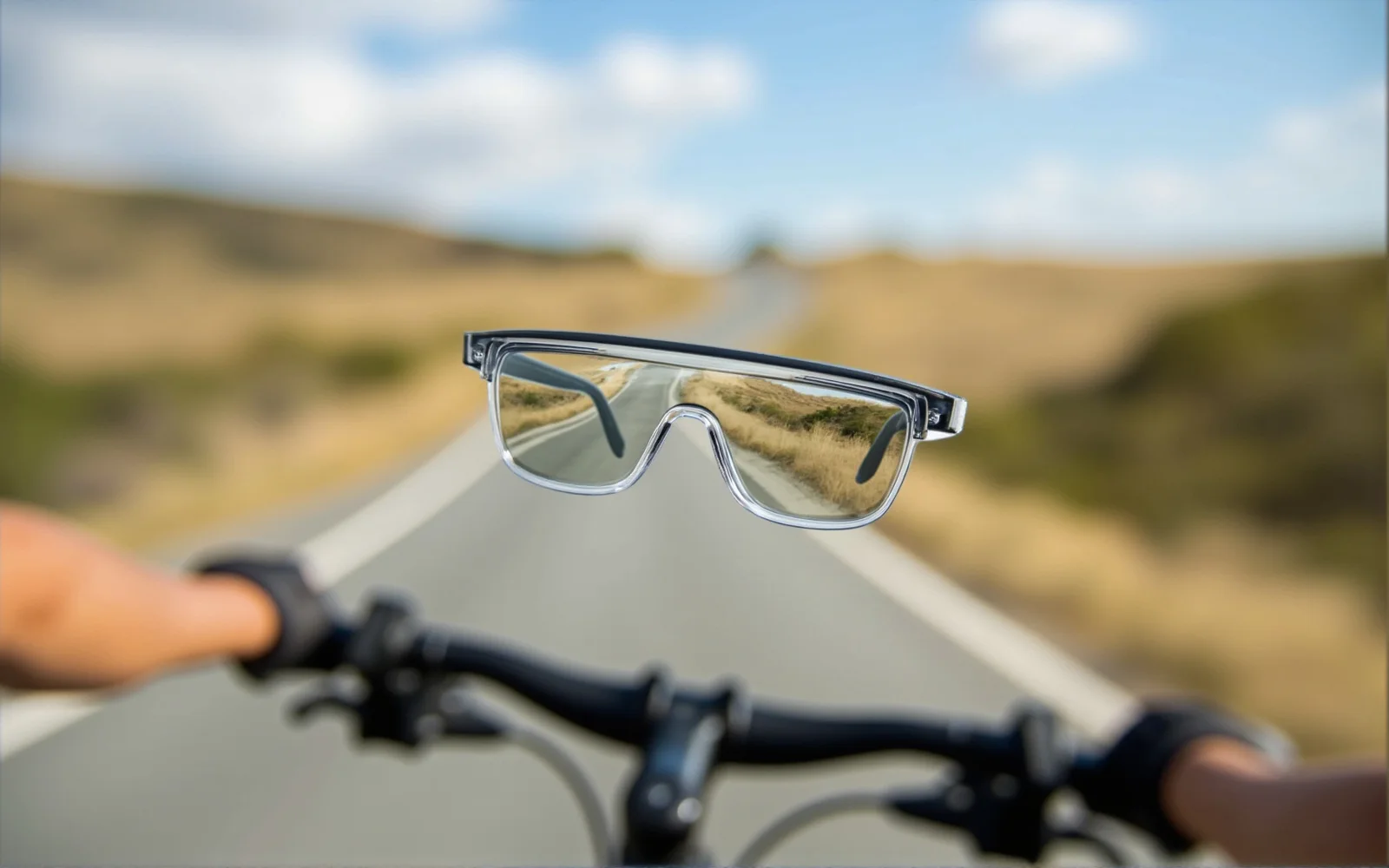
Because the lens follows gaze and both hands stay on the bars, the footage carries the rider’s actual reference frame — where they look into a corner, how close a wheel is in the draft, the scale of a climb. That perspective cannot be reconstructed from a chase vehicle. The general sports case is made on the team and event POV content guide; this page focuses on the ride itself.
The honesty note is essential. Camera eyewear is a complement to, not a replacement for, a dedicated action or broadcast camera. Stabilization, low-light performance, zoom and wind-noise handling have real limits; clips, editing, storage and AI features belong to the companion application; and CYNRIN supplies the capture hardware, not a media platform. The feature-set boundary mirrors the cycling pillar.
Why eye line wins
What first-person footage preserves that mounts cannot
Persuasive ride video is defined by reference frame, and head-worn capture is the only position that matches the rider’s own senses.
- True line of sight. The lens looks where the rider looks — apex, exit, obstacle — teaching the viewer how the rider reads the road rather than showing the rider from outside.
- No rig, no aero penalty. Nothing is bolted to helmet or bars, nothing adds drag or wind noise from a housing, and there is no mount to vibrate loose.
- Both hands stay on the bars. Capture starts and stops from a simple control through technical sections, which matters on gravel and descents where a hand movement is a real risk.
- Socially ordinary. The device reads as sport eyewear on group rides and at cafe stops, where a conspicuous camera changes how people behave around the wearer.
- Always present. The spontaneous moment — wildlife on the trail, a sunset over the col — is captured because the camera is already worn.
For creators this overlaps directly with the general creator POV content workflow: authentic short clips and behind-the-scenes material produced during normal riding, rather than separate filming days. The footage’s value is volume and truthfulness, not cinema staging.
From finish line to feed
The capture-to-share loop, without a laptop ritual
Hardware earns its place only if footage actually leaves the glasses. Programs that scale treat content as a short pipeline owned jointly by the rider and the brand’s companion application.
- Ride and capture. The rider starts short clips deliberately — a climb, a sector, a finish sprint — rather than recording continuously, which is better for battery, storage and the review problem.
- Transfer. Material reaches the companion application over the program’s defined pairing model, ready to review on a phone at the cafe or at home.
- Trim and edit. Selection, trimming, captions and any AI-assisted editing happen in the app; editing features and storage limits are the solution owner’s specification, never a CYNRIN promise.
- Publish or approve. Creators post directly; brand teams route ambassador clips through an approval and rights process before they reach official channels.
For teams and events, logistics become the product: numbered units, charging cases, pairing to named riders and reset between sessions turn prototypes into a reusable content asset, the same discipline described for team and event programs.
Honest expectations on image and sound belong in this conversation. Programs are well advised to test clips in the real conditions of their audience — dappled forest light, damp gravel, open descents — during sampling, and to market what the platform genuinely delivers rather than benchmarking against studio footage.
Privacy on group rides
Filming other riders: etiquette and visible capture state
A camera pointed down a road frequently contains other people: riding companions, passing cyclists, drivers, families at a trailhead. The growth of body cameras on group rides has made those bystanders sensitive, and responsible programs treat the question as a design requirement rather than a disclaimer.
- Unmistakable capture state. A visible indicator makes recording obvious to nearby riders; indicator behavior is configurable per program so active capture cannot be mistaken for idle wear.
- Deliberate clips, not continuous surveillance. Starting clips at chosen moments is better etiquette than recording an entire group ride, and it also produces far less material to review.
- Group norms and event rules. Many rides, clubs and events set their own recording policy; the rider and brand follow those rules and applicable law — the hardware vendor cannot set them.
- Faces and incidents. Footage of other identifiable people, or of road incidents, needs the same care as any public filming; the full principles are in the filming and privacy guide.
For brands that serve riders who do not want any camera in their social riding, the answer is product architecture: an audio-first tier (E13/K01) exists alongside the camera hero, so a range can offer content capability without forcing capture on everyone. The same camera-free choice is central to the kids and accessibility programs on the kids pillar.
Specifying the capture platform
Camera, optics, wind audio and ride-long power
POV capture is a camera-first use case, so the reference starting point is the V03-T5: first-person photos and video plus open-ear audio for calls and voice between clips. Specifying it honestly means four engineering conversations rather than a megapixel headline.
- Optics for riding light. Sport tints and optical quality do the seeing job first; camera field-of-view behavior and real results in dappled and low light are reviewed on the program datasheet, not marketed through generic numbers.
- Wind and mic behavior. Microphone placement is tuned against real riding positions; riders should expect usable ambient sound and voice, with honest limits in high-speed wind rather than studio-grade narration.
- Fit under the helmet. Strap-flush temple geometry, sweat grip and balanced weight decide whether creators wear the camera on every ride; custom strap-channel shaping is available through ODM.
- Capture-day power. A clips-and-standby profile across an event day differs from continuous recording; the power budget is matched to actual use and runtime confirmed on the datasheet.
A tiered range follows naturally: V03-T5 as the content hero for ambassadors and creator programs, audio-first E13 or K01 for the wider riding audience, sharing identity and packaging. Compare the trade-offs on the platform comparison, and review the commercial model on the sports and cycling brands solution, with branding through customization and dedicated geometry through ODM.
Building the program
For creators, teams and bike-brand content departments
Customers for capture eyewear arrive from three directions: independent cycling creators who need always-with-them footage, teams and event organizers who need a managed fleet, and bike brands whose content departments want authentic ambassador material. A workable program follows the same sequence for all three.
- Define the content goal. Social clips, sponsor deliverables, ambassador material or a rider community feed — each implies a different unit count and workflow.
- Select and sample the platform. Camera-first V03-T5 with optics and audio evaluated in the riders’ real conditions before commitment.
- Define the app workflow. Pairing, transfer, editing, rights and approval responsibilities sit with the brand or its solution partner and are scoped early.
- Specify etiquette and fleet logistics. Visible capture state, deliberate recording, event policy, and for fleets numbered units, cases and reset routines.
- Scale per program. Volumes, lead time, protection documentation and destination-market compliance confirmed per program.
Evaluate the camera firsthand through the samples process, review volume tiers on the MOQ page, and open the brief with request a quote. The winning program is honest about what the footage is for and what it is not: dozens of genuine, eye-line clips from real rides — not a substitute for a cinema rig, and far more content than a mount-and-hope camera ever produces.
Buying considerations
What to put in a POV capture brief
Content goal
Creator social, sponsor deliverables, ambassador feeds or event material — the goal sets the fleet size.
Ride conditions
Road or gravel, typical light, speed and climate in which clips must actually look usable.
Capture workflow
Who transfers, trims, clears rights and publishes, and which companion application does the work.
Privacy posture
Visible capture indicator, deliberate clips and conformance with club, event and local rules.
Fleet logistics
For teams: numbered units, charging cases, named pairing and reset between sessions.
Platform tier
Camera-first hero for creators plus optional audio-first tier for the wider audience.
Browse the application
More cycling guides
Keep exploring
Related reading
FAQ
Frequently asked questions
Do camera glasses replace an action camera?
How good is the footage and the audio in wind?
Is it acceptable to film other riders on group rides?
Who handles editing, storage and AI features?
Can a team or brand run a managed capture program?
Build this use case into a private-label program
Tell us the workflow, environment and volume. Engineering scopes the platform, optics, power and documentation per program.