
The content problem
Event content still looks like a phone following the action
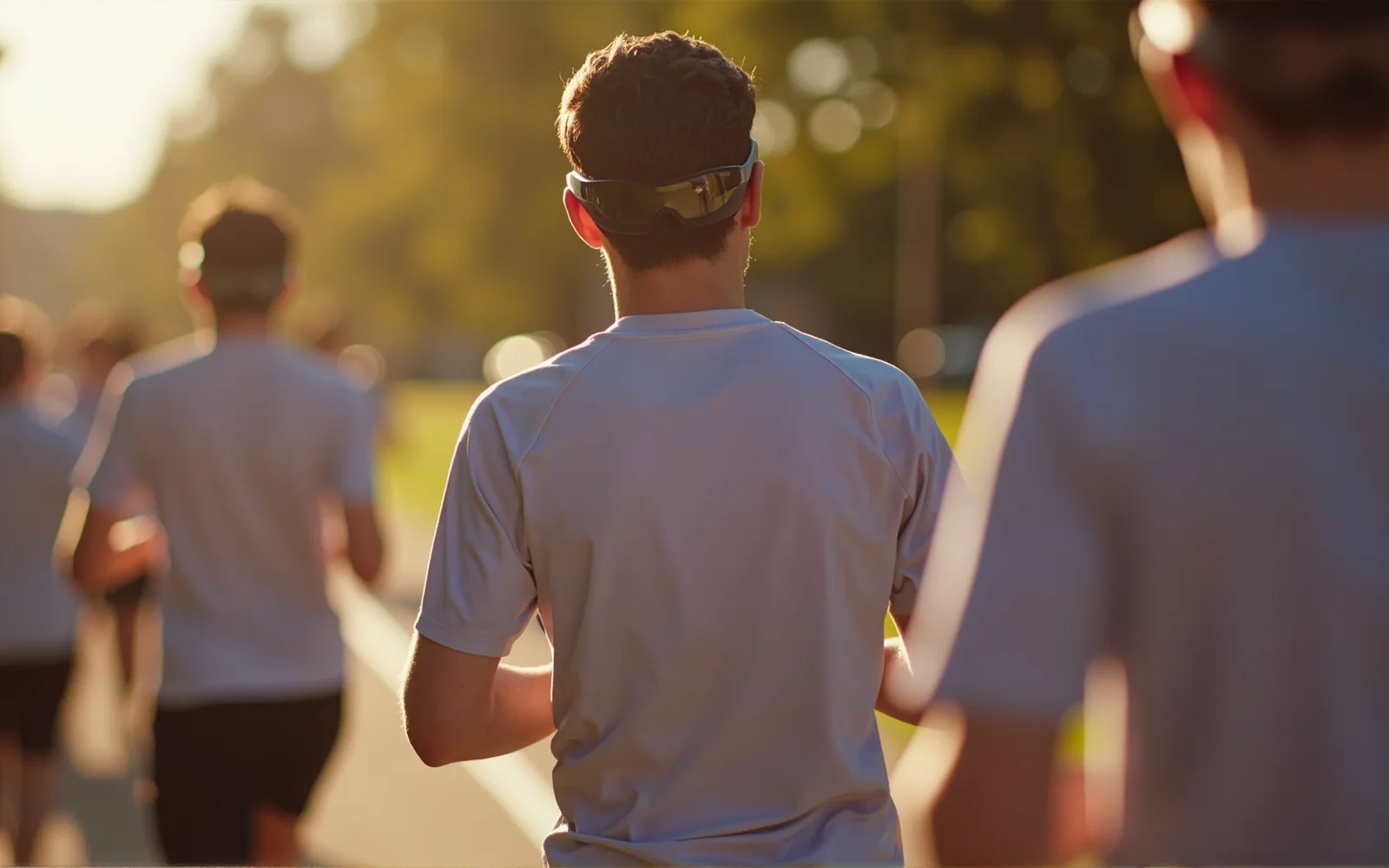
Sports marketing runs on content, and the hardest content to produce is the point-of-view kind. Brands, clubs and event organizers need clips that make a viewer feel inside the action — a warm-up on the pitch, a start-line rollout, a climb with the group, a celebration from the athlete’s own eyes. The usual tools fight that goal. A handheld phone yields selfie-arm footage with the athlete looking at a screen, not ahead. A chest or helmet camera needs a mount and an extra battery, and marks the wearer as filming rather than participating.
The deeper issue is workflow. Great event content is perishable: the golden-hour session, the podium moment, the ambassador ride happen once. If an athlete has to stop, mount a camera, frame the shot and offload the file at a laptop later, most of that material never gets made, and the season ends on a folder of third-person b-roll.
Smart glasses remove the friction at the source. The camera sits at eye line, on eyewear many athletes already wear, and records a first-person view as a by-product of taking part. Both hands stay on the ball, the paddle, the ropes or the bars. The clip starts from a simple control, and the athlete never breaks posture or eye contact with the moment. For a brand, that means content generated by the people the content is about — not by a camera crew orbiting them.
The boundary matters as much as the capability. CYNRIN designs and manufactures the camera-eyewear hardware platform. The companion app, clip editing, publishing, rights management and any performance analytics are owned by the brand or its software partner. A strong program pairs dependable, privacy-conscious eyewear with the content workflow the brand already runs — not a hardware vendor improvising a media platform.
Why eye line wins
First-person framing versus phones and action cameras
POV footage is persuasive because of reference frame: the viewer sees approximately what the athlete sees, from head height and in the direction of gaze. A pass across the court, a technical descent or a summit view carries the speed, spacing and attention of the participant, not an observer across the field.
- Eye-line perspective. The lens follows where the athlete looks — teammates, the line, the finish — which teaches the viewer how the athlete reads play.
- No camera operation. There is no framing, no rig and no visible screen, so body language stays natural and performance is not interrupted for content.
- Socially ordinary. Glasses look like sport eyewear, so athletes wear them in a team huddle or a sponsor handshake where a mounted camera would feel intrusive.
- Always on the athlete. The device is already worn when the moment happens, which is the difference between capturing the celebration and hearing about it afterward.
This is not a claim that glasses replace a professional camera for broadcast hero shots. They complement broadcast and phone coverage with dozens of authentic first-person angles produced by the participants themselves — the case made in depth on the POV ride capture guide and for marathon and road-running content.
For creator-led campaigns the output feeds the creator POV content workflow: short clips and behind-the-scenes material that reads as lived experience, not advertising.
The capture workflow
From a clip at the finish line to an approved social post
A workable program is a pipeline, not a gadget. The hardware only earns its place if footage moves from an athlete’s glasses to a social channel without a laptop-and-cable ritual. Programs that scale tend to run the same short loop.
- Capture. The athlete starts and stops clips with a simple control during warm-ups, play intervals or the post-finish lap, without breaking rhythm.
- Hand off. Material reaches the companion application over the brand’s defined pairing model, where the athlete or a content manager reviews it on a phone.
- Select and trim. Usable moments are trimmed, captioned and routed for approval; the editing and rights workflow belongs to the brand or its app partner.
- Publish and reuse. Approved clips post to race-day social, ambassador channels and sponsor reports, with the strongest moments retained in a content library.
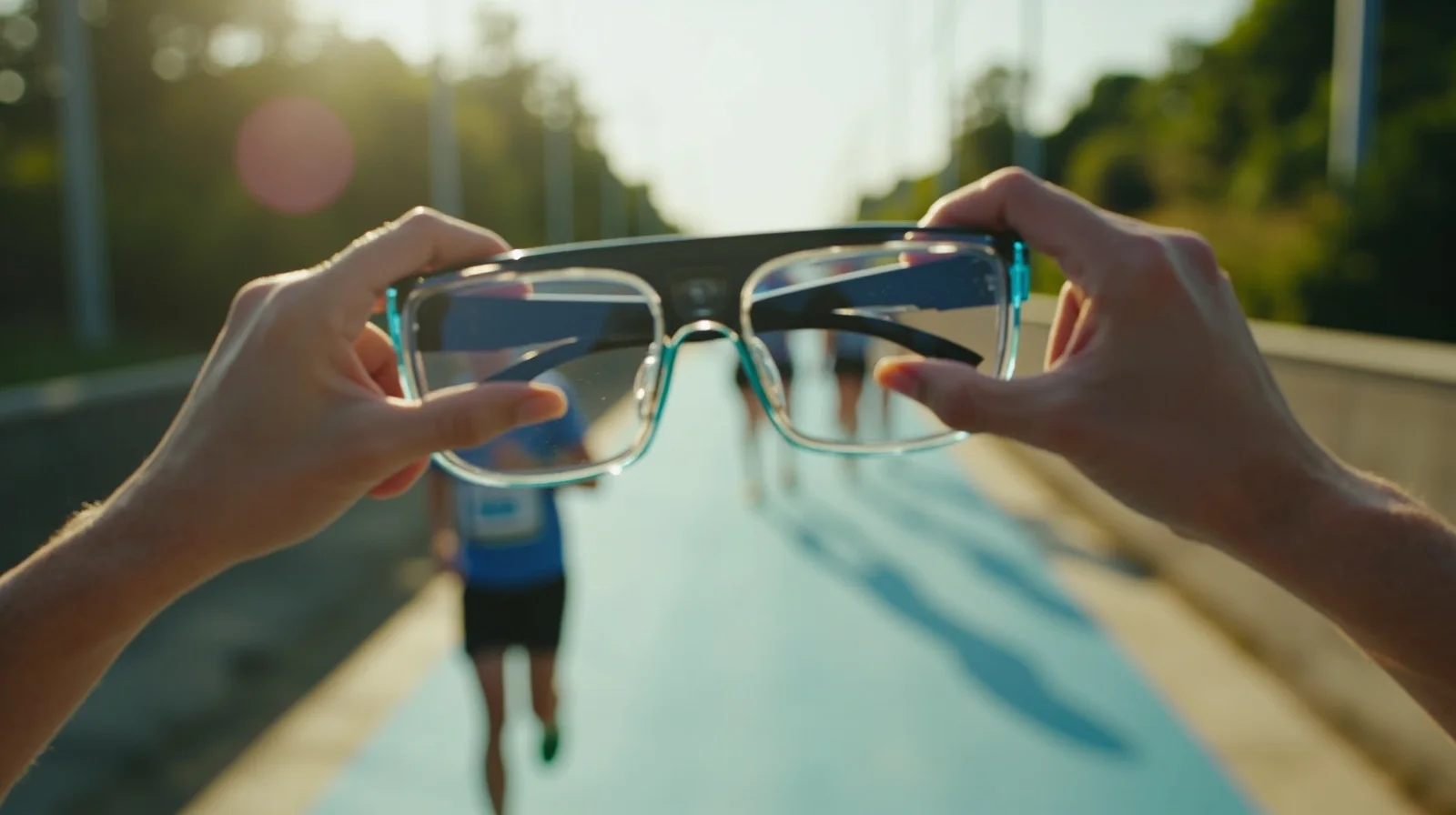
At a multi-athlete event the logistics are the real product. Teams issue numbered units before a session, pair each to a named athlete, collect and charge them afterward, and reset them before the next group. Multi-unit cases, simple enrollment and a defined reset routine turn a handful of prototypes into a repeatable event asset. Exactly how pairing, accounts and clip transfer behave is configured per program rather than promised generically.
Where it is used
Four settings that generate a steady stream of POV material
The use cases with the best return share a trait: the brand wants authentic volume — many short, genuine clips — rather than one polished film.
Race and event days
A road race, triathlon, regatta or obstacle event issues glasses to seeded athletes or a content team for start-line atmosphere, in-race perspective and finish-line reactions. The output fills social channels during the event itself, when attention peaks.
Club and team sessions
Coaches and content officers capture training-ground POV from rotating players: a drill from the ball-carrier’s view, a warm-up, a team huddle. The same footage serves both social channels and the coaching review covered in coaching & performance.
Ambassador and sponsorship kits
Branded athletes and ambassadors receive co-branded glasses as part of a kit, generating first-person clips across their own seasons and geographies. Sponsor deliverables then include authentic footage rather than only logo placement. The commercial framing for this is set out in the sports and cycling brands solution.
Fan and experiential activations
At a festival, expo or brand day, visitors wear loaner units through a short experience and receive a shareable clip — which makes the privacy and reset discipline described below essential.
Endurance overlaps are handled on their own pillars — on-bike content on road and gravel cycling and race-day running on trail running. This hub focuses on team, event and ambassador capture around those sports, not the ride or run itself.
Privacy and logistics
Indicators, consent and shared units at events
A camera worn into a crowded event points at other competitors, juniors, officials and spectators — people who never chose the device. Responsible programs treat that as a design requirement, and most event organizers and governing bodies now expect it.
- Unmistakable capture state. A visible indicator shows everyone nearby when the glasses are active; indicator behavior is configurable per program so recording cannot be mistaken for idle wear.
- Bounded capture. Athletes start clips deliberately rather than recording continuously — better for consent, for battery and for the editorial problem of reviewing hours of footage.
- Event policy first. Where recording is permitted, how minors are handled and where footage may be published are governed by the organizer and applicable law, not by the hardware vendor.
- Managed fleet reset. Loaner units are re-paired and cleared between wearers so a fan activation never carries one visitor’s session to the next.
The privacy principles for filming people in public are explored more fully in the filming and privacy guide. For youth and school events specifically, many programs prefer an audio-only, camera-free model for the participants and reserve camera units for staff — a configuration that is straightforward to specify on the platform.
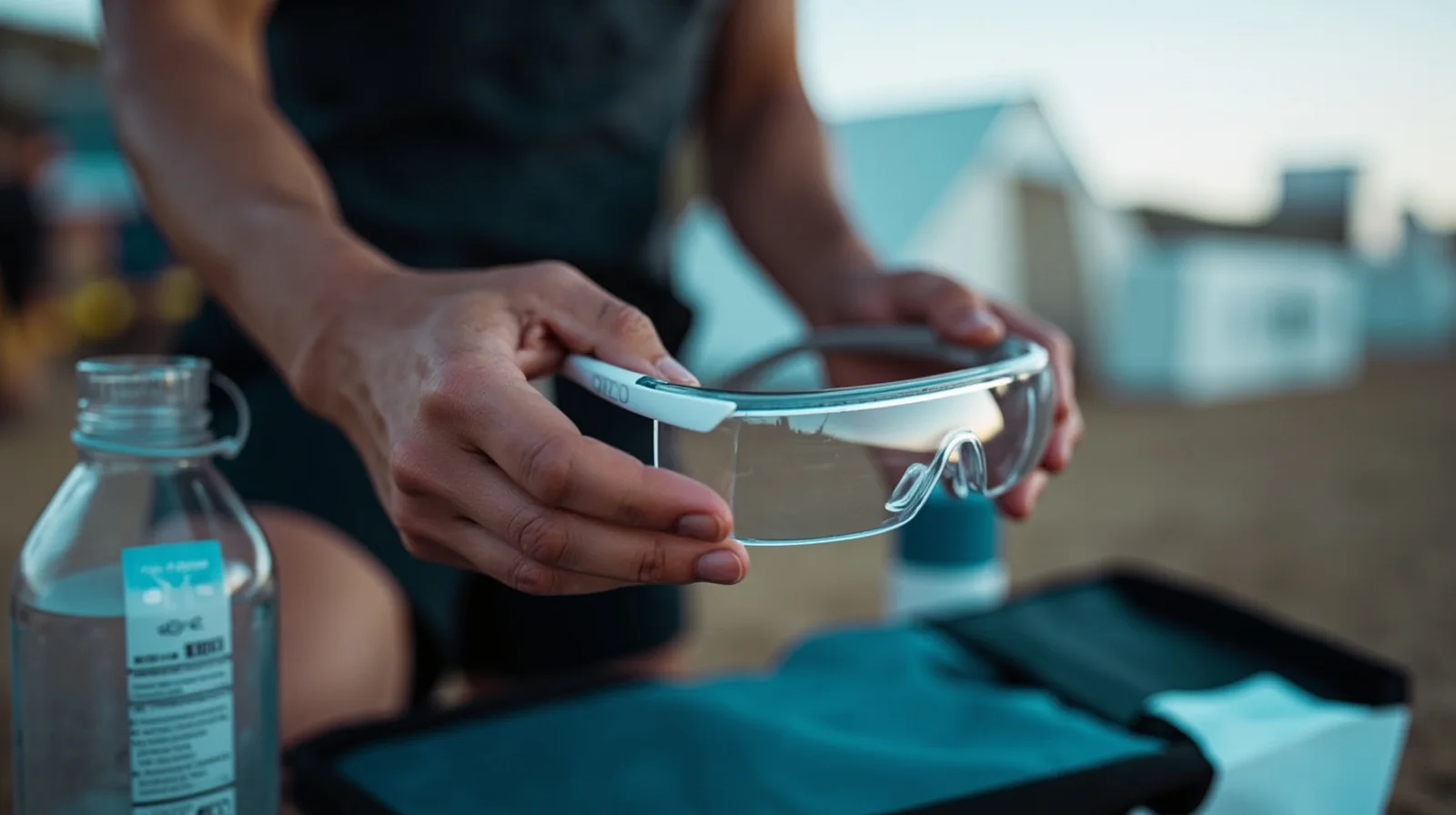
Durability is the other half of event logistics: units get passed through dozens of hands, dropped in gear bags and worn through sweat and weather, so frame construction, hinge treatment and replaceable contact parts are scoped for exactly that handling.
Specifying the platform
Camera range, sport optics and a private-label path
Event content is a camera-first use case, so the camera platform leads. A typical program is built around the V03-T5 reference platform: first-person photos and video with open-ear audio for hands-free calls and voice between clips. Lens options are specified for the real environment — bright-field sport tints for outdoor events, clearer optics for indoor arenas — and camera field-of-view behavior is reviewed on the program datasheet rather than marketed through generic numbers.
Three hardware questions decide adoption. Weight and secure fit: glasses that shift during a sprint or a header do not get worn a second session, so temple grip and nose-pad options matter. Sweat and weather handling: materials, sealing and port placement are scoped and validated under the brand’s quality process for real outdoor use. Power for an event day: the capture-and-standby profile is matched to how a unit is actually used across a race day, with runtime confirmed on the datasheet rather than as a headline figure.
Not every unit in a range needs a camera. Brands often tier the line: a camera hero for content athletes and an audio-first platform such as the E13 or K01 for open-ear communication and music across the wider team, sharing one visual identity. For helmet-strap and cap compatibility at endurance events, the geometry work described under ODM programs applies directly.
The commercial path follows the standard CYNRIN model. Private-label programs carry the brand’s logo, colors, cases and quick-start material through customization; custom frame geometry, temple profiles and accessory tooling are available under OEM/ODM. Volumes, lead times and destination-market documentation are confirmed per program, with evaluation samples available before fleet commitment.
Buying considerations
What to put in a team or event POV brief
Content goal
Social volume, sponsor deliverables, ambassador material or fan experiences — each implies a different fleet size.
Wearers and settings
Named athletes, rotating players or loaned-to-public units; outdoor field, arena or mixed weather.
Clip workflow
Who reviews, trims, clears rights and publishes, and which companion application does the transfer.
Event logistics
Numbered units, charging cases, pairing model and reset between wearers across multi-day events.
Privacy posture
Visible active-state indicators, deliberate capture, and organizer policy for crowds and minors.
Platform tier
Camera-first hero units plus optional camera-free audio frames for the wider team.
Browse the application
More sports & outdoor guides
Keep exploring
Related reading
FAQ
Frequently asked questions
Can athletes really wear camera glasses during a competitive match or race?
How do clips get from the glasses to our social channels?
How do we manage dozens of units at a single event?
What about filming other competitors, children and spectators?
What is the minimum order for a branded team or event program?
Build this use case into a private-label program
Tell us the workflow, environment and volume. Engineering scopes the platform, optics, power and documentation per program.