

The paper-and-tablet problem
Instructions still live somewhere the operator is not looking
The standard operating procedure is perfect on paper, which is precisely the problem: the paper is on a bench hook two feet from the work. Every few steps the operator looks down, breaks the rhythm of the task, loses their place, and returns to the assembly relying partly on memory. On a high-mix line — many variants, frequent changeovers, long gaps between runs of any one product — that memory is exactly where errors live.
Tablets improve version control but recreate the same physical interruption: set down the part, pick up the tablet, scroll with a gloved finger that does not register, wipe the screen, set it down, pick up the part. Fixed terminals force the operator to leave the station to read. Paper is annotated until the official revision and the floor revision silently diverge. Each format assumes the worker will keep dividing attention between the instruction and the work.
The cost of that divided attention lands downstream: a skipped torque step, a fitting handed the wrong way, a variant configured with the previous model’s part. Mistakes at low-frequency, complex stations are disproportionately expensive because they are rare enough to be unfamiliar yet systematic enough to recur across every new operator. Training new staff has the same shape — an experienced operator is shadowed for days, and the SOP is only truly learned by making the early mistakes.
Digital work instructions on eyewear put the cue where the attention already is. A prompt appears in the operator’s upper field of view or is spoken through open-ear audio at the moment it applies; confirmation happens by voice, glance or a single control while the hands continue the assembly. The procedure is followed in sequence rather than recalled from it. As elsewhere, CYNRIN provides the connected-eyewear hardware platform; authoring, versioning, approval workflows and MES integration are owned by the instruction-software partner.
How guided assembly runs
Cues, confirmations and honest overlays at the station
A guided job begins when the operator or the line system identifies the work order — by scanning the traveler or selecting it on the station terminal. The partner application loads the current, released revision of the procedure and presents it one step at a time rather than as a page to hunt through. The operator performs the step, confirms, and the next cue unlocks only when the software accepts the confirmation.
- Eyes-up step cues. Short text, an icon or a still reference for the current step sits in the peripheral field, readable without abandoning the workpiece.
- Pick and place prompts. Bin location, orientation and part identity are cued for the exact variant, which is where high-mix assembly gains the most.
- Hands-free confirmation. Voice, head gesture or a single control acknowledges completion; where the station uses scan or torque-tool interlocks, the software holds the sequence until the real signal arrives.
- Error-proofing branches. A failed or ambiguous step routes to a rework cue, a supervisor call or an expert escalation instead of letting the unit proceed.
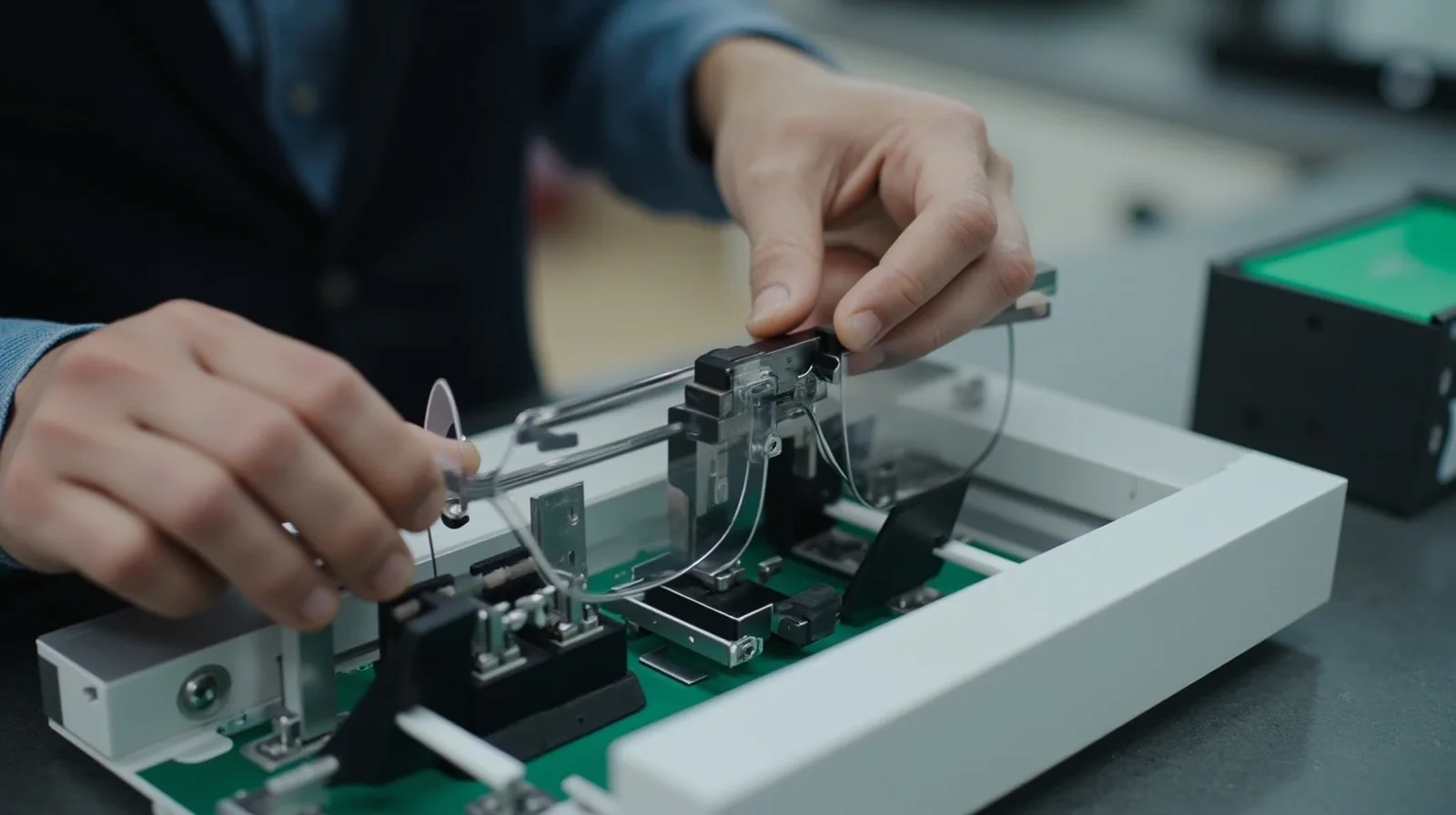
A note on honesty: production eyewear shows cues, prompts and reference images — it does not project holographic overlays onto the machine. Programs that describe every step as “AR” overpromise what the hardware renders. The valuable behavior is sequential, eyes-up guidance with forced confirmation, and that is what reduces errors whether the cue is a glanceable prompt or a spoken instruction.
Where it pays off
The stations where guided instructions change outcomes
Guided assembly is not prescribed for every workstation. Tact-time-pacing stations where an operator repeats one second of motion thousands of times a day gain little from step prompts; the instructions live in muscle memory. The return concentrates where variety, unfamiliarity or consequence is high.
High-mix assembly and changeovers
Lines running many variants in small batches, with frequent changeovers, are the textbook case. Variant-specific pick cues and sequence confirmation stop yesterday’s configuration being built into today’s order.
Kitting and internal pick-and-place
Pre-assembly kitting shares its logic with logistics picking: eyes-up location and quantity cues, confirmation per pick, fewer walk-backs to re-pull a missed component. The warehouse version is covered in warehouse picking & logistics.
New-operator training and ramp
A newcomer follows the released procedure directly, with the pacing and branch logic embedded in the cue flow. Shadowing time shortens and the first unaided units follow the official method rather than the neighbor’s shortcut.
Maintenance SOPs and rework
Procedures performed rarely — calibration, change-part replacement, documented rework — are exactly the ones nobody remembers correctly. Guided steps plus first-person completion evidence overlap with inspection and quality documentation.
Content and integration
The instruction system is the partner’s product
Hardware is the smaller half of a work-instructions program; content is the larger half. Procedures must be authored, reviewed, released and versioned, tied to product variants and engineering changes, and retired when obsolete. That content lifecycle belongs to the instruction platform — CYNRIN does not ship an MES and does not author a customer’s SOPs.
Mature deployments connect the instruction layer to the systems already governing the line: the work order identifies the procedure; barcode or RFID confirms the right part; smart tooling confirms the right torque; completion and exception events return to the MES or quality record. The depth of those integrations varies enormously by site, and buyers should ask the software partner specifically what is productized versus custom-built for each connector. The eyewear’s obligation is narrower but real: stable companion behavior, manageable identity, and firmware that behaves under the site’s device policy.
Change management matters as much as integration. Procedures presented one step at a time only help if they match the work engineers actually perform; an SOP nobody updated becomes visibly wrong the moment it is cued over the operator’s hands. Successful programs start with a small, well-maintained procedure family, assign content ownership clearly, and treat authoring discipline as the ongoing cost it is.
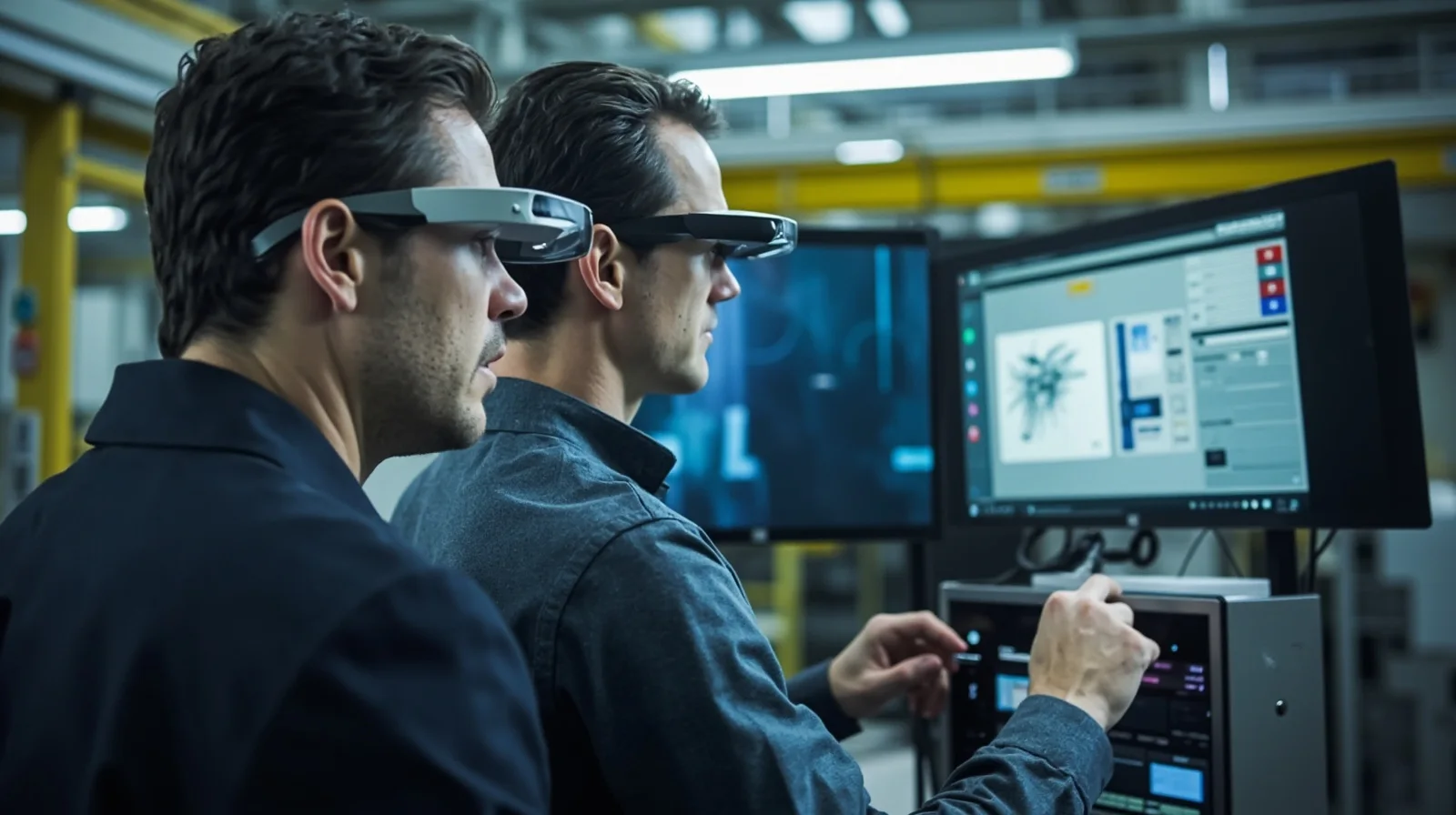
Workforce framing follows from the same honesty: the device guides the work and records completion events; it is not positioned as keystroke surveillance. Visible capture state, job-bounded operation and consultation with worker representatives belong in the rollout plan.
Specifying the eyewear
Glanceable cues, open-ear prompts and shift-long comfort
Guided assembly makes a specific set of hardware demands. The display requirement is for a readable cue under station lighting — including bright inspection bays — without dimming the real workpiece or tunneling peripheral vision; the optical arrangement and see-through behavior are confirmed on the program datasheet. Open-ear audio carries step prompts while the operator still hears the line and colleagues, which sealed earbuds cannot safely do in an active cell.
Because the glasses stay on for a full station rotation, weight, balance and heat are adoption-critical. Frames are tuned for extended wear, fit over prescription eyewear, and work with caps, hairnets or other headwear where the station requires; temple and nose-contact options account for different faces and for cleaning between users on shared stations. The power profile is matched to a guided-shift pattern with charging between rotations, specified per program rather than quoted as a universal runtime.
Durability is scoped honestly: finishes and sealing are chosen around the actual contaminants and the plant’s cleaning routine, with any protective-lens or sealing level confirmed per program; the reference platform is not generically marketed as certified PPE. Camera-led hardware, such as the V03-T5 camera glasses, supports steps that also capture completion evidence, while audio-led platforms suit voice-cued stations; custom frame geometry, accessory tooling and station packaging are available through ODM and customization.
Building the program
From one procedure family to a branded rollout
Buyers are usually instruction-platform vendors, system integrators, and manufacturers modernizing specific lines — notably electronics, automotive tier suppliers, machinery and complex appliance assembly. The pragmatic programs narrow the first scope instead of converting every SOP on day one.
- Pick the stations. Choose high-mix, low-frequency or training-heavy cells where error cost is measurable and the procedure is well maintained.
- Scope the platform. Define glanceable display versus voice-led cues, completion evidence needs, wear duration, headwear and PPE context.
- Confirm the software architecture. Authoring, version control, MES/tooling connectors and device policy are agreed with the solution partner before hardware is committed.
- Pilot a bounded family. Run evaluation units on one variant family, measure rework and training-ramp change, and validate the content-update discipline.
- Scale as a branded fleet. Roll out with the deploying brand’s identity, station packaging and charging model; volumes, lead time, tiered MOQ guidance and documentation are confirmed per program via the samples process and MOQ guidance.
Delivered this way, digital work instructions become part of the process instead of a reference beside it — cued in sequence, confirmed honestly, and governed by the systems that already own quality. Begin with request a quote or review quality control.
Buying considerations
Guided-assembly program brief
Target stations
High-mix, low-frequency or training-heavy cells with measurable error or ramp cost.
Cue modality
Glanceable display, spoken prompts, or both; what confirmation each step requires.
Interlocks
Scan, RFID or smart-tool signals that gate sequence progression.
Content ownership
Who authors, releases and retires procedures, and the connector roadmap to MES.
Wear and PPE
Shift duration, prescription fit, headwear and any protective-lens or sealing need.
Pilot metrics
Rework, defect-escape and training-ramp baselines to measure against.
Browse the application
More industrial & manufacturing guides
Keep exploring
Related reading
FAQ
Frequently asked questions
Do the glasses project holographic AR overlays onto the machine?
Can steps only advance after a photo or a barcode scan?
Will voice prompts work in a noisy assembly plant?
Who builds the instructions and connects them to our MES?
Can we pilot before committing to a fleet, and brand the units?
Build this use case into a private-label program
Tell us the workflow, environment and volume. Engineering scopes the platform, optics, power and documentation per program.