

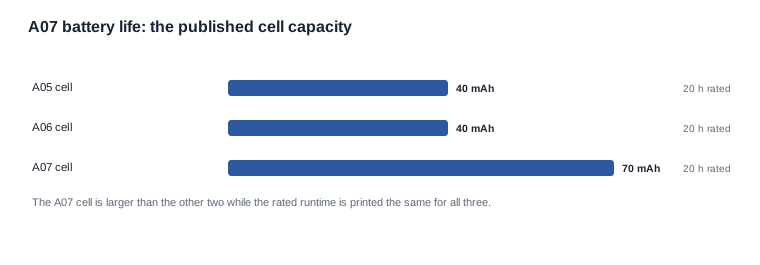
The A07 publishes a 70 mAh cell and a rated use of about twenty hours. The two neighbouring models in the same children's range publish 40 mAh and the same twenty hours. That combination is the single most useful fact about this model, and it is the fact most often misread. The larger cell does not produce a longer rating; it produces margin inside a rating that is otherwise undefined. For a buyer, margin is worth more than a headline, because a headline is a number you have to defend and margin is a number that absorbs the thing you could not specify.
This article treats the published rows as an energy budget rather than as a spec sheet: what the number rests on, what it leaves undefined, how to convert it into a test you can repeat on a sample, and which rows belong in the purchase order rather than in a listing.
A07 battery life: the published cell and the published runtime
The catalogue prints five rows for this model. Two of them are energy figures, one is a charging method, one is a radio version, and one is a rated runtime. Read together rather than separately, they describe a small cell doing a light job with a generous charge budget.
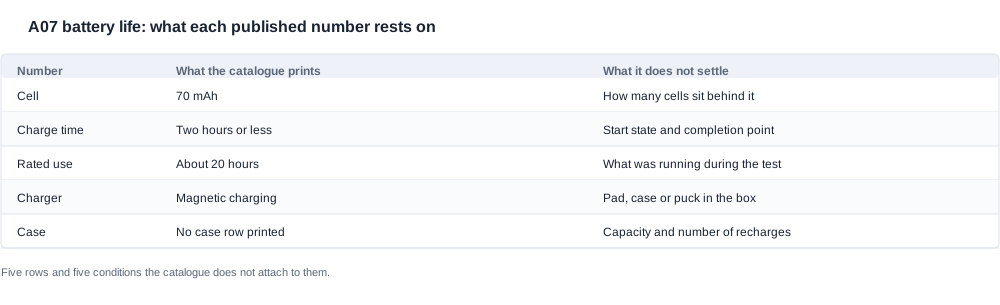
The cell. 70 mAh. The catalogue prints a single capacity value for this model and does not state a cell count, a cell chemistry or a rated capacity under a defined discharge rate, so a procurement file that quotes "70 mAh" is quoting a number whose measurement conditions the supplier has not declared. That is normal in this category and it is not a reason to reject the model. It is a reason to ask one question: what discharge profile was the cell rated against, and is the figure in the catalogue a rated capacity or a nominal one. A cell rated at a low drain reports more usable milliamp-hours than the same cell at a high drain, and the difference shows up in the field rather than on the datasheet.
The rated runtime. About twenty hours. This is a rated figure, not a measured one in any condition the catalogue describes, and the difference between those two things is the whole of the risk in this row. No start state is given, no volume level, no distance from the device, no ambient temperature, no radio state and no sample count. It is a manufacturer rating, which is a legitimate thing to publish, and it is not a thing to write on a product page without the word "rated" attached to it.
The charge time. Two hours or less. The catalogue publishes a ceiling here, and the ceiling is the correct form of the claim: it says the charge completes in two hours or less, and it does not say how long it takes. A listing that says "charges in two hours" has converted a ceiling into a measurement, and a listing that says "under two hours" has made a stronger assertion than the catalogue makes, because it excludes the two-hour case itself. The defensible phrasing is two hours or less. Note that this is an upper bound on the charging task, not a measurement of it, and that it says nothing about the starting state — which is the reason the same row is worth requesting in detail further down.
The charging method. Magnetic. The catalogue prints the word and nothing further: it does not describe whether the charger is a pad, a case, or a cable-ended puck, it does not publish a charge indicator row, it does not publish the accepted input current and voltage, and it prints no charging-case row for this model at all. Every one of those absences is a question for the supplier, and every one of them becomes a specification line in your purchase order or it becomes a support contact.
The radio. Bluetooth V5.4. Published for this model and for no other model in the children's range, which means the runtime figure on this model is a figure produced with a radio in the product. This is worth dwelling on, because a radio consumes power whether or not it is carrying traffic, and a runtime figure that ignores the radio is not a runtime figure for a connected device.
What the twenty-hour figure does not state
The cleanest way to see what is missing is to compare this model with its two neighbours. All three publish a charge time of two hours or less. All three publish a rated use of about twenty hours. All three publish magnetic charging. The A05 and the A06 publish 40 mAh; the A07 publishes 70 mAh.
A cell that is seventy-five per cent smaller producing an identical runtime figure is not a rounding difference. It is evidence that the figure describes a duty cycle rather than a continuous load, and the duty cycle on the smaller cells is lighter: the A05 and the A06 carry a lens-type electronic fogging arrangement and a posture and distance indication, and a device that sleeps and occasionally wakes to sample and indicate consumes a great deal less than a device that holds a radio link and runs an audio path.
Three readings follow, and only one of them is safe to use in a listing.
The first reading is that twenty hours means twenty hours of continuous operation. This is the reading a shopper makes, and it is not supported. A 70 mAh cell running a connected audio product for twenty hours straight is at the edge of what is plausible at any reasonable cell voltage, and the catalogue gives no condition that would make it routine.
The second reading is that twenty hours is a low-power figure with long idle periods. This is the reading the catalogue's own comparison implies, because the smaller cells produce the same number. It is almost certainly closer to the truth, and it is still not safe to publish, because you do not know the idle period, the reminder interval or the radio state.
The third reading is the one to use. The A07 publishes a rated runtime of about twenty hours, and that rating belongs on a product page as a rating, attributed as a manufacturer rating, with no implication of continuous use. Any listing that turns the rating into a promise of continuous operation creates a returns exposure that the documentation cannot support.
The same discipline applies to the charge time. Two hours or less is a ceiling on a charging task designed to complete overnight. It is not a specification of how long charging takes, and it cannot be used to work out how much of a shift is lost to charging, because the start state is unknown and the completion criterion is unknown.
There is also a row that is missing rather than undefined. The catalogue prints no charging-case row for this model, and it prints no row describing the physical charger. That is a difference worth keeping sharp: a row that says "no case" and a row that says nothing at all are different answers, and they need different handling in a costing model. The first is a decision you can price. The second is a question you have to ask before you can price the box.
Three red flags to watch for in a supplier's answer. An answer that gives a runtime with no radio state is describing a different product from the one you are buying. An answer that gives a charge time measured from an empty cell to a full cell is describing a laboratory figure no household will reproduce. And an answer that declines to give a spread across units is telling you that the spread exists. Each of these is a normal and commercially reasonable thing for a supplier to say, and each of them is a reason to ask a second question rather than to accept the row as it stands.
A07 headroom: what the larger cell actually buys
Headroom is the difference between what a rating promises and what a household actually does. It is not a marketing term; it is the margin between the published figure and the worst realistic day, and its size is the reason a buyer's decision can be made on the catalogue alone.
Margin for the radio, not just for the audio. A connected device spends power on three things at once: the audio path, the radio link, and whatever else the firmware does while neither is carrying traffic. A larger cell does not change any of those; it changes what happens when all three are active at once for longer than the average case. A call that runs long, a video that is watched in full rather than in fragments, a second pairing session after the first one failed — these are the events that consume margin, and they are exactly the events a twenty-hour rating does not describe.
Margin for temperature. Cell performance falls in cold conditions, and it falls on a curve the catalogue does not publish. A product used on a journey in winter carries that penalty with no margin of its own. On a 40 mAh cell the penalty is a larger fraction of the day's requirement; on a 70 mAh cell it is a smaller fraction. This is a genuine differentiator between the models, and it is a differentiator you can describe honestly without inventing a figure.
Margin for the accessory decisions. This is the commercial point that usually gets missed. The catalogue prints no case row for this model, so you cannot plan a multi-day routine from the documentation. If a case is not part of the box, the daily routine has to work with the charger alone, and the daily routine has to work for a parent and a child without supervision. A twenty-hour rating does not fix that problem; it changes how much margin is available while the problem is being solved. The A07 charging options breakdown covers the accessory and packaging programme in detail, and the kids box contents analysis covers what the carton has to carry.
Headroom is also what makes the model easier to qualify. A product whose figures rest on a narrow, tightly specified duty cycle needs a measurement protocol, a written condition and a defensible test before it can be listed honestly. A product with margin can be listed as a rating, qualified with a sample measurement, and defended on the sample. For a first purchase in a category, that difference in qualification effort is worth more than the cell capacity itself.

How to measure A07 battery life on a sample
A runtime figure is only useful if it can be reproduced. The catalogue does not publish its test condition, so the only way to get a number you can defend in a purchase order is to build the protocol yourself and record the condition beside the figure. This is the same procedure the battery comparison method sets out in general form; here is the version for this model.
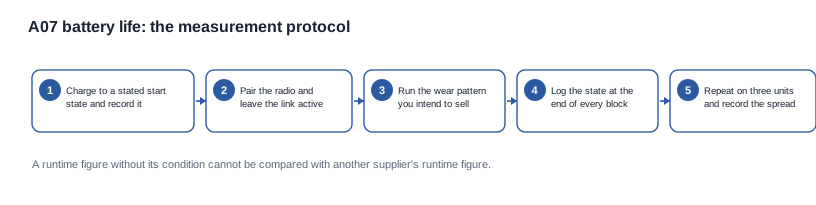
Fix the start state before you fix anything else. Record the state of charge at which the test begins, the ambient temperature, and the number of units. Three units from the same batch is a minimum, not an aspiration, because a single unit tells you about that unit.
Decide the radio state in advance. Leave the link paired and idle, or unpaired, and write down which. If the intended product depends on the app and firmware position, that position is recorded as awaiting verification for this tier, so the radio state in a test may not be the radio state in the field. Test the state that matches the listing you intend to publish.
Run the pattern you intend to sell, not a laboratory pattern. A useful protocol for this model is a school-day block followed by an evening block, with the audio path exercised and the radio idle between blocks. Write the pattern down before the first run, because a pattern designed after seeing the result will always produce a flattering number.
Log the state at the end of every block rather than only at the end of the day. A single end-of-day reading gives you one number and no information about where the energy went. Block-level readings give you the radio cost and the audio cost separately, which is what you need in order to describe the duty cycle honestly to a channel that will ask.
Time the charge from a stated start state and record the completion criterion. You are measuring the interval between two defined points, not between empty and full in some informal sense. If you do not state the start point, the number you record is not comparable with the catalogue's ceiling, and the comparison is the whole point.
Repeat across units and record the spread. The spread tells you two things: whether the sample you received is representative, and what tolerance to write into the acceptance criterion. A supplier who will commit to a spread is making a different commercial offer from one who will commit to a single figure.
A07 battery: what to request before the figure goes on a page
Ten items are open on this model around the energy and charging rows. Three of them can be closed by the supplier in a single email, three need a sample and a protocol, and four are decisions you take in your own copy and in your own purchase order.
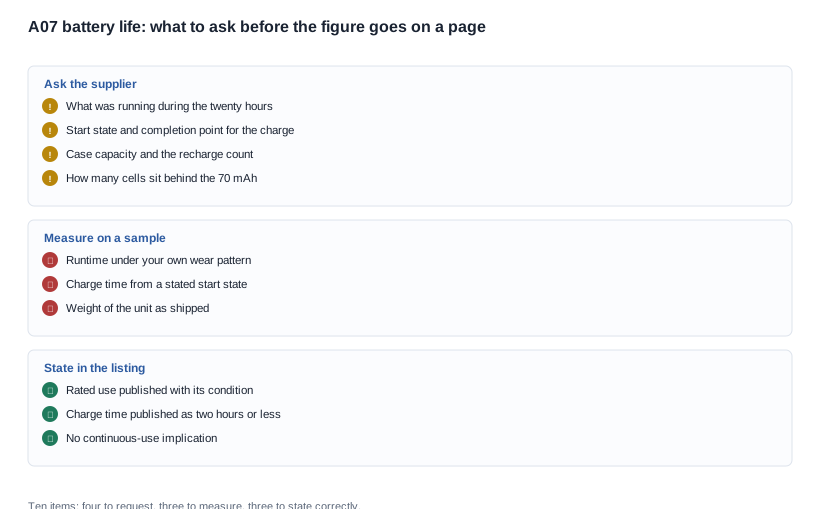
Ask the supplier for four things in writing. What was running during the twenty hours, including the radio state and the reminder interval if any sensing is present in the configuration. The start state and the completion criterion behind the two-hour ceiling. Whether a charging case exists for this configuration and, if so, its capacity and the number of recharges it provides. And how many cells sit behind the 70 mAh figure. None of these four costs the supplier anything to answer and each of them changes what you can write.
Measure three things on the sample. The runtime under your own usage pattern, the charge time from a stated start state, and the weight of the unit as shipped including the charger if the charger is the shipping configuration. These three measurements turn three catalogue figures into three figures with a condition attached.
State four things correctly in the listing. The runtime as a rated figure with its condition. The charge time as two hours or less, which is a ceiling rather than a measurement. The cell as the catalogue value, with the discharge profile asked for. And no implication anywhere of continuous use, because the documentation does not support one.
Two commercial points belong in the negotiation rather than in a listing. The accessory set and its minimum order quantities are order-planning items with a unit cost and a place in the box, and asking for them alongside the product rather than after the packaging artwork exists is the difference between a plan and a retool. The spare charger route is a term: a magnetic charger is a small object, small objects get lost, and whether a replacement can be ordered separately, at what price and at what minimum order quantity, is cheaper to settle before the first order than to fix after the first call from a parent.
The evaluation criterion you are actually writing is a tolerance, not a figure. A criterion that says about twenty hours cannot be failed. A criterion that says not less than eighteen hours with the radio paired and idle at twenty-five degrees, measured on three units from the delivered batch, can be failed, can be disputed and can be priced into a returns term. That distinction separates a specification from a slogan, and it is the same distinction that separates a negotiated charge time from a quoted one. When you assess this model against an alternative supplier, the thing to compare is not the two numbers on the page but the width of the acceptance criteria each supplier will sign. What to ask, in order, is: the condition, the spread, the tolerance, and the remedy if a delivered batch falls outside it. The A07 buyer review checklist turns that sequence into a repeatable review, and the total cost of the programme is usually decided by the tolerance rather than by the cell.
The line we hold on this model's energy rows
On the A07's energy rows, our position is that the 70 mAh cell is real and useful, and that it should be described as margin rather than as a longer rating, because the rating is the same number across all three models and the capacity is the thing that differs. We publish the twenty hours as a manufacturer rating and we will not convert it into a continuous-use claim, because the condition is not published and we will not estimate one. We publish the two hours or less as a ceiling, and we will not write it as under two hours, because those are two different assertions and only one of them is the one the catalogue makes.
We will not quote a cell discharge profile, a case capacity, a charge indicator, an accepted charging input, a frame weight or an ingress rating that the documentation does not contain, and where a row is absent we will say so rather than supply a typical value. We publish no ageing data for the cell and we will not estimate a service life for something we have not tested. And we make no vision, hearing or eye-health claim for this model or any other, because a runtime figure says nothing whatever about eyesight and there is no claim to attach.
What we will do is tell you which of the ten items above our documentation answers today, which have to come back to you as unknown, and which need a sample and a protocol. Send us the application, the expected daily usage and the volume, and we will say which published figures apply to your listing and which have to be measured first. The published A07 specification list is the honest baseline, and the A07 limitations analysis sets out the full gap set for the model.
Related reading
- What is published for this model — A07 smart glasses specifications and features
- The accessory and packaging programme — A07 smart glasses charging options
- The method in general form — how to compare smart glasses battery life
Send us the application, the expected daily usage and the volume, and we will tell you which published figures apply and which have to be measured on a sample.


