
Smart glasses battery life: a workload claim, not a product property
Two products stating eight hours cannot be compared on that basis, and most runtime comparisons in this category fail at the first step because they compare stated figures across different test conditions. Putting a smart glasses battery life smart glasses how to compare exercise in order means putting every figure on one axis and accepting that some will be indistinguishable — which is itself a useful finding.
There is a second reason the published figure is not the deciding variable, and it is the one that actually costs money. A runtime figure is a statement about a workload, and the workload that matters is set by the customer, not by the factory. Six hours of continuous audio is irrelevant to a customer who uses the product for two hours a day and charges it nightly; the same six hours is decisive for a customer who works a full shift in the field. The question a buyer has to answer is therefore not "how long does it run" but "how many charge cycles does my customer need to get through a working week, and can they get to a charger when they need one."
That reframes the comparison. It moves it away from the hours figure and towards three things the hours figure hides: what the workload was, what the scope of the measurement was — the glasses alone, or the glasses plus the case — and what the charge routine in the channel actually looks like. This page sets out the four disqualifiers that make a runtime figure unbuyable, the two-day measurement protocol that produces one you can use, and the commercial structure that follows from it.

The buyer whose runtime promise is a logistics problem
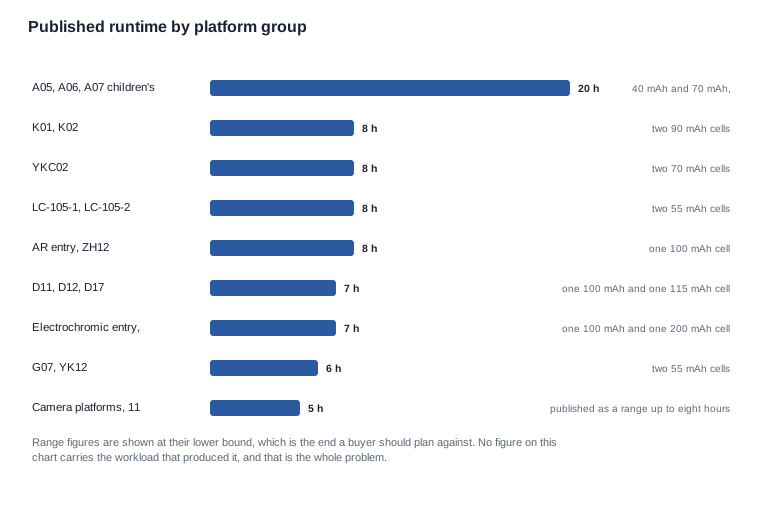
The published runtimes, grouped by platform
Our published runtimes, grouped so that like sits with like:
- Children's models — around twenty hours, on 40 mAh and 70 mAh cells, magnetic charging.
- Twin-cell audio models — around eight hours on two 55 mAh cells, around eight hours on two 90 mAh cells. The G07 and YK12 state around six hours.
- Single-cell audio models — the D11 and the D12 at around seven hours on 100 mAh; the D17 at around seven hours on 115 mAh; the ZH12 at around eight hours on 100 mAh.
- The AR entry — around eight hours on 100 mAh.
- The electrochromic entry and the bone conduction entry — around seven hours on 100 mAh and 200 mAh respectively.
- Camera models — the 220 mAh and 260 mAh models state a five to eight hour range, and the 290 mAh models state around seven hours.
The pairs that cannot be separated on the published rows
The G07 and the YK12 at around six hours against the twin-cell models at around eight hours: a two-hour gap stated without conditions is not a decision basis. The same applies to the D11 at seven hours against the ZH12 at eight hours, where the cells differ at 100 mAh against 100 mAh and only the charge time separates them — about two hours in one case and about an hour in the other.
If your decision turns on those pairs, you need a measurement rather than a comparison. And the measurement is not expensive: it is two days, two units of each candidate, and a written script.
Why the channel, not the product, sets the requirement
A runtime promise is really a promise about a place. A warehouse, a retail floor, a classroom, a hospital, a vehicle and a home are six different charge routines, and the same product can be excellent in one and unusable in another. A warehouse order has one charge point at the end of the shift; a hospital has a charging trolley that everybody fights over; a classroom has a teacher who charges a box of devices at the end of the day; a field service brand has a customer who charges the product in a van.
The commercial consequence is that a runtime figure should be read as a number of charge cycles per week, and the number of cycles is a function of the customer's day, not of the cell. A brand that writes "about eight hours" on a listing sells a number; a brand that writes what the product does across a working week sells an outcome, and the second one is the one that survives a returns conversation.
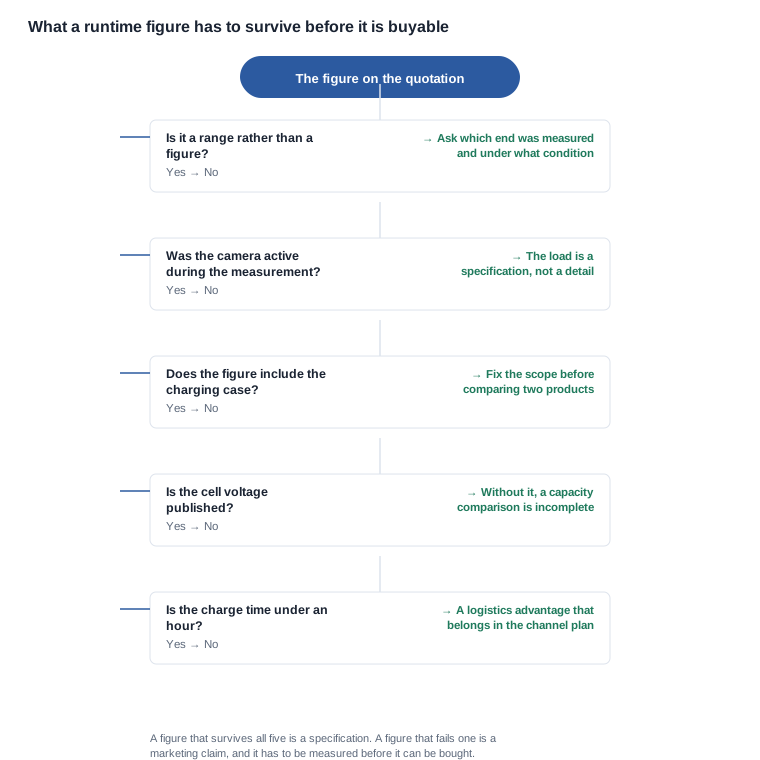
The four disqualifiers that make a runtime figure unbuyable
The range problem and the load problem
The range problem. A five to eight hour range is the least useful figure available, because the top of the range is presumably a favourable condition and the bottom is presumably a realistic one. When you see a range on a datasheet, ask which end was measured under what. Our camera models state a range, and the honest reading is that the range is a statement about the variance of the test rather than a specification of the product.
The load problem. On camera platforms, the camera is the power draw that changes everything. A figure measured without the camera active describes an audio product wearing a camera's name, and a brand that publishes it as a camera runtime is publishing a comparison it has not made. Our own published figures for the camera models do not state the load, and the load is not published to us.
The case problem and the voltage problem
The case problem. Seven of the camera models in our catalogue ship with a charging case, and the case is a second cell — 1400 mAh on the CY03 and the CY05, and the L1 Pro, 900 or 1400 mAh on the L2 Utral, and 1200 mAh on the MT6. A figure quoted for the complete system is not comparable with one quoted for the glasses alone, and the mistake is invisible because both are written as "8 hours" on a datasheet. A case also changes the logistics completely, because it changes what the customer has to carry and where they can charge.
The voltage problem. Capacity in milliamp-hours is charge, not energy. Voltage is not published for our range, so a milliamp-hour comparison between two products is incomplete in a direction that favours whichever you assumed. This is a small technical point with a large commercial consequence: it is the point at which a comparison that looked decisive stops being decisive.
The charge-time row, which is really a logistics row
Charge time is published across the range: two hours or less for most models, and about an hour for the D17 and the ZH12. It is easy to read as a convenience metric, and it is not — it is a logistics variable, and it is one of the few published rows in this category that is genuinely comparable between suppliers.
A one-hour charge means a customer can top up during a break, or a warehouse can put a returned unit back into stock the same day. A two-hour charge means a same-day turnaround is not available and the return-to-stock cycle is longer, which is a real cost in a channel where the supplier is a distributor. A buyer who negotiates only on unit price leaves this row unexamined.
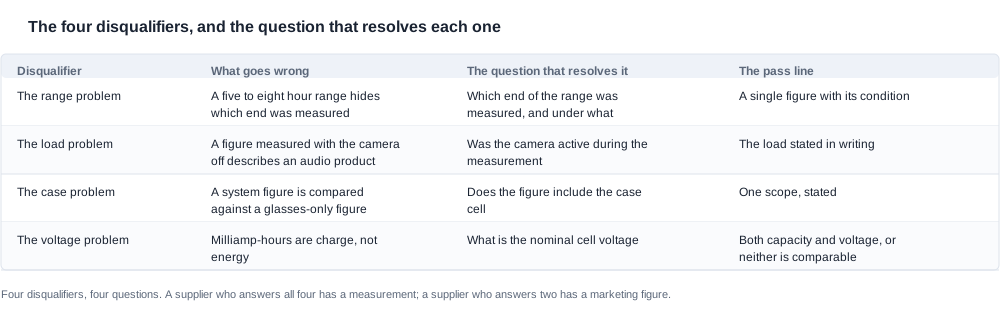
The questions that resolve the four disqualifiers, in the order to ask them, are these. The point of asking them in this order is that the first two can end the comparison before any samples are ordered, which is the cheapest possible outcome.
- Is the figure for the glasses alone, or for the glasses with the case?
- What was the workload during the measurement, and was the camera active?
- What start state was the unit in, and what was the ambient condition?
- What is the nominal cell voltage, and is the cell single or twin?
A supplier who answers all four has a measurement. A supplier who answers two has a marketing figure, and the difference is worth more than the unit price gap it appears on.
How to measure two candidates in two days
The bench test is short and it is the only method that produces a comparison that survives a supplier conversation. Pick the two candidates, charge both from a genuinely low state, and run them through the same script.
- Write the workload script in advance. Three workloads: continuous audio, intermittent audio, and audio with the camera active where the platform has one. Write down the duty cycle for the intermittent case — how long on, how long off, how many cycles in a day.
- Start both units from a genuinely low state. A unit charged from a shallow cycle will report a runtime the customer will never see, and the difference is large enough to change the answer.
- Run the continuous audio case and record the start and end states on each unit, with the ambient condition.
- Run the intermittent audio case with the duty cycle from step one. This is the case that reflects a real working day, and it is the one that usually differs most between two products.
- Run the camera-active case on camera platforms. This is where a pair that looked identical on the published rows separates, and where the published range turns out to be the honest figure rather than the optimistic one.
- Repeat on two units of each candidate, and record the results on the same protocol.
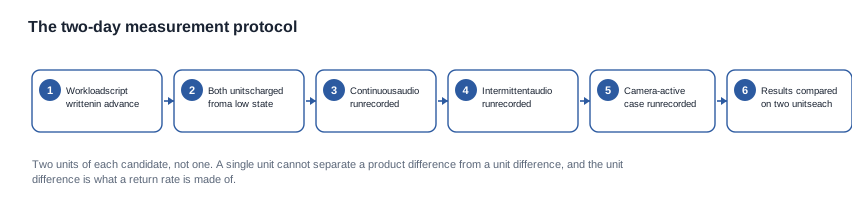
Two units of each candidate, not one. A single unit cannot separate a product difference from a unit difference, and the unit difference is what a return rate is made of. Write the script down, because a measurement whose protocol was reconstructed afterwards is a measurement you cannot use in a dispute.
The breakdowns that turn a runtime figure into a complaint
Four breakdowns that turn a figure into a complaint
A range is quoted as a single number. Symptom: the product underperforms the listing, and the listing says otherwise. Root cause: the top of the range was taken as the specification. Prevention: ask which end was measured, and plan against the lower one.
A runtime is quoted with the camera inactive. Symptom: a camera product drains faster in the field than the listing implies, and the returns are filed against the battery. Root cause: the load behind the figure was never stated. Prevention: require the load in writing and put it in the acceptance criteria.
A figure is quoted for the complete system and compared against a glasses-only figure. Symptom: a supplier's eight hours beats your seven, and the comparison is void. Root cause: two scopes were treated as one. Prevention: fix the scope before the comparison starts, and check whether a case is in the box.
A milliamp-hour comparison is treated as an energy comparison. Symptom: a product with a larger cell appears to have more endurance and does not. Root cause: the voltage was assumed. Prevention: ask for the nominal cell voltage, and treat the comparison as incomplete until you have it.
There is a fifth pattern that belongs to the shipping side rather than the product. The battery documentation is requested after the transport booking. Lithium cells move under a regime with its own documentation requirements, and the cell marking on the unit and the packaging has to match what is declared. A mismatch discovered at the freight stage is a delay of days and a cost that was never in the budget. The related requirements are set out at battery transport.
The cost of a charge routine, and what a case changes
Terms open to negotiation against terms that are not, and the battery file
The battery conversation is mostly about the second cell rather than the first, because the case is a second cell, a second logistics item and a second thing to explain in the listing. The terms worth negotiating time on:
- Minimum order quantity tiers.
- Whether the case is supplied in the box, sold as an accessory at its own minimum order quantity, or omitted.
- Packaging specification, including the market labels and the language of the documentation pack.
- Delivery splitting against a sample-approval milestone.
- Payment node structure, with a balance on inspection before shipment.
- The warranty period with a stated response, and the return terms for a channel where the battery is the most common complaint.
Two cost lines here can be quoted but not negotiated, and both belong to the cell rather than to your order. What a certification costs, and how long the test takes, are set by the process and the body that runs it. Tooling is normally amortised across the first order and quoted as a separate line rather than folded into the unit price. Below both of them sits the cell itself: a supplier who will not change the cell or the platform is telling you the runtime ceiling is fixed, and no commercial term moves it.
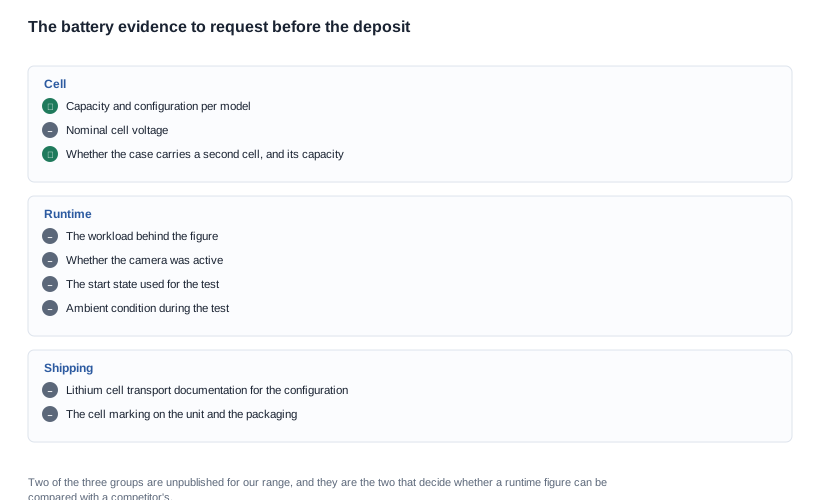
The battery file that should be on the table before the deposit is: the cell specification per configuration, with the capacity and the configuration — single or twin cell — and the nominal voltage; the runtime figure with the workload and the ambient condition behind it; whether the camera was active during the measurement; the start state used for the test; the case capacity, where a case is supplied; the charge time with the accepted input current; the lithium cell transport documentation for the configuration; and the model designation on the quotation.
A worked example: a wholesale buyer with a four-hour duty cycle
Below is an example assembled to demonstrate the order of the checks. It is not a record of an order and it does not claim an outcome.
Assume a wholesale buyer supplying field-service technicians in a European market. The technicians work four-hour shifts, travel between sites in a van, and return the product to the warehouse at the end of the week. Two candidates are quoted, both camera platforms with a charging case.
Step one, the duty cycle. The buyer writes it down: four hours of use a day, a van charge opportunity once a day, and a full charge at the warehouse at the weekend. The published runtimes of around seven hours and a range of five to eight hours are, at face value, more than the shift requires. The buyer marks this as a starting position and not as an answer, because the shift figure is not the figure that was published.
Step two, the scope. The buyer asks what the published figure covers. One supplier states that it is the glasses alone and that the case is a separate cell; the other quotes a system figure. Those are not comparable, so the buyer asks both to quote the glasses alone, on the same protocol, with the camera active, because the camera is what the technicians would be using during a shift.
Step three, the charge time. The buyer notices that one candidate charges in about an hour and the other in two. The van charge opportunity is a twenty-minute stop, so the one-hour candidate is the one that can be topped up in the field and the other cannot. This is a real operational difference that the runtime figures did not show, and it comes from a row that was published all along and that nobody had read as a logistics variable.
Step four, the bench test. Two units of each candidate, from a genuinely low state, through continuous audio, intermittent audio on a four-hour duty cycle, and the camera-active case. The camera-active case separates the two candidates more than the published figures suggested, and the intermittent case is where the difference in the customer's actual experience is largest.
Step five, the decision. The buyer selects on the combination rather than on the hours: the camera-active runtime under a realistic duty cycle, the ability to top up during the day, and the case decision. Because the technicians return the product at the end of the week, the buyer also negotiates the case as a stocked accessory rather than an in-box item, which turns a packaging cost into a sellable accessory and gives the technicians a spare to keep in the van.
Step six, the commercial structure. The buyer splits the first run against a small pilot with two accounts, so that the field data exists before the season's volume is committed. The warranty is negotiated with a stated response, and the return terms are written around the specific failure mode that the field data showed, rather than a generic returns clause.
The result is a decision made on a duty cycle the buyer wrote down, not on a published hours figure, and a range configuration that puts the accessory where the customer will actually use it.
What our catalogue publishes for runtime, and what it does not
It is worth being precise: we publish runtimes as our catalogue states them, and we do not publish the conditions behind them, the input power, the cell voltage or the case contribution, because those are not in our published material. We would rather a buyer knows the figures are weakly sourced than treats them as a specification.
What we publish: the runtimes, the cell capacities and configurations, the charge times and the charging interfaces, and where a case is supplied, its capacity. What we do not publish for any model: the runtime test condition, the workload behind the figure, whether the camera was active, the start state, the ambient condition, the nominal cell voltage, the accepted input current, and the input power.
The checklist form of this is in smart glasses battery life checklist for procurement teams, the interface side is in smart glasses charging smart glasses why it matters, and the model-level detail on the camera platforms is at L1 Pro smart glasses specifications.
The request that starts the runtime comparison
Send us two models, the channel, and the duty cycle in hours per day with the charging opportunities available, and we will give you the published figures side by side with the disqualifiers marked, tell you which of the four disqualifiers we can answer from our own documentation and which have to come from a written confirmation from the factory, and say plainly which of the two figures you are looking at is the glasses alone and which includes a case. We will also tell you when a pair of published figures cannot be separated, because that is a finding worth having before the purchase order rather than after.


