

We publish no price for either of these models, and this article will not estimate the gap between them. That makes it narrower than most price comparisons, and the useful part is what survives the removal of the numbers: the price difference between these two models is not in the battery. It sits in a feature that the catalogue documents at family level rather than on the model row, and in a compliance route that the catalogue does not document at all.
So the honest way to position these two models is not to compare what they cost but to establish which of them carries more cost, and on which lines. That is answerable from the published rows, partly. Where it stops being answerable, the answer is a list of questions rather than a number, and this article is that list.
Two rows to start from. The A05 publishes a 40 mAh single cell and a rated runtime of about 20 hours. The A07 publishes a 70 mAh single cell and a rated runtime of about 20 hours. Both charge magnetically, with a charge time of two hours or less. Neither publishes a charging-case capacity, a frame weight or a Bluetooth version for the A05.
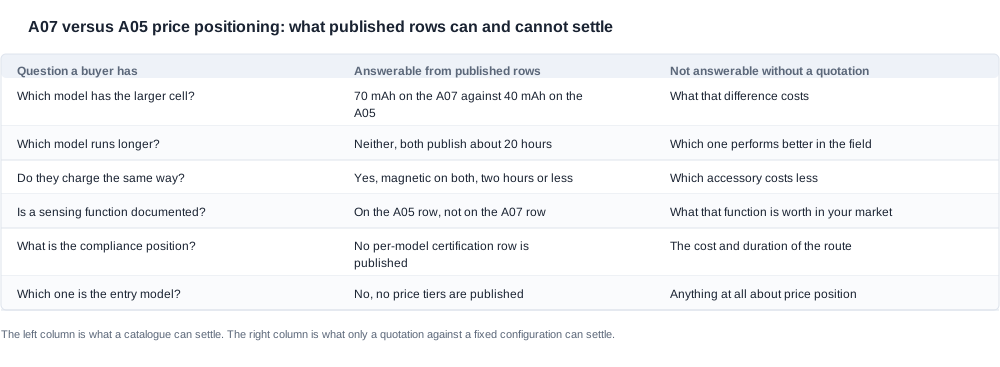
A07 versus A05 price positioning: what the published rows can and cannot settle
Read the comparison in three layers, because the layers fail in different ways and a buyer who mixes them will reach a wrong conclusion.
Layer one is settled by the catalogue. The two models differ on the cell, and they do not differ on the runtime, the charge time or the charging method. One carries detection functions on its model row and the other carries none. One publishes a Bluetooth version and the other does not. Everything at this layer is a fact you can put in a comparison table without qualification.
Layer two is structural and needs a quotation to close. What the features cost to build, what the compliance route costs and how long it takes, what the accessory and packaging arrangements cost, what the freight profile costs, and what the return rate is likely to be. None of this is published for either model, and none of it is inferable from a specification sheet. What the published rows do is tell you which direction each of these lines moves in.
Layer three cannot be touched at all from a catalogue. Whether two models will actually be priced close together or far apart in your market, and what the shelf position of each should be. Those are commercial facts about your channel, your competitors and your buyers' expectations, and they are not in our documentation or in any manufacturer's. We do not publish price tiers and we do not label models as entry, mid-range or premium, because a label of that kind is a promise about a number we do not publish and cannot verify.
The practical consequence is that positioning has to happen after the quotation, not before it. A buyer who positions two models in a catalogue or a channel plan before the configurations are fixed and quoted is positioning a guess. The order that works is: fix the configuration, get the quotation against it, build the landed cost, and only then decide the relative position of the two SKUs in the range.

The battery rows are not the commercial difference
The instinct on seeing 40 mAh against 70 mAh is to treat the difference as the cost difference. That instinct is wrong for a reason worth stating precisely.
A cell of this size is not where the money is. The two models are otherwise built to different jobs: one carries a lens-type electronic fogging element and posture and viewing-distance detection, the other carries a speaker, an amplifier, a microphone and a radio. The electronics, the enclosure, the tooling, the packaging and the compliance route all cost more than the cell does. A buyer who attributes the cost gap between these two models to 30 mAh of battery capacity will be wrong by a wide margin, and will negotiate on the wrong line.
The runtime row does not differentiate them either. Both publish about 20 hours, so neither model gives a buyer a longer figure to put on a box, a listing or a shelf edge. A range where two SKUs share the headline number needs a different separator, and the catalogue only supplies one candidate: the feature set.
The charging row is identical, and that is useful. Identical charging means one accessory decision, one packing instruction and one spare-parts line can serve both models. Where a range has a charging-method split, that split becomes a cost multiplier across packaging, replenishment and quality inspection. This pair does not have that split, so the charging decision is not where the commercial difference lies either.
Where the charging decision does bite is on the case. Neither model publishes a charging-case row, so neither programme can plan a case-based routine from the catalogue. A case is a second lithium cell, a second transport document and a different parcel profile. If one model is supplied with a case and the other is not, that is a packaging difference, a freight difference and a customer-expectation difference — and it is a difference that has to be established in writing before it can be priced, because the catalogue does not publish it for either model.
One more line that is easy to overlook. The A05 and the A06 publish identical specifications across every published row, and the catalogue carries no statement that separates them. If your programme carries both of those models rather than one of them, the commercial risk is not the price gap between them, it is carrying two lines of stock that may turn out to be indistinguishable. That question should be settled before either is positioned in a channel.
The cost lines a landed-cost comparison has to collect
Positioning two models against each other only works if both are costed on the same lines. These are the lines that decide a landed cost in this category, in the order they usually get decided, and none of them is published for either model.
- The device itself, at the confirmed configuration. Configuration means model, colourway, accessory arrangement and destination market, all named in one line of the quotation. A comparison built on two quotations that differ in any of those is not a comparison.
- The accessory and packaging arrangement. The charging pad or cable, any case, the retail carton, the master carton and the void fill. A magnetic charging arrangement and a Type-C arrangement produce different packing instructions and different carton contents.
- The freight profile. Packed unit weight and carton dimensions, measured rather than estimated. This is where a case changes the answer, because a case adds a second lithium cell and a second transport document to the parcel.
- The compliance cost. Testing, submission, retest and certificate renewal, amortised across the volume the programme actually intends to order. The amortisation is what makes this line decisive at volume and irrelevant at sample quantity.
- The returns and warranty provision. In this category the driver is usually sizing and accessory fit rather than electronics, which is why the frame dimensions and the age band are commercial inputs even though they are physical ones.
Collect these five lines for both models, from the same supplier or from suppliers quoting on the same basis, and the two become comparable. Skip any of them and the comparison drifts back towards being an impression.
The feature documentation gap is the commercial difference
This is where the positioning question actually resolves, and it resolves in the opposite direction to the cell.
The A05's model row carries a feature note; the A07's row carries none. The A05's page documents a lens-type electronic fogging element, correct and incorrect posture and viewing-distance indication, and the lens clear and lens fogged states. The A07's page documents the cell, the charge time, the rated runtime, the charging method and the Bluetooth version, and nothing else. That is not a matter of degree. It is the difference between a product with a subsystem and a product without one.
A subsystem is a cost item, and it is a large one. A lens element with its electronics, the sensing path behind it, the behaviour logic that turns a detection into a signal, and whatever application or firmware work sits behind it, are not component-scale expenses next to a battery. A buyer who wants to know which model will cost more to build is being pointed at this row by elimination.
The app and data question belongs here too. If a detection function exists on one model and not on the other, then the programme that carries the detection model inherits questions the audio model does not have: what the detection collects, whether any of it leaves the device, who operates the companion application, whether the product functions without one, and whether the data position is documented at all. None of this is published for either model, and all of it affects the cost of taking the product to market.
The risk on the A07 side is an inherited feature. The catalogue documents this family's functions at family level, and a listing writer who reads a family-level feature note as a model-level feature produces a page that makes a claim the model row does not support. For a children's product, a claim about viewing habits is not a small detail, and it is the kind of claim a distributor's due diligence will stop on. Confirm the feature list per model, in writing, before any positioning work begins.
The compliance position is a cost that no catalogue line shows
The single largest unpriced variable in this comparison is the route to market, and the catalogue publishes nothing about it.
What the catalogue does contain. A company-level export certification page, and the content on it is imagery rather than extractable text, carrying ten patent certificates, eight for appearance designs and two for utility models. That is a statement about industrial design protection, not about product conformity.
What the catalogue does not contain. There is no per-model certification row anywhere in it, and not one of CE, FCC or RoHS appears anywhere in the catalogue text. There is no UN 38.3 entry published for any cell. So the conformity position for either model, in any destination market, is not something you can read — it is something you must obtain as a document from a testing body or from the supplier, with a cost and a lead time attached.
Why this dominates the commercial comparison. A product with an established conformity file and a product without one do not reach market at the same cost or the same speed. The testing route, the sample submission, the retest cycle and the certificate renewal all have to be absorbed into a unit cost before a first order. Where one model in a family is already covered by an existing file and the other is not, the cost gap between them is larger than the hardware gap, and it is invisible in a specification comparison.
The regulatory vocabulary has to be kept straight. In the European framework, the radio equipment directive is (EU) 2014/53/EU and the electromagnetic compatibility directive is (EU) 2014/32/EU. They are different instruments with different scopes, and a buyer who writes the wrong number into a technical file creates a document that a reviewer will send back. EN 301 489 and EN 300 328 are harmonised standards that support conformity assessment under those directives; they are not directive numbers and should never be written as if they were.
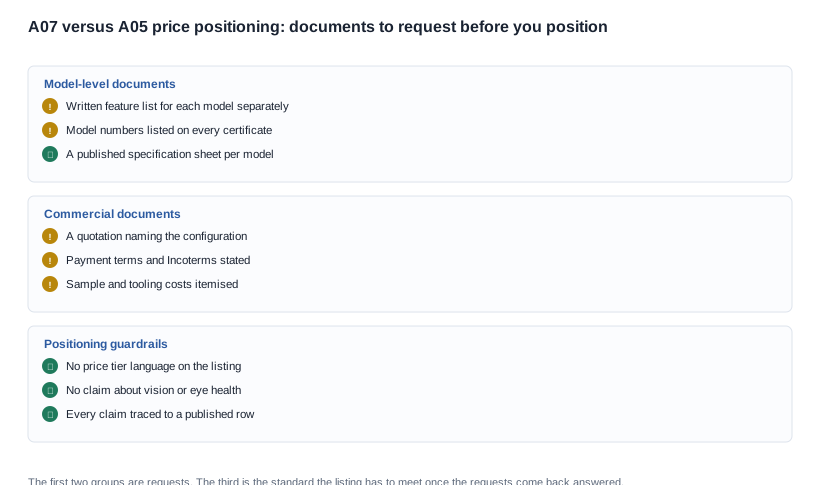
Two things to request rather than assume. The list of model numbers that appear on the conformity file, because that is what tells you whether the file covers the model you are ordering; and the battery transport documentation for the cell configuration offered, which is a separate obligation from product conformity and is not published for either model here.

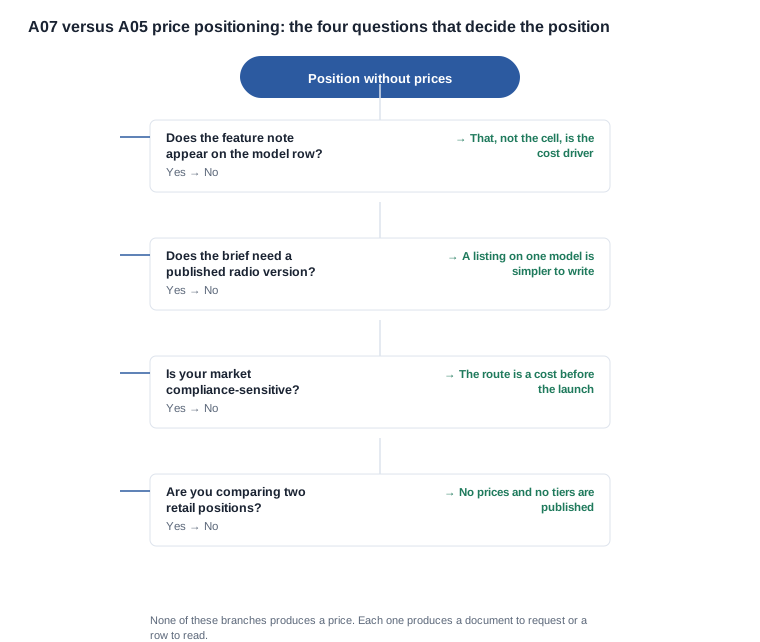
Four questions to settle before either model is positioned
Question one: does the feature note appear on the specific model row, in writing? This is the price question, because it determines whether you are buying a subsystem or not. Ask for a per-model feature list, not a family description, and ask which function is physically present in the unit that ships.
Question two: does either model require a companion application, and who operates it? The answer determines whether the programme carries a software relationship, a data position and an ongoing maintenance obligation, or whether it carries a closed product with a radio. Neither answer is published, and both have cost attached.
Question three: what is the conformity route in your market, and from a testing body rather than from the factory? A factory's description of its own certification position is not the same artefact as a certificate with an issuing body and a reference number. The route also has a duration, and the duration belongs in the programme plan before the order, not after it.
Question four: what test condition produced the rated runtime on each model? One model has a much smaller cell and both publish the same figure. Until the condition is known, the figure is a rating that cannot be differentiated, and it cannot be used to argue that one model's power budget is better engineered than the other's.
The commercial questions that follow from those four. Ask for the unit price against a named configuration and a named destination, the minimum order quantity, the lead time, the payment terms and the Incoterms. Ask whether sample order cost and any tooling or customisation charge are separate line items in the quotation, because a quotation that bundles them hides the variables you will want to change later. Ask what the warranty and returns position is, since in this category the return rate is usually driven by sizing and by the accessory arrangement rather than by the electronics.
Where to record the answers. Keep them per model, in one file, with the date and the question wording alongside the answer. A comparison built on answers collected in different conversations cannot be audited, and an unauditable comparison cannot be defended when a distributor asks why the two models sit where they sit in your range.

A worked positioning exercise
Take a hypothetical buyer with a specific brief. A brand owner is building a children's audio line for a marketplace channel, and has two candidate models from the same family in front of them. One publishes a detection feature set; the other publishes a radio version and a larger cell. The brand owner wants to know which one sits lower in the range and which one sits higher, and has asked us for a price comparison.
We cannot give one, and the reason is not a commercial reluctance. It is that the two variables that would decide the answer are both unpublished and both large. The feature gap determines which model carries a subsystem and therefore which one costs more to build and more to support. The conformity route determines which one costs more to put on sale in a given market. Until both are answered in writing, the gap between the two models in the range could be narrow or wide, and no arrangement of the published rows narrows it.
What we can do is tell the buyer which questions settle it, and in what order. First, get the per-model feature list, because it is the cheapest question to answer and the one with the largest effect on the build cost. Second, get the conformity position for the destination market, because it has the largest effect on the launch cost and the longest lead time. Third, get the quotations against one fixed configuration each, with the same accessory arrangement and the same terms, so the two are comparable. Only after the third does a position exist, and at that point the position is derived from documents rather than from an impression.
The generalisable lesson is about method rather than about these two models. When a category publishes no prices, the correct substitute for a price comparison is a cost-driver comparison: identify the published rows that differ, map each to the cost line it drives, and check the magnitude of each line against a quotation. That produces a defensible order of magnitude for the gap and, more importantly, it tells you which questions are worth the time before the quotation is even requested.
Where our pricing position leaves this comparison
We will not quote a unit price, a price gap or a price tier for these models, and we will not label either of them as entry, mid-range or premium. Our documentation does not contain those numbers, and an estimate that later turns into a quotation is worse than an open question, because the open question gets asked and the estimate gets defended.
We will publish, and publish freely, the rows that decide the commercial comparison: the cell, the rated runtime, the charge time, the charging method, the Bluetooth version where it is published, the presence or absence of the feature note on the model row, and the whole of what the catalogue leaves open. We will say plainly that the catalogue carries no per-model certification row and names no conformity framework, and we will identify that as a document you need to obtain rather than a position we can supply.
The distinction we draw is between a number we do not have and a comparison we can make. The first gets answered by a supplier. The second gets answered here, and it is the second that saves a buyer from negotiating on the wrong line.
Related reading
- The models this comparison covers — kids smart glasses
- The rows each model publishes — A05 specifications and features
- How certification is actually verified — certification checklist
- The compliance framework behind the claims boundary — child product compliance
Send the market, the channel and the wording you intend to use, and we will tell you what this comparison can support and what we will mark as unknown.


