
The interesting part of the A05 smart glasses is not the numbers. The A05 and the A06 are the only two products in our entire catalogue whose pages carry functional illustrations — one set contrasting a correct posture and viewing distance against an incorrect one, and a second set contrasting a clear lens against a fogged one. In a category where no product photograph, no video and no test report exists for any model, that is a genuine documentation asset, and it is the closest thing this range has to explaining what the product does.
The numbers themselves are five rows, and they are consistent. This article sets out the complete published baseline, what each row licenses you to claim, and what it does not.
A05 smart glasses specifications: the complete published baseline
The five rows and the two illustrations
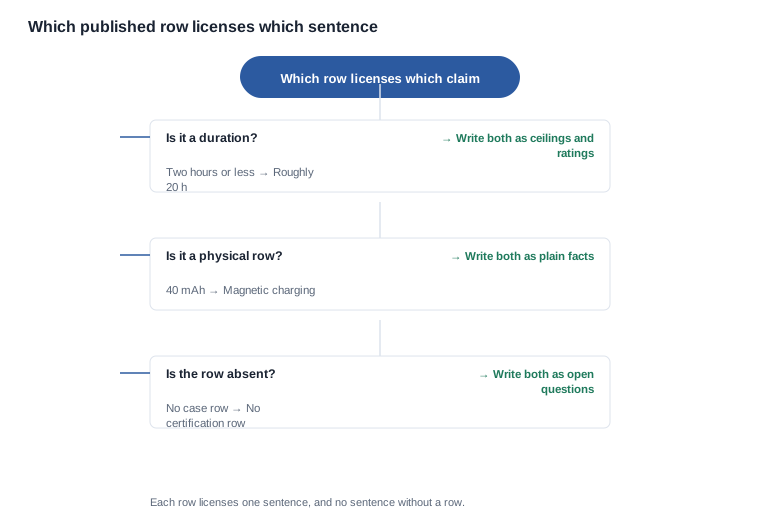
The A05's published rows are: a lens-type electronic fogging element, a 40 mAh cell, a charge time of two hours or less, roughly twenty hours of rated use, and magnetic charging. Alongside them the page carries two sets of functional illustrations.
That is the whole of it, and the shape of it matters. This is a deliberately simple product, and a buyer who is comparing it against a specification file from another supplier will notice how little is there.
What a buyer should also notice is what the rows are consistent about. A cell of 40 mAh, a charge ceiling of two hours, a magnetic dock and a runtime of roughly twenty hours are internally coherent for a product whose job is to wake occasionally, sense, remind and sleep. The row set describes a low-power sensing device rather than a processing device, and every published number in it is consistent with that description.
What a complete row set still leaves open
A complete row set is not the same as a complete specification, and the difference is worth naming precisely because a buyer with all five rows in hand still cannot answer several basic questions.
The rows describe what the product is. They do not describe what the product does in a customer's day. The sensing function is published as existing; nothing is published about the threshold at which it acts, how often it fires, or whether it can be dismissed. The fogging element is published as a powered lens element; nothing is published about how fast it responds, how long it lasts, or what it does at a low cell level. The runtime is published as roughly twenty hours; nothing is published about what was running when that figure was taken.
In a category with no test reports and no product photography, this is the normal condition rather than an exceptional one. It does mean the specification file a buyer builds has two columns, not one: a column of published rows and a column of questions.
The two published features and what each one licenses
The lens-type electronic fogging element
The published description is a lens-type electronic fogging mechanism, illustrated as a clear lens beside a fogged lens. The honest reading is that this is an active element in the lens path rather than a coating, and that it is powered — which is why it sits next to a cell and a charging method in the row set rather than with the frame description.
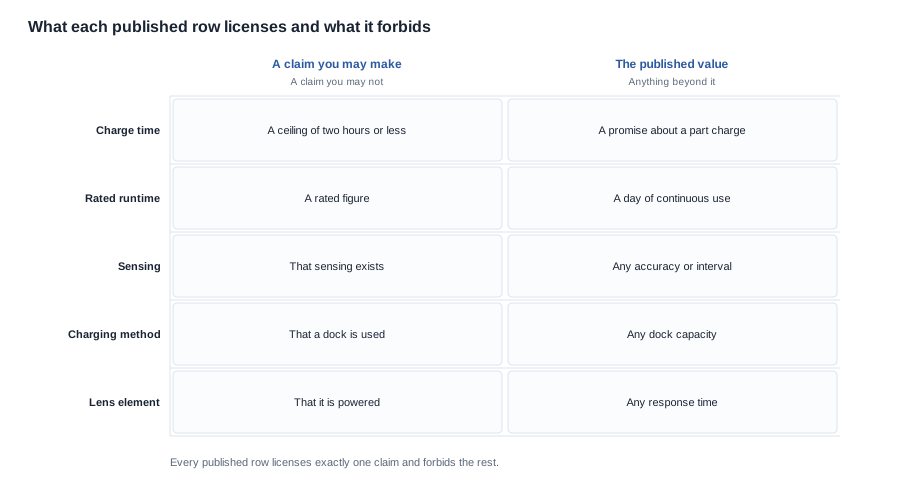
What the row licenses you to claim: that the product has a lens-type electronic fogging element, that it has a visible state, and that the state can be shown in a photograph. That is genuinely more than most of this range offers, and it is what makes the feature demonstrable rather than asserted.
What is not published about it: the mechanism itself, the power draw, the activation trigger, the response time, the cycle life, and the behaviour when the cell is low. None of those is a small gap for a powered optical element in a product used by a child, and it is why the durability question has to be answered with a sample rather than with a document.
What it must never be described as. A fogging element is a physical mechanism with a visible state. It is not a vision benefit, not a protection claim, and not a treatment. We make no claim about myopia, vision development or eye health for this product or any other, and the sensing notes for the kids range set out where that boundary sits.
Posture and distance sensing with a reminder function
The published use case is a posture and viewing-distance sensing reminder with a parent-side concern behind it, illustrated by the correct and incorrect posture and distance states. The illustration tells a buyer that the detection state is visible to the person using the product, which is what makes it demonstrable.
What the row licenses you to claim: that posture and viewing-distance sensing with a reminder function exists on this model, and that its state is visible.
What is not published about it: the sensing accuracy, the sensing range, the reminder interval, what triggers a reminder, whether the wearer can dismiss it, and whether the reminders are configurable from a parent device.
Why that gap matters commercially. A reminder product has a rate, and the rate decides whether the product is used or ignored. A reminder that fires every few minutes is switched off inside a week, and a switched-off reminder is a product that has stopped doing the thing it was bought for. A buyer's brief depends on the sensing behaviour, so the behaviour has to be tested on a sample and with a child, and the A07 buyer checklist sets out the question list that works for this family.
The runtime, and the arithmetic that explains it
Seventy-five per cent larger, the same twenty hours
Roughly twenty hours from a 40 mAh cell is the number in this row, and it is the number most likely to be misread by everyone who sees it, because it is also the highest published endurance figure in the range and the smallest published cell in it.
The proof is outside this row. The A07 publishes a 70 mAh cell and the same roughly twenty hours. A cell seventy-five per cent larger delivering an identical runtime can only mean that the figure describes a light duty cycle with long idle periods — which is exactly what a posture and viewing-distance reminder product does, waking occasionally to prompt and then sleeping again.
So this is not a twenty-hour continuous-use product, and a listing must not read as one. A customer who expects the product to be running all day and finds it part-charged in the evening has been misled by a correct number attached to the wrong sentence. That is the mistake this row invites, and it is the one most worth designing around.
The five questions that turn the figure into a specification
The published figure becomes usable the moment the condition is attached, and the condition is five questions:
- What was active during the measurement — sensing with reminders firing, or the device idle with detection disabled?
- What was idle, and for how long in proportion to the active periods?
- At what reminder frequency, which is the input that links the runtime to the behaviour.
- Over how many units, and on new cells or aged ones?
- Whether the figure is a mean or a best case.
A figure you took yourself on a sample, with the condition recorded next to it, is worth more on a product page than a figure you were given. The battery specification guidance covers the general set of conditions to hold for any runtime figure in this category.


The rows a specification file must not leave blank
The nine unpublished rows, and what each one blocks
- Any certification document or number. We hold none for this model, and the catalogue carries a company-level export certification page whose content is images rather than text, with no reference to CE, FCC or RoHS in the catalogue text.
- The difference between the A05 and the A06. Our documentation records the two as having identical specifications in every row.
- The sensing accuracy, range, reminder interval and trigger logic. This blocks any claim about how well the sensing works.
- The fogging element's mechanism, power draw, response time and cycle life. This blocks any durability claim and any cycle-life warranty.
- Frame weight, temple length and lens dimensions. This blocks sizing, and sizing decides the age band and the return rate.
- Ingress protection. Not published for this model, and a child uses these in the rain. Two models elsewhere in our range carry an IP54 rating; this is not one of them.
- The charging input, the charge indicator behaviour and the charge-time starting point. This blocks a support script, because the customer instruction leaflet is written from these.
- Whether a charging case is available at the quantity. This blocks the packaging specification and the accessory cost line.
- Minimum order quantity, lead time and price. We do not publish these, and they are the numbers a quotation has to supply.
The distinction between unpublished and explicitly absent
One distinction in the catalogue is easy to get wrong and expensive to get wrong. A model can have a row that states something is absent, or it can have no row at all. Those are different facts.
In the camera models, for example, four camera models are published with no charging-case row at all, and three camera models are published with no charging-method row at all while still publishing a case capacity. The first is a blank row and the second is an omission, and neither is a specification. A buyer reading an omission as a specification will build a product page, a packaging design and a support script around a fact that was never stated.
The same applies to the A05 and the A06. The catalogue publishes rows for both, and the rows are identical. That is not a statement that they are the same product — it is the absence of a statement that they are different.
How to use the specification rows in a buyer conversation
What to write into the request for quotation
A specification file built from published rows should be sent as two lists, and the separation is the point.
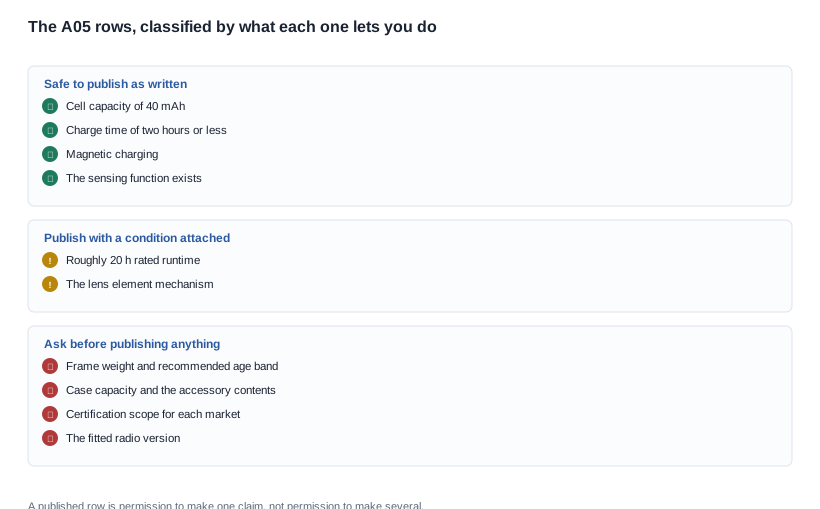
The published list goes in unchanged: the lens-type electronic fogging element, the 40 mAh cell, the two-hours-or-less charge ceiling, the roughly twenty-hour rated runtime, magnetic charging, and the posture and distance sensing with a reminder function. It is short, it is accurate, and it is the baseline every later claim has to stay compatible with.
The open list goes beside it, each item with the decision it blocks. The reminder interval blocks the sensing claim. The weight blocks the age band. The certification scope blocks market entry. The case row blocks the packaging design. The radio version blocks any specification that names one. An open list without owners behind it becomes a wish list, and a wish list does not get answered.
Two things go in with both lists. The request to state what separates the A05 from the A06, because that answer determines the range and the document scope. And the agreement that measured figures, where the catalogue has none, will be recorded with their conditions and treated as your own measurements rather than as supplier claims.
Why a five-row baseline is harder to work with than a twenty-row one
A sparse specification is not a simpler specification. It is a specification that pushes the verification work back onto the buyer, and the work does not shrink — it moves.
With a twenty-row sheet, most of the comparison is done on paper. The rows are already aligned, the differences are visible, and the buyer's task is to weight them. With a five-row sheet, almost nothing can be compared on paper, so the buyer's task shifts from weighting to acquiring, and acquiring is slower.
The practical consequence is that the criteria have to be written before the data arrives rather than after. A buyer who compares two suppliers on a five-row sheet and then chooses will end up comparing the richness of the documentation rather than the suitability of the product — and the supplier with the longer sheet wins by default, whether or not the product is better.
The countermeasure is a shortlist built against criteria that are fixed in advance, and a request list written from the same criteria. Three criteria do most of the work in this category: whether the product's function matches the proposition being sold, whether the documentation names the model, and whether the product can be sized and supported for the channel it is going into. Against those three, the A05's five rows are enough to start, and the open list tells you exactly what to ask next.
Two questions to ask before shortlisting are worth adding to the list. Whether the supplier's own specification sheet contains rows the catalogue does not — a supplier sheet with more detail is good, and it is also the thing to verify rather than assume. And whether the supplier will sign the figure set, which is a commercial question rather than a technical one and which tells you how the number will be defended when a customer challenges it.
What we publish, and what we will not
The A05 is a well-specified, deliberately simple product whose two published features are real, and whose documentation happens to be better illustrated than anything else in the range. That illustration set is a genuine asset for a brand building a product page, and we would rather point a buyer at it than at adjectives.
We will not estimate the sensing behaviour, the fogging element's performance, the certification position or a weight, and we will not describe a difference between the A05 and the A06 that our own documentation has not confirmed. And we make no claim about myopia, vision development, vision protection or eye health — this is a behaviour-reminder product, we hold no clinical data for this category, and the boundary is set out in our medical boundary guidance.
What we will do is confirm the published rows, tell you which questions we can close for you directly, and be plain about which we cannot. If you set out the volume, the target markets, the channel and the age range, we will come back with the answer we can give and the part we cannot close. The family is on our kids smart glasses range page.
One practical note on the illustration set, since it is the part of this model's documentation that is genuinely unusual. A brand building a product page for this model can photograph the two states on its own sample rather than describing them, which means the demonstration the listing shows is the buyer's own and carries the buyer's own evidence behind it. That is a better position than a specification sheet, and it is available precisely because these two models publish a visible state where the rest of the range publishes only a name.
A specification file for the A05, built from the published rows
The rows as they go into the file
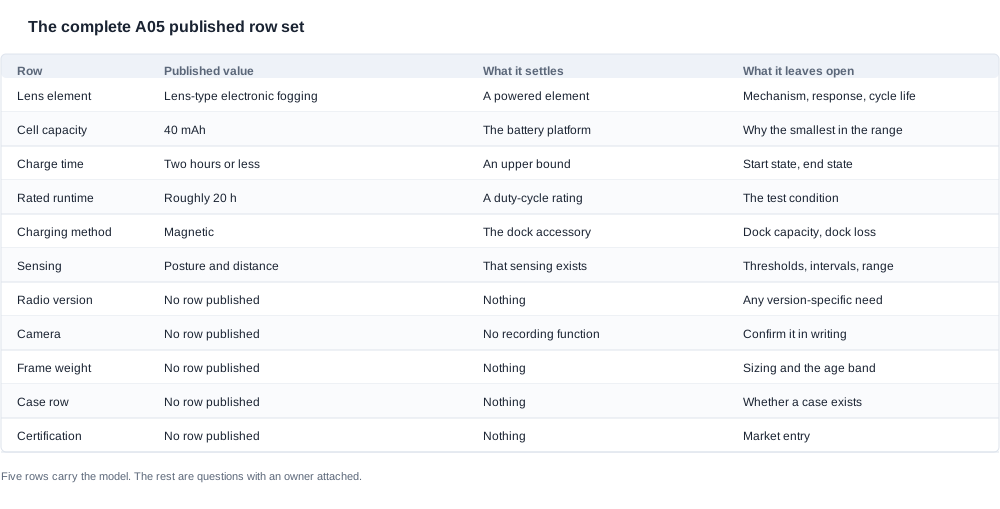
A specification file is more useful as a table than as prose, because a table can be checked line by line against the catalogue and against the documents that arrive. Each row carries the published value, the claim it supports, and the claim it does not support.
| Row | Published value | Supports | Does not support |
|---|---|---|---|
| Lens element | Lens-type electronic fogging | That a powered lens element exists | Any response time or cycle life |
| Cell capacity | 40 mAh | The battery platform and the weight class | Why it is the smallest in the range |
| Charge time | Two hours or less | An overnight ceiling | A promise from a part charge |
| Rated runtime | Roughly 20 h | A rated figure with a condition | A day of continuous use |
| Charging method | Magnetic | That a dock is used | Any dock capacity or contents |
| Sensing | Posture and distance | That sensing exists | Any accuracy, range or interval |
| Radio version | Not published | Nothing | A version-specific requirement |
| Camera | Not published | That no recording function is published | Nothing about image or video |
| Frame weight | Not published | Nothing | Sizing, age band or returns |
| Case row | Not published | Nothing | What is in the box |
| Certification | Not published | Nothing | Market entry in any market |
The open rows as questions, not as blanks
The second table is the one that does the work, because it converts each absence into a request with an owner and a decision attached.
| Open row | Question to send | Decision it blocks | Who answers |
|---|---|---|---|
| A05 against A06 | Which rows are shared, on what attribute do they differ | The range plan and the document scope | The supplier |
| Sensing behaviour | Interval, threshold, dismissal, configurability | The feature claim and the support script | The supplier, then a sample |
| Fogging element | Response time, cycle life, low-battery behaviour | The durability claim and the warranty | The supplier, then a sample |
| Frame weight | Grams including the cell, temple and lens size | The age band and the return rate | The supplier, then a sample |
| Case and dock | What is supplied, at what capacity, at what price | The packaging and the accessory line | The supplier |
| Radio version | The version fitted to this configuration | A version-specific specification | The supplier |
| Certification | Documents naming this model, per market | Market entry and tender scoring | A determination |
| MOQ, lead time, price | The commercial terms | The business case | A quotation |
Nothing in either table is a number we hold and are declining to publish, except the commercial terms, which a quotation will supply. Everything else is either published, or a question with a route attached to it.
Related reading
- The buyer-side check for this family — A07 buyer checklist
- Which buying situation this model fits — A06 best for
- Where the claims boundary sits — medical boundary
Pass the channel, the volume, the age range and the target markets, and we will reply with the rows that exist and the rows that do not.


