

Supply continuity is usually filed as a factory problem and then experienced as a support problem, because the customer holding a defective unit cannot be told that the component is unavailable. That gap is where after sales support supply continuity is actually decided, and it is decided long before anyone raises it in a meeting. For the models in this range the honest starting position is that there is no published lead time, no published minimum order quantity and no published spare-parts list, so continuity has to be negotiated as a commercial term rather than inherited as a default.
After sales support when the parts list is the real problem
When supply breaks, the first question is not when the next order arrives. It is what you replace on the unit you already shipped. Reduce the programme to the specific things a service operation consumes, because "supply continuity" is too broad to negotiate against and a parts list is narrow enough to write into a contract.
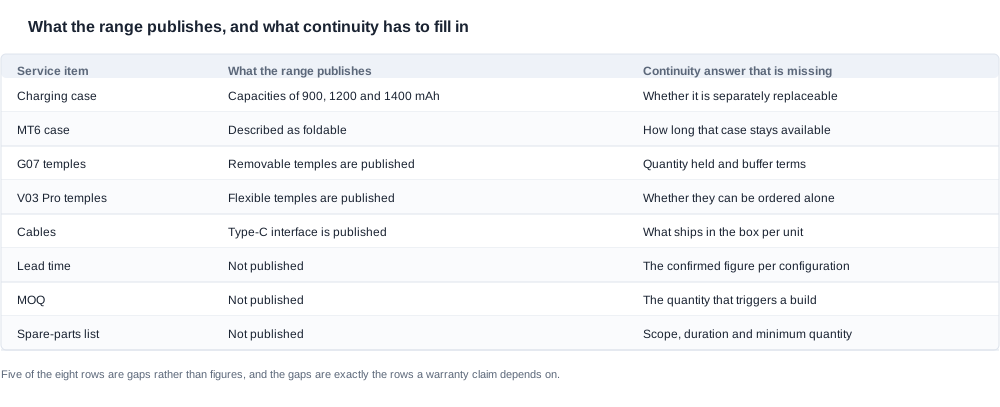
- The charging case. The most frequently replaced accessory and the one most likely to define your SKU strategy. Published case capacities in this range run at 900, 1200 and 1400 mAh, and the MT6 case is described as foldable. Whether a case can be replaced independently of the glasses is Not published for any model in the range, which is precisely the gap a continuity clause has to close.
- Temples. The G07 publishes removable temples and the V03 Pro publishes flexible temples, so a temple-level replacement is conceivable on those two. No other model in the range publishes a removable element, so for everything else the temple is not a serviceable part at all.
- Cables and interfaces. Type-C models need cables. Nothing in the range publishes what ships in the box, so the cable count per shipment is a question to ask rather than a line item to assume.
- The unit itself. For an out-of-warranty replacement the question is whether a configuration of that kind still exists. If a model has been superseded, you have no answer, and the customer does not care that the reason was a platform decision.
That list is short, which is useful, and every line on it is currently Not published. The negotiation is therefore not about whether continuity matters. It is about four dates and four quantities that nobody has written down yet.
A useful discipline here is to write the parts list in the same form as a bill of materials, with a replaceability column, a published-figure column and a source column. Most buyers discover that the source column is empty for every accessory line, because a product page lists what a unit does rather than what a service operation consumes. That gap is not a supplier failing; it is an information design problem that nobody has been asked to solve.
Run the same discipline against your own customer-facing claims. If your listing promises a spare case, a replacement temple or a same-configuration exchange, you have already created a support obligation that the published material does not fund. Either the clause exists or the claim should be softened, and the decision is cheaper now than after the first customer holds you to it.

Three continuity tiers, and the one most programmes never design for
Tier one — the channel absorbs the disruption. You hold finished stock and sell through it. It works for a fixed period, and the period is your stock cover divided by your run rate. This is the most common answer for a first-year product and it is the only tier that needs nothing from the supplier.
Tier two — the factory holds it. Stock sits with the manufacturer and moves when you order. Better capital efficiency, and it requires a written commitment to a named configuration and a quantity, because holding an uncommitted buffer on a model that has moved is worthless. Ask what happens to that buffer if you never call it: released, scrapped or invoiced.
Tier three — the design absorbs it. The product is built so that the most failure-prone consumable is interchangeable with something you already hold. This is the tier a buyer earns by choosing a model that publishes a removable or configurable element, and it is the only tier that depends on neither party's stock position. In this range that option exists on the G07 removable temples, the foldable MT6 case and the configurable case on the L2 Utral.
Most programmes start at tier one, never design for tier three, and then discover at month fourteen that a single failure-prone accessory has become the constraint on the entire service operation. The discovery is not a surprise to the factory, because the factory knows which parts it can and cannot supply separately. It is a surprise to the buyer, because the buyer was the only party that had to assume.
The trade-off between tiers is a capital trade-off, and it is worth stating plainly. Tier one ties up cash in the highest-value, slowest-moving inventory. Tier two ties up a smaller sum but converts it into a contractual claim whose value depends entirely on the supplier's willingness to honour it when it is inconvenient. Tier three costs nothing extra if it is chosen at design stage and is impossible to retrofit once tooling is committed. That is the argument for deciding before you commit, not after.
There is also a due-diligence consequence. During a supplier audit, ask to see how a spare-parts request is actually processed, and ask who can authorise one. A factory that can name the person, the system and the typical elapsed time has continuity in practice even if no document promises it. A factory that answers with a policy statement has a document and possibly nothing else. This is a question to ask before you commit rather than a clause to negotiate after, and it costs nothing to put in the audit checklist.

The three horizons you actually have to plan for
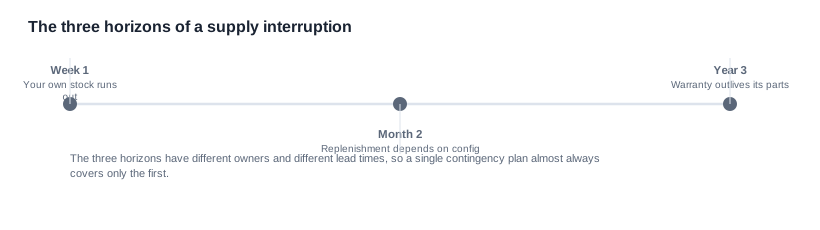
Interruptations do not arrive in one shape, and a single contingency plan usually covers the easiest one. Split the problem by horizon, because the response time available to you differs completely between them.
The immediate horizon is the stock you can reach this week. It is finite, it is measurable, and it is the only horizon where you can act without a supplier's cooperation. Measure it as units of each consumable divided by its actual consumption rate, not by the rate assumed in the business plan. If you have never counted returns by cause, your consumption rate is an estimate and the horizon is fictional.
The medium horizon is the replenishment you have to order. Here the question is whether the order is still placeable, which depends on whether the configuration still exists and whether the minimum order quantity still applies. Both are Not published, so both belong in the contract.
The long horizon is the warranty tail. Your warranty obligation runs for a period that outlasts most product cycles, while the parts that satisfy it do not. This is the horizon where a support obligation outlives the ability to fulfil it, and it is the horizon that generates disputes.
Treat them separately in the agreement. A clause that says the supplier will support warranty claims for a stated period is worthless unless a second clause says what happens in year four, when the case for a given configuration is no longer produced. The two clauses are read together or not at all, and suppliers know it, which is why the second one is the one that gets dropped in negotiation.
A useful way to test a continuity clause is to ask what a customer hears. If the honest answer to a customer asking for a same-configuration replacement is "we would need to check with the factory", the programme has no continuity in the sense the customer means, regardless of what the contract says about obligations. Only the buyer-side stock position and the design-side replaceability can answer that question instantly, which is why the other two tiers exist.

Four clauses to draft, and the evidence that makes them hold
These are provisions to draft, not questions to ask in passing. Each one converts a conversation into an enforceable term.
- Configuration availability period. How long a named configuration remains orderable after the programme ends, and what notice applies to a change. Without this, your listing can stay live while the product becomes unshippable, which is a customer-facing failure rather than an internal one.
- Spare-parts scope and duration. Which parts, for how long, at what minimum quantity, and whether the minimum is per part or per shipment. For cased models this is a case question; for the G07 and the V03 Pro it is a temple question. Ask for the answer as a list, not as a commitment to "support".
- Buffer stock treatment. What happens to committed or uncommitted safety stock when an order is placed, when a configuration changes, or when the programme ends. Absent a clause, the default in most agreements favours the seller.
- Allocation of the obligation. Who carries a warranty claim when a component becomes unavailable mid-programme. The default answer in most contracts is you, and the default is usually not what either party believed was agreed.
Assign each clause an owner before signature, not after the first claim. Most of these are not engineering decisions and not support decisions; they are commercial decisions that belong with the person who signs the purchase order and negotiates the payment terms. A continuity clause that has no owner is a clause that gets deprioritised the first time a larger order arrives, and it will be the first thing renegotiated when volume matters more than cover.
One practical test: hand the draft clause set to someone outside the negotiation and ask them to describe, in one sentence each, what happens when a part is unavailable in the fourth year. If they cannot do it from the text alone, the clause is not finished. This costs an hour and it catches the majority of drafting gaps before signature rather than during a dispute.
Add a fifth in practice: the notice period on a configuration change. A model superseded without notice is the failure mode that costs the most, because it lands after the marketing has already committed and before the channel has stopped promoting.
Draft these before the purchase order rather than after the first dispute. The leverage a buyer has during supplier selection is materially higher than the leverage available afterwards, because afterwards the supplier knows your volume is already committed and your launch date is already public.
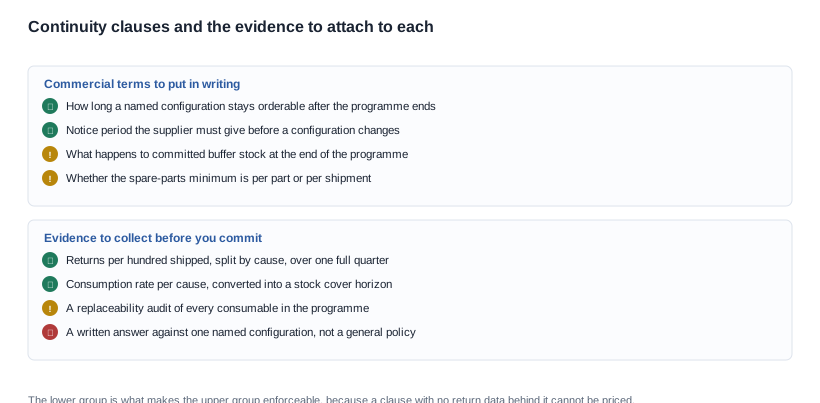
The evidence chain behind them. A continuity clause is only as strong as the evidence behind it, and that evidence is collected before the interruption, not during it. Build the chain in this order.
Step one — the return log, split by cause. Count returns per hundred units shipped, categorised by cause, for at least one full quarter before drawing any conclusion. Cause codes need to distinguish accessory damage from unit failure, because a stock policy built on the manufacturer's intuition about which part fails is a guess carrying a holding cost.
Step two — the consumption rate per cause. Convert counts into a rate per hundred shipped per month. Four case returns per hundred shipped per month means your horizon is your case stock divided by that number, and nothing else.
Step three — the replaceability audit. For each consumable, record whether the model publishes a removable or configurable version of it. This is the step that reveals your tier-three option exists on three models and on none of the others, and it takes an afternoon.
Step four — the contractual mapping. Map each consumable to the clause that covers it. Any consumable with no clause is a gap, and the gap is where the dispute will happen.
Step five — the written test. Before you commit, ask the supplier to answer the continuity questions against a specific configuration rather than in general terms. A general answer describes their policy. A configuration-specific answer describes what will actually happen to you.
Step six — the rehearsal. Once a quarter, take one real return and run it through the full chain: cause code, consumption rate, replaceability status, clause mapping, and the answer the customer receives. The rehearsal usually exposes a missing cause code or an unmapped clause within ten minutes, and it costs one unit. Skipping it means the first real test happens at the worst possible moment, with a customer waiting.
Keep the chain somewhere the support team can act on it rather than in a procurement file. A continuity plan held only by the person who negotiated it is not a plan; it is a record.
Review the chain whenever the product mix changes, not only when volume does. Adding a second configuration adds a second parts list, and the older chain does not extend to it automatically. The most common late-stage failure is not a supplier failing to supply; it is a chain that was correct for the original SKU and was never rebuilt for the SKU that replaced it.

The failure modes that only appear at volume
Three failures are invisible below a certain shipment rate, and all three are expensive when they appear.
The cause-code collapse. Below a few hundred units a quarter, most returns get logged as "customer issue" because the cost of coding properly exceeds the benefit. By the time volume justifies proper coding, the historical data needed to set a stock policy no longer exists, and the policy has to be guessed from scratch. Start coding causes from the first batch, even if the codes are crude, because the series matters more than the precision of any single month.
The single-SKU dependency. Early programmes frequently launch one configuration to move fast. A continuity plan built around that configuration has no fallback, so a supersession is not an inconvenience but an extinction event. If the programme depends on one configuration, continuity terms should reflect that dependency explicitly.
The accessory pull-forward. A supplier under allocation pressure will often preserve finished units in preference to loose accessories, because a unit carries more value. That behaviour is rational and it is the worst case for support, because the accessories are what your returns consume. Ask for an allocation rule that names accessories, not just units.
Each of these is a boundary condition rather than a hypothetical. They happen at the transition from pilot volume to programme volume, which is exactly the point at which most buyers stop re-reading the contract and start re-reading the price list.
Two more belong on that list because they are common and because they are cheap to prevent.
The shipping-damage misclassification. Transit damage is frequently logged as a customer fault rather than as a packaging failure, which shifts the cost onto your support budget and hides a packaging specification problem that is actually a supplier question. If the published material for this range does not state what ships in the box, then damage attribution has no agreed baseline, and every dispute becomes a negotiation. Agree the packaging specification in writing and log damage against it.
The supplier change without a handover. If a second factory is introduced mid-programme to absorb volume, the continuity clauses do not automatically transfer. Ask explicitly whether the spare-parts commitment follows the units, and whether the new source is bound to the same configuration. A change of source is one of the most common triggers for a configuration drifting out of availability, and it is usually announced as an improvement.
Where this range leaves you, honestly
Spare-parts availability is a commercial commitment and belongs in the agreement rather than in a conversation after something has gone wrong. We do not publish spare-parts availability, lead times, minimum order quantities, weights or certificate numbers as fixed figures on this site. All of those are confirmed per enquiry, because each depends on configuration and on where a model sits in its lifecycle.
What we will do in a continuity conversation is tell you which models publish removable or configurable elements, because those are the designs where your tier-three option actually exists and where a buffer-stock commitment is worth negotiating. Where a figure is Not published we will say so rather than imply a supply guarantee we cannot evidence, and we will put the answer we can evidence into the contract on the same terms as any other commercial commitment.
The practical result of that position is that your continuity plan rests on two things you control: the stock you hold, and the parts list you negotiate. Neither depends on a supplier publishing a number it cannot currently stand behind. Ask for the replaceability facts first, because they are published and they determine which of the three tiers is even available to you; ask for the commercial terms second, because those are the ones that require negotiation and therefore the ones that take time.
For the wider support structure, the parts that can be held and the escalation path that determines who picks up a claim, see spare parts for after sales support, the warranty terms we write into contracts in after sales support warranty policy, and the escalation ladder in after sales support technical support.
Related reading
- After sales support getting started — building the returns structure before you need it
- Charging arrangements and cases — which models publish a case
- OEM and ODM service structure — what each engagement commits to
Tell us the configurations you are running and the volumes you expect, and we will tell you which published models offer replaceable elements and which continuity terms we can commit to in writing.


