

Returns are usually discussed as a cost problem, and then fail because the two parties were never talking about the same process. The supplier hears "warranty"; the buyer hears "we will replace what comes back." Neither has agreed how a fault is reported, what evidence is required, who pays the freight, where defective units physically go, or what gets written down so that the same failure is not rediscovered in the next production run.
After sales support packaging for returns is the part of that problem most often left to the packaging engineer, and it is the part that quietly destroys the economics. A unit that arrives back without its accessories, without the firmware version recorded, and without a usable fault description is close to worthless as a return. It gets written off, the write-off is counted against the supplier, and the next lot repeats the same defect. The packaging is therefore not a presentation decision. It is the container the evidence travels in.
There is a second reason the same conversation keeps failing, which is that the two parties are usually optimising different numbers. The buyer is tracking return rate as a commercial problem, because a return rate above a threshold triggers a channel review. The supplier is tracking diagnosability as a quality problem, because an undiagnosable return is an unresolved defect rather than a closed case. Both are correct and they point at different decisions: the buyer's number improves with fewer returns, the supplier's improves with better returns. The only decisions that improve both are the ones taken before the unit ships — the marking, the tray, the accessory bay, the printed instruction — which is precisely why the packaging belongs in this discussion at all.

What the returns process has to fix before it is written down
Four things have to be settled before a returns policy is a document rather than an intention. Each of them is cheap to agree at the first order and expensive to agree during a claim.
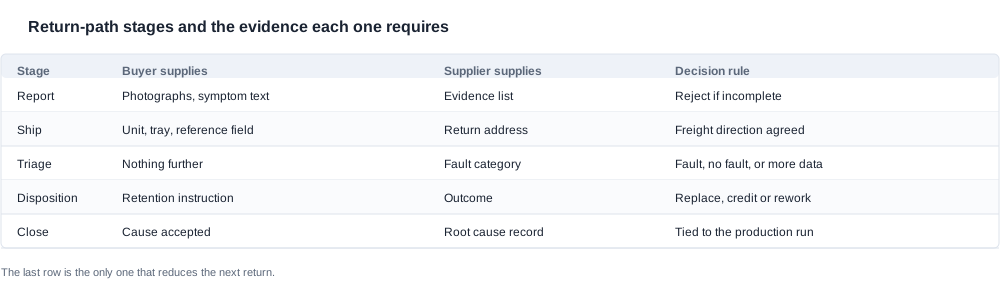
Evidence first, replacement second. Agree in advance what a fault report contains: photographs, the unit's batch or serial marking, a description of the state in the customer's own words, the firmware version, and a short video for anything involving audio, camera or connectivity. This is not bureaucracy for its own sake. A charging fault and a connectivity fault present identically from the outside and require completely different investigations, and a report that says "not working" sends the investigation to the wrong place in the first hour.
Disposition, decided in advance. What happens to returned units: refund, replacement, credit or rework. If the answer depends on who the buyer happens to be at the moment of the claim, the argument will happen on every single claim and none of them will be about the product. The supplier may also need the unit for analysis, which is a legitimate reason to keep it, but that should be a stated term in the agreement rather than a decision made by a warehouse.
Freight direction, both ways. Returns freight is expensive relative to the product in this category, sometimes disproportionately so. Agree who pays inbound and who pays the replacement outbound, at what carrier rate, and whether the same rate applies to a warranty unit and a second replacement. A supplier that pays both directions is unusually generous; a buyer that pays both directions is usually being realistic about who holds the evidence.
Root cause capture. This is the step most suppliers skip and the only one that reduces future returns. A returns process that ends at "replaced" has learned nothing and will repeat the cost indefinitely. Ours has to end at a recorded cause even when the cause is inconclusive — "could not reproduce after three attempts on the same firmware build" is a useful finding, and it is a finding that a supplier who discards the unit can never produce.
Our page on after-sales support covers the commitments we can make. The evidence requirement in practice is developed in quality claims, and the process that consumes the evidence is in returns and RMA. The freight terms behind both sit in response times, because a clock that starts when the unit arrives is a clock that has already lost a week.
A fifth term is worth adding to that list even though it is not about returns at all: the classification of units that are not faults. A proportion of what comes back was never defective — it was a configuration misunderstanding, a charging error, or a customer expectation the product description did not set correctly. If those arrive inside the same channel as genuine faults, every rate you compute afterwards is wrong, and the quality signal you are trying to read is buried under a category that should never have been counted. Agreeing a short list of non-fault categories before launch costs one page and makes every number downstream more honest.

What a returnable unit has to carry back
The unit should arrive back in a state where the failure can still be identified. Three design choices do most of the work, and all three are cheaper at the first order than as a retrofit.
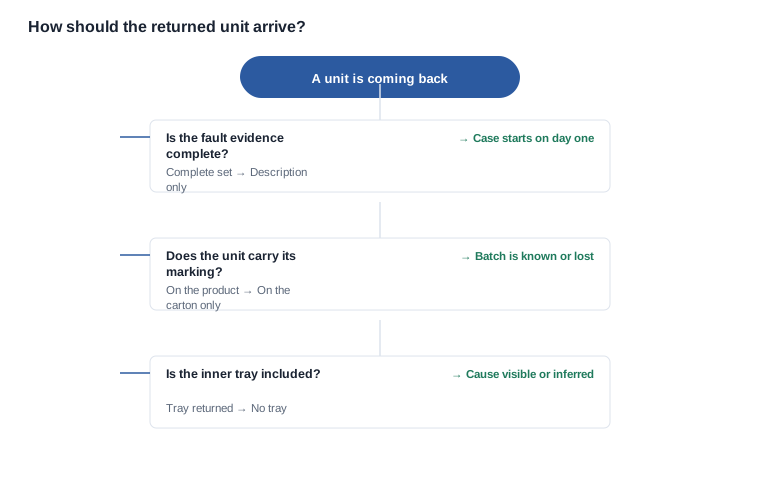
The inner tray does the protecting. A tray cut to the shape of the temples prevents the two common transit failures: a hinge twisting under a point load, and a lens rim taking an impact on a hard edge. A soft bag prevents neither, and it also prevents the unit from being identified on arrival, because a bag does not hold a shape.
Accessories need their own compartment, or they arrive loose. This sounds trivial until you work out why it matters. A meaningful share of units returned as "not working" turn out, on inspection, to be units whose charging case or cable was never included and which were therefore never charged. The fault report says "flat battery", the investigation goes at the cell, and a perfectly good cell gets replaced. Separate compartments cost a tooling change and remove an entire class of false claim.
The outer carton carries the return instruction. A printed return address, a fault-report reference field, and a line stating that the inner tray must go back in. Returns that arrive without the tray are usually unidentifiable, and an unidentifiable return is usually credited by default, which is the most expensive outcome available to a supplier and the cheapest one available to a careless buyer.
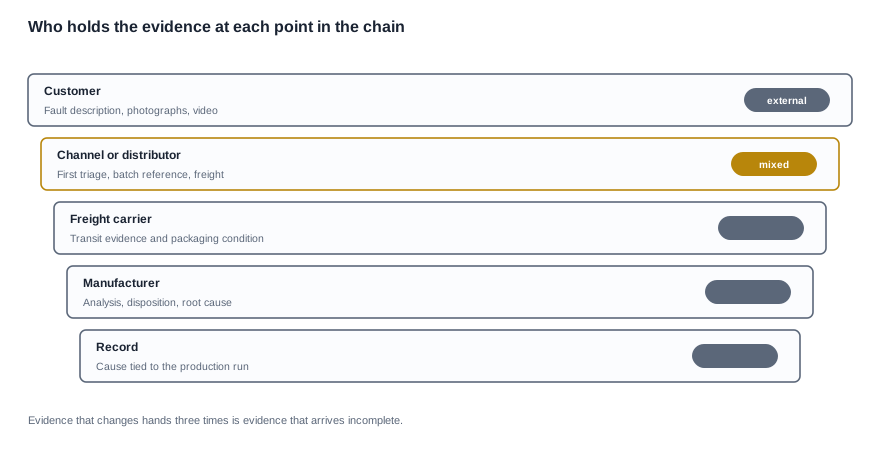
The fourth item is not packaging but belongs in the same decision: the marking on the unit itself. A production batch reference on the product, or at minimum a serial marking that maps to a batch, is what turns a return from an inquiry into a transaction. Where the marking is on the carton only, the unit loses its identity the moment it leaves the tray, which is the single most common reason a warranty claim cannot be closed without a full investigation.
A fifth item is worth naming because it is easy to miss in a packaging review that focuses on damage: a unit that cannot be re-entered into packaging. Some protective designs — tight moulded shells, over-wrapped cable channels — make it hard to put the product back into a box for onward dispatch or for a second inspection. That matters more than it sounds, because the disposition agreed in the contract may be "return the repaired unit to the end user", and a unit that cannot be repacked cheaply gets scrapped instead. Ask the packaging engineer to demonstrate the repack cycle, not just the pack cycle. A repack demonstration takes two minutes and settles a question that otherwise reappears as a warranty cost eighteen months later.
After sales support packaging: what to settle before the quotation is issued
The packaging that supports returns costs more than packaging that does not, and the difference belongs in the quotation rather than in a discovery after launch. Six items are worth putting on the quote as line items so that both parties can see what the return capability costs.
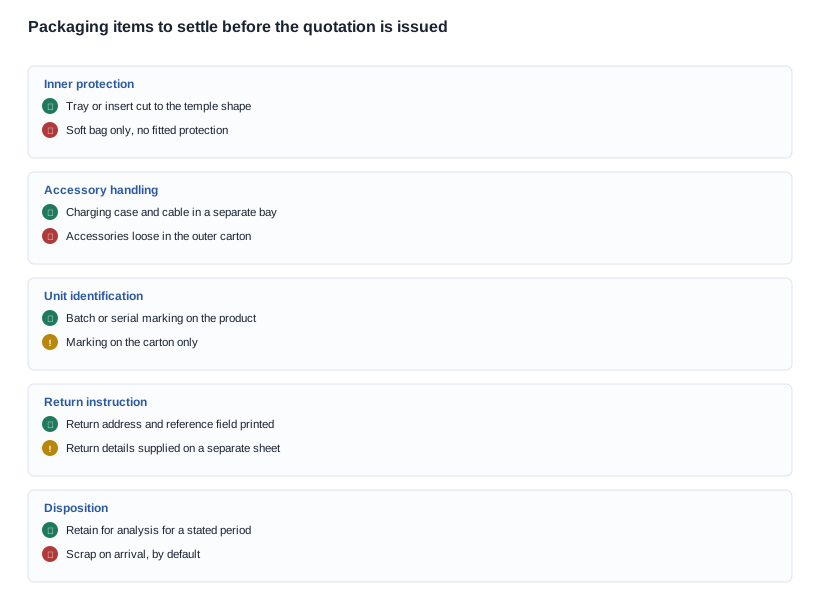
A moulded or fitted inner tray sized to the unit, quoted as an option with and without, so that the buyer can see the cost of not having it. A separate accessory compartment, quoted as an option. A return instruction panel on the outer carton, which is an artwork change and close to free, and which is the single highest-return-on-cost item in this list. A batch or serial marking strategy — printed label, laser marking, or a data-matrix code — and the record that maps it to a production run. A fault-report reference field that ties the physical unit to a case in the buyer's system. An agreed disposition instruction on what the supplier does with the unit on arrival: analyse, retain for a stated period, return to the buyer, or scrap.
That last item is the one most often left out and the one most often regretted. A supplier that scraps on arrival cannot show a buyer that a fault was batch-related, because the evidence is gone. A buyer who does not state a disposition cannot complain when a returned unit is not returned, because no disposition was ever agreed.
There is a cost-side consequence worth putting in the same place as the specification. Returns freight, analysis labour and write-off are all driven by how diagnosable a returned unit is, so a packaging line item should be evaluated on the total cost it avoids rather than on its own price. When to spend on the tray is a fairly straightforward call: if the product ships in a configuration where units fail in ways that need physical inspection — anything involving a hinge, a case, a lens rim or a port — the tray pays for itself the first time an investigation is shortened by a day. For a product whose failures are purely electronic and whose evidence sits entirely in the firmware log, the marking strategy matters more than the tray and the money is better spent there. The general criteria are simple: spend on the packaging that carries evidence, and spend on the marking that identifies the batch.

The questions to ask a supplier so the answer is usable
The questions below are phrased for a buyer who has to act on the answers. They are worth more than a general request for a returns policy, because a policy describes intentions and these questions produce artefacts.
Show a returns policy that names an evidence list, a disposition rule and a freight direction. If the supplier sends a document with none of the three, ask again with the three named. Most suppliers in this category have a policy and almost none have the three terms inside it.
Ask what proportion of returned units arrive with enough information to diagnose, and how that figure is measured. A supplier that cannot produce the figure probably does not count. A supplier that can produce it will have an opinion about which packaging decision moved it.
Ask whether returned units are retained, for how long, and whether the buyer may request them back. Retention without a stated period is not retention. This matters for consumer-protection reasons as well, because a returned unit may still hold the previous owner's recordings, and that is a larger problem in a category with a camera than the freight ever was.
Ask what the data-clear step is, who performs it, and whether it is recorded. A repair process without a documented data-clear step is not finished, and asking the question before the PO is far cheaper than asking it after a privacy complaint.
Two more questions decide whether the answers above are usable. Ask whether the supplier will sign the returns terms into the agreement, or treat them as a general policy. A general policy is a document that changes when the person who wrote it changes; an agreement term is a document that changes when both parties change it. And ask what the supplier needs from you that it does not get today — in practice the answer is usually a consistent unit-level statement of what was bought, when, in which configuration, which is a purchase order amendment rather than a system, and which is the buyer's side of the trade-off nobody prices.
There are three red flags to watch for in the answers. A policy that says the supplier will "review each case on its merits" has moved the triage decision to the moment of maximum pressure. A freight term that says the buyer pays "actual costs" without a rate basis will be settled by invoice rather than by agreement. And a disposition term that says returned units may be "disposed of as appropriate" has, in effect, pre-decided that the evidence is scrap. None of the three is a reason not to work with the supplier; all three are reasons to write something specific instead.

What we cannot tell you today
Our replacement rate history is not published, and our return rate history is not published either. Our warranty duration is not published. Our returns freight policy is not published. Each of those is a place where we simply hold no information, not a position we have chosen to withhold, and a number published without a denominator we can defend is worse than no number at all — so we would rather leave the gap open than fill it with a figure that later turns out to have been wrong in the direction you did not expect.
A returns file eventually asks for every row the specification sheet does not carry. Ours carries one weight figure in total, 158 g for the MT6, while the weight of each other model is Not published. Not published either are the video specification, the microphone specification, the field of view and the sensor model. The ingress test report numbers are Not published beside them. On the regulatory side, the catalogue text carries no CE, FCC or RoHS reference and no per-model certification row, so the certificate behind any model is something to request in writing, and nothing about the children's models has been published to us. Every one of those items will be needed on a returns file at some point, so it is better to learn at the quotation stage that the answer has to come from the manufacturer.
What we can say is what we will do. For a specific channel and a specific configuration, we will agree the evidence requirement, the disposition and the freight direction in writing before the first order; we will state which packaging changes are required for that configuration and quote them; and we will record a root cause for every return even when the cause is inconclusive. For a first project, that written agreement is worth more than a warranty length printed on a brochure, because the warranty length is the part that is easiest to claim and hardest to use.
One qualification belongs here rather than in a footnote. A supplier that publishes a returns rate without publishing how it is measured is telling you a number it chose the definition for. We are not going to do that, and we would ask the same of anyone else: if a supplier offers you a replacement rate as a quality argument, ask for the denominator, the period, the fault categories included and the disposition of the units that were never returned. A rate that excludes units the buyer never bothered to send back is not a reliability figure, and a shortlist built on one will pick the supplier with the easiest return policy rather than the best product. That is the checklist version of this point: measurement method first, figure second.
How this sits inside the wider agreement
A returns process is part of the product, not part of the after-sales department. Packaging that cannot return a diagnosable unit and an evidence rule that has to be negotiated mid-claim are both costs, and both are avoidable by deciding them before the purchase order is issued. That is the argument we make to buyers who want a shorter warranty period and a better returns process: the second is worth more than the first, and it is the only one that reduces the volume of returns rather than the cost of each one.
The commercial terms behind this are covered in standard OEM service scope, and the preventive work that reduces return volume in the first place is in preventing returns. The trade-off buyers most often get wrong is treating a long warranty as a substitute for a workable returns process. A long warranty changes what happens after a claim; a workable process changes how often a claim happens and how long it takes to close. Only one of those compounds in your favour, and it is the one that does not depend on the supplier's goodwill surviving a difficult quarter.
Before you commit to a packaging specification on this category, the shortlist criterion is worth stating plainly: a supplier is more useful when the returned unit is diagnosable. Ask to see one worked example — a unit that came back, the evidence it carried, and the cause that was established. A supplier who can produce that has a returns process; a supplier who cannot has a returns department. If you want a written returns and packaging proposal for your specific configuration, send us the channel, the target market and the packaging you already have. We will tell you what we need added, what it changes in the quotation, and which of it we can evidence today.
Related reading
- after-sales support commitments
- handling a quality claim with evidence
- what packaging adds to landed cost
Send the channel, target market and current packaging and we will tell you what the return path needs.


