

Repair options in this product category are decided long before anybody needs one, and they are decided by design decisions rather than by service decisions. Whether a battery can be replaced without destroying the frame, whether a charging port is a serviceable item or an integrated one, whether the electronics can be separated from the structure at all — those are questions that are cheap to answer during platform selection and expensive to answer in year two. After sales support repair options are therefore mostly a procurement question, and the right time to settle them is while you are still choosing the platform.
The consequence for a buyer is uncomfortable but useful. A brand that discovers in its second year that the frame cannot be separated from the electronics has a cost structure it never planned for, and no amount of negotiation afterwards will change the tooling that has already been paid for. The same applies in the other direction: a design chosen for a cheap assembly step can leave a component that is technically replaceable and practically unreachable, which is the same problem wearing a different hat.
There is a second reason to settle this early that has nothing to do with cost. The repair route is what determines the spare-parts list, and the spare-parts list is what determines whether a distributor can run a repair channel at all. In this product category the distributor is frequently the party that ends up holding the relationship with the end customer long after the original purchase order has been forgotten, and a distributor who cannot replace a component cannot repair anything — every fault becomes a whole-unit swap, and every whole-unit swap comes out of the factory's capacity.

After sales support repair options: what the design makes repairable
Four design properties determine which repair routes exist at all, and each one is visible in a specification or a sample before anybody signs anything.
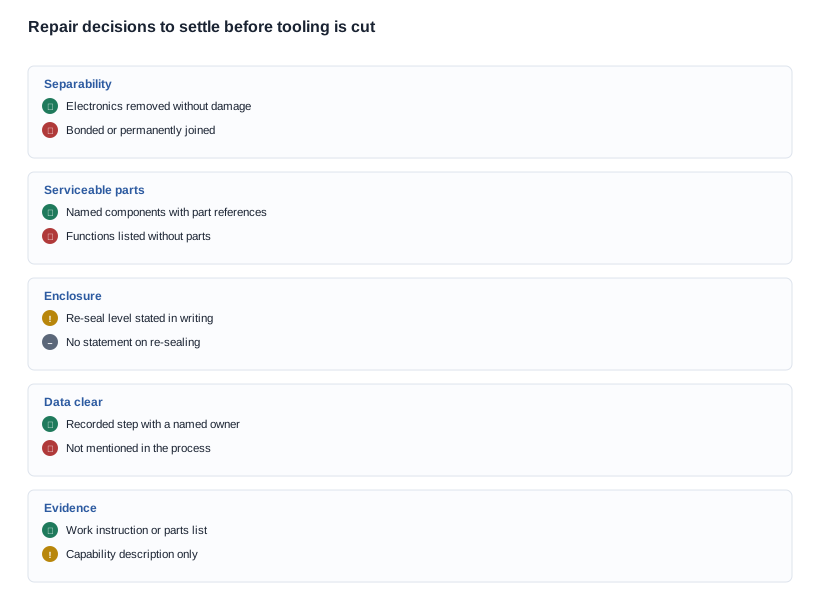
Separability. Can the electronics assembly be removed from the frame without destroying it? This single property decides whether component replacement is a repair or a rebuild. Where the assembly is bonded or integrated, the only routes left are whole-unit replacement and scrap, and those two have very different economics from a spare-parts programme.
Which components are independently replaceable. A configuration with a charging case has at least two components that can fail, and where the case is separate the cell is usually in the case rather than in the glasses. That makes the case the serviceable item and the frame the durable item, which is a fundamentally better position than a design where everything is in one enclosure. A configuration with a Type-C port has the opposite characteristic: the port is a deliberate opening, so it is a wear item and eventually a replacement item, and the question is whether replacing it destroys the water resistance the product was specified for.
Whether the firmware can be recovered. A software fault that can only be fixed at the factory is a round trip. A software fault that can be fixed from a download is a support call. Which one you have depends on whether the product has a recovery path, and it should be established from a sample rather than from a roadmap.
Whether the data can be cleared. A unit coming back may still hold whatever its last owner recorded. In a category with a camera that is a privacy question which outranks the repair economics, and a repair process without a documented, recorded data-clear step is not a finished process.
The privacy point deserves more attention than it usually gets in a commercial conversation, because it is the one where a repair process can create a liability that did not exist before. A unit returned from a customer still holds the customer's data. It travels by courier, sits in a returns warehouse, and reaches a technician. Unless a clear step exists and is recorded, every one of those handovers is an uncontrolled copy of somebody's recordings. In several markets that is not a service-quality issue but a regulatory one, and it is one of the few places in this category where we would tell a buyer to treat the gap as blocking rather than as a refinement.

The six repair routes and what each one costs to establish
Establishing these is the substance of the decision. Each has a different upfront cost and a different ongoing one, and the trade-off between them is usually the reason programmes stall.
Firmware recovery. The cheapest route to establish and the one with the highest return. It needs a defined recovery path, a decision on who is authorised to use it, and a published instruction set for the customer if that is allowed. Its limit is that it only addresses software faults, and it is unavailable in configurations where the product has no recovery path.
Component replacement. Needs separability and a stable part. It is the route that turns a repair into a parts order, and it is where the spare parts programme in spare parts either exists or does not. Establishing it requires knowing which components are replaceable, which requires a design answer rather than a service answer.
Whole-unit replacement. Always available in principle and always expensive in practice, because each replacement is a new unit from a new production run, which means the replacement may not be the same as the unit it replaces — different firmware build, different component set, different batch. That drift is discussed in replacement process.
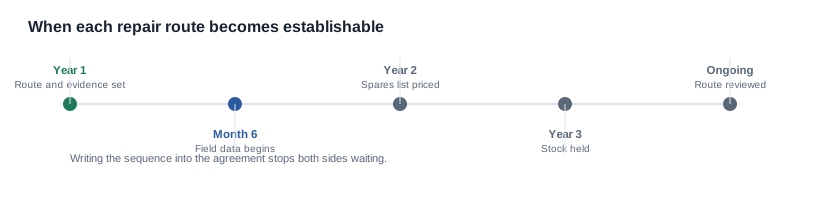
A spare-parts programme. The recurring failures held as stock. It converts a reaction into a plan, and it costs a forecast, which means it needs field data that only exists after several months of sales. In practice this is a second-year decision rather than a launch decision, and pretending otherwise produces an inventory nobody wanted.
A refurbishment line. Returned units graded and sold again. It needs a grading standard, a disclosure obligation and a data-clear procedure, because a refurbished product sold as new is a consumer-protection problem rather than an operational one. In markets where disclosure is specific, this route carries legal weight rather than commercial weight.
Third-party service. A partner performs the work under a standard you specify. It buys capacity without building it, and it costs margin plus a quality standard to write plus an audit right that is worthless unless you actually exercise it.
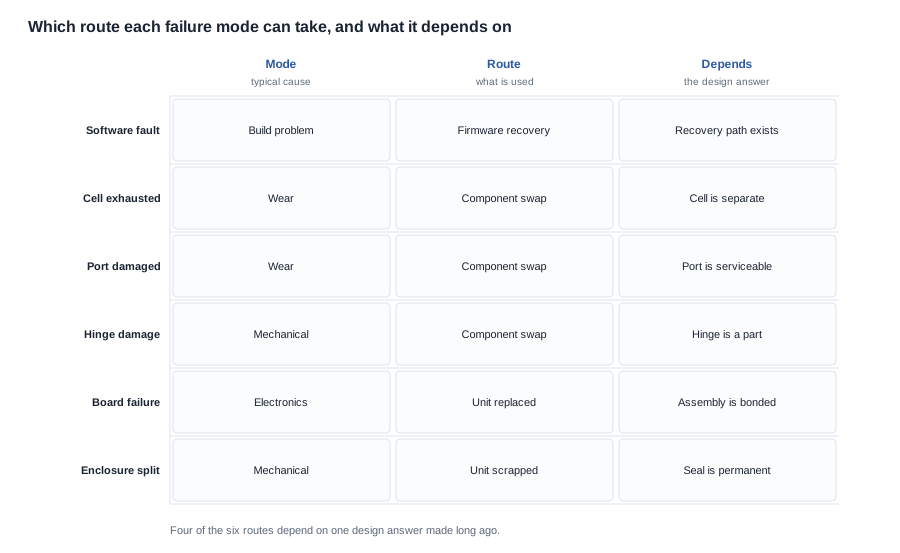
The two routes that buyers most often want and least often have are component replacement and a spare-parts programme, and both depend on the same design answer. That is why the platform decision matters more than the service negotiation.
It also explains why repair programmes in this category tend to start late and stay small. A programme launched in the first year has no field data, so it has no spare-parts list and no basis for deciding which components to hold; a programme launched in the third year has a large installed base and an accumulated failure distribution that nobody recorded. The workable compromise is to establish the route and the evidence discipline in year one and the stock in year two, and to write that sequence into the agreement so that neither party is waiting for the other. Buyers who write the sequencing down tend to get it; buyers who assume it tends to arrive as a dispute in month twenty.
Designing for repair before the tooling is cut
If the repair options have to be settled early, it is worth knowing what to ask while the tooling is still a drawing rather than an injection mould.
Ask whether the electronics assembly is removed as a unit, and by what method. Glue, screws, snap fits and conductive adhesive have completely different service costs. A conductive adhesive joint is effectively permanent and turns every component fault into a whole-unit replacement.
Ask which components carry the highest failure probability and how each is reached. The answer tells you whether the serviceable parts are the ones that actually fail. A design where the serviceable part is the one that rarely fails gives you a repair programme on paper.
Ask what the port and the enclosure do together. A deliberate opening in an enclosure is a compromise between usability and ingress resistance, and whichever way it was resolved, it determines whether a port replacement is possible at all.
Ask whether the enclosure can be re-sealed to its original specification after opening, and who says so. If the answer is that sealing is "to a comparable level", that is not an ingress claim and should not be presented as one.
Ask what happens to the unit's data and configuration when the main board is replaced. This is the question that connects repair to privacy, and it is the one most often left unanswered because it is assumed rather than designed.
None of these questions requires a prototype to answer, and all of them are cheaper to ask than to discover. The tooling cost of a design change made after the first mould is routinely larger than the entire engineering cost of making the change before it, which is the whole argument for asking now.
The second group of questions is about evidence rather than design, and it belongs in the same conversation because the design answers are only useful if somebody records them. Ask for the assembly drawing or its revision, ask which component revision was actually used in the production samples, and ask whether that revision is frozen for the first production run. A repair design that is described accurately on a drawing and implemented differently on the line is the most common cause of a repair programme that appears to exist and cannot be used. The check is cheap and it is one question: does the current build match the drawing revision we were shown?

Questions to ask a supplier about repair capability
These are the questions that separate a supplier who has a repair process from one who has a replacement counter.
Which components can be replaced on the configuration you are quoting, and which require the unit to be scrapped? This is the foundation question and it is a design question. A supplier that answers with a list of functions rather than a list of parts has not answered it.
Who performs the work — the factory, a partner, or the customer? Each has different economics. Factory work means a round trip and a logistics operation. Partner work means a margin, a quality standard and an audit right. Customer work means published instructions and a support line, and it carries the risk that the instructions are followed incorrectly.
What is the turnaround, and what happens when it is missed? A customer told three weeks who waits five has a complaint that has nothing to do with the product, and a supplier who has not thought about the miss has no process for the complaint at all.
Does the data get cleared, by whom, and is it recorded? In this category a repair process without a documented data-clear step is incomplete, and the buyer should treat that as a compliance gap rather than a service preference.
What is the spare-parts position for the two or three components that fail most often? Ask for a period, a price basis and a minimum quantity. Ask specifically which of those parts depend on a component supplier outside the factory, because that dependency is what determines whether the commitment survives.
Can you evidence any of this with a document? A process diagram is not evidence. A work instruction, a parts list with part numbers, or a returned-unit analysis record is. Buyers in this category are routinely shown capability decks in place of process, and the difference matters more than it appears.
There are two red flags worth naming. The first is a repair capability described entirely as a future plan with no components named — that is a roadmap, not a capability. The second is a service partner arrangement offered without an audit right, which means the buyer has bought a margin rather than a service.

Criteria for comparing two repair offers
Five criteria, applied to any supplier's answer, including ours. They are deliberately weighted towards evidence rather than towards capability, because capability is easy to claim.
Does the answer name components, with part references? Parts, not functions. A function list cannot be costed and cannot be turned into a spare-parts order.
Is the answer written or conversational? A written answer can be put into the agreement at no additional effort. A verbal answer requires somebody to remember it, and that somebody will leave.
Does it cover the data-clear step explicitly? Not as a footnote, not as a general privacy statement, but as a step with an owner and a record.
Does it state what is not repairable? This is the most informative part of any answer. A supplier who states clearly that a bonded assembly is not repairable has told you the real cost structure of the programme, and one who claims everything is repairable has told you they have not looked.
Does it survive a change of counterparty? The same test used for lifecycle commitments: does the repair capability depend on a relationship or on a documented process at a named facility? Where it depends on the relationship, it will not be available to the next owner.
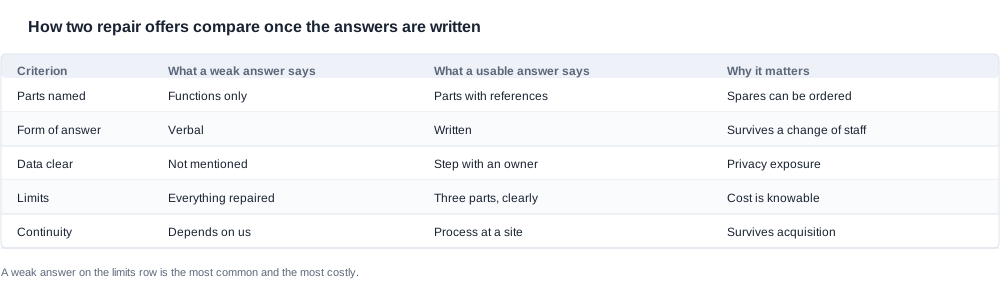
The trade-off to keep in view is between breadth and depth. A supplier who will repair anything has a shallow capability that is expensive to run and impossible to price. A supplier who repairs three components well has a deep capability that can be written into a parts list, an instruction and a spare-parts order. For a first programme in this category, depth is almost always the better trade, and the breadth can be added once the field data says which components actually need it.
A sixth criterion is worth adding because it is the only one that survives contact with a budget: what the route costs per event. Not what the programme costs to establish, but what a single repair costs in parts, labour, freight and the capacity it consumes. A component swap that costs a fraction of a new unit is worth building a process around; one that costs nearly as much as a new unit is a process that exists mainly to appear in a capability document. Neither is wrong, but they are very different decisions and they should not be argued about on capability grounds alone.
The published position on repair, and what we will state instead
Split the answer in two, then: what is a commitment, and what is simply a hole in what we have published.
Our repair process is not published. Our spare-parts programme is not published. Our service pricing is not published. Our turnaround commitment is not published. Our warranty duration is not published. None of those is a position we are withholding; each is an internal question that is still open, and a service commitment printed on a website is a commitment a customer can hold us to. We will not describe a repair capability we have not established.
The missing rows constrain the repair answer as well. Exactly one model in the catalogue publishes a weight, the MT6 at 158 g, and every other weight is Not published. We publish no sensor model, no field of view, no video specification and no microphone specification. Ingress test report numbers are Not published with them. Regulatory status is narrower still: no CE, FCC or RoHS reference appears in the catalogue text and there is no per-model certification row, so the documents behind a model are requested in writing, and the children's models have nothing regulatory published. The designations are unstable too. "L2 Utral" appears in the catalogue with a note that it is a typographical rendering of "Ultra". "Utral Pro Max" appears alongside it, with no published meaning. Neither the light-responsive entry nor the bone conduction entry carries any designation of its own. Software support per model and the location of stored data are Not published as well, and that last row is a repair question before it is an IT one, because it decides what a main-board replacement has to achieve.
What we can do is take a specific model and configuration and tell you, from the published position, which failure routes the design makes straightforward and which it makes difficult. For example: a configuration that includes a charging case has two components that can fail, and where the case is separate the cell is in the case rather than in the frame — which makes the case the serviceable item and the frame the durable one. A configuration with a Type-C port has a port that is a deliberate opening, and therefore a wear item that is not the same thing as a repair item. And a configuration with a camera makes the data-clear step mandatory rather than optional. Those are statements we can make from the configuration, and they are more useful than a general claim about service capability.
We will also say which of the six routes we can evidence today for that configuration and which we would have to build. If you want that as a written statement for a specific model, send us the configuration, the expected volume and the markets and we will produce it.
Related reading
- The parts the routes depend on — spare parts
- The unit that comes back — replacement process
- The clock the routes have to meet — response times
Tell us the models and the expected volumes, and we will tell you which failure routes the published configuration makes straightforward.


