

AI camera glasses certification is not one document, and the camera is the reason. A radio product needs a radio file, a lithium product needs a transport file, and a camera product adds a third subject on top of both — the imaging module — while changing the shape of the first two. Buyers who arrive expecting a single certificate number find instead a file that has to be assembled in a fixed order, because each piece depends on the one before it and a gap in the middle invalidates the end.
This article is that order, written for procurement and sourcing teams who need to know what to ask for, in what sequence, and what to do on the day a supplier answers that a document does not exist. It also sets out plainly what our own catalogue does and does not publish, because the catalogue position and the compliance position are two different lists, and merging them is the most expensive mistake available in this category.
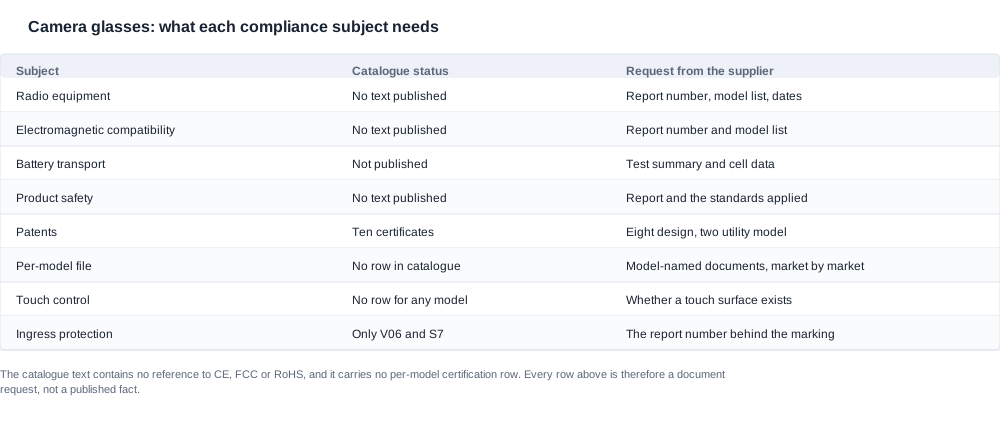
The catalogue publishes eleven camera models — the L1 Pro and the V03 Pro, the L2 Utral and the CY03, the V03 and the MT5, the MT6 and the S7, the KY06 and the V06, and the CY05. It carries a company-level export certification page whose content is images rather than text, and its text contains no reference to CE, FCC or RoHS anywhere. There is no per-model certification row for any of the eleven. That is not a criticism of the models. It is a description of the documentation, and it decides what your file has to contain.
AI camera glasses certification: the file is assembled in a fixed order
Compliance work for a camera product fails in one predictable way: the pieces are collected in whatever order the requests happen to be answered, and the discovery that the report names a different model arrives after the artwork is printed. The sequence below is the order we would use on our own programme, and each step has a completion condition you can check without a compliance team.
Step one is model identity, and it comes before every other request. Write the exact model designation, including the variant, onto the purchase order before any document is requested. Every later step is a comparison against that string, and a comparison against a string that has drifted — a trade name on one document and a factory code on another — is not a comparison at all. The eleven camera models in our range include near neighbours by design: the CY03 and the CY05 differ only in name on the published sheet, and the V03 and the V03 Pro differ by one word and by a photochromic lens configuration. Character-by-character checking is not paranoia here; it is the whole method.
Step two is requesting numbers rather than assurances. A number can be resolved later by a broker, a marketplace operator, a customs authority or your own compliance function. An assurance cannot be resolved by anyone, including the supplier who gave it. When you write to a factory, ask for the report number, the issuing body, the standard applied and the edition of that standard, for each model in your order. If the answer comes back as a sentence about the supplier's capability rather than a list of numbers, the second request should be more specific and should name the model.
Step three is resolving the number in the issuing body's register. This is the step that most suppliers skip, and it is the only step that turns a document into evidence. Read the model list printed on the document. Read the validity dates. Read the scope of what was assessed — radio only, or radio and safety, or a family rather than a configuration. A certificate whose scope is the radio function does not cover the general safety obligation, and a test report is not a certificate: one is a record of a test, the other is a declaration attached to a product.
Step four is the battery transport evidence. Every camera model in our range carries a lithium cell, from 220 mAh on the V03 and the V03 Pro up to 290 mAh on the CY05 and the L2 Utral, and the L1 Pro and the CY03. Models that ship a charging case add a second lithium item to the parcel, and the case is the larger one: 1400 mAh on three models, 900 or 1400 mAh on one, 1200 mAh on a foldable case on another. The number of declared cells and their capacities are what set the freight mode and the documentation set. The catalogue publishes no UN 38.3 summary for any camera model, so this is an item to request rather than one to quote.
Step five is checking the unit against the file. When the samples arrive, before anything else is done to them, read the designation on the unit and compare it with the designation on the document. A mismatch is a stop condition rather than a query, because the alternative is discovering it at a customs inspection or in a warranty file.
Step six is retention with an owner and a date. A compliance file that nobody holds is not a file. Agree in writing who keeps it, for how long, and what triggers a review — and treat a change of model, a change of configuration and a change of destination market as three separate review triggers, because each of them can invalidate a document that was otherwise in order.


What the catalogue publishes about compliance, and what it does not
The honest description of our own documentation is short, and a buyer who has the short version can plan around it in an afternoon rather than in a quarter.
What is published. A company-level export certification page. Its content is images rather than text — ten patent certificates, of which eight are appearance-design patents and two are utility-model patents. That is a statement about intellectual property held at the organisation level. It says nothing about any individual model, and it cannot be converted into one.
What is not published. The catalogue text contains no reference to CE, no reference to FCC and no reference to RoHS. There is no per-model certification row for any of the eleven camera models, and no per-model record of a pending certification either. There is no UN 38.3 summary. There is no touch-control row for any model in the entire catalogue — the row is simply absent — so whether a temple carries a touch surface and how it is configured is a question for the supplier. And the ingress marking is exceptional rather than general: IP54 appears on the V06 and the S7 and on no other camera model, with no report number attached to it in the source.
This matters because buyers arrive with a mental model in which a manufacturer's catalogue is a compliance document. In this range it is not, and the difference is structural rather than a matter of how much detail a particular factory chose to include. A catalogue is a selection sheet. A technical file is an evidence set. The selection sheet tells you which models exist and what their published rows say; the evidence set tells you whether the unit in your carton may lawfully be placed on the market in the destination country. Only the second one answers the question your compliance function is actually asking.
The practical consequence for a sourcing team is that the catalogue narrows the field and the compliance file closes it. Narrow first — using the published frame cell, runtime, resolution tier and charging rows to build a shortlist — and then spend the compliance effort on the models that survive, rather than on the full range. A buyer who requests model-named documents for four candidates has a manageable file. A buyer who requests them for eleven has a programme with no focus and a quotation that cannot be compared.
There is one category of answer worth handling in a defined way: the supplier who states that the file exists but will not name the numbers. This is not unusual, and the reasons are ordinary — the customer has not signed an NDA, the document is issued in the factory's name, or the person answering is a salesperson who has been given the task of producing a quotation and not a file. The useful response is procedural rather than confrontational. Ask for the issuing body and the standard first, which most suppliers will supply because it carries no commercial weight. Then ask for the model list, which is the part that reveals whether the document covers your unit. A supplier who names the body and the standard but refuses the model list has told you something important, and the right next step is to ask the supplier's compliance contact rather than the account manager. Two red flags are worth escalating rather than working around: a document that names a brand rather than a model, and a supplier who asks you to accept the file without looking at it.

The three subjects a camera product adds to the radio question
Most of the confusion in camera glasses compliance comes from treating the electrical file as the whole file. There are at least three subjects, and each has its own instrument, its own document and its own failure mode.
The radio subject. For products placed on the European market the governing instrument is the Radio Equipment Directive (EU) 2014/53/EU. The electromagnetic compatibility question sits under a different instrument, the EMC Directive (EU) 2014/32/EU. Buyers who conflate the two lose time, because a report under one does not cover the other. It is worth being equally careful about the standards that sit underneath the directives: EN 301 489 and EN 300 328 are harmonised standards, not directive numbers, and a document that cites a standard has still cited it under an instrument. None of this appears as a published row in our catalogue, so all of it belongs in the request list rather than in the comparison table.
The battery subject. A lithium cell in a wearable is a transport question before it is a product question. The cell capacity is published for every camera model, which is the number the freight forwarder and the carrier will use, and the number of cells in the parcel is set by the charging case configuration. What is not published is the transport evidence itself. That is a documentation gap with an operational consequence: freight booked before the transport summary exists is freight booked against an assumption, and assumptions of this kind surface at the wrong end of the shipment.
The imaging subject. A camera raises a question that an audio product does not: what is the sensor, and has the module been assessed for the emissions a camera introduces into a device worn close to the head. The catalogue publishes no sensor model, no field of view, no video resolution and no frame rate for any camera model, so this subject cannot be closed from the catalogue and cannot be closed by an assurance either. It is closed by a document that names the model, or by a test on a sample.
The lens subject, on one model only. The V03 Pro is published with a photochromic lens configuration. A lens worn near the eye is a distinct subject from the electronics around it, and no lens test evidence is published for it. If a lens feature is going to appear in a listing, the evidence that supports that listing is a separate request, and it should be raised as one rather than folded into a general compliance enquiry where it can be missed.
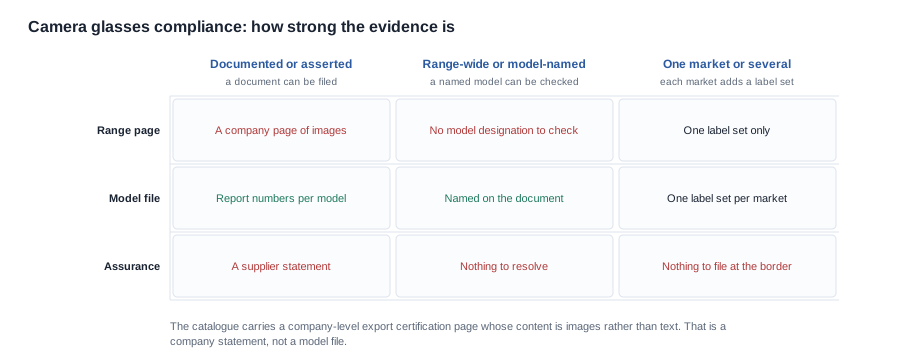
The general pattern across all four subjects is the same. Our catalogue publishes the physical and electrical rows and withholds the documentary ones. That is a coherent position — a selection sheet should describe the product — but it means the buyer has to know that the documentary layer has to be requested separately, model by model and market by market, or it will simply be missing when the shipment is booked.

How to request, verify and retain the evidence
A request list is only useful if it is specific enough that the supplier cannot answer it with a brochure. The six questions below are the ones that produce documents rather than descriptions, and each of them is asked identically of every supplier, which is what makes the answers comparable.
- Which report numbers cover the exact model designation on our order? Ask for the numbers, the issuing bodies and the validity dates, in the body of the email, before the first sample is produced.
- What is the model list printed on each document, and does it include our designation? If the answer is a description of the supplier's range rather than a list, the document covers the range and not your units.
- Which harmonised standards were applied, and under which directive? This is where a radio document and an EMC document are told apart, and where a standard number gets mistaken for a directive number.
- What is the battery transport summary for each lithium item in the parcel? One summary for the frame cell, one for the case cell, and a note of the declared capacity of each.
- Which markets does the file cover, and who holds it? A file scoped to one market is not a file for the second market, and the general product safety regulation (EU) 2023/988 adds a documentation and labelling layer on top of the electrical file for consumer products placed on the European market.
- What is the retention period, and what triggers a review? A change of model, configuration or destination market should each be listed as a trigger.
When the answers come back, the verification step is short and it is mechanical. Resolve each number in the issuing body's register. Compare the model designation on the document with the designation on the purchase order, character by character. Confirm that the validity dates have not passed at the date of your shipment, not at the date of the enquiry. Confirm that the scope of each document covers the functions the unit actually performs. And record the result in a table — one row per document, one column per check — so that the file can be re-verified later rather than re-argued.
Two failure patterns are worth naming in advance because both look harmless until they are not. The first is the family-level document: a supplier provides a report covering a range, the buyer files it as coverage for a branded unit, and the gap surfaces in a customs query or a marketplace rejection. The second is the variant drift: a configuration change alters the documented product, the original document quietly stops applying, and nobody notices because nothing about the paperwork looks different. Both are prevented by the same clause — a requirement that the model designation be attached to the order, and a notice obligation before any change to the configuration.
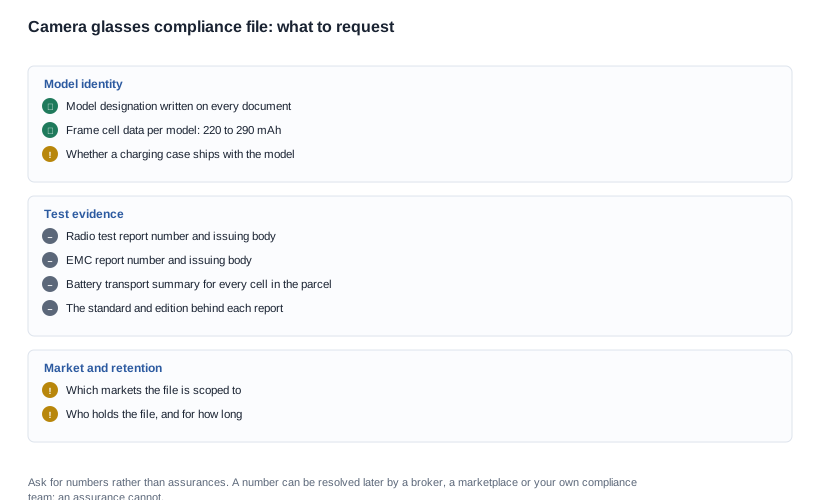
For a negotiation, the useful point is that the document set is a supplier obligation with a delivery schedule, and it should sit in the purchase order rather than in an email thread. The clauses that earn their place are a model-named document schedule, a re-issue obligation when the file lapses, a notice obligation on any configuration change, and a statement of who bears the cost when a lot arrives without a file that covers it. Certification cost and certification time are fixed per configuration and are set by a laboratory queue rather than by order size — which means they are a line in the quotation rather than something a buyer can negotiate by ordering more units.
The boundary of what we can evidence for a camera model
We would rather hand you an accurate short list of the documents that exist for a model than a long list of claims we cannot substantiate. For the camera range that list is currently short. We publish the company-level export certification page, whose content is ten patent certificates — eight appearance-design patents and two utility-model patents — as images rather than text. We publish no per-model certification row, no certificate number, no UN 38.3 summary and no touch-control row for any model.
We will also say the other half plainly, because a buyer who checks a claim should be able to check ours first. We publish no sensor model, no field of view, no video specification, no frame rate and no aperture for any camera model, so no imaging claim on a product page can be supported by anything we publish. We publish one weight in the whole catalogue — 158 g for the MT6 glasses unit, which includes the battery and the camera and excludes the foldable charging case — and no weight for any other model, and no frame-only weight for any model at all. We publish the ingress marking on the V06 and the S7 and no report number behind it.
Those are absences rather than adverse findings, and the distinction matters. No published certification row does not mean the model cannot be sold; it means the evidence has to come from somewhere else, and from someone specific. What we will not do is convert a company-level page into a model-level claim, present a marking without a report as a tested rating, present 13 MP as an image quality figure, or quote a certificate number, a weight, a case capacity or a sensor that our documentation does not contain.
On the commercial side, the same discipline applies. The catalogue publishes no minimum order quantity, no lead time, no production capacity, no warranty period and no unit price for any camera model. Those are quotation items, and a quotation is a document you can negotiate and compare — unlike a catalogue row, which is a fact you can only accept or reject. MOQ, lead time, sample terms, payment terms, packaging, warranty and the treatment of tooling and NRE belong in the quotation and in the purchase order, and the questions to ask about each of them are set out in the certification checklist and the battery transport notes.
That distinction has a practical use beyond bookkeeping. A catalogue row is comparable across suppliers, so it belongs in the shortlist. A quotation term is only comparable once it has been quoted, so it belongs in the negotiation. Buyers who mix the two end up comparing a published cell capacity against a quoted unit price and concluding that one supplier is more expensive, when what they have actually done is compare a specification with a price. The evaluation method for each kind of item is different, and the shortlist should be built on the first kind before the second kind exists.
If you are working through a file now, send us the target market, the quantities, the destination countries and the exact models under consideration. We will tell you which of our published rows bear on the decision, which documents we can produce for the specific model you are buying, and which parts of your requirement remain sample questions because no published row settles them. The range is at AI camera glasses, the electrical background sits under charging solutions, and the imaging background is under AI camera glasses imaging. For lens-bearing configurations, photochromic lens technology is the relevant reference.
Related reading
- The camera range this file applies to — AI camera glasses
- The document set to request — certification checklist
- Battery transport before freight is booked — battery transport
Tell us the target market, the quantity and the required configuration, and we will come back with what is available and what is not.


