

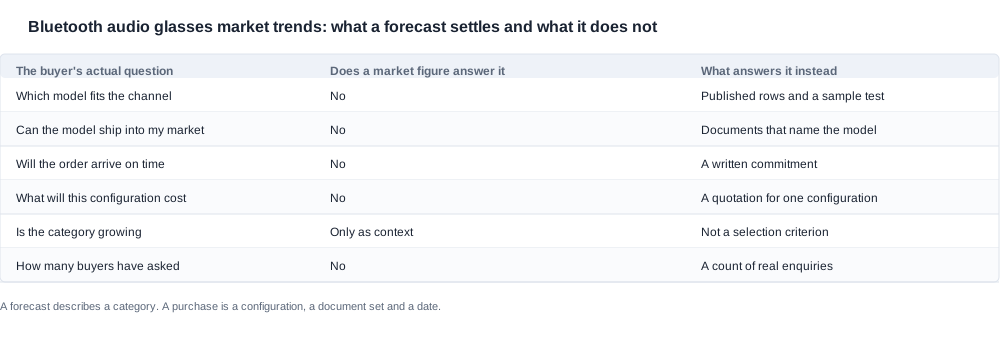
The conclusion first, and it is slightly uncomfortable for anyone who buys market reports. We do not hold a verifiable market figure for this category, and in this specific category the figure would not change your decision anyway. What determines a Bluetooth audio glasses purchase is knowable without a forecast: it is regulatory readiness, whether the product works on the customer's own devices, whether the order arrives when it was promised, and whether the brand can put its own name on it. Those four things can be checked by asking. A forecast tells you nothing about any of them. This page is written for the buyer who has been handed a market number by a supplier or a distributor and has to decide what to do with it.
Bluetooth audio glasses market trends are a reading problem rather than a data problem
A market figure arrives with a number attached, and the number creates the illusion that the decision has been made. In a category where the published specification is five electrical rows per model, that illusion is dangerous, because the rows that decide a purchase are not the rows a forecast describes.
Why a market number would not move the shortlist
The published specification in this range is unusually thin, and that is what makes it competitively interesting. The audio models in our catalogue publish a radio version, a charge time, a cell configuration, a rated use figure and a charging interface. Two models publish a feature line on top of those five rows. The remaining models publish nothing else at all — no frame weight, no acoustic figure, no microphone specification, no ingress marking, no capacitive touch row. A market that thin on specification is not a market that competes on specification. It competes on regulatory readiness, on compatibility with the customer's own devices, on delivery reliability and on the ability to put a brand on the product.
A second reason a number misleads is that the band structure is already visible in the hardware. The catalogue divides into an audio band, a sport band and a camera band, and a buyer choosing between them is making a channel decision rather than a market-share decision. A brand that specifies a product in the camera band may find itself competing head-on with a large platform vendor on a product it cannot differentiate. A brand that serves a channel the platform vendor does not address has a clearer proposition in the audio band. Which band you are in is decided by the channel you already have, and no forecast tells you anything you did not already know.
The third reason is that the forecast is about a category and the purchase is about a configuration. A forecast describes a volume of units moving through a channel. A purchase is one model, one configuration, one artwork, one document set and one delivery date. The gap between those two things is where the money is lost, and it is not a gap any market number can close.
The cost of using an unverified figure internally
A number that enters an organisation without a method attached tends to become a target, and a target becomes a plan, and a plan becomes a commitment. In this category that chain is particularly dangerous because the figure usually describes a category that blends open-ear audio frames with display products and with headsets. The buyer who acts on it ends up with a plan built for a product category they are not entering.
The commercial defence is procedural rather than analytical: before any figure is allowed into a decision, somebody has to be able to produce the source document and answer four questions about how it was built. If they cannot, the figure is context, and context does not belong in a business case.

Six structural facts a buyer can verify before reading any forecast
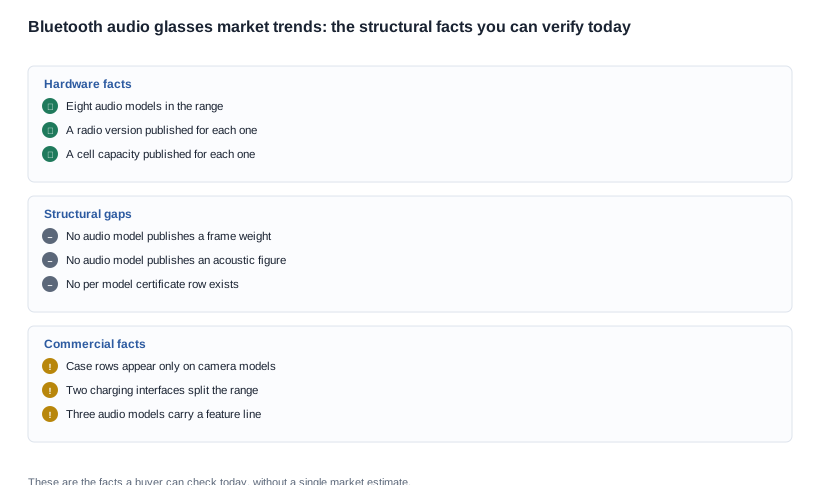
These are the facts that actually change a purchase, and every one of them can be established today without a single market estimate. They are the substitute for a forecast, and in a category this thin they carry more commercial weight than any growth rate.
One: the radio version is the platform decision, and it splits the range in two. The K01 and the K02 publish Bluetooth V5.3. The YK12 and the D11, the LC-105-2 and the D12, and the G07 and the LC-105-1 publish V5.4. A brand that does not decide this deliberately is deciding it by accident, because the customer's device fleet decides it instead, and a compatibility problem returns to the supplier as a quality complaint.
Two: the charging interface is a commercial fact rather than a preference. Six of the eight audio models charge magnetically and two charge over a Type-C port. An interface is an accessory chain, a packaging specification, a spare-parts plan and a stock line in the buyer's own stores. A range that mixes both interfaces pays for both, and the buyer who has not counted the chains has not costed the range.
Three: the cell configuration is a structural fact with three values. Two 90 mAh cells, two 55 mAh cells and one 100 mAh cell. That is three platforms behind eight models, and a range built on one platform shares its firmware, its app, its accessory family, its documentation file and its artwork, while a range assembled from three platforms pays three times for the setup.
Four: the case is a camera-model fact, not an audio-model fact. Five camera models publish a charging-case capacity, two more publish a case with no capacity figure, and one has no charging-case row. No audio model publishes a case row at all, which means an audio shipment carries one cell per unit and the second lithium cell that dominates freight class in this catalogue is simply absent. That is a freight and transport difference, and it is free to establish.
Five: the specification gap is a support cost. No audio model publishes a frame weight, no acoustic figure, no microphone specification and no ingress marking. Every one of those is a question that arrives after the launch, and each one becomes a ticket, a return authorisation or a listing correction that the channel absorbs.
Six: three models carry a published feature line and five do not. The D11, the G07 and the YK12 publish a feature line on top of the five electrical rows. The LC-105-1 and the LC-105-2, the D12 and the K02, and the K01 publish nothing beyond the electrical rows. In a specification-thin category, that difference is the whole of the differentiation available, and it is a narrower field than most buyers assume when they hear that a range offers eight models.
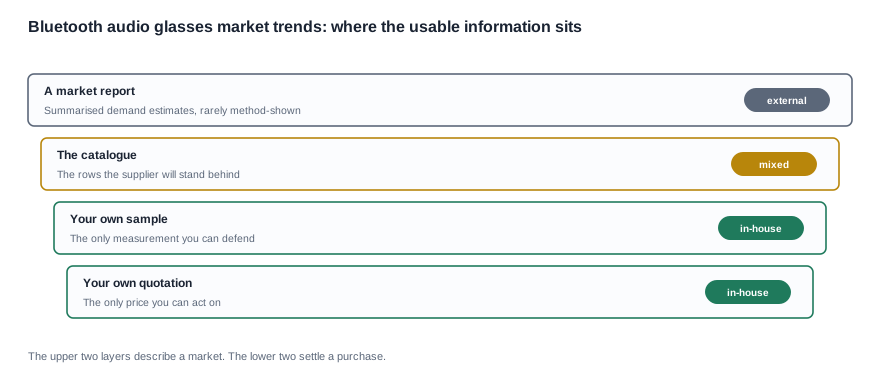
The layers diagram is the shortest summary of this page. A market report sits at the top and describes a category. The catalogue below it holds the rows a supplier will stand behind. The buyer's own sample and the buyer's own quotation sit at the bottom, and they are the only two layers that can settle a purchase. The information that moves a decision is in the bottom two layers, and neither of them requires an estimate to be produced first.
The band decision, stated as a channel question
The band structure is worth one more paragraph because it is where a forecast usually does damage. A buyer who has been told that the category is growing will try to place themselves at the growing end, which in practice means the camera band, where the products carry cameras, larger cells, charging cases and a far more expensive compliance path. The consequence of that choice is not a bigger order — it is a different business. The camera band competes on imaging and on a feature set that a buyer without imaging development capability cannot differentiate, and it carries a documentation burden that is per model and per market.
The audio band is where a brand without that capability competes on the things it can control: the platform, the interface, the feature line, the customisation and the channel relationship. That is a smaller opportunity by any measure a forecast might produce, and it is also the one where a brand can actually win. The right question to ask a supplier is therefore not how fast the category is growing but which band the buyer's channel has actually placed an order in, and the answer to that is observable without a single market estimate.
The third band, the sport tier, is a different product again and the fastest-turnaround entries in the catalogue sit there. A buyer whose channel is genuinely sport-led should ask about that tier directly; a buyer whose channel is office-led should understand that the sport tier is a different document set and a different accessory chain, and that treating them as interchangeable is how a range acquires a second set of costs that nobody costed.

How to interrogate a market figure when a supplier offers one
When a supplier, a distributor or a trade publication hands you a figure, the useful response is not a challenge to the number but a set of questions about its construction. Four questions separate a figure you can act on from a figure you can only repeat.
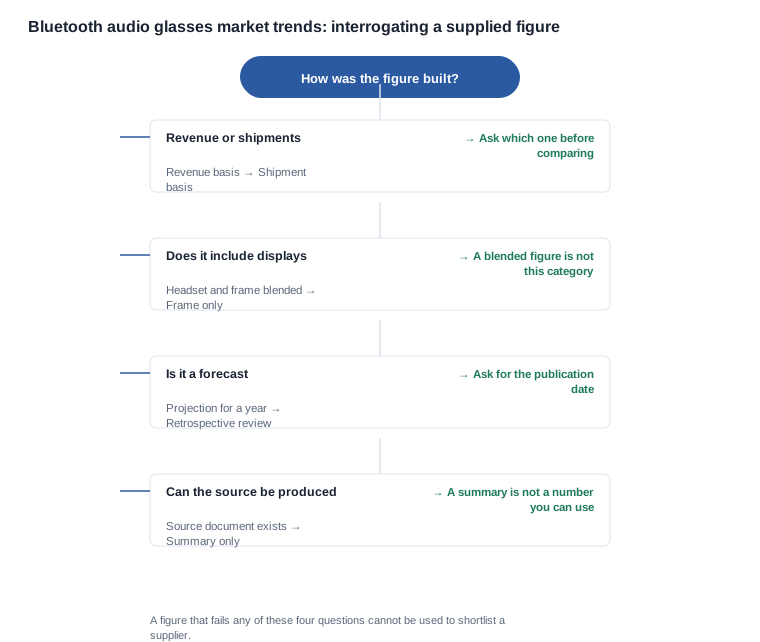
Is the basis revenue or shipments? The two are not comparable, and a supply chain that mixes them produces a figure whose magnitude depends on the choice rather than on the market. Ask which one it is before asking anything else.
Does the category include display-type products? A figure that blends headsets with open-ear audio frames is not a figure about this category. The category definitions — "smart glasses", "AI glasses", "display-less glasses" and "open-ear wearable audio" — describe four different products with four different supply chains, and a figure that does not name which one it is measuring cannot be applied to a purchase decision.
Is it a forecast or a retrospective, and when was it published? A projection for a year is a projection, and a projection published after the year it describes is a retrospective dressed as a forecast. The publication date is not a detail; it is the difference between a leading indicator and a description of what already happened.
Can the source document be produced? A summary of a figure is not a figure, and a number that cannot be traced to a document with a method and a category definition is a number that a retailer, a compliance team or your own finance function will ask about.
If the answer to any of the four is unclear, the honest treatment is to record the figure as context with its caveats attached and to keep it out of the business case. A figure that fails these tests is not wrong; it is unusable for the decision you were about to make with it.

The six questions that replace a forecast in a supplier conversation
When the forecast is set aside, the conversation gets more useful almost immediately, because these six questions are answered from experience rather than from a report.
- How many buyers have asked for this category, and what did they say they were trying to do? A count of real enquiries with the stated purpose is worth more to a buyer than a market estimate, because it describes demand that already exists in the buyer's own world rather than a demand that exists in a model.
- Which destination markets have had their requirements confirmed, and which have not? This tells you where the category is sellable today and where it is a research project, and it is a question a supplier can answer honestly because it is about their own programme.
- What did the compliance programme cost in time for a comparable product? The compliance route is the real barrier in this category, and it becomes a known quantity the moment somebody has walked it. The answer is a schedule, not a number, and it is one you can plan against.
- What is the return rate on a comparable wearable sold to the same customer? That is an operational figure, and any brand that has already sold one can give it. It is also the figure that determines whether a channel works, because in this category the return rate is driven by the two rows nobody publishes.
- What has the retail channel actually said about the category? Placement is a decision somebody has already made or already refused to make. A category that retailers decline to stock has a structural problem that no demand estimate addresses.
- Which band is the channel actually buying? An answer that places the channel in the entry audio band rather than the camera band is the single most useful number in the conversation, because it determines the product the channel can absorb and the competitor you will not be measured against.
These six questions have a property that a forecast does not have: they are answerable, they are checkable, and they change a decision. Question four in particular is the one most buyers skip and the one that predicts the commercial outcome of a range better than any demand estimate.
The commercial conversation this replaces
Removing the forecast from a supplier conversation does not remove the commercial content; it relocates it to the lines where the buyer can actually move something.
Negotiable, and worth the negotiating capital. The number of artwork rounds is negotiable and each round is a schedule. The delivery schedule is negotiable in its staging rather than in its length — a split shipment against a staged payment node gives the buyer a holdback that a single bulk delivery does not. The payment nodes against inspection are negotiable, and in this category they matter more than usual because the acceptance criteria are sample-based. The return terms and the warranty response time are negotiable, and a channel buyer who takes them on a business deployment has to be able to pass them on. The market scope is negotiable in the sense that a supplier who has already supported a destination market will usually support another at a lower incremental cost.
Not negotiable, and worth saying so early. The compliance cost and the compliance lead time follow the testing body and the laboratory queue, and pressing on either produces a longer schedule rather than a shorter one. The tooling cost is a one-off that is amortised across the first order, so the useful question is over what volume it is amortised and what happens to it if the programme is discontinued. The per-configuration re-validation cost compounds with every configuration change, which is why the configuration list has to be frozen before the artwork is approved rather than after. And the acoustic specification is not a commercial variable at all: it has to be measured on samples or received in writing, and no negotiation converts one into the other.
How to build the business case without a forecast
A buyer who has to present a case internally can build it entirely from the structural layer, and the case is stronger for it. The four inputs are: the unit economics per configuration, built from a quotation rather than from a market rate; the cost of the setup, amortised over the volume the buyer actually intends to place; the document and testing cost per model and per destination market, which is a schedule as much as a cost; and the return exposure, which is the variable that decides whether the range works. Each of those is a fact the buyer controls or can obtain. A growth rate is not on the list, because a growth rate does not change any of the four.
The market data we will not publish, and the reason we will not
We would rather hand you a method, a set of structural facts and a question list than a figure we cannot evidence, because in this category the structural facts are the decision. The radio version, the case position, the compliance position, the published feature lines, the accessory chains and the customisation questions are all knowable today, and each of them moves the commercial outcome more than a growth rate would.
We will not publish a market size, a growth rate, a segment share or a competitive ranking for this category, and we will not present a figure we cannot evidence as though we could. That is not a refusal to be useful; it is a refusal to put a number in your business case that will not survive the first question from your finance function.
What we will do is tell you which rows each model publishes, which rows every model in the range leaves open, which band your channel is actually buying, and which questions have to be closed before an order can be placed. Those are the parts of the decision that are actually open.
Five things to establish before you read another market figure in this category
- The band your channel buys, stated in one sentence, with the reason.
- The published rows for each candidate model, with the model designation attached to every value.
- The device fleet your customers run, checked against the published radio versions.
- The accessory chain count for the range you intend to build.
- The compliance schedule for one destination market, in writing, from a supplier who has walked it.
Tell us the channel, the volume, the target markets and how many models you plan, and we will come back with the published routes, the platform decisions and the questions we can close for you directly. The range is on our Bluetooth audio glasses collection page, and the model-selection logic is in which model to pick.
Related reading
- How the family divides by platform — which model to pick
- What the radio version changes — Bluetooth connectivity
- How a branded programme is costed — Bluetooth audio glasses price comparison
Tell us the channel, the volume and the target markets, and we will come back with the platform decisions.


