

No unit price is published for any model in this range, so a price comparison built from the catalogue is impossible. What is possible, and more useful, is a comparison of the cost drivers: the accessory chain, the parcel, the platform sharing and the specification you have to beat. A buyer who works the cost drivers can build a landed cost and therefore a price comparison that survives scrutiny. A buyer who asks for a price list first is comparing the wrong thing, and will go back to the cost drivers after the supplier has quoted anyway. This page is written for the procurement manager who has to defend a comparison to a colleague who wants a number.
Bluetooth audio glasses price comparison has to be built from cost drivers
The four cost drivers in this category are structural, and every one of them can be established before a price exists. That is the whole argument of this page, and it is why a comparison built on them is more durable than a comparison built on a quotation that will change the next time the order quantity changes.
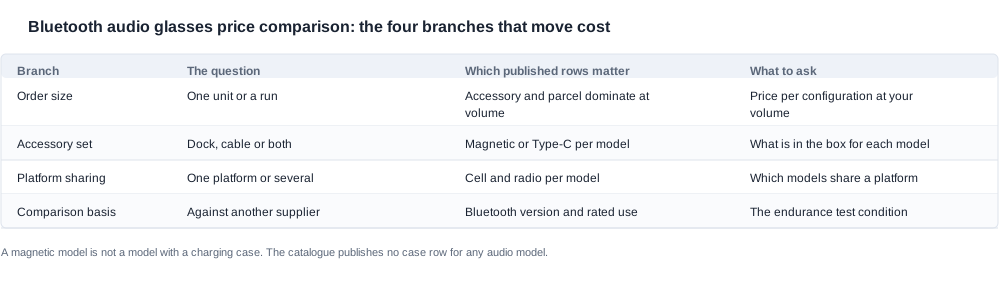
The four branches that determine what a unit actually costs
Is the order one unit or a run? At volume, the accessory chain and the parcel dominate the unit cost and the specification barely registers. At single-unit or sample quantities the reverse is true: the specification and the retail story dominate, because the freight difference on one parcel is negligible and the buyer is paying for what they can see. How to compare the two situations is a question about quantities, not about suppliers, and the same model can sit at either end depending on the order. The volume mechanics are in bulk ordering Bluetooth audio glasses.
What is in the box? For the audio models, the answer is short: the frame, the charging accessory for that model's interface, the cable where the interface requires one, and the documentation the market needs. No audio model in this range publishes a charging-case row, which is worth stating explicitly because the camera models in the same catalogue do, and because a second lithium cell inside the box would change the packed weight, the volumetric weight, the freight class and the transport documentation all at once. Six of the eight audio models charge magnetically and the D11 and the D12 charge over a Type-C port, so a range that mixes both interfaces carries two accessory chains and two packaging specifications. The trade-off between the two is in Bluetooth audio glasses charging options.
Is the range one product or a family? Platform sharing is the strongest cost lever in this range. Three platforms sit behind the eight audio models: the K01 and the K02 on two 90 mAh cells with Bluetooth V5.3; the G07 and the YK12, and the LC-105-2 and the LC-105-1 on two 55 mAh cells with V5.4; and the D11 and the D12 on a single 100 mAh cell with V5.4. A family built on one platform shares the firmware, the app, the accessory family, the documentation file and the artwork, and each additional SKU becomes materially cheaper than the first. A range assembled from three platforms pays the setup three times. The platform map is in which model to pick.
Is the comparison against another supplier? Then a specification comparison is needed, and the published rows in this range are thinner than a buyer expects. Across the audio range there is no published frame weight, no published acoustic detail, no published microphone specification and no published ingress rating. The rows that are comparable across models are the cell configuration, the rated use figure with its caveat, the charging interface and the radio version. Everything else has to be established on samples, and the range comparison across the audio models sets out the full grid.

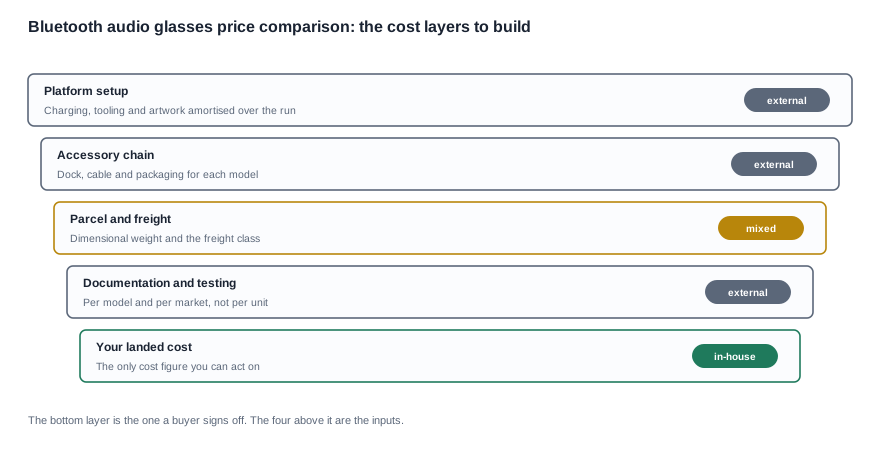
The five cost layers a landed cost is assembled from
A landed cost is not a unit price with freight added. It is five layers, and the layer diagram above is the order in which they have to be worked, because each one depends on the one above it.
Layer one, the platform setup. Tooling, the platform's own development, the artwork master and the documentation file are amortised across the models that share the platform. This is the layer that decides whether a range of four models on one platform or on three is affordable, and it is the layer that a price-per-unit comparison hides completely. Total cost per model, not per unit, is the number that shows it.
Layer two, the accessory chain. The dock or cable, the packaging structure and the spare-parts plan are per model and per interface. Two interfaces across a range means two chains, and the second chain is a stock line and a supplier dependency that runs for the life of the range rather than for the length of the order.
Layer three, the parcel. Dimensional weight and the freight class, both of which depend on the packed carton rather than on the retail box. A light product in a large carton is charged by volume, and the surcharge on a bulky-light consignment can exceed the margin on the product itself. This is the layer a buyer most often estimates rather than models, and it is the layer that most often turns a workable price comparison into an unworkable one. The parcel arithmetic for the camera models is in shipping weight breakdown.
Layer four, the documentation and testing. This is per model and per destination market, not per unit, and it is the layer a buyer starting from a unit price forgets entirely. It is also the layer that scales badly: a range of three models into two markets is six document sets, and each one has a lead time that runs in parallel with production rather than after it.
Layer five, the landed cost. The only layer a buyer can act on, and the only one that should reach a comparison table. Everything above it is an input.
The specification you will actually be compared on
If a buyer is comparing a product against a competitor's listing, the rows that decide it are the radio version, the rated use figure, the charging interface and the cell configuration. Everything else in this range is either unpublished or shared with competitors.
Two of those need care. The rated use figure is a rating without a stated test condition, so it should be published as a rating and not placed beside a competitor's single figure without a footnote. The cell configuration is published as a cell and a count rather than as a total, so a comparison that uses the total has to say that the total is derived. How to compare these two rows honestly is the difference between a comparison a buyer trusts and one that falls apart the first time somebody measures it.
How to build the comparison so that it can be defended
A defensible comparison has a specific structure, and it is not the one a buyer builds by collecting quotations.
Build the cost layers first, and the quotations last. Once the platform count, the accessory chain count, the parcel model and the document set are fixed, the quotations are compared on the one variable that is genuinely variable, which is the unit price at a stated quantity. Comparing quotations before the structure is fixed compares two different products.
State the quantity at which each quotation holds. A price quoted at a pilot quantity and a price quoted at a run quantity are different numbers, and a comparison table that mixes them is worse than no comparison table. The quantity belongs in the same cell as the price.
Keep the non-price terms in the comparison, separately. The payment nodes, the delivery schedule, the warranty response time and the return terms are part of the commercial offer, and a table that shows only unit price hides the terms that decide whether the order is workable. The total cost of the order includes what happens when a unit comes back, and that belongs in the comparison even when it cannot be quantified yet.
Mark every row that is an assumption rather than a published figure. A comparison table with a column for source turns an argument into an audit, and the audit is what the buyer's colleague will ask for when the number on the page does not match the number in the supplier's quotation.

Which comparison to build: model against model, or against a rival
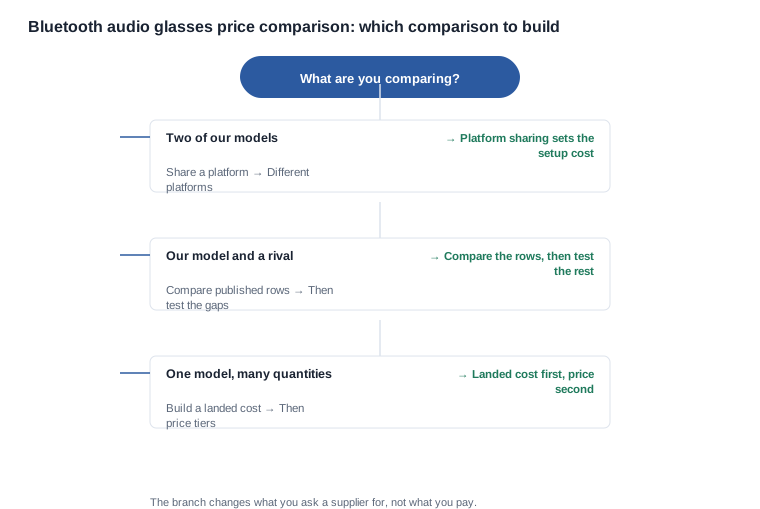
Comparing two models from this range is a platform question, and the answer is that a model sharing a platform with an existing product in your range is materially cheaper to add than one that does not. The setup is amortised, the accessory chain is shared, the documentation file is shared and the artwork is shared. Which model to pick is therefore decided by platform first, and by the published rows second.
Comparing a model against a rival's product is a specification question, and the published rows are too thin to carry it alone. The method that works is to compare the published rows where they exist and to test the gaps yourself on samples, because the gaps are where a competitor's product will usually differ from the published description. The rows worth testing are the ones a customer would notice: the leakage, the call behaviour in noise and the frame weight.
Comparing one model across quantities is a landed-cost question, and it should be answered before the order rather than inferred from the quotation. The cost of the accessory chain and the parcel is largely fixed per unit and falls in the commercial terms, while the platform setup falls with volume, and the documentation cost is per model and per market and does not fall at all. Which quantity a buyer should commit to depends on which of those three the range is most sensitive to, and in this category it is usually the documentation layer rather than the unit price.
What the four branches have in common
Every one of the four branches is a question about structure rather than about price, and that is the single most useful thing a buyer can take from this category. A quotation tells you what a supplier charges for one configuration at one quantity. The structure tells you what that configuration will cost across a range, across a channel and across a year. Which comparison to build is a question about structure, and the structure is the part that stays fixed while the quotation moves.
The three questions a buyer asks when a supplier pushes back
A comparison built on cost drivers invites resistance, and three objections come up often enough to be worth preparing for.
"The specification is the same across the range, so the price should be too." In this category the published rows are the same in kind but not in value: three platforms, two interfaces, three rated use figures and three feature lines. The right response is to name the platform the two models sit on and to ask what the setup is amortised over, because the unit price difference is usually the smaller of the two numbers.
"We can do that as an option." An option is a configuration, and a configuration carries a minimum order quantity, an artwork run and a documentation file. The correct question is what the option costs in all three, because an option priced only by its unit price is not an option at all.
"The price is the price at this quantity." This is the fairest of the three and the easiest to handle: state the quantity in the comparison table, put the quotation against it, and check whether the structural costs change at a higher quantity. How to compare two quotations at different quantities is a question about where the breakpoints are, and in this category the breakpoint is usually in the setup amortisation rather than in the unit price.
None of the three objections requires a market figure to answer, which is the practical point of building a comparison this way.

What is not in the comparison and should not be
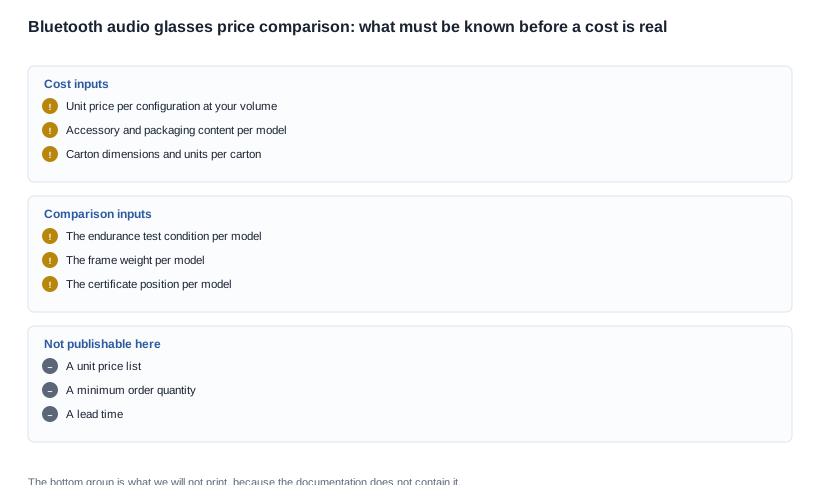
Frame weight, ingress ratings, the acoustic detail, the microphone specification, the endurance test conditions and the certificate numbers are all absent from the published data for this range, and each one of them belongs in the first list of questions rather than in the comparison table.
Two of those absences are worth a sentence each, because they are the ones that get filled in with an estimate. The endurance condition: the rated use figures here are published as about six, seven or eight hours with no condition attached, and two figures produced under different conditions are not comparable even when they are the same number. The certificate position: a model that cannot ship into a market is not comparable at any price, so the document position is a filter that runs before the comparison rather than a row inside it.
There is also a category of comparison that should never be built: a comparison against another supplier's published specification sheet presented as if it were a product test. A datasheet is a claim, and a claim cannot be compared with a measurement. It can be compared with another claim, and that comparison tells you how the two suppliers talk about their products — which is useful information about the market, and not useful information about the product.
A worked example: comparing two ranges for a wholesale channel
This is a worked case rather than a customer case. It shows how decisions fall.
Assume a wholesaler supplying electronics retailers who have asked for an open-ear audio frame at a price point they can promote. Two suppliers have quoted, and the quotations differ by less than a tenth. The wholesaler's commercial manager wants to pick on price and move on.
Step one, the structure. The wholesaler counts the accessory chains in each proposal. One has quoted a single interface across the whole range; the other has quoted two. That one fact, visible in two lines of the request for quotation, is worth more than the price gap, because the second range carries two accessory lines, two packaging specifications and a spare-parts plan the wholesaler has to fund for the life of the programme.
Step two, the platform count. The wholesaler maps each quoted range onto its platforms. One proposal is three models on two platforms; the other is three models on three platforms. The second one pays the setup three times for three models, which is the opposite of the dilution the wholesale model needs. The wholesaler does not know the setup figures — it was not quoted — and it asks for them as a separate line, because a unit price that excludes an unquoted setup is not a price.
Step three, the documentation layer. The wholesaler counts the document sets: three models into two destination markets is six, and it knows from its own experience that these run in parallel with production. It asks how long the programme takes to reach the point where the first units can ship, because a shorter schedule is worth more to a promotional channel than a small unit-price difference.
Step four, the gaps. The wholesaler establishes that neither proposal publishes a frame weight, a leakage figure or a microphone specification, and it writes the questions rather than the estimates. It also asks each supplier to confirm the rated use figure's condition, which neither has stated, so that the two ratings can be compared rather than merely lined up.
Step five, the comparison. The wholesaler builds the comparison as a table with a column for source, a quantity stated against every price, and the commercial terms kept separate from the unit price. It arrives at a decision that is not the cheapest quotation, and it can explain why in one page: the second quotation is cheaper per unit and more expensive in structure, and the structure is what the wholesaler carries.
The result is a decision made on structure rather than on price, from information that was available before the order rather than after it. No market figure and no estimated weight was involved.
The commercial figures we will not publish
We will not quote a unit price, a minimum order quantity or a lead time in any article, because our documentation does not contain them, and an estimate that turns into a quotation is worse than an open question. What we can do is set out the published rows, name the cost drivers, and tell you which questions have to be answered before a landed cost can be built.
There is a practical reason for the narrowness that is specific to this category. A price comparison built on a number nobody can trace is a number that changes the moment it matters. The buyer who has built a comparison out of published rows and cost drivers can re-run it when the quotation arrives, and the comparison holds. The buyer who has built a comparison out of a price list has nothing to re-run, because the list is the comparison. The commercial structure is in OEM ready pricing tiers, and the reason that conversation starts with a configuration and a market rather than a number is in OEM ready minimum order quantity.
Five things to establish before you can compare prices
- The landed cost per unit, by configuration, including the accessory chain and the freight class.
- Which models share a platform, and therefore share the accessory, the app and the documentation file.
- The frame weight for each model, which sets the parcel and the sizing story.
- The endurance test condition for each model, so the figures can be compared honestly.
- The document position for each model and each destination market, since a model that cannot ship is not comparable at any price.
The range is on our Bluetooth audio glasses collection page, and the platform structure is set out in which model to pick.
Related reading
- The platform structure behind the cost — which model to pick
- The accessory cost driver — Bluetooth audio glasses charging options
- The specification grid across the range — YK12 smart glasses how it compares
Send us the models, the volume and the destination, and we will tell you which platform to build the range around and which cost drivers dominate the landed cost.


