

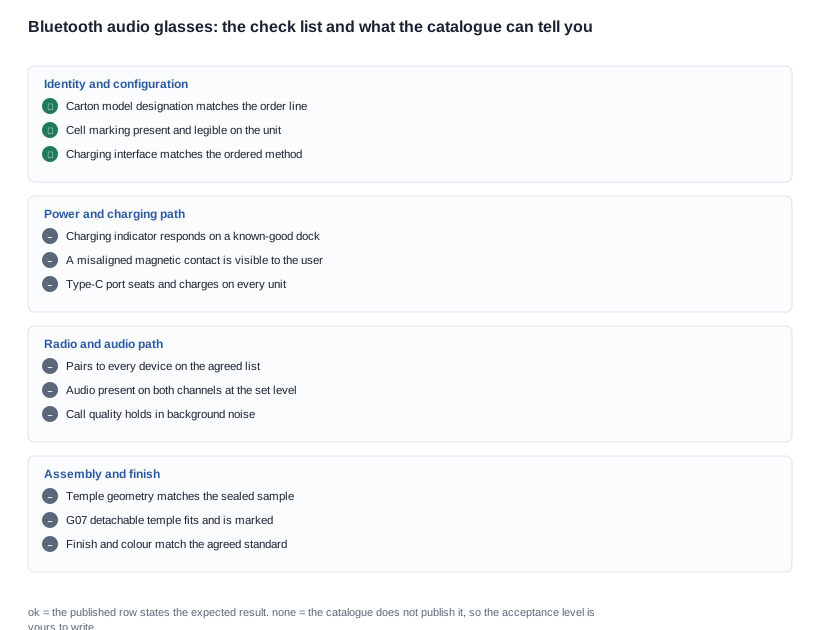
Every model in our Bluetooth audio glasses range publishes the same five rows — Bluetooth version, cell capacity, charge time, rated runtime and charging method — which means a quality check written against a specification sheet checks almost nothing. A frame can match its published row perfectly and still be wrong, because the published rows do not describe the things that fail. This article is the check list for the things that do.
And it is deliberately a list of measurements rather than of appearances, because in this category the recurring failures are functional and are invisible in a visual inspection.

Bluetooth audio glasses quality checks: the faults the datasheet never names
The decision this article is written to support
A buyer holding a signed quotation is not deciding whether the product is good. That decision was taken when the sample was approved, and it was taken on the evidence available at that moment, which in this category is five electrical rows. The decision that arrives later, in a warehouse or on a distribution centre dock, is a different one: is this lot the same thing as the approved sample, and if it is not, what happens next.
That distinction is worth writing down explicitly, because it determines the entire shape of the inspection plan. "Is the product good?" is answered once, by a sample, at low cost. "Is this lot identical to the approved sample?" is answered on every lot, by a procedure, at a cost per lot, with a written rule attached to the result. A buyer who has not separated those two questions tends to buy a one-time sample approval and then discovers, at the first production delivery, that no procedure exists at all.
Either way, the plan is a how-to-evaluate exercise rather than a list of observations: every check needs a pass condition, a sampling level, and a stated action when the condition is not met. A check without a pass condition is a note in a report, and a note in a report is not a control.
The second question is also the one that a supplier's quality system is actually built to answer, which is why the requests in this article are addressed to the factory rather than to the catalogue.
What the range publishes, and why that is the wrong place to start a check
The Bluetooth audio glasses family is eight models: the K02 and the D12, the G07 and the YK12, the LC-105-1 and the K01, and the D11 and the LC-105-2. Every one of them publishes a Bluetooth version, a cell capacity, a charge time, a rated runtime and a charging method. Six of the eight publish a Bluetooth version of V5.4; the K01 and the K02 publish V5.3. Six charge magnetically; the D11 and the D12 charge over Type-C. The published capacities are 55mAh2 on the LC-105 pair, the G07 and the YK12; 90mAh2 on the K01 and the K02; and a single 100mAh cell on the D11 and the D12. The published runtimes are approximately eight hours on the K01, the K02 and the LC-105 pair, approximately seven hours on the D11 and the D12, and approximately six hours on the G07 and the YK12. The published charge time is two hours or less on all eight.
That is a complete description of the electrical configuration and an empty description of the product. There is no published frame weight for any of the eight, no packed unit weight, no charging-case capacity, no driver size, no frequency response, no microphone count, no leakage figure, no ingress rating, no colour option list, no box contents, no defect rate, and no certificate number. The one frame weight published anywhere in our catalogue, 158 g, belongs to the MT6 camera model and is explicitly stated as the glasses unit excluding its foldable charging case — a different product in a different family, and not a usable proxy for an audio frame.
A quality plan built on those published rows would confirm the cell capacity, the radio generation, the charge time, the runtime and the interface. It would catch a unit from the wrong model and a unit with the wrong cell. It would catch nothing else, because every one of the five rows is a configuration statement, and every one of them is satisfied by a unit that is also dead, deaf, silent, cracked or misshapen.
Who is reading this, and what they are carrying
Three buyers land on this material with different problems.
A brand owner's quality engineer is usually holding a sample approval and a supplier's incoming inspection report, and needs to know whether that report is worth accepting. The question is usually about sampling: what was checked, on how many units, against what standard, with what disposition rule.
A procurement manager is usually holding two quotations that look similar and needs to know why the inspection cost differs between them. Inspection effort is one of the few lines on a quotation that is not a unit price, and it is frequently buried inside a delivery charge or a quality assurance fee.
A channel buyer is usually holding a landed cost model and a return rate assumption, and needs to know which defect families generate returns in this category, because a return rate is a per-unit cost that sits below the gross margin line where nobody looks.
All three are working on the same underlying problem, which is that the published data is thin enough that the only reliable way to know what you are getting is to test it. The questions to ask, in priority order, are the same in all three cases: what will be tested, on how many units, against what reference, and what happens to a lot that fails.

What an eight-model audio programme costs when inspection is written from the specification
Two quotations for the same product, and where the difference actually lives
The first thing to understand about this family is that the published rows barely differentiate it. The K01 and the K02 publish the same five rows. The D11 and the D12 publish the same five rows. The LC-105-1 and the LC-105-2 publish the same five rows. The G07 and the YK12 publish the same electrical rows and differ only in a temple description.
Two consequences follow, and both are commercial rather than technical.
First, a buyer comparing quotations cannot use the published rows to justify the price difference, because the rows are identical. The difference has to be established somewhere else, and in practice it lives in the cells and their suppliers, the drivers and their suppliers, the microphones, the enclosure material, the certification scope, the packaging specification, the warranty terms, the lead time, and the inspection regime the factory is actually running. Each of those is a legitimate line of differentiation, and each of them has to be named in the quotation or the comparison has no basis.
Second, a buyer building a range for a channel has to decide how many distinct SKUs the eight models can really support. On the published evidence, six of them publish no distinguishing feature at all. A range plan built on eight differentiated listings is a range plan that will collapse at the artwork stage, when someone has to write what makes the third 55mAh*2 model different from the fourth.
Where the money sits in a shipped audio frame
An open-ear audio frame is a light object, and that is the whole commercial problem in one sentence. The device inside the product — the cell, the radio, the amplifier, the drivers, the microphones, the battery management — is a small fraction of the value. The packaging, the accessory, the documentation and the freight are a large fraction of it.
The freight consequence is structural rather than incidental. Carriers bill the greater of actual weight and volumetric weight, and a small product in a large box is a shipping bill that has nothing to do with the product. A frame that is heavier than its packaging has a problem on the pallet; a frame that is lighter than its packaging has a problem in the carton design. Neither is visible in the published rows.
There is a second cost that a light product hides, and it is the one that actually decides the inspection budget. The value of a unit is low, so the value of catching a defect late is also low — which is exactly the condition under which a supplier stops inspecting and starts shipping. The inspection regime is therefore not a service the supplier provides; it is a condition the buyer has to write into the purchase order and pay for.
The vocabulary problem, and why it costs buyers money
One more structural fact about this catalogue is worth putting in front of a procurement team, because it explains why comparison tables built in a hurry go wrong.
The eight audio models do not use a single set of row labels. The K01 and the K02 pages label the runtime as 使用时长 and the charge time as 充电时间, with the charging method as 充电方式. The D11 and the D12 pages use 使用时长 for the runtime and 充电时长 for the charge time, and they label the cell as 电磁容量 where the other pages label it 电池容量. The LC-105 pair, the G07 and the YK12 use 续航 for the runtime, 充电时长 for the charge time and 充电模式 for the charging method.
This is a fact about how the documentation is written, not a criticism of the product. But it has a direct operational consequence: any comparison sheet that is assembled by keying on labels will either miss rows or map them to the wrong field, and a buyer who has spent a week building that sheet will produce a table with a column of blanks and a cell capacity that is not a cell capacity. The same applies to any specification extractor you build, including a simple spreadsheet, and the consequence of getting it wrong is a range comparison that cannot be defended in a review.
The remedy is unglamorous: transcribe the eight rows by hand, from the pages, and keep the catalogue's own wording. There are eight models and five rows each. It is an afternoon's work and it removes a class of error that no inspection will ever catch.
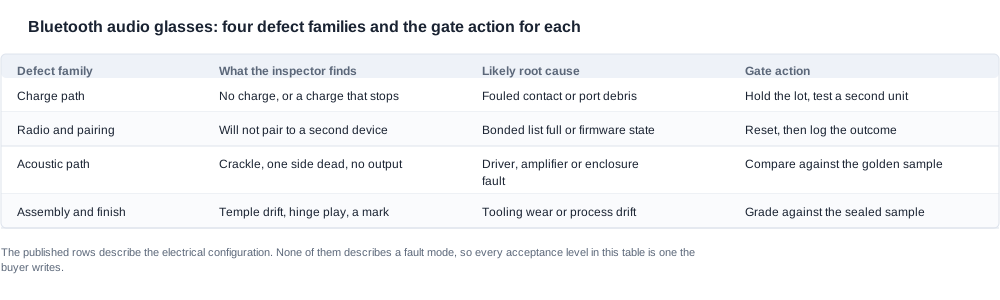
The four defect families that carry the volume in an open-ear programme
One: the charge path, and the two different charging interfaces
The magnetically charging models are the G07 and the K02, the K01 and the LC-105-2, and the LC-105-1 and the YK12. The Type-C models are the D11 and the D12. The failure modes are different in kind, which is why one inspection routine cannot cover both.
A magnetic contact fails in ways that are close to invisible. A frame that has been in a warehouse against a steel shelf picks up debris. A frame that has been in a case picks up a partial alignment. A dock that is not seated produces a frame that appears dead. The customer experiences all three as the same symptom — it does not charge — and the unit comes back. The test that catches this is the deliberate misalignment test: seat the frame, confirm the indicator responds, then displace it by a few millimetres and confirm that the indicator still shows the customer what is happening. It costs seconds per unit and it is the single most valuable check in this category.
A Type-C port fails differently. Lint in the receptacle presents as a unit that will not charge, and a cable that seats properly in the factory presents as a dead unit in a customer's house when they use a different cable. The test here is not the port but the cable tolerance: a defined set of cables, and a defined pass on all of them.
The published charge time of two hours or less is a ceiling, not a typical figure, and it comes without a starting state, a termination criterion or a temperature condition. Two hours or less is what the catalogue says; it is not a statement that a unit charges in two hours, and it certainly does not describe how long the frame is unavailable during a shift. The check for a buyer is therefore not the charge time — it is whether the unit charges at all, and whether a flat unit recovers, which is a protection-circuit behaviour that is not published for any model in this family.
Two: the radio path, and why a protocol generation is not a product identity
The K01 and the K02 publish Bluetooth V5.3. The other six publish V5.4. That is a protocol generation, and a generation number is a weak product identifier: it tells you the radio follows a specification, not which radio is fitted or what behaviour you get.
The published rows say nothing about firmware version, about how many devices the frame can hold at once, about what happens on a re-connect after a phone change, about whether updates can reach a unit already in the field, or about a documented reset sequence. Each of those is a support cost, and the reset sequence in particular is the first thing a support team needs and the last thing a catalogue mentions. A reset procedure that is not documented is a procedure your distributor will invent, and the invention will differ between agents.
A frame that will not associate with a second device looks exactly like a frame with a failed radio. The unit-level test that separates them is simple and belongs in the 100 per cent column: associate with a known-good device, remove the device, associate again with a second known-good device, and confirm the unit returns to a usable state. Do it once per lot on a defined device list, because the behaviour of a radio implementation often depends on the phone operating system rather than on the frame.
Three: the acoustic path, where every published row is silent
Nothing about the sound path of these eight models is published. There is no driver size, no frequency response, no microphone count, no noise-handling description, no leakage figure, no output level and no pickup distance.
That silence is why a specification-based check is worthless here, and why the check that protects the channel is a comparison against an approved unit rather than an absolute measurement. A unit with a cracked driver, a partially detached enclosure, a mis-seated amplifier or a blocked microphone port can pass every published row, associate normally, and be returned by a customer within a week. An absolute measurement against a published figure would catch it if the figure existed; a relative measurement against a sealed golden sample catches it without needing the figure.
The two tests that matter are a sustained audio output check on both channels with the unit in motion, and a two-person call test in background noise rather than in a quiet room. Call quality in noise is the claim most likely to be tested by an end customer and least likely to be captured by a specification sheet. The microphone testing notes cover what to listen for.
Four: assembly, finish, and the removable temple
This family is where the visual inspection earns its place, but only against a physical standard rather than a description.
The G07 publishes an ultra-slim detachable temple. That single row creates an extra inspection obligation and an extra service question. A detachable temple is a variant, and variants multiply inspection: each removable part is a swap opportunity, a tolerance stack, and a question about whether the end user can replace one or whether only the factory can. An interchange tolerance that is not stated will be discovered in the field.
The other mechanical checks are the standard ones and they still have to be written down: temple geometry and symmetry, hinge play and hinge alignment, the seating of the audio module relative to the temple, the finish and colour against an agreed standard, the alignment of the lens to the frame, and the drop behaviour of the retail pack. The standard has to be a sealed unit, not a photograph and not a written description, because a photograph does not carry the three-dimensional judgement that a limit sample carries.
A fifth family that is not a defect family: configuration drift
Configuration drift is not a manufacturing fault. It is the risk that the unit in the warehouse is not the configuration that was approved — a different radio revision, a different cell lot, a different firmware, a different accessory, a different packaging revision. It is invisible to a visual check and it is not caught by a published-row comparison, because the published rows are the same for six of the eight models.
The control is a version and configuration record: which radio generation, which cell configuration, which charging interface, which firmware, which accessory set and which packaging revision is in the unit, recorded against the serial reference. Without it, a quality question three months after launch cannot be answered, because the unit in the field may not be the unit that was approved. The battery specification guidance covers the part of that record that concerns how the runtime figure was produced.

Sequencing the inspection so each fault is found once, and only once
Stage one: unit level, on every unit, on two checks only
Not every check can run on every unit, and a plan that says otherwise is a plan that gets abandoned in week three. The two checks that justify 100 per cent coverage are the charge path and the association path, for a specific reason: both are cheap in seconds, both are functional rather than judgemental, and both fail in a way that is invisible to a visual inspection and expensive to discover in the field.
Everything else belongs in the sampled column, and what determines the sample size is not the cost of the test but the cost of the escape. A test that takes forty seconds and a defect that generates a return should be sampled at a low rate; a test that takes ten seconds and a defect that generates a return should be at 100 per cent. That is a commercial decision, and it belongs in the purchase order, in writing, with a number attached.
The unit-level stage also has to produce a record, not just a result. A serial reference, a date, a pass or fail, and the identity of the unit. Without a serial reference a defect rate is a feeling, and without a date a trend is a guess.
Stage two: in process, against the sealed sample
These are the checks that run while the lot is being built, and they are the ones that determine whether the finished lot matches the approved sample.
The cosmetic and dimensional comparison against the sealed golden sample comes first, because it is the cheapest check and it catches the most expensive rejections. A cosmetic mismatch found at final inspection is a rework; the same mismatch found at the customer's warehouse is a return, and the return is a cost your channel sees and you do not.
The functional sub-set runs at a defined rate: charge, association, indicator, the control behaviour, and a call test. The rate is a commercial decision and it should be set against the cost of a field failure rather than against the cost of the test. The acoustic comparison against the golden sample is the measurement that is most often skipped and most worth doing: a fixed source, a fixed distance, a fixed volume setting, compared to the approved unit. It is the only way to catch a unit with a driver, an amplifier or an enclosure fault that is otherwise perfectly functional.
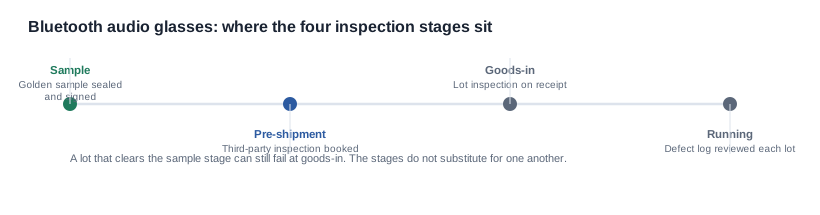
Stage three: batch acceptance, and the records that have to survive it
Four rows decide whether a lot is accepted, and a buyer has to keep all four.
The traceability record: the marking on the unit has to match the marking on the paperwork, because a recall or a quality claim is resolved by tracing units back to a lot. The conformity documents matched to the configuration that shipped: no certificate numbers, issuing bodies, validity periods or covered model schedules are published for these models, so this is where a buyer either receives the documents or records the gap, and a recorded gap is worth more than an assumed coverage. The quantity, accessories and packaging: the dock, the cable where the configuration includes one, the documentation, the carton count and the carton dimensions, because the carton data drives the freight cost per unit and a light product in an over-sized carton is a quiet margin leak. And the version and configuration record described above.

Five ways an audio inspection programme fails, and the lines that carry the risk
The five failure patterns, each with its early warning
The limit sample drifts, because it was defined by photograph. The symptom is a rising cosmetic rejection rate that nobody can explain, because the standard is a picture and the picture does not carry a three-dimensional judgement. The root cause is that the limit sample was agreed as a description rather than as a sealed unit. The prevention is a signed, sealed physical unit with a version number, referenced by the purchase order.
The charge test was run with the supplier's cable, and the customer uses a different one. The symptom is a cluster of returns concentrated on the Type-C models — the D11 and the D12 — from customers who charged the frame with a cable that was not in the box. The root cause is that the test used the convenient cable rather than the defined set. The prevention is a cable list in the purchase order, with the pass condition written against it.
The sample was inspected and the production lot was not. The symptom is a first production delivery with a defect pattern that has no precedent in the sample stage. The root cause is that the inspection plan was written as a sample-stage activity. The prevention is to make the goods-in stage a named gate in the quality agreement, with a named owner at the factory.
The defect rate was measured and the disposition rule was not written. The symptom is a failed lot that ships anyway, because nobody had decided what happens when the rate is exceeded. The root cause is that the acceptance level and the consequence were treated as separate questions. The prevention is one sentence in the purchase order: a sampling level, and the action taken when it is exceeded.
The removable temple on the G07 was counted as a variant rather than as a component. The symptom is a field replacement request for a temple that the factory will not supply. The root cause is that the interchange question was never asked. The prevention is to ask, in writing, whether the temple is user-replaceable, what the adjustment range is, and how a replacement is ordered.
What the inspection regime is worth, and what it can be traded for
The inspection effort is a real cost and it is worth spending the negotiating capital on, because it is the one line on a quotation that changes the quality of what you receive rather than the price of what you receive. The trade-offs are worth naming before the negotiation starts, because the total cost of a quality programme is not the inspection line on the quotation — it is that line plus the cost of the escapes you chose to accept. The negotiable items are specific: the number of days a third-party inspector is on site, the booking window for a pre-shipment inspection, whether the pre-shipment inspection is a stated cost or absorbed into the unit price, the packaging specification, the rework labour for cosmetic non-conformities, delivery splitting against an inspection result, payment nodes tied to an accepted lot, the warranty period with a stated response time, the sample order quantity, the spare-parts minimums for docks and cables, the sampling level itself, the defect classification scheme, and the right to re-inspect a lot that failed.
The items that do not move are worth naming, because a buyer who spends a quarter arguing about them has wasted the quarter. The test method, once it is agreed, is agreed — changing it mid-programme invalidates the history without improving the product. The acceptance level, once it is agreed, is agreed. The cost of a re-inspection after a failure follows from the process rather than from the negotiation, and it is the price of the right you asked for. Certification cost and certification time follow the process and the testing body, and pressing on either produces a longer schedule rather than a shorter one. Tooling is a one-off that is usually amortised across the first order, so the useful questions are over what volume it is amortised across and what happens to it if the programme is discontinued.
The documents to request before the first inspection are short: the golden sample protocol and the version number of the sealed unit; the defect class definitions with reference photographs; the sampling level and the disposition rule; the unit serialisation method; the version and configuration record; the accessory and packaging specification; the certificate schedule matched to the shipped configuration, or a written statement that none exists; and the rework and return route with the turnaround. They are also the checklist against which a supplier's quality system can be judged before you order — a factory that has a written golden sample protocol and a disposition rule is a factory whose red flags reach you as a number, and a factory that does not will reach you as a story.
A hypothetical goods-in plan, and the boundary of our own published data
The plan, step by step
This is a constructed scenario, not a client project, and it is written to show the order of the decisions rather than to report an outcome.
Assume a brand-side buyer who has approved two models from the audio family — one magnetically charging model from the 55mAh*2 group and one Type-C model from the 100mAh group — for a single destination market, and who is placing a first production order.
The decision that comes first is not the inspection plan; it is the size of the range. Two models means two accessory chains only if the interfaces differ, and here they do: one dock, one cable. That is a real cost and it is cheaper than eight models across both interfaces.
The second decision is which two checks get 100 per cent coverage. Charge path and association path, for the reasons set out above. Both are seconds per unit and both fail silently.
The third decision is the sampling level for the remainder, set against the cost of the escape rather than the cost of the test. The cosmetic comparison against the sealed sample, the acoustic comparison against the sealed sample, and the two-person call test in noise are the sampled column, and the level is written into the purchase order with the action that follows a failure.
The fourth decision is the record set. Serial reference, date, result, unit identity, and the version and configuration record. The buyer's team agrees on this before the first shipment rather than after the first dispute, and the configuration record is what makes a later question answerable at all.
The fifth decision is the documentation position. The buyer asks for the certificate schedule for the shipped configuration and receives a written statement that no per-model certificate schedule exists. That statement is then attached to the file, and the buyer decides, with counsel, whether a family-level document is sufficient for the destination market. The record is what matters here: an assumed coverage that is never checked is the most expensive kind of gap, because it is invisible until it is tested.
What we publish, what we do not, and what we will do when you ask
We publish the five electrical rows and the model designations for the eight models in this family, and we would rather show you the five empty fields than eight plausible values.
We will confirm the published rows — the charge time of two hours or less, the cell configuration, the Bluetooth version, the rated runtime and the charging method — and we will tell you which of the checks set out above we can run directly and which are process questions for the factory. Our quality consistency guidance covers what to do when a production batch does not match the approved sample, and the sample evaluation piece covers the first-article stage.
We will not publish a frame weight, a packed unit weight, a charging-case capacity, a driver size, a frequency response, a microphone count, a leakage figure or a certificate number, because none of them is published for these models. We will not present a rated runtime as a working day without the test condition behind it, and we will not publish prices, minimum order quantities or lead times in an article. We will not describe any model in this family as the lightest, the most durable or the best, because the evidence for those comparisons does not exist in our documentation.
The open-ear supplier question list sets out the questions worth sending before the first sample order, and the family is on our Bluetooth audio glasses range page.
Three things to send before the next supplier call
Send the model list and the volume in one message. The range is small enough to specify in a single document, and a buyer who asks in three rounds gets three partial answers.
Send the four questions that decide the inspection plan before the quotation is discussed. Which two checks are run on every unit; what the sealed golden sample is and how it is versioned; what the defect classes are and what happens when the sampling level is exceeded; and what the document set is for the shipped configuration.
Send the destination market and the channel. The accessory chain, the packaging specification and the inspection effort all follow from those three inputs, and they are the three inputs that decide whether the inspection cost is worth the programme.
Related reading
- How a runtime figure should be read — battery life
- What to ask a supplier before you order — open-ear supplier questions
- What to do when a batch does not match the sample — quality consistency
Tell us the models, the volume, the channel and the target markets, and we will come back with what is published and which checks we can own.


