

Smart glasses microphone quality: compare with a script
A microphone test that starts in a quiet room tells you almost nothing about a product that will be used on a street. The comparison worth running walks outward from the quiet room to the real call to the street, and the reason for the order is that each position tells you which of the earlier ones you can trust. The position you skip is the position your customer will complain from, and the result you publish will be the one you recorded, not the one you hoped for.
There is a second decision inside this one, and it is commercial rather than acoustic. A buyer comparing two candidates for a call-driven product is not deciding which microphone is better. They are deciding whether the difference they are about to observe is worth the money it will take to change the product they have already tooled for. A comparison that produces a ranking and no consequence is an afternoon wasted; a comparison that produces a ranked list with a threshold attached to each row is the document that justifies the second purchase order.
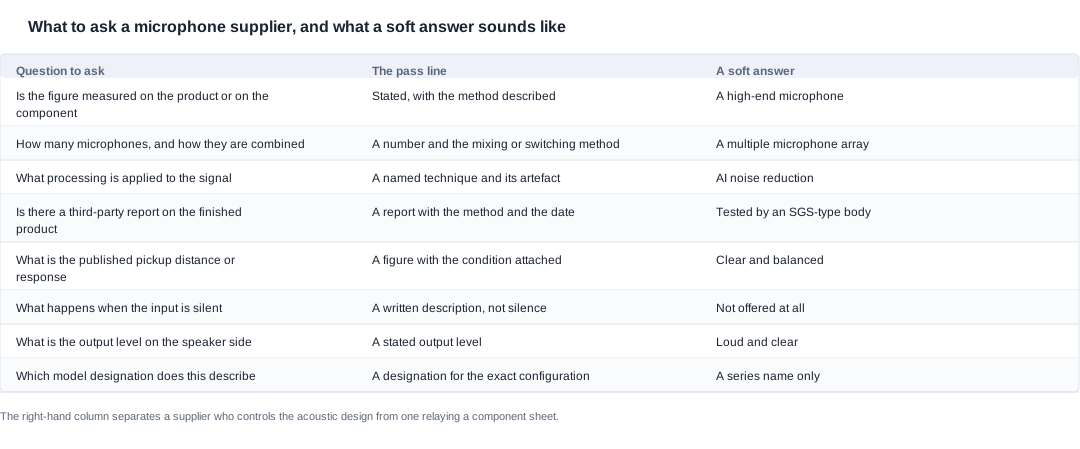
The Bluetooth audio family publishes its technique, and with it the company's stated capability in directional audio and smart noise reduction, while no model in it publishes a microphone specification: no pickup distance, no noise figure, no frequency response, no microphone count, and no third-party report behind any of them. That absence is the reason this article exists. When the specification is missing, the protocol is the substitute, and the protocol has to be written before the samples arrive rather than after the disagreement.
What the buyer already holds, and what is missing from it
A buyer running this sequence is usually choosing between two candidate models for a product that will be used for calls, and holds samples, a customer profile, a target price and a supplier's catalogue entry. What they will not hold is any acoustic data at all, and the reason is structural rather than careless: the acoustic data is generated by the module maker, and the assembly factory usually receives it as a component specification rather than as a finished-product result. The gap is not the buyer's fault and it is not the factory's fault either, but somebody has to close it before a purchase order goes out.
The demo prior is the main risk inside the process. Demonstrations are run in good conditions, by the person who built the product, at a favourable distance, with a familiar phrase, at a volume the demonstrator chose. Every one of those is a variable, and the combination almost always flatters one product — usually the one whose processing is tuned to survive the specific conditions in which it is being shown.
Two things make a comparison reproducible, and both are cheap. The first is a fixed script, because improvised speech changes the content and the content changes intelligibility. The second is a matched output level, because a louder product sounds clearer whether or not it is, and this single omission invalidates more comparisons than any other error in the sequence.
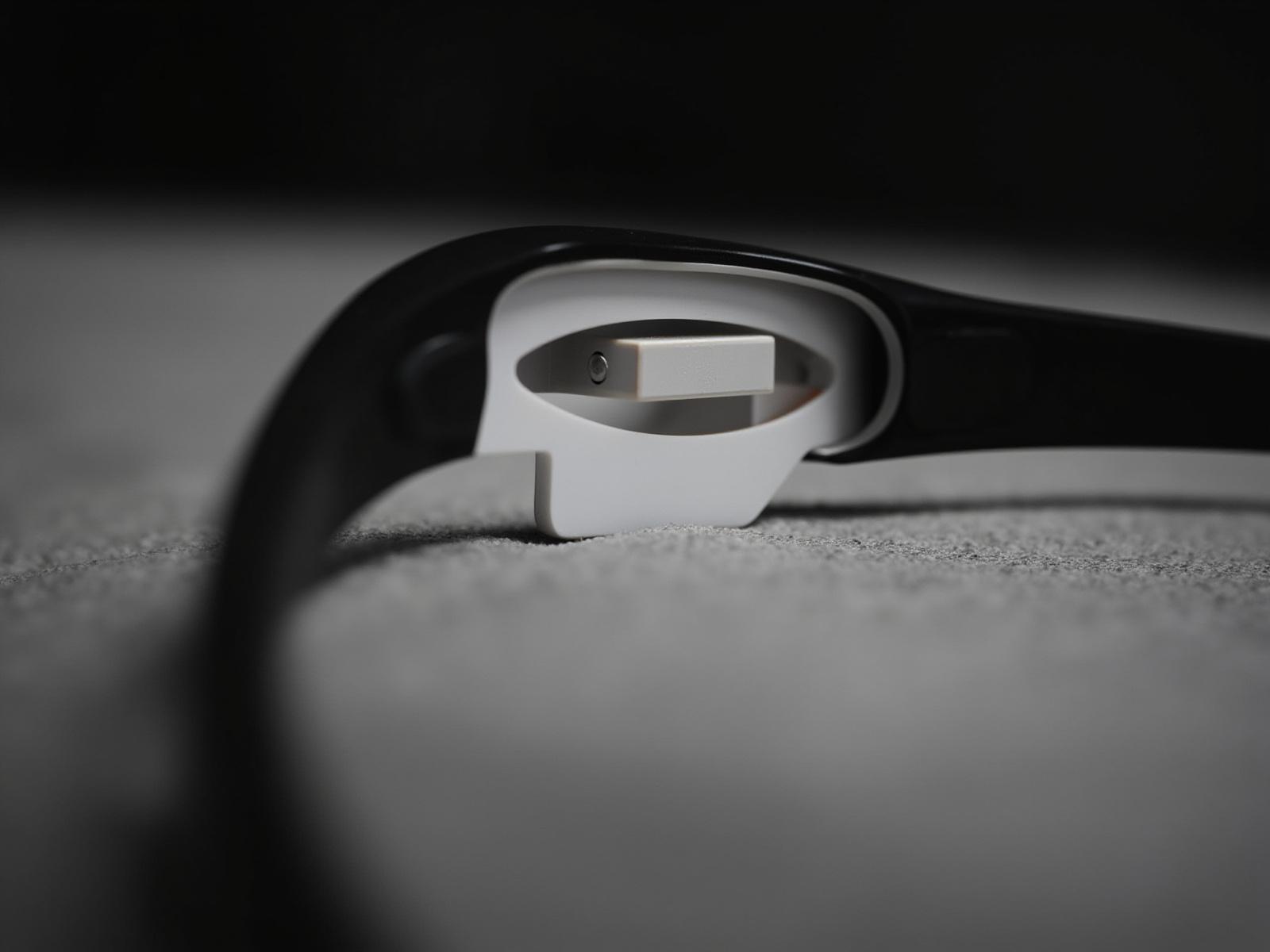
The question list that separates a designer from a component relay
Ask these in writing before the samples are tested, and separate the two lists into two columns before you send them. The right-hand column below is the one that matters: it is where a supplier who controls the acoustic design answers and where a supplier relaying a component sheet does not.
Is the figure measured on the product or on the component. A component datasheet describes a microphone in a test fixture, at a fixed distance, with a fixed input. What the customer buys adds the frame geometry, the sealing, the wind handling, the port position against the mouth, and the processing the firmware applies on top. The two are not comparable, and the second is the one your customer buys.
How many microphones there are, and how they are combined. A number plus a method — whether they are mixed, switched, or beamformed — is a usable answer. A phrase such as "multiple microphone array" is a category, not a specification, and a category cannot be tested against a threshold.
What processing is applied to the signal. Every processing stage has an artefact: gating between words, pumping on sustained syllables, a thin or breathy quality on vowels, the sense that something has been removed from the voice. Naming the technique and describing the artefact is more useful than claiming the technology removes noise, because the first can be tested and the second can only be repeated in a listing without any evidence behind it.
Whether a third-party report exists on the finished product. The pass line is a report with a method and a date. "Tested by an SGS-type body" is a description of a category of testing, and it is not a document that anyone can resolve later.
What is published about pickup distance or response. The pass line is a figure with the condition attached. "Clear and balanced" describes a preference, and preferences do not survive a comparison.
What happens when the input is silent. This is the question nobody asks and it is the one that exposes processing behaviour. A written description of the idle state is a sign the supplier has characterised the product. Not offering it at all is information too.
What the output level is on the speaker side. The microphone is half the conversation. An excellent microphone combined with a quiet speaker makes a product for a quiet room, whatever the microphone can do on its own.
Which model designation the answer describes. A published designation for the exact configuration is the pass line. A series name is not, because a series contains at least one configuration that behaves differently.
Thresholds written in the vocabulary of a phone call
| Row in the scorecard | How it is measured | Threshold for a call-driven product | A result that fails |
|---|---|---|---|
| Speech at three metres | Fixed script from a speaker at three metres | Understood on first hearing, no repeat requested | The far end asks for a repeat |
| Speech at one metre | Same script, same level | Understood on first hearing | Not usually a failure point |
| Real call | A live call, scored by the far end | The far end reports the call as clear, unprompted | The far end says "you are a bit quiet" or "what?" |
| Street noise | Recorded caller at a fixed distance, noise level held constant | The words remain separable from the noise | The caller has to move out of the wind to be heard |
| Wind | Airflow across the front of the glasses, condition recorded | No low-frequency roar over the speech | The caller reports a crackle or a rumble |
| Processing artefacts | Listening pass with no score attached | No gating, no pumping, no thin tone | A clean clarity score on a lifeless signal |
| Output level | Matched before the first recording | Matched, and the setting recorded | Any comparison made without a match |
Two rows in that table are the ones that predict a returns trend rather than a review score. The real call row, because it is the only one where the customer experiences the product, and the artefact row, because a clarity score systematically rewards a signal that has been processed until it is thin. If your scorecard has a clarity column and no artefact column, the scorecard will systematically prefer the worse product.
Five positions from the quiet room to a windy street
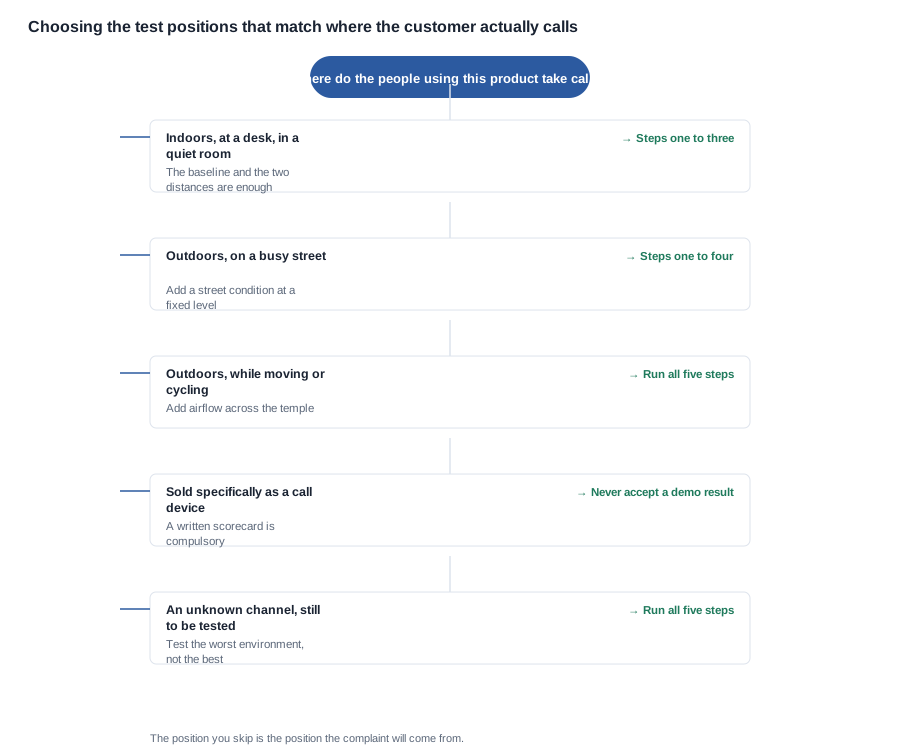
The verification path has five positions, and each assumes the one before it passed. A failure at any position tells you what the next position would have told you, which is why the order matters and why a protocol that starts at position four is not a protocol.
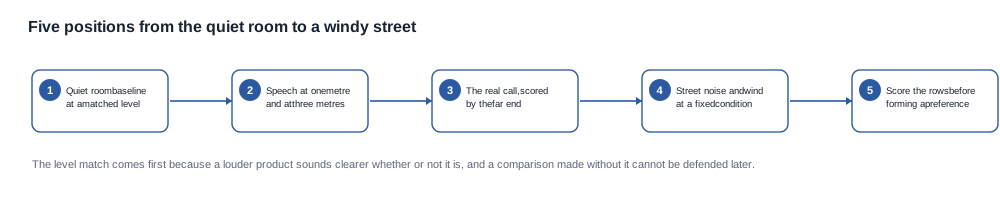
Position one, the quiet-room baseline. Same script, same distance, same presenter, in a quiet room, at a matched output level. This is the reference against which the other four are read, and if the level match is wrong here then every later position is wrong as well, which is why the match comes before the recording rather than after it.
Position two, speech at one metre and at three metres. Play a fixed passage from a speaker at one metre and then at three. One metre passes on almost anything, which makes it a control rather than a test. Three metres is roughly conversational distance on a real call, and it is where sensitivity differences appear. Use fixed source material with an even level and known content — a news bulletin is ideal — rather than improvised speech, because improvised speech varies in syllable density and the variation will be read as a product difference.
Position three, the real call. Make the call. Have the far end score intelligibility, because intelligibility is what the customer experiences and volume is not. The far end should not know which product they are scoring, and should score without seeing the screen, since a person who can see a model name will forgive more. This is the position that answers the question the product is bought for.
Position four, street noise and wind. Record a caller at a fixed distance with background noise at a fixed level, and hold the noise type constant — traffic noise at a stated level is not the same test as a crowd, and switching between them mid-sequence makes the results incomparable. Then test wind, with the airflow condition stated in writing, because a temple-mounted transducer sits directly in the airflow. Wind noise is low-frequency, which is the range that basic filtering handles worst, and it is the condition most often left unstated because it is hard to reproduce. A paper strip moved at a stated distance in front of the temples is crude, reproducible and good enough for ranking.
Position five, the scorecard. Score before you form a preference and decide afterwards. Two people should score independently, and any row they disagree on is the row to re-test — it is almost always the row that predicts returns, because disagreement concentrates where the difference is marginal, and marginal differences are where customer thresholds sit.
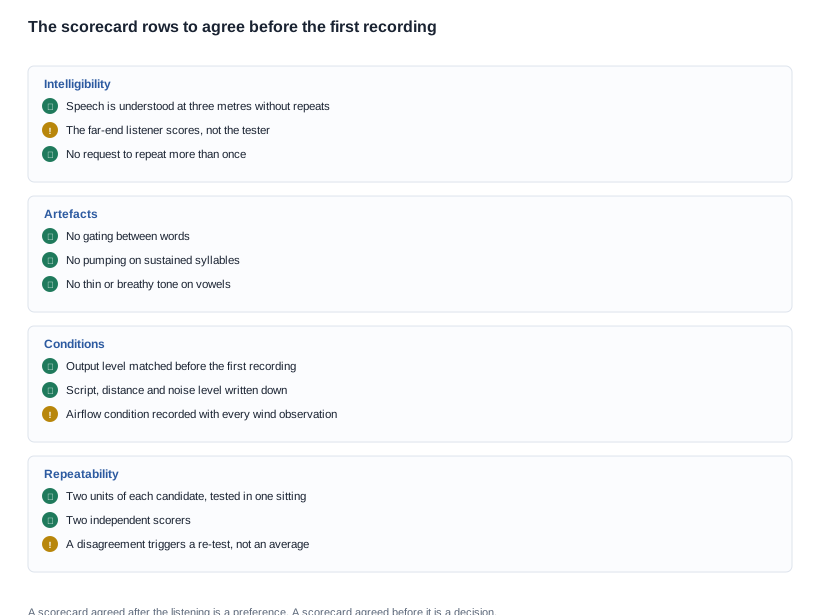
Test two units of each candidate, in the same sitting. A single unit can be atypical, and two units also tell you whether the products are consistent, which is a production question rather than a product question. If the two units of the same model score differently, you have a manufacturing consistency problem to raise with the supplier, and it is much cheaper to raise it on two sample units than on a production batch.
Write the script before the first recording and keep it with the recordings. The script, the distance, the noise level, the airflow condition, the matched output setting, the two scorers and their raw scores. When a customer complains six months later, this document is what turns an argument into a re-test.

The six ways a call-quality programme is decided wrongly
The louder product wins, and the louder product is not the better one. The symptom is a ranking that reverses when a second buyer runs the same test. The root cause is that the level match was skipped, so the comparison measured output power rather than transmission quality. The prevention is to match the output level before the first recording and to record which setting produced it, because the setting means nothing across two different products.
A comparison is won at one metre and lost at three. The symptom is a supplier quoting the one-metre result in a proposal while a customer reports that they cannot be heard. The root cause is that only the easiest distance was tested, which is the one that passes on almost any hardware. The prevention is to run both distances in the protocol and to treat the three-metre result as the one that predicts a call.
The product is fine indoors and unusable on a street. The symptom is a good review score from an office-based test panel and a poor one from the actual channel, which usually arrives as a review-platform pattern rather than as a returns pattern. The root cause is that the noise condition was never part of the protocol, because the buyer's own environment was indoors. The prevention is to build the street condition into the protocol before the samples arrive and to hold the noise type constant throughout.
Wind noise appears only outdoors and the supplier calls it normal. The symptom is a remark in a supplier call that wind handling is normal for this form factor, which is true and is also the whole problem. The root cause is that the airflow condition was never stated, so the result cannot be compared with anything at all. The prevention is to record the airflow condition with every wind observation and to refuse to compare two wind results unless both carry one.
Noise processing removes part of the speech and nobody notices. The symptom is a product that scores well on clarity and is described by users as robotic, flat or quiet. The root cause is that the test scored clarity only, and clarity scores do not capture a lifeless signal. The prevention is to listen for artefacts explicitly and to treat a gating artefact as a failure regardless of the clarity score.
The comparison was done once and never repeated. The symptom is a product that is fine in the sample and inconsistent in production, which arrives as an unexplained return drift. The root cause is that a single sample session was treated as a production control, which it is not. The prevention is to agree a production-side control at the same time as the sample comparison: a reference unit, a defined test frequency, and a third-party report on the finished product if the programme is long enough to justify one.
What a failed call costs, and what that sets the testing budget
The commercial question underneath an acoustic comparison is easy to lose sight of, and it determines the amount of effort the comparison deserves. A call that fails is not a return. It is a customer who stops using the feature, and a feature that stops being used is a feature that cannot be defended in the next renewal conversation. The cost lands in the retention curve rather than in the returns line, which is why it does not show up in the file the buyer is looking at when the decision is made.
That is the argument for spending on the test rather than on the sample fee. A comparison costs the buyer a day of one person's time and a small amount of travel or shipping, and it produces a ranked list with thresholds attached. The alternative is to skip the comparison, commit to a supplier on a demonstration, and find out in the field — at which point the costs are a supplier change request, a re-tooled enclosure if the port position has to move, a revised product page, and a channel conversation about a product that no longer does what the listing says.
Some of the commercial terms around a call-driven product are genuinely negotiable. Minimum order quantity is negotiable per model and per channel, and a two-model commitment is usually worth more to a supplier than a higher unit count on one. Packaging and insert design, including the market labels and the language of the documentation pack, is a low-cost negotiation that carries no tooling implication for an electronic product. Delivery splitting against a sample-approval milestone is often granted more easily than a price concession, and for a programme whose key variable is acoustic it is worth more than a price concession, because it lets the acoustic decision land before the artwork is locked. The payment terms are ordinary ground: an initial payment on order, a balance payable once the inspection is passed, and a holdback tied to the document set protects the buyer on the failure that costs most.
Other things are not negotiable and it is worth saying so early rather than discovering it late. Certification cost and certification lead time are not a commercial lever; the cost sits per product family and the elapsed time belongs to the test laboratory and its review queue. Tooling is normally a one-off cost amortised across the first order, so the questions worth asking are over what volume it is amortised and what happens to the tooling if the programme is discontinued. The firmware is also not negotiable in the way the unit price is: the microphone set, the digital signal processing tuning and the default processing state are part of the product, and a supplier who will not discuss them is telling you the acoustic behaviour is fixed and that your only lever is the enclosure.
Documents to request before the deposit. The microphone configuration in writing, with the count and the combining method. A written description of the processing and its expected artefacts. The third-party report reference with the method and the date, if one exists. The certificate numbers with the issuing body and the validity dates. The model designation written on the quotation rather than implied by a series name. The sample route itself is at sample evaluation.
Clauses to write into the contract. The model designation as a line item, with the certificate numbers attached. The acceptance criteria for the sample, referencing the five positions and the matched output level. A clause requiring notice before any change of microphone, digital signal processing tuning or firmware, because a firmware change alters the acoustic result without altering the hardware. A clause on who bears the cost when the sample does not meet the acceptance criteria.
A hypothetical voice-first line tested against a headset incumbent
What follows is a worked example rather than a client project, and it is here to show the order of the decisions rather than to describe a result.
Assume a brand entering a call-driven category with a first product line, competing against an established headset. The buyer has one supplier quoting a Bluetooth audio model, a target price band, and a channel that mixes a professional buyer and a casual caller. The binding constraint is that the brand's listing will be read by people who have a working alternative in their pocket, so a product that sounds worse than the incumbent is a product that does not get a second purchase.
Step one, the environment. The buyer writes down where the calls happen before writing anything else: a train platform, a street, an office. That resolves the test positions immediately, because a train platform and a street are not the same noise condition and a protocol that mixes them produces a result nobody can act on. The buyer also writes down what a failed call costs the programme, which is a feature that customers stop using, which is a retention problem rather than a returns problem.
Step two, the question list. The eight questions go to the supplier as a list. The answers separate the supplier cleanly. The microphone configuration comes back with a count and a combining method. The processing comes back with a named technique and, unusually, a description of its artefact. The third-party report reference comes back with a method and a date, and the number resolves in the issuer's register. The output level comes back as a figure. On that basis the buyer knows the supplier controls the acoustic design rather than relaying a component sheet, and the price comparison becomes a comparison between two designed products rather than between two datasheets.
Step three, the baseline and the two distances. The matched-level baseline is set first, and the buyer records the setting. At one metre both candidates perform acceptably and the test proves nothing, which is expected and is why it is a control. At three metres the candidates separate, and the separation is in the direction the supplier's answers predicted.
Step four, the live call. The live call is scored by the far end, who does not see the model name. One candidate returns a comment the buyer did not ask for, which is that the call was clear. That single unsolicited remark is worth more than a clarity score, and the buyer records it as an observation rather than converting it into a number.
Step five, street and wind. The street condition is recorded at a fixed noise level with the noise type held constant across both candidates. Here the separation is larger than at three metres, which is the finding that changes the decision: the difference between the two products is not a sensitivity difference in a quiet room, it is a noise-handling difference in the environment the product is actually bought for.
Step six, the artefact pass. The artefact pass is run separately from the scoring, and it finds a pumping artefact on one candidate that the clarity score had rated highest. This is the moment the ranking reverses, and it is the moment the buyer understands why the artefact column had to be in the scorecard before the listening rather than after it.
Step seven, the commercial structure. The buyer keeps the candidate with the better noise handling, negotiates the minimum order quantity across two models rather than one, splits the first delivery against the sample-approval milestone so the artwork decision follows the acoustic decision, and writes the notice clause for any firmware change so that a later processing update cannot silently move the result.
The result is a programme whose acoustic decision was made on a ranked table with thresholds, in one week, before the packaging was approved. The decisive step was not the listening. It was putting the artefact column in the scorecard before the listening started.
What we publish about microphones, and what we will not estimate
Here, a microphone comparison is worth doing only once, only with a script, and only with the variables held constant, and the result should be recorded so that it can be revisited when a customer complains. We publish the technique for the Bluetooth audio family and the company's capability in directional audio and smart noise reduction, and we publish no microphone specification for any model in it.
We will not quote a microphone figure from the industry for a product we have not measured, and we will not present a technique name as a result. We will also be plain about the limit of any comparison: it establishes a ranking under the conditions you tested, and it does not establish a ranking in the environment your customer will use, nor one across the population the supplier will ship. Both of those need a production-side control — a reference unit, a defined test frequency and a third-party report on the finished product.
What to send us for a written comparison script
Send the two candidate models, the environment your channel calls from, and the price band you are working to. We will write the comparison script for you, with the script text, the distances, the noise conditions and the scorecard rows, so that what you publish is something you heard rather than something you were told. The background is under noise control, the alternative form factor is open-ear audio, and the sample route is sample evaluation.
Related reading
- The background — noise control
- The sample route — sample evaluation
- The alternative form factor — open-ear audio
Tell us the two products and the environment, and we will write the comparison script for you.


