

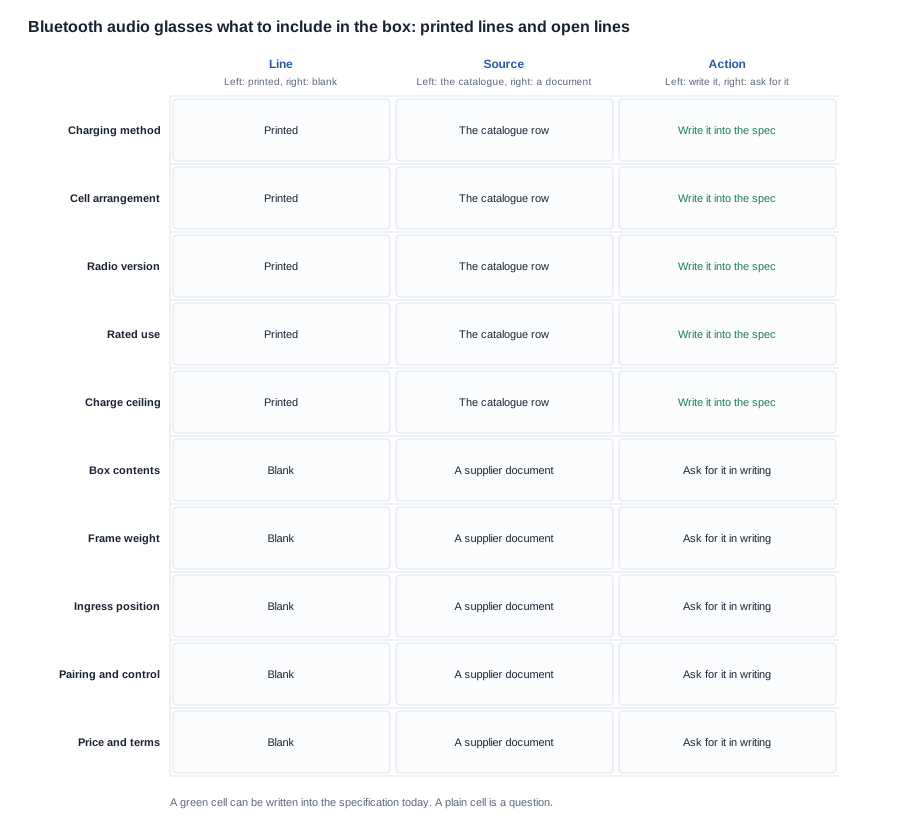
Bluetooth audio glasses what to include in the box is not a question our catalogue answers with a packing list, and it is not a question that can be answered by inference either. Our catalogue prints no packing list for any of the eight audio models, and it prints no photograph of what ships in the box. What it does publish is a set of rows, and for these eight products those rows are enough to determine most of what the carton has to carry and most of what the customer will be handed. There are three cell arrangements across the eight models, two charging interfaces, two published radio versions, and a published endurance band on every one of them. Everything else the customer will find in the box has to be obtained from the supplier in writing, and the discipline for a channel is simple: every line of the box specification is either a published row, or a question, and it is never a guess.
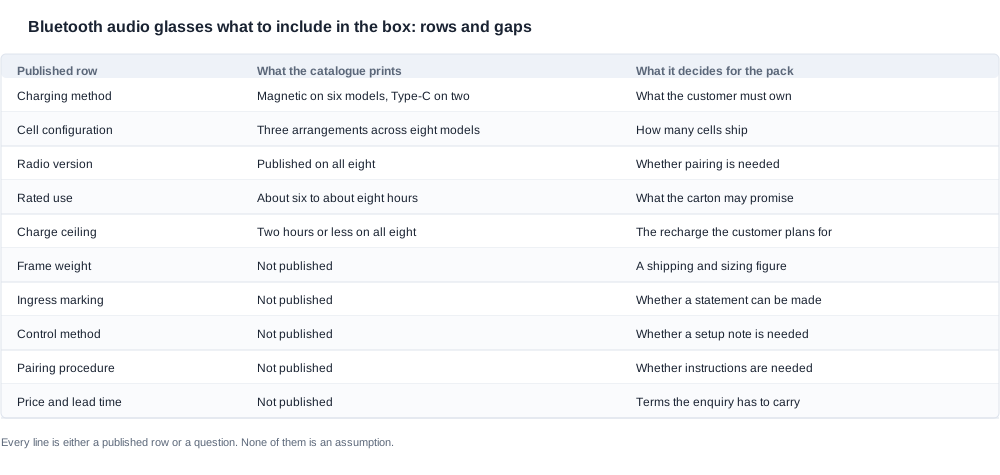
What to include in the box to know about Bluetooth audio glasses: the rows that decide the parcel
The useful reframing is to stop treating the box as a list of objects and start treating it as the delivery mechanism for a set of published rows. Our catalogue carries five standard rows for each of these audio models — the cell capacity, the radio version, the charge time, the rated endurance and the charging method — and, for some of the models, a set of feature notes as well. Of those rows, four of them reach the customer in the box in a form that is decided by the published value rather than by a packaging choice.
The charging method is the first, and it is the one that decides whether the customer can use the product on arrival. Six of the eight audio models charge magnetically and two charge over a Type-C port. A magnetically charging product needs a specific charging part, and whether that part is in the carton or has to be ordered separately is a packing decision with a direct commercial consequence: a customer who opens a box containing a product they cannot charge has a product they cannot use, and the first contact a channel has with that customer is a support contact rather than a sale. A Type-C product asks something different of the packer, because the customer may already own a suitable cable, and the question becomes whether one is included and how the port is described.
The cell configuration is the second. Our catalogue prints the cell value together with the number of cells, and the audio line uses three arrangements: 55mAh*2 on four models, 90mAh*2 on two models, and 100mAh on two models. A product with one cell and a product with two cells are different objects in a warehouse, different objects in a carton, and different objects in a transport file, and the number of cells is what determines which of the three it is. The third row that reaches the customer is the published radio version, which decides whether the customer has a pairing step at all: six of the eight publish a version and the two in the 90mAh*2 group publish an earlier one, so the packaging content for those two is not the same as for the other six.
The fourth is the endurance band, and it reaches the box because it is a promise the customer will read. The published endurances in this line run from about six hours to about eight hours, and the band is what a customer will hold the product against. That makes it a packing obligation rather than a technical detail: the carton has to carry a claim that the product meets, and the claim has to be the published band rather than one the documentation cannot carry.
Everything else in the box is a blank. Our catalogue publishes no weight, no ingress marking, no control method, no pairing procedure, no acoustic figures, no price, no minimum order quantity, no delivery lead time, no warranty term and no per-model conformity record for these products. Those are not small omissions — they are the majority of what a box specification has to state. The correct working method is to convert each of them into a question, send the list with the enquiry, and write the answer into the specification when it arrives. A box built on published rows and documented answers is defensible; a box built on assumptions is a liability that surfaces in the first returns.

The eight audio models, and the three cell arrangements among them
The audio line in our catalogue holds eight products, and they are not variations on a single specification. They divide by cell arrangement into three groups, and each group divides again by what the remaining published rows say.
The 55mAh*2 group is the largest and the most internally varied. Four models carry it: the G07 and the YK12, and the LC-105-2 and the LC-105-1. All four charge magnetically, all four publish a radio version, and all four sit under the same two-hour-or-less charge ceiling, but their published endurances do not match: the LC-105-1 and the LC-105-2 publish about eight hours, and the G07 and the YK12 publish about six hours. The 90mAh*2 group holds the K01 and the K02, which publish the same radio version, the same cell arrangement, the same charge ceiling and the same rated use, and which are the two audio models whose published radio version is the earlier one. The 100mAh group holds the D11 and the D12, both of which publish a single cell, a Type-C interface, a radio version and about seven hours of rated use.
What this grouping means for a box specification is worth stating carefully, because it is the point at which a naive reading goes wrong. The cell arrangement cannot be used to infer the endurance, because the largest group contains both the eight-hour and the six-hour figures on the same 55mAh*2 arrangement. The two audio models that publish the longest rated use in the line publish the smallest cells, and the two that publish a single cell publish something in between. So the three cell arrangements tell a packer how many cells are in the product and how the transport file is built; they do not tell a copywriter what to promise. Those are two separate published rows, and the box needs both of them stated separately.
The interface distribution follows the same logic. Two of the eight charge over a Type-C port and six charge magnetically, and because the charging method is a published row the packer can work from it directly rather than by assumption. What the published rows do not settle is what travels with the product in either case. That is a question about the contents rather than about the hardware, and it belongs in the enquiry alongside everything else, because a customer who opens a carton and finds no way to charge the unit has a product they cannot use.

There is a third structural point that a channel should establish early, because it affects how many distinct box specifications the programme needs. If a programme carries models from more than one of the three cell arrangements, it is carrying at least three transport files and at least two different charging arrangements, and each of those is a separate request to the supplier. A programme that carries one model needs one set of answers; a programme that carries six needs six, and the difference is a week of correspondence at best. Deciding the breadth of the programme before the first enquiry, rather than after the first quotation, is what keeps the packaging work from expanding silently.

A magnetic charger, a Type-C port, and what each one asks of the packer
The two charging arrangements in this line are not a detail of the product; they are two different packing problems, and the difference shows up in three places at once: in what the customer receives, in what the channel stocks afterwards, and in what the printed material has to say.
For the six magnetically charging models, the customer needs a part that is specific to the product. If that part is in the carton, the box is carrying an item that the customer cannot buy in a shop and cannot substitute, which makes it a line in the pack, a line in the box description, and a line in the after-sales stock. If it is not in the carton, the first experience of the product is a customer looking for a charging solution, and the packaging has to say where to get one. Both of those are packing decisions, and neither of them can be taken from a catalogue row, because the row records the method and not the contents.
For the two Type-C models, the part the customer needs is one a customer may already own. The packing question becomes a smaller one and the after-sales question becomes a smaller one, and what is left is the question of whether a cable is included and how the port is described. It is worth noting what this difference is not: it is not a quality difference, and nothing in the published rows supports ranking one arrangement against the other. It is an operational difference, and it shows up in the cost of running a channel rather than in the capability of the product.
There is a third consequence that a buyer should raise before the artwork is drawn, and it concerns the printed content rather than the contents. The published feature notes are what a customer can be told about the product, and they are not uniform across the line. For the models whose pages carry feature notes, the box has something to describe beyond the electrical rows; for the models whose pages carry none, the printed content is thinner, and the box has to carry the electrical rows and the usage material instead. Neither of those two situations is a problem in itself, and the difference between them is not a difference in the products. It is a difference in what the catalogue publishes for them, and a channel that has not noticed it will find out at artwork stage.
A fourth consequence is the one that the least attention usually gets. The charging arrangement is published, the cell arrangement is published, the radio version is published, and the endurance band is published. The box specification therefore has a factual spine. The blanks are the weight, the ingress marking, the control method, the pairing procedure, the acoustic figures and the commercial terms, and the discipline that keeps the programme honest is simply to keep them in a separate list, marked as open, until a supplier answers them in writing. A box specification that mixes published rows, documented answers and assumptions cannot be reviewed, because a reviewer cannot tell which is which. A box specification that keeps the three apart can be reviewed line by line by somebody who did not do the work.

Turning the remaining blanks into packing questions
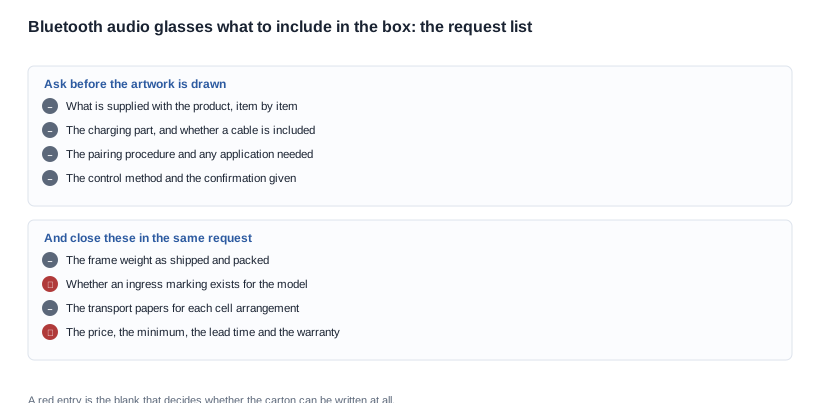
The request list below is what converts the blanks into answers, and it is written in the order a supplier can answer it most easily. Every item names what has to be established, and every item can be met from paperwork the supplier already keeps.
- What is supplied with the product, item by item, for each model in the programme.
- For a magnetically charging model, what the charging part is and whether it is supplied.
- For a Type-C model, whether a cable travels in the carton and how the port is labelled for the customer.
- How a customer connects each model for the first time, and whether an application is involved.
- How each model is operated, and the signal a wearer gets that an action has registered.
- The frame weight as shipped and the packed weight.
- Whether an ingress marking has been applied to a model, and to which build.
- Any acoustic figures the supplier is willing to publish for the model.
- The price, the minimum order quantity and the delivery lead time, and the sample terms.
- The warranty term, the defect replacement route, and the conformity record for the build that ships.
- The transport documentation for the cell arrangement of each model in the programme.
- The artwork approval route, and who signs the pack off on the supplier side.
The first three of those are the ones that decide whether the customer has a working product in front of them, and they are cheap to ask. The fourth and fifth decide whether the product needs a setup instruction in the carton, and they are the questions that turn a box from a container into an operating document. The sixth and seventh are the physical ones: a weight is a shipping figure and a dimensional figure, and an ingress position is the difference between a printed statement and a blank. The eighth is the one that a channel has to handle carefully, because a figure that a supplier is willing to publish is a figure a channel can quote, and a figure it is not willing to publish is a figure a channel does not put on a box. The last four are commercial and documentary, and they belong in the same request because the box specification and the order terms are one conversation rather than two.
A buyer should also set the criteria by which the answers will be judged, because a request for a box specification tends to produce a mixture of answers at three different levels of usefulness. The first level is a value that can be printed: a dimension, a weight, a number of items, a statement about the environment. The second is a value that can be used internally but not printed: a tolerance, a test method, a service position. The third is a description of what the product feels like to use, which is the least useful level of all and the one that most often comes back in a reply. Choosing between two suppliers then comes down to putting the same question to both in the same form and marking the replies against the same three levels, and a buyer who does that ends up with a comparison between two specifications rather than between two brochures. The same discipline applies to what a buyer writes on the box: a line that cannot be traced to one of those levels should not be on the carton at all.
There is a commercial point behind the method that is worth making explicitly, because the temptation is to treat the box as a finishing item and to move on to the commercial terms. The carton is the first thing a customer sees and the last thing a channel can change, and the two facts together mean that a box decided late is a box decided expensively. A specification built in the order set out above is built while the answers are still cheap, and a specification assembled at the end is assembled out of whatever has arrived by then.
A buyer working through this list should also decide the order of the work, because the list has a dependency structure that is easy to get wrong. The contents question comes first, because it determines what the box has to accommodate. The contents question needs the weight and the ingress position, because a box that cannot be sized or that has to be labelled around an unstated environment is a box that has to be reworked. The artwork comes last, because artwork is the slowest item to change and the fastest to lock. And the commercial terms run alongside, because a programme that cannot be reordered at the same specification is a programme whose box specification is only provisional.
There is a short checklist of criteria for the finished specification that a buyer can apply before it goes to a printer, and it is worth having in front of the review meeting rather than in a file afterwards. Does every line trace to a published row or to a document that is filed? Is anything in the specification an assumption that has been left unmarked? Does the description of what the customer receives match the published rows for the model that will actually be packed? Has the weight been taken from a measured sample rather than from a drawing? Is the printed content limited to statements the supplier has agreed to stand behind? Those five questions are a short review, and a specification that answers all five is one a quality team can approve without reading the whole correspondence. A specification that fails the first one is a specification whose accuracy rests on a person remembering what a supplier said in a meeting, and that is a condition no buyer should ship against.
What to ask is therefore not a preliminary step to the packing work; it is the packing work. The question list, the replies and the carton are the same document seen from three angles, and the only thing that makes them one is that each blank in the specification carries the name of the document that closed it.
The point of the exercise is that the resulting document is short, checkable and defensible. It has one column for the published rows, one for the documented answers, and one for the questions that are still open, and a reviewer can see in a few minutes which of the three a given line belongs to. That is the whole difference between a box specification that a channel can sign and one that it can only hope survives the first returns.
The same question has a different answer in the children's line, where two of the three models publish no radio row at all, and the same question has a different answer again in the sport line, where two of the three models publish a charge time of about an hour. Both are covered on their own pages: the children's box question is in what belongs in a box for kids smart glasses, and the sport one is in the packing question for sport smart glasses.
Send us the models you are considering, together with the carton copy you have drafted, and we will mark each line of your box specification as published, blank or answered — and tell you which of the blanks have to be closed before the artwork is locked, because a carton that has to be reprinted is the most expensive form of packaging mistake there is.


