

Kids smart glasses what to include in the box is a question with two halves, and the first half is the easier one to get wrong. The box for a children's product is read by a parent before it is read by a child, and a parent is reading it to find out what the product does, what it connects to, what it is made of, and what the company is promising. That makes every sentence on the carton a claim, and it means the carton is where the boundary between a published row and an effect claim is either held or lost. Our catalogue publishes the rows; it publishes no statement about eyesight, health, concentration or the effect on a child, and the box has to hold that same line. The second half is the mechanical one: three models in this line, two of which publish no radio version at all, and a set of blanks that have to be converted into questions before the carton is designed.
What to include in the box to know about kids smart glasses: three models and three different rows
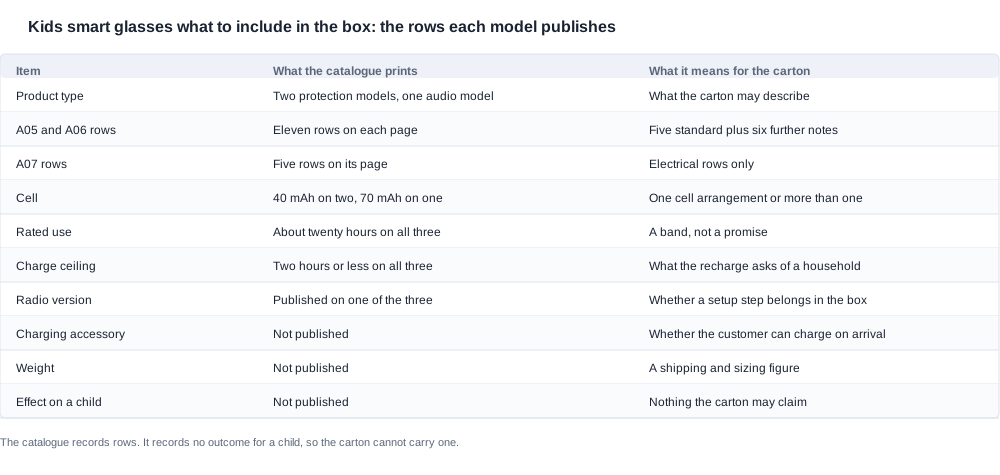
Three products sit in this line in our catalogue, and they are not three versions of one thing. The A05 and the A06 are both published as 儿童智能防护眼镜. They each carry a 40 mAh cell, a rated endurance of approximately twenty hours, a charge ceiling of two hours or less, and magnetic charging, and their catalogue pages each record the same six further notes. The A07 is published as a 儿童智能音频眼镜 and is a different product type: a 70 mAh cell, the same approximately twenty-hour rating, the same two-hour charging ceiling, magnetic charging, and a published radio version of 5.4. Its page records no further notes at all.
That gives three different row sets, and the difference between them is what the box has to carry. The A05 and the A06 pages each record eleven rows in total — five standard rows plus the six further notes — and those six notes are what a box can describe about what is fitted. The A07 page records five rows, so the only things a box can say about that product are the electrical ones: the cell, the rated endurance, the charge ceiling, the charging method and the radio version. A channel that writes one carton copy for the whole line and adapts it slightly for each model is working from a false premise, because the three products do not have the same amount of describable content.
The second difference is the radio. Two of the three products publish a radio version and one does not, and that is not a small difference in a box: it decides whether the carton has a setup step in it or does not. The third is the cell, and because the A05 and the A06 use a 40 mAh cell while the A07 uses a 70 mAh cell, a programme that carries more than one of these products is carrying more than one cell arrangement, and each arrangement is a separate transport question and a separate line in the request list.
What a box can never carry, for any of the three, is an effect. Nothing in our material measures these products, records a test method for them or publishes a result for them, and it publishes no statement connecting what is fitted to anything a child experiences. The six further notes on the two protection models are catalogue rows — a lens-based electronic item, a fogging unit, correct and incorrect posture-and-distance prompts, a lens clarity note and a lens fogging note — and they record what is fitted and what the catalogue lists. They are not a statement about eyesight, and a box that turns them into one is a box that has made a claim the underlying documentation does not support.
The twenty-hour band, and the cell sizes behind it
All three products in this line publish a rated endurance of approximately twenty hours, and that is the longest figure our catalogue prints for any product in any line. It is also the number most likely to be copied into a carton, which makes it the number that most needs a condition attached to it, because the catalogue attaches none: no workload, no start state, no end criterion.
The cell sizes are worth setting out next to the band, because the relationship between them is not what a reader would assume. The A05 and the A06 publish a 40 mAh cell against the same approximately twenty-hour band, and the A07 publishes a 70 mAh cell against the same band. A buyer should not read that as a performance comparison, and this page will not make one, because the catalogue does not support one: the band is published without the conditions that would make any comparison possible, and two products with different cell values carrying the same band tells a buyer that the band is not published as a function of the cell value. That is a statement about the published data, and it has a direct consequence for the box — the band cannot be used to describe relative endurance between these three models, so a carton that compares them cannot be written from the catalogue.
The mechanical consequence of the band is simpler and more useful. A box that prints a twenty-hour figure is making a promise a customer will hold the product against, and the only version of that promise the catalogue supports is the published band, stated as a band. The other mechanical consequence is about the charge ceiling: all three publish two hours or less, which means the recharge has to fit somewhere in a household's day, and a box that prints the band without mentioning the charge figure leaves the customer with half the arithmetic.
There is a third consequence, and it is the one that is easiest for a buyer to overlook. A band of approximately twenty hours is a long time in a child's day, and the questions it raises are questions about the box rather than about the cell. If a product is expected to be used for long stretches, then the questions of how it is charged, where it is charged, whether the charging part is in the box and what the parent is expected to do all become box questions rather than technical ones. Our catalogue publishes the charging method for all three, and publishes nothing about the charging accessory itself, which means the accessory is a blank on all three.
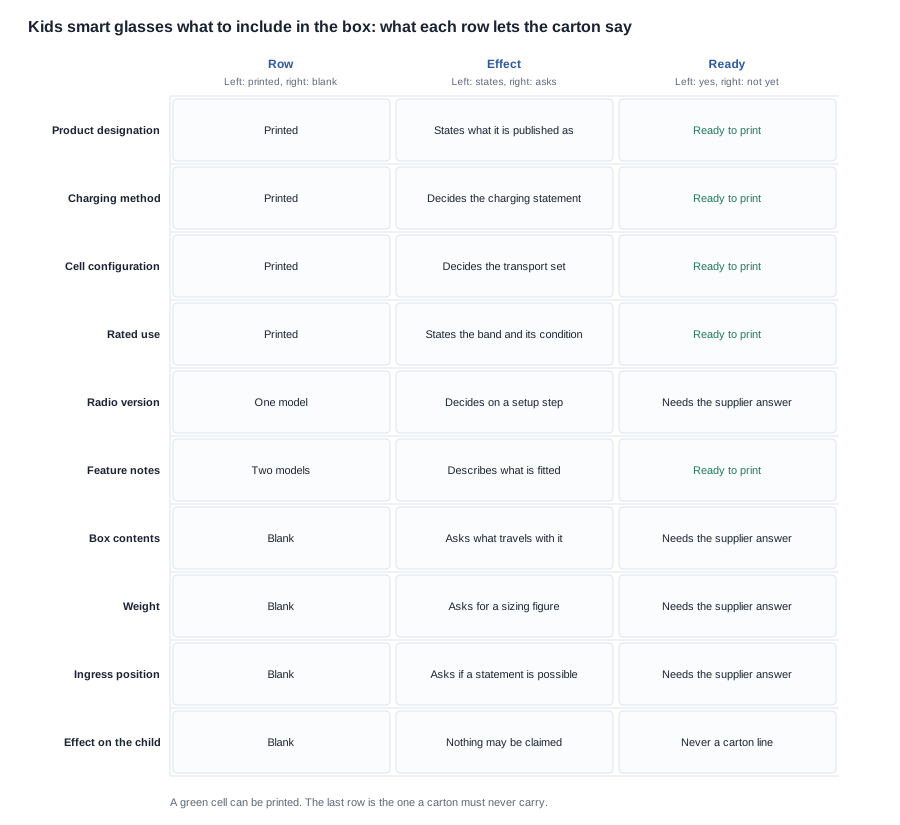
The matrix above is the part of this page a buyer can use directly, and the way to read it is column by column. Where a row is printed, the box can say it. Where a row is blank, the box can ask about it. And the third column is the one that does the work, because it converts each printed row into a decision rather than a description: the charging method decides whether the box needs a charging-part statement, the cell configuration decides whether there is more than one transport file in the programme, the radio version decides whether a setup step belongs in the carton, and the band decides what claim the carton has to carry and on what condition.

The two models without a radio row, and what a box can do about that
Two of the three products here publish a radio version and one does not, and the box consequence is larger than it looks. A product that publishes a radio version has a documented connectivity position, and a carton can therefore describe a setup step: what to pair, with what, and what happens afterwards. A product whose page prints no radio version does not have a documented connectivity position, and a carton for that product can neither describe a setup step nor state that there is none.
That distinction is the one worth making carefully, because it is easy to read a missing row as a statement of absence. Our catalogue printing no radio version for the A05 and the A06 means the row is simply missing; it does not mean the manufacturer has published a position that the product makes no radio transmission. A box that says "no wireless" on the strength of a missing row is making a claim the catalogue does not carry, and in a category where a parent is reading the box to decide whether a device is connected, that is a claim worth not making. The position has to be established with the supplier, and then the box can state whatever the position turns out to be.
There is a second, more practical point about the same row, and it is about who the box is written for. A setup step in a children's product is not a setup step for the child. It is a step the parent performs, usually once, usually at a kitchen table, usually with the device in a hand and a printed sheet in the other. That changes what the carton has to carry: not a technical instruction, but a short sequence that a parent can follow without a second device and without a translation, and it changes when it has to be settled, because a setup card that is not designed until the artwork stage is a setup card that is designed badly.
The third point is the one that connects to the other two models. A programme that carries the A07 alongside either of the protection models has to carry two different box structures, because the radio position is different and the describable content is different. A buyer who has planned the programme around one carton design will discover this at the artwork stage, which is the most expensive place to discover it.

The sequence above is arranged so that the questions with the longest lead time are asked first, and so that nothing that constrains the artwork is left until after the artwork is done. The radio position and the charging accessory come early because both of them may add a printed element. The cell and the transport documentation come next because they decide whether there is one set of papers in the programme or several. The band and the claim wording come last because they depend on the answers, and because they are the part of the box that is easiest to correct before it is printed and hardest to correct after it has been.

The claims a children's box has to stay clear of
The boundary section of a box specification for this line is not a formality, and the reason is specific. Two of the products publish notes that describe elements fitted to the frame, and those notes are the part of the catalogue that a copywriter is most likely to convert into a benefit by accident, because a note about posture and distance reads like a note about a benefit. It is not. A note that the catalogue lists a correct posture-and-distance prompt and an incorrect posture-and-distance prompt records that a prompt exists in the product and nothing about what happens to the child who receives it. The same applies to the note recording a lens clarity state and a lens fogging state, and to the note recording a fogging unit, which is an accessory or function row and not a parameter of the lens itself.
A box for these products therefore describes construction and operation, and it does not describe an effect. That is not a stylistic preference; it is the only position the documentation supports, and in a children's category it is also the position that protects a brand. A claim about eyesight, a claim about how a child's eyes are protected, a claim about reduced fatigue, a claim about concentration and a claim about development are all things our catalogue says nothing about, and a carton that makes any of them is making them on the brand's own authority. A parent who reads such a claim on a box, and then a fortnight later has a different experience, does not make a technical complaint. They make a complaint that ends with the brand's name in it.
The other half of the boundary is the one a procurement team has to write rather than avoid. A box has to say what the product does, and "a product that does not claim any effect" is not a description that helps a parent. The workable version of a compliant carton is a three-part structure: what is fitted, what it is published as, and what the company will support. What is fitted comes from the feature notes where the page has them. What it is published as comes from the designation. And what the company will support is the part that has to be written by the buyer and approved by whoever is answerable for it, because it is a set of statements about the product that the carton makes on the brand's behalf.
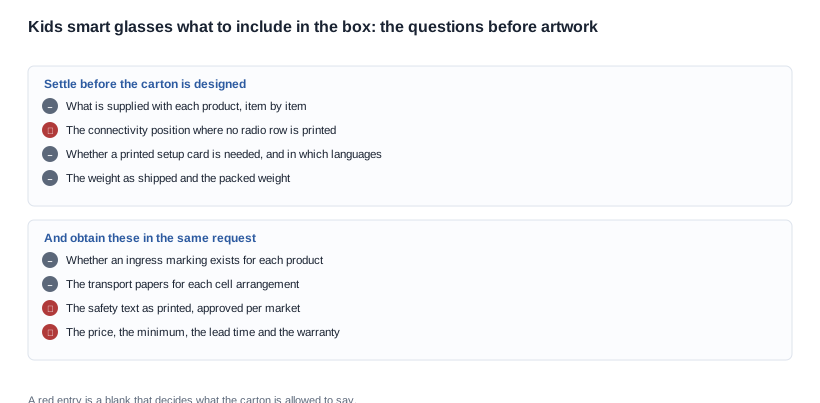
The questions below are the ones that have to be answered before the carton is designed, and each of them can be met from documents the supplier already holds. They are written in the order that costs least to get wrong, rather than in the order they appear on the box.
- What is supplied with each product, item by item, and is the charging part included.
- For the two products whose pages print no radio version, what the connectivity position is, and whether a setup step is needed.
- For the product that publishes a radio version, what it pairs with and what the parent has to do.
- The control method for each product, and what confirmation is given.
- The weight as shipped and the packed weight.
- Whether an ingress marking exists for each product, and for which configuration.
- The transport documentation for each cell arrangement in the programme.
- Whether a printed setup card is required, and in which languages.
- The text of the safety information as it will be printed, approved for each market.
- The unit price, the smallest order the supplier accepts, and the length of the warranty cover.
- The artwork approval route, and who signs off on the supplier side.
- The conformity record for the configuration that will ship.
Before the list is sent, it is worth fixing the criteria the replies will be scored against, because a request without criteria collects answers that cannot be compared. A buyer who wants to evaluate two suppliers on this line should put the same twelve questions to both, in the same sequence, and mark each reply against the same three levels of usefulness, noting which questions produced a document and which produced a description. The trade-offs between the two suppliers will then be visible without either side being asked to argue its case. The red flags to watch for are consistent enough to name: a reply that answers the neighbouring question, a reply that describes the product rather than specifying it, a reply that quotes a figure for a different model in the range, and a reply that treats the carton as the supplier's problem rather than the buyer's. Any of those four tells a procurement lead something useful before the first order, and the due-diligence value of the enquiry is mostly in what it reveals about the supplier's documentation discipline rather than in the answers themselves. Which model to take forward, and on what criteria, is a decision a buyer makes afterwards; the purpose of this list is to make sure that whichever model is chosen, the carton that arrives says only what the documentation behind it supports.
The ninth of those is the one a channel should treat as the hardest, and the reason is that the text has to be right in a language the reader uses and approved for a market the buyer has chosen, and both of those are decisions that have to be made before the words exist. A carton that is written first and approved afterwards is a carton that is printed twice, and the second print is the expensive one.
A procurement team doing this work for the first time will find that the commercial half of the enquiry decides whether the programme is viable, and the documentation half decides whether it is safe. The commercial half covers the smallest order the supplier accepts, the price breaks, the unit price, the production lead time, the length of the warranty, the sample order and the bulk order terms — none of which our catalogue prints for any of these three products, and all of which a factory quotation carries. The documentation half covers the transport papers for the cell, the conformity record covering the configuration that will ship, the certificate and labelling position, and the change process that keeps both valid when the configuration moves. A buyer who separates the two gets sharper answers, because the factory's commercial quotation and its technical file usually arrive in different formats and from different people, and a request that expects both in one reply tends to get neither.
The total cost of getting this wrong is worth putting in the same frame as the lead time. A carton that has to be reprinted after artwork approval costs the tooling again, the freight again and the shelf time again, and a programme that discovers a missing safety text at that point has a defect rate rather than a delay. Risk management in this line is mostly a matter of sequence: fix the market, fix the age band, fix the product, get the file, write the copy, and only then let anyone draw anything. A quality-control team asked to check a finished carton can only confirm what was decided; it cannot decide it, and the due-diligence work that lets a carton be approved in one pass happens before the first instruction is issued to a printer.
A buyer should also decide, before the first enquiry, how the answers are going to be judged, because the replies to this list come back in several shapes. Some are printable — a dimension, a weight, a count, a statement about the environment. Some are internal only, and have to be marked as such so that nobody downstream mistakes them for something that can go on a carton. The least useful shape is a description of what the product is like to use, and it is the one that comes back most often, because it is the easiest to write. A box cannot be built on it, and a buyer who has asked for it in those terms has to ask again for the same information in a form that can be used.
The same question has a different shape in the sport line, where two of the three products publish a charge time of about an hour and the third publishes two hours or less, which changes what a carton has to say about the recharge. That is set out in the carton question for sport smart glasses.
Put your product selection, the markets, the volume bands and the carton copy you have drafted in front of us, and we will mark each line of it against the published rows for the three models, tell you which lines are answers and which are assumptions, and identify the ones that have to be closed before the artwork is locked so that nothing on the box is a claim the documentation does not carry.


