

Most of the questions buyers send us about bone conduction glasses have the same answer, and it is not a number: the catalogue publishes one line for this product, and that line answers roughly a third of what a procurement team needs before it can place an order. The published line is an amplification gain of 35 dB, a 200 mAh cell, a charge time of two hours or less, a rated runtime of roughly seven hours and Type-C charging. There is no model number, no Bluetooth version, no frame weight, no ingress rating, no acoustic measurement and no certification row attached to it.
This article is the answer map. For each of the seven questions that arrive most often, it states what is published, what is not, and what a buyer should ask the supplier to get a defensible answer in writing. The value of a question list like this is not that it produces better copy. It is that it converts a vague supplier conversation into a document trail that a compliance reviewer, a tender scorer or a channel partner can be shown.
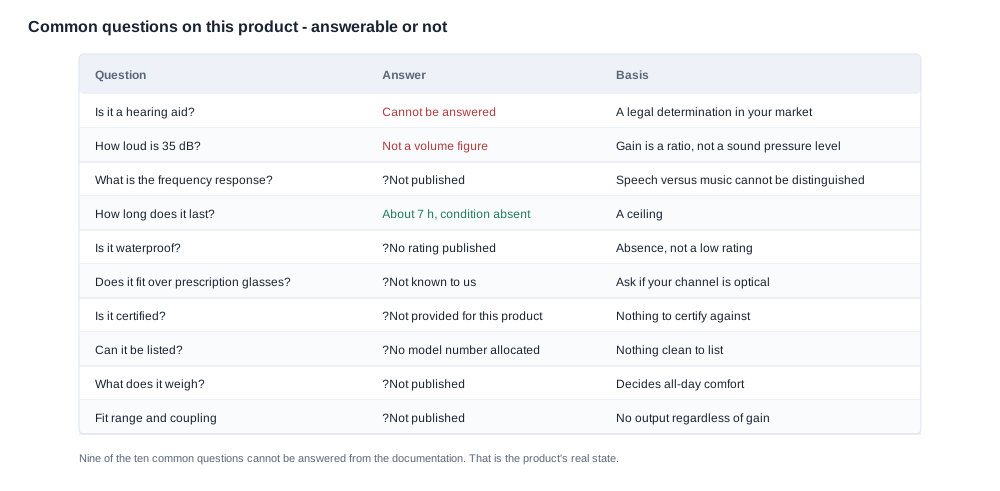
Bone conduction glasses: the seven questions buyers ask
Every buyer who has taken a bone conduction product to a listing review has asked at least one of these seven. They arrive in a predictable order, and the order matters, because the first two questions are blockers and the rest are refinements.
Who asks them, and what each one is deciding
A brand-side product manager asking about the 35 dB figure is usually deciding whether the product can carry a differentiator at all, or whether the listing has to be a mechanism story instead of a performance story. Their cost of failure is a weak listing that ranks for the wrong reason.
A compliance officer asking whether the product is a hearing aid is usually deciding whether the product can be sold into a health-oriented channel, or whether the artwork has to be written for an electronics channel. Their cost of failure is a regulatory exposure that lands on the brand carrying the listing, not on the factory.
A sourcing manager asking about the model number is usually deciding whether this is an orderable item or a concept. Their cost of failure is a purchase order that cannot be raised, a customs file that cannot be completed and artwork that cannot be printed.
Three different decisions, three different questions, and the answers to them are not interchangeable. A reply that satisfies the product manager does not satisfy the compliance officer, and a reply that satisfies the sourcing manager says nothing at all about the acoustic performance. Askers who are told "yes, we can do that" without a row behind the answer usually discover the gap later, at artwork stage or at a customs query, which is the expensive way to find it.
The one published row behind every answer
The published row for this product is short, and it is worth reading precisely rather than approximately. Five values exist: a 35 dB amplification gain, a 200 mAh cell, a charge time of two hours or less, a rated runtime of roughly seven hours, and Type-C charging.
Two properties of that row shape everything below. First, it is a platform entry rather than a named model: the catalogue lists the product as bone conduction glasses, with no model designation attached, which means there is no string that a certificate, a declaration, a purchase order or a piece of artwork can name. Second, four of the five values are electrical, and none of the five describes how the product behaves: the gain figure is a ratio with no reference level, no input signal and no frequency band, and the runtime figure has no test condition attached to it.
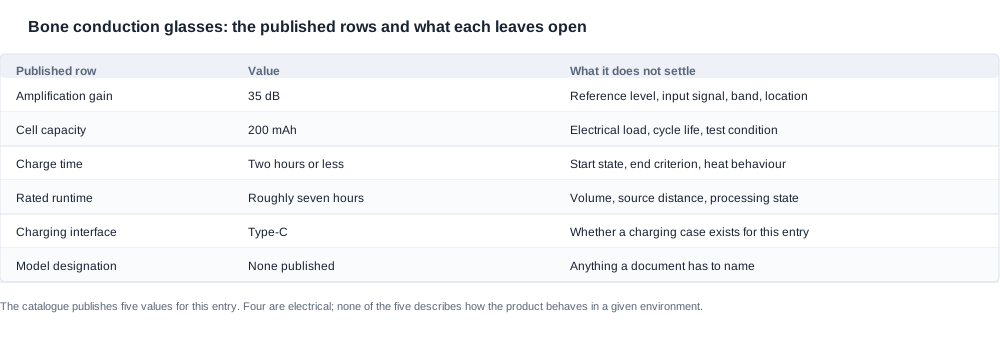
What the single published row actually settles
It is worth being precise about how much the published row does settle, because a buyer who assumes the answer is "nothing" will over-order documentation and a buyer who assumes the answer is "a lot" will under-order it.
The five values, and what each one is good for
The 200 mAh cell is the most operationally useful number on the row. It is larger than any cell published in the audio range of this catalogue, where single cells run at 100 mAh and paired cells run at 55 mAh × 2 or 90 mAh × 2. It tells a logistics team that this is a single-cell device on a standard cable with no charging case row, and it lets a packaging engineer size the carton and the insert before any sample arrives.
The charge time of two hours or less is a ceiling, not a precise value, and it should be quoted as one. The catalogue publishes a charge time for every product it lists, and for this entry that figure is two hours or less, with no starting state of charge and no termination criterion attached. That is enough to plan a charge window and not enough to compute an interruption in a shift.
The roughly seven hours of rated runtime is a rating rather than a measurement, because no test condition accompanies it: no volume level, no source distance, no processing state, no sample size. It is usable as a category marker and unusable as an engineering input.
The Type-C charging interface is the row that most reduces friction in a supply chain. A standard cable means no accessory in the box, no proprietary dock in the bill of materials, no charging dock as a separate stock line and no charger variant per destination market.
The 35 dB amplification gain is the only value on the row that a customer will react to, and it is the value that carries the most conditions. It is discussed in full below.
What a published value is not
A published value is a claim that a measurement was made, not a substitute for the measurement. That distinction is not pedantic in this category; it is the whole category. The gap between "35 dB" and "35 dB measured at 1 kHz against a 1 V input at the transducer surface" is the difference between a specification that can be defended and a number that cannot survive a single question from a competitor's product team, let alone a test house.
The arithmetic that does not reconcile
Here is a useful piece of diligence that costs nothing and that we recommend to every buyer who is comparing this entry with the audio range. The 200 mAh cell is roughly twice the size of the 55 mAh × 2 paired cells used in the LC-105 pair, the G07 and the YK12, and larger than the 100 mAh cells in the D11 and the D12. The published runtime, at roughly seven hours, sits in the middle of the audio range rather than above it.
That is not a contradiction, but it is an unanswered question. A larger cell paired with a mid-range runtime implies a heavier electrical load than a temple speaker, which is what an amplifier with a 35 dB gain would be expected to be. That is an inference, not a catalogue statement, and it is exactly the kind of inference that needs a measured load or a test condition before it becomes a number a buyer can use. The point for procurement is not the arithmetic itself. It is that the arithmetic tells you where to ask.
The acoustic questions a spec sheet leaves open
The acoustic questions are the ones the published row cannot touch at all, and they are also the questions that determine whether the product can be sold into a channel at all.
Gain is a ratio, and a ratio needs two references
Decibels are relative. A gain of 35 dB describes the ratio between the signal entering the amplifier and the signal leaving it, and it becomes comparable only when the input reference, the frequency band and the measurement location are fixed. A gain measured against a one-volt electrical input and a gain measured against a calibrated acoustic reference are different quantities that are both written in decibels, and only the second can be compared with figures quoted in hearing-related literature.
None of those conditions is published for this product. The reference level, the input signal, the frequency band, the measurement location, whether the gain is adjustable and over what range, and the full frequency response are all absent. The consequence is concrete: a speech-oriented buyer and a music-oriented buyer cannot be told whether they are evaluating the same product, because the band over which the 35 dB holds has not been shown.
Where the response curve is actually decided
For a temple-speaker frame, the acoustic signature is set mostly by the driver's position relative to the ear. For a bone-conducted frame, the dominant variable is different and harder to hold: the coupling between the transducer and the temporal bone. The same frame can produce materially different delivered output on two people, and the variable that separates them is contact pressure and temple position rather than a component selection.
This has a commercial consequence that is not obvious from a spec sheet. The measurement a test house performs on a bench, with the frame held in a fixture, is not the measurement the person in the street receives. A buyer who needs a number for a listing therefore needs to know which measurement the number came from, and the answer for this product is currently unavailable. Any figure quoted without its location is a figure about a fixture.
Leakage, microphones and the room
Three further rows are absent, and all three matter to different buyers. There is no leakage figure, which matters for an open-ear frame because leakage is the trade that determines whether the product works in a shared space; here the question is different, because the product delivers through the skull rather than radiating into the room. There is no microphone specification, which matters to a buyer whose channel is voice-driven: pickup distance, the number of microphones and any processing behaviour are all unpublished. There is no noise figure, which matters to a buyer whose use case is a noisy environment, because a 35 dB gain amplifies the noise floor as faithfully as it amplifies speech.
A buyer should treat these three as separate asks. "Send us the acoustic data" is not a usable request, because it returns a data package that may contain none of the three.

The physical questions behind the acoustic ones
The physical rows are usually treated as secondary, and in this category that is a mistake, because the physical properties of the frame are what the acoustic performance is built on.
Contact is a signal path parameter
The transducer has to rest against the temporal bone for the amplification to couple properly, so the contact geometry, the temple length and the stiffness of the frame determine the delivered output. This makes the contact a measurement question rather than a preference question, and it changes what a sample review has to record. A review that checks whether the frame sits well and stops there has not checked the acoustic path at all.
It also changes the shape of the acceptance value. The useful acceptance value is not a comfort preference and it is not a gram figure; it is a delivered-output range across the temple adjustment range, measured on a set of heads rather than on a fixture, with the coupling condition recorded next to the number.
Weight, ingress and temperature
Three physical rows are unpublished, and each one is a question a buyer should put in writing. Frame weight is not published for this entry, and for a device that rests against the side of the head through a working day it is a row most buyers would want before they commit. No ingress rating is published, and the absence is not a low rating: it means no claim can be made in either direction, and a buyer whose deployment involves weather or washdown has to treat that as a product limitation until a figure exists. No temperature range or thermal behaviour is published, which for an entry that carries a 35 dB amplifier alongside a 200 mAh cell is a sensible thing to request.
The battery as a physical question
The electrical row is the part of the specification that is complete, and it is also the part that interacts with the physical design in ways the catalogue does not describe. The cell sits behind a temple, the amplifier draws power continuously while it is active, and the published runtime carries no test condition. A buyer planning a shift pattern for a guided tour, a warehouse walk-through or a site inspection needs to know whether the seven-hour rating is measured with the amplification stage running at its working level, because that is the only way to know whether the rating describes the product's actual duty cycle.
That question has a precise answer that only a supplier can give, and it should be asked before you order the sample rather than discovered during a pilot.


A written question list for the supplier
This is the part of the conversation that creates value for both sides, because it converts an open-ended brief into a document request with a defined finish.
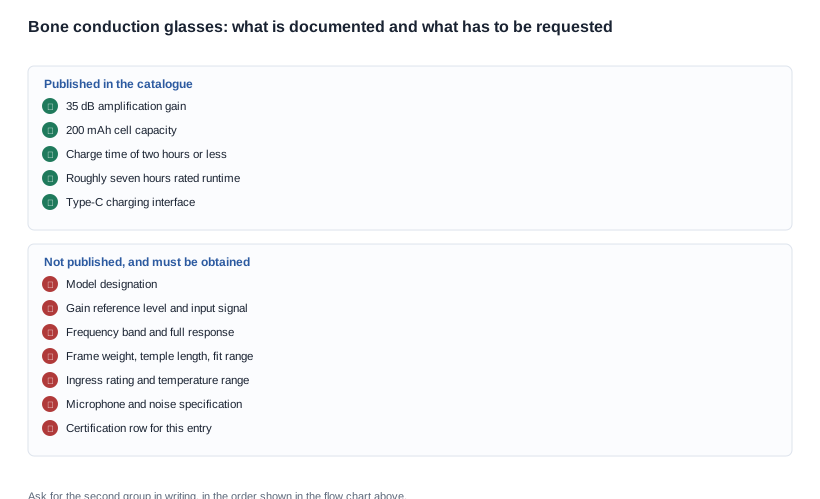
The three-part answer format
Every question below should be answered in three parts, and a supplier that answers only the first part has not answered the question. The format is: what is published, what is not published, and what the buyer must obtain and from whom. The third part is where the diligence sits, because it moves the row from "unknown" to "known to be somebody else's responsibility", which is a state a project can actually manage.
This format also protects the supplier. A row that is marked "not published" is not a refusal; it is an accurate statement about the documentation. A supplier that invents a value to fill the gap creates a liability that resurfaces at conformity assessment, when a document has to name the product and match the test.
Nine questions, in the order they unblock each other
- Is a model designation allocated, and when will it be issued in writing? Nothing downstream can be named until this exists. It is the cheapest question on the list and it blocks the most.
- What is the reference level, input signal, frequency band and measurement location behind the 35 dB figure? Without all four the gain cannot be compared with anything, including our own other figures.
- Is the gain fixed or adjustable, and over what range? This decides how many people the product addresses and whether a single SKU serves a channel.
- What is the full frequency response, and is it the same at the low and high ends of the fit range? This is the row that separates a voice product from a music product.
- What is the microphone specification, including pickup distance and any processing behaviour?
- What does the roughly seven-hour rating assume, and what does it become with the amplification stage running at working level?
- What is the frame weight, the temple length and the fit range? Without these the coupling cannot be replicated across a population.
- Is there an ingress rating and a temperature range, and can a test report be provided for this product?
- Which conformity route applies for the claim we intend to make, in each destination market? This is a question for a qualified adviser in the destination market, supported by the supplier's technical file rather than by a catalogue line.
What to do with a soft answer
A soft answer — "we can do that", "our engineers will check", "that is standard for this category" — is a scheduling problem rather than a fact, and it should be handled as one. Ask for the answer in a document that names the product, with a date against it, and record the request in the sample order. A supplier that cannot produce a value in writing has told you something useful about the product, and the useful thing is that the value does not exist yet.
Red flags in the answers this category produces
Five answers in this category are reliably unhelpful, and a buyer who has seen them before will recognise them quickly.
"It is the same for all our bone conduction products." There is no second bone conduction product in this catalogue to compare against, so a statement about a family cannot be checked against anything.
"That is standard for the category." A category convention is not a test result, and it is not a document that names a product. The only rows in this category that are worth anything are the ones attached to a specific measurement of a specific configuration.
"We can make that available on request." Sometimes true, and always worth following up in writing, because the difference between a figure that exists and a figure that can be produced for a buyer is often a test schedule rather than a technical limitation.
"The gain is 35 dB, as listed." This is a number with no conditions, and it will not survive a competitor's product team, a compliance reviewer or a tender scorer who asks what the reference level was.
"The certification is handled at company level." A company-level capability is not a document that names your product, and the catalogue's company-level export certification page is a page of images rather than text, so it cannot be read as a per-model conformity statement either.
The general rule for a due-diligence checklist in this category is simple: a row counts when a document names the product and the measurement condition. Everything else is context.
What we will and will not answer directly
On this product, our position is narrow and we will keep it narrow. We will publish the 35 dB gain figure because it is documented, and we will publish the cell, the charge ceiling, the runtime rating and the charging interface because they are documented. We will not supply a reference level, a frequency band, a measurement location, a noise figure, a frame weight, an ingress rating, a certification status or a model designation, because our documentation does not contain them.
We will also not describe the product as a hearing aid, and we will not attach a hearing-improvement claim to the amplification figure. We hold no clinical data, no test protocol and no regulatory assessment for this product, and the determination of how the product must be described in a given market belongs to a legal adviser qualified in that market, not to a factory and not to a copywriter. A listing that describes the product in clinical terms is making a claim the brand cannot defend, and the exposure lands on the brand carrying the listing.
What we can do is answer the questions precisely, mark the ones that are open, and tell you which of the nine items above are documentation requests and which are decisions that need a qualified adviser. How to choose between this entry and the audio range, on the published rows alone, is a shortlist decision that most buyers can make in an hour: the two product types answer different briefs, publish different rows and carry different compliance exposure, and the selection criteria that follow from that are set out in the open ear comparison. The published bone conduction specification is the honest baseline, and the certification checklist sets out the document set a launch programme has to assemble.
Related reading
- The published rows and what they leave open — bone conduction glasses
- The document set a launch has to assemble — certification checks
- Where the claims boundary sits — bone conduction glasses health claims and limits
Send us the destination market, the wording you intend to use and the environment it will be used in, and we will tell you which of the nine questions we can answer from documentation and which have to go to the engineering team or a test house.


