

The published specification for this platform is one line: an amplification gain of 35 dB, a 200 mAh cell, a charge time of two hours or less, a rated runtime of roughly seven hours and Type-C charging. There is no model number attached to it, no certification status, and no disclosed customisation capability. Within that single line, one number creates the entire compliance question, and it is not a small one.
A 35 dB amplification gain is the most aggressive parameter in this range. It is what turns an audio product into something that has to be described very carefully, and it is the reason this article exists. A brand that lists this product without a settled claim strategy is not making a marketing decision; it is making a regulatory decision by accident, and the exposure lands on whoever carries the listing.
This article sets out where the line sits in the terms a buyer can act on: what the published number is, the three categories of wording that sit on either side of it, why a figure like this attracts clinical language without justification, what a compliant listing actually says, and the two documents that have to exist before anything goes live.
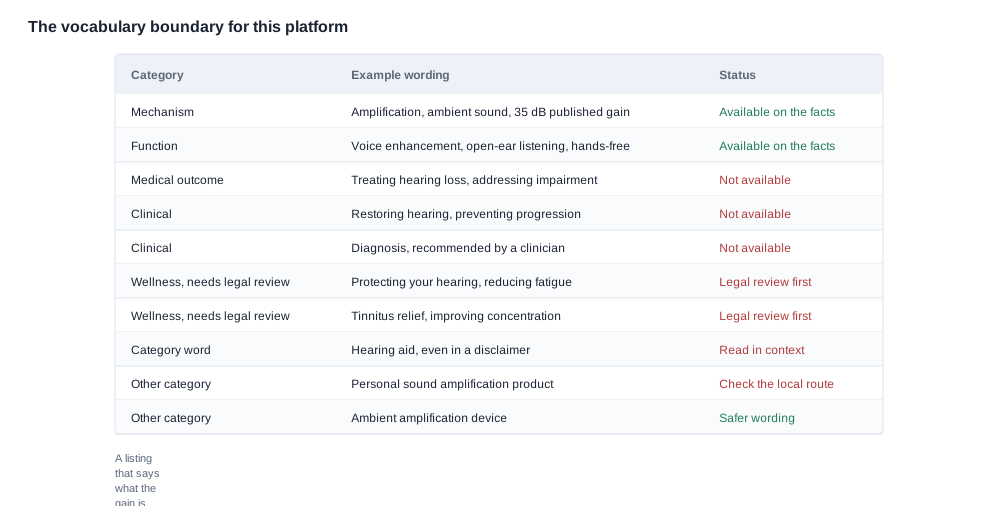
Bone conduction glasses health claims: the vocabulary line
The line is not drawn where most people expect it. It is not drawn between a consumer product and a medical device as a category. It is drawn between describing a mechanism and describing a clinical outcome, and it is drawn independently for each market.
What the published number actually is
The catalogue publishes an amplification gain of 35 dB for this entry. It is a real, documented figure and it is the only acoustic performance figure anywhere in the range. It describes how much the device increases the signal passing through it.
It is not a hearing assessment, it is not a clinical result, and it is not a measure of what a person hears. Those three things are routinely conflated in listings, in distributor training and in channel conversations, and the conflation is where the risk starts. A figure that describes an amplifier tells you nothing about anyone's hearing, because hearing is a property of a person and a signal, and the published figure is a property of a circuit.
We hold no clinical data, no test protocol and no regulatory assessment for this product. That sentence is the honest starting position, and every claim decision follows from it.
How the United States draws the line
In the United States, the over-the-counter hearing aid framework is the relevant reference. The definition at 21 CFR 800.30 describes an over-the-counter hearing aid as an air-conduction device for adults with mild or moderate hearing impairment, and a personal sound amplification product sits outside that definition. A bone-conducted product is not an air-conduction device, so it sits outside that definition rather than inside it.
The practical effect is a vocabulary rule rather than a ban. The language that describes a hearing aid — treating hearing loss, addressing impairment, restoring or improving hearing as a medical outcome — is not available to this product. The language that describes ambient amplification is.
It is a legal determination, not a marketing one. Whether a product is regulated as a medical device in a given market depends on the claims made about it and on the rules of that market, and the determination belongs to a legal adviser qualified there. We set out the general framework in our medical boundary guidance; we do not make the determination for a brand.
How Europe draws it
The analysis in Europe is the same in principle and different in detail. The Medical Device Regulation (EU) 2017/745 governs medical devices, the general product safety framework governs consumer safety, and the radio framework governs the Bluetooth module, with the Radio Equipment Directive (EU) 2014/53/EU as the reference for the radio side. A product that describes itself as a medical device enters a route with evaluation requirements that this platform's documentation does not support.
The determination of which route applies is a legal question and it should be answered before the product reaches a listing rather than after. The pattern is the same in every market: a claim written for a consumer product and a claim written for a device that assists with hearing pull the documentation requirement in opposite directions, and the hardware does not change.
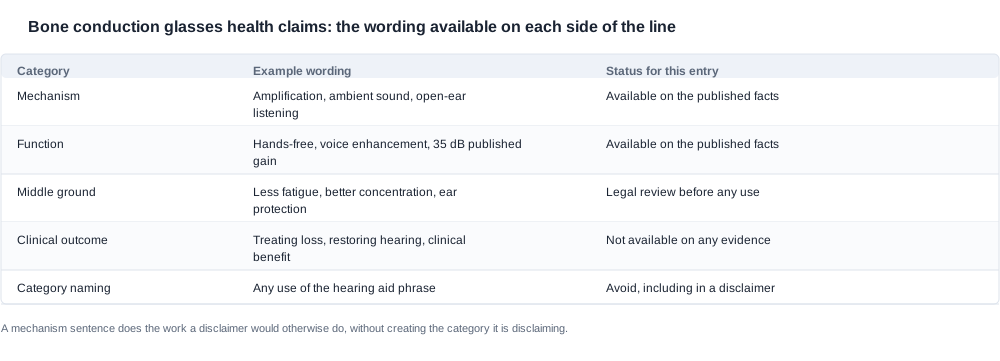
Mechanism words, outcome words, the middle ground
Most of the practical work in this category is done at the level of individual words, so the vocabulary is worth sorting precisely.
Words that describe a mechanism, and are available on the facts
Amplification, ambient sound, voice enhancement, the published 35 dB gain, open-ear listening, hands-free operation, and hearing the surroundings. Each of these describes what the circuit does or what the physical arrangement allows, and each can be supported by the published specification or by the mechanism itself.
These are the words a listing should be built from, and there are enough of them to write a complete product page without approaching the line.
Words that describe a clinical outcome, and are not available
Treating hearing loss, addressing impairment, restoring hearing, preventing progression, clinical benefit, diagnosed, recommended by a clinician. None of these is available, and none of them becomes available by being softened. "Helps with mild hearing loss" is a clinical outcome described in the vocabulary of a benefit, and it is a claim in the same sense as the version without "helps".
We will not write these words in a listing, and we will not endorse a listing that does. A supplier that supplies the copy that makes the claim is making it with the brand, and the exposure lands on the brand carrying the listing.
The middle ground, which is where the mistakes are made
Protecting your hearing, reducing fatigue, improving concentration, tinnitus relief. These sound like ease claims rather than medical ones, which is exactly why they are dangerous: they are the words most likely to be written by a copywriter without a legal read, and they slide into clinical territory without ever using a clinical word.
Every one of them needs a legal review before it is used, and the review has to happen before the artwork is released. These are also the claims that produce the most customer support contacts when they turn out to be wrong, because they set an expectation about a result rather than about a mechanism.
The category trap
A listing that uses the phrase "hearing aid" anywhere can be read as a medical claim depending on the context, including in a comparison against another brand's product and including in the phrase "not a hearing aid". The safe approach is to describe the function and never to disclaim the category. If the copy says "this is not a hearing aid", the copy has still said it, and a reviewer will read the rest of the sentence in a different light.
Why the 35 dB figure attracts clinical language
The number itself is doing something to the conversation, and a buyer who understands why will find it easier to handle.
A large number reads as a promise
A gain of 35 dB is a big ratio, and big ratios read as outcomes. The mechanism explanation — a microphone, an amplifier, a transducer pressed to the temporal bone — is technical and takes a paragraph, while the number fits in a bullet. The number will win the argument in the listing unless something better is in its place, which is why the fix is not to remove the figure but to give the buyer a sentence that carries the same interest and stays inside the line.
Compare it with the rest of the range to see the size of the effect. The open-ear audio products in this catalogue publish no acoustic figure at all: no gain, no response, no driver size, no leakage level. A buyer comparing a listing with a 35 dB bullet against a listing with no acoustic bullet will conclude that the first product is louder, which is not a conclusion the documentation supports. That is the comparison trap, and the open ear comparison sets out the mechanics behind it.
The comparison that is actually available
The honest comparison is a comparison of function, not of loudness. The open-ear frames deliver the audio and calls the person plays. This entry amplifies the sound already present in the environment. They are different products with different briefs, different customers and different compliance exposure, and a listing that puts them in one comparison table on a single "how loud" scale is comparing two different quantities. The open-ear audio guidance covers the mechanism on the other side of that table.
The customer expectation it creates
There is a second-order effect worth naming, because it decides how a support function will be staffed. A product that amplifies the environment invites a customer to ask whether it helps them hear better, and a question like that invites a promise. The support script has to have a written answer for it, and the answer has to describe the mechanism, not the result. Brands that skip the script discover the question first in a public review, where the answer is made by whoever replies.
The listing rules that follow
A workable set of rules is short, and it can be applied to a draft listing in an afternoon.
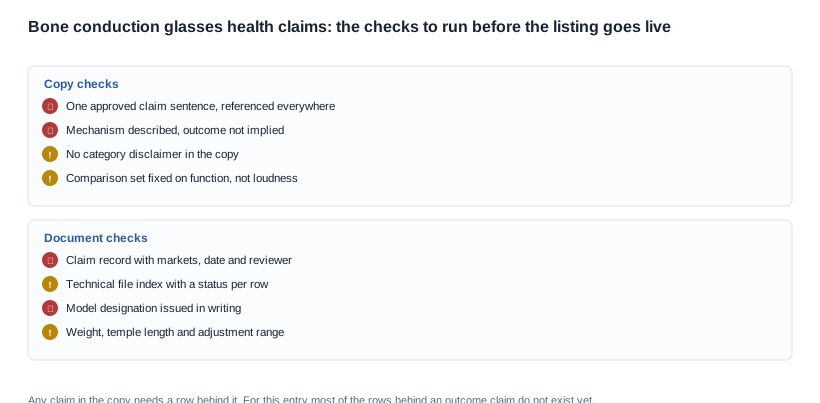
Rule one: one approved claim sentence
Fix a single sentence that describes the product's function, have it reviewed by a legal adviser qualified in the destination market, and make every piece of copy reference it. The listing, the product page, the packaging, the instructions and the support script then all say the same thing, and a change of claim becomes a change of one sentence rather than a rewrite of five documents.
Rule two: separate the mechanism from the outcome, in the copy itself
Describe the mechanism, and let the reader draw the conclusion. "Amplifies the sound around you by up to a published 35 dB" describes a circuit. "Helps you hear conversations more clearly" describes an outcome, and there is no data behind it. The second sentence is also the one that converts a technical product into a health product in a reviewer's eyes, so the rule is worth enforcing at the level of the sentence rather than the level of the page.
Rule three: no clinical vocabulary, including in disclaimers
No outcome words, and no category disclaimers. The mechanism sentence does the work that a disclaimer would otherwise be doing, and it does it without creating the very category it is disclaiming.
Rule four: the comparison set is fixed
Compare against the audio range on function, and say which product answers which brief. Do not merge the two into a single loudness scale, do not publish a direct output comparison, and do not imply that a listing with a gain figure is a louder version of a listing without one.
How to choose a claim route when the product is not yet defined
A brand in this position has three options, and the decision is a scheduling one rather than a marketing one.
Wait for the documentation and launch later. The safest route and the most expensive, because the compliance work, the artwork and the channel plan all wait for documents whose schedule the brand does not control.
Launch with a mechanism-only claim. The claim sentence describes the published specification and nothing beyond it, so the copy needs no acoustic document, no clinical position and no conformity evidence. This is the option most brands underrate, because it is available today and it is the only one that can be supported by what exists rather than by what is promised. The cost is a listing that says less than a competitor's might.
Launch with a claim that needs a legal opinion first. The route is available, but it puts a legal adviser on the critical path and it means the listing cannot be written until they answer, which usually means the artwork waits too.
How to choose between the three is a function of the channel deadline and the claim risk. A channel with a fixed date and a low-risk claim usually takes the second option; a regulated channel with an aggressive claim needs the third; a programme with no external deadline should take the first. What no option avoids is the third state, which is launching with a claim that nobody has approved.
Red flags in a draft listing
Five patterns in a draft copy predict a claims problem later, and all five are easy to find before the artwork goes out.
Any sentence describing what a person hears better. It is an outcome claim, and there is no data behind it.
Any comparison against a competitor on output. There is no comparable measurement on either side.
Any use of the words that describe a condition. Even phrased as a use case, a condition word in the copy makes the product read as a device for that condition.
A disclaimer. A disclaimer names the category it disclaims, and it invites the reading it was written to prevent.
A customer photograph showing a result. An image of a person reacting to the product is a performance claim, and it is the hardest one to withdraw once it is in circulation.
Rule five: the claim travels with the documentation
Any claim in the copy needs a row behind it. For this entry the rows behind a mechanism claim are the published specification and the catalogue page; any claim that goes beyond those needs a document that does not yet exist, which is the point at which the claim becomes a risk rather than a marketing choice.


Two documents the brand has to hold
The vocabulary work is necessary but not sufficient. Two documents turn a set of rules into an operating control, and neither of them is the factory's to write.
The approved claim record
A short document containing the approved claim sentence, the markets it is approved for, the date of the review, the adviser who reviewed it, and the words that are explicitly not to be used. The value of this document is that it can be handed to a copywriter, a distributor and a support team without any of them needing to interpret it, and it can be revised without the listing changing by accident. A buyer reviewing a draft should ask for it before approving copy, because the questions to ask about a claim are short: which sentence is approved, for which markets, by whom, on what date, and what evidence sits behind it.
The record should also carry the expiry. Claims get reviewed, and a claim that was approved against a set of documents should be re-approved if those documents change. A claim approved in the absence of a certification document and carried forward after a certification document arrives is a claim whose basis has shifted underneath it.
The technical file index
The second document is an index of the evidence behind the product side of the claim: the published specification, the acoustic documentation, the cell data, the instructions and the conformity file, each with its status. An index makes the gap visible, which matters because for this entry the gap is large. There is no model designation, no certification status, no acoustic measurement beyond the gain ratio, no frame weight, no ingress rating and no disclosed customisation capability.
The certification checklist sets out the document set a launch programme has to assemble, and the common questions piece covers what the documentation does not contain for this entry.
The third thing that is not a document
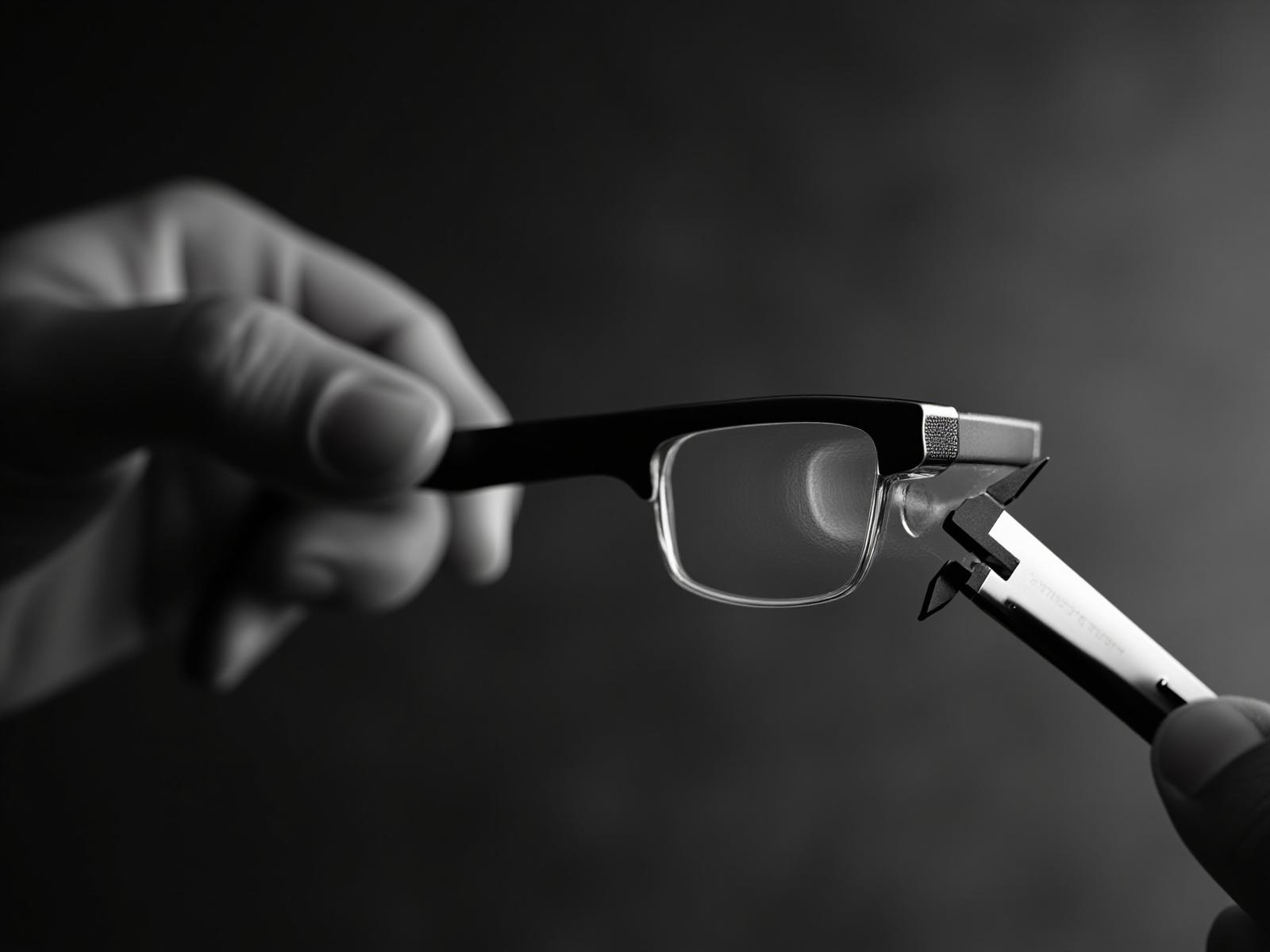
A product whose transducer has to press against the temporal bone depends on how the frame sits on the head, and no weight, temple length or adjustment range is published for this entry. That is not a paperwork gap; it is a product characteristic, and it determines whether the amplification reaches the person at all. The coupling and geometry analysis covers how to test it, and it is the third element a brand has to solve rather than document.
How we describe this product, and why
This product has a real and documented capability, and the way to sell it honestly is to describe the capability rather than the disease. The 35 dB gain is the strongest differentiator in our range and we will put it in a listing. The moment the listing says what that gain is for in medical terms, it becomes a claim we cannot support and we will not endorse it.
We will not publish a clinical result, a diagnostic capability or a hearing outcome, and we will not describe the product as a hearing aid in any framing, including a disclaimer. We will not invent a reference level, a frequency band, a measurement location, a certificate number or a model designation, because our documentation does not contain them.
What we will do is tell you which descriptions of the capability are defensible on the published facts, which questions have to go to a legal reviewer before launch rather than to a supplier, and where the claim sentence should sit in your own document set. The category is covered on our bone conduction glasses page.
Related reading
- Where the claims line sits — medical boundary
- How this compares with ordinary open-ear audio — open ear comparison
- How the mechanism behaves on the head — coupling and geometry
Tell us the destination markets, the intended use and the volume, and we will come back with what is published, what we can close for you directly, and what needs a legal determination.


