

Bone conduction glasses technology: a chain of gates
Most buying checklists are unordered lists wearing the clothes of a procedure. This one is ordered, and the reason for the order is specific to this category: in bone conduction the first gate can end the conversation before any money changes hands, and the gates that follow are ordered by what it costs to reach the wrong answer at each one.
The distinction that makes it work is between a task and a gate. A task ends when you have done it. A gate ends when you have decided, and the decision has exactly three outcomes: go, conditional go, or stop. If your checklist does not say what each gate is allowed to conclude, it is a to-do list, and a to-do list will happily carry a programme into a market where it cannot be sold.
The sequence below runs eight gates. Gates one to three are answerable by asking, at no cost beyond an email, and any of them can stop the programme. Gates four to six are the acoustic rows, and they decide whether the sample is worth measuring at all. Gates seven and eight convert everything above into a document that survives a dispute with a supplier.

Who runs it, and what a gate is allowed to decide
The person who runs this checklist is usually a sourcing manager or a product lead, and they are rarely the person who will use the product. That separation is the source of most of the friction in this category, and it is worth naming: the person asking the questions is usually looking for a reason to stop, and the person who will benefit from the product is looking for a reason to continue. A gate structure resolves this by making the stopping conditions explicit and putting them in writing before the enthusiasm arrives.
Three things the runner is usually carrying. First, one or more quotations that are thinner than the category deserves — a gain figure with no conditions, a cell with no runtime condition, a product with no designation. Second, a launch date that somebody else set. Third, an unresolved question about what the product may be called in the market where it will be sold.
What the runner is afraid of is specific. A product that arrives behaving differently from the demonstration unit. A listing that says something the documentation does not support. A paper trail that names a model the channel has never seen. And, less obviously, the fear of having spent the sample budget on a programme that was never sellable in the first place — which is the failure this ordering exists to prevent.
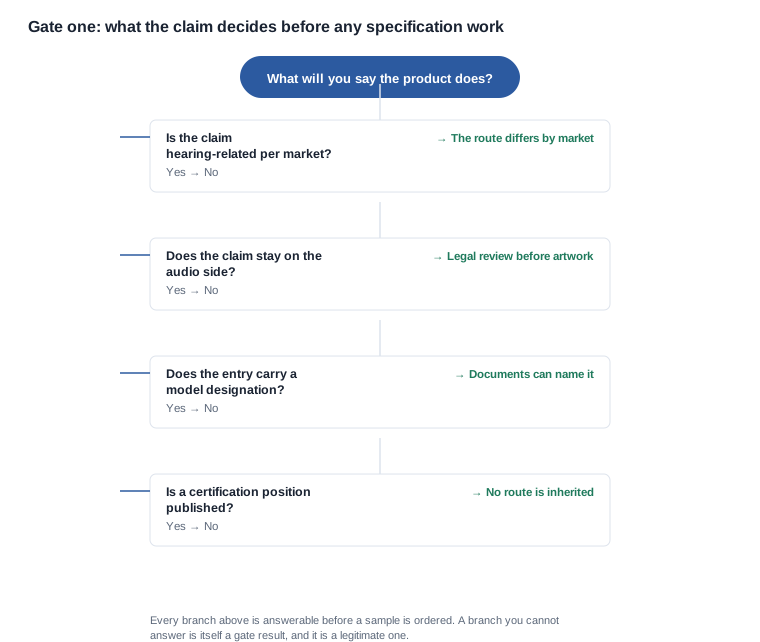
Note what a gate is allowed to decide. Gates one to three do not produce a specification; they produce a stop or a permission to continue. Gate one produces a legal question that belongs to your own function, and the honest output of gate one is often "we cannot answer this yet", which is a legitimate result and a good one, because it is free.
What the supply chain tells you before the first gate
Before you run any gate, three structural facts about this entry will shape what the gates can realistically achieve, and all three are visible in the published catalogue rather than in a quotation.
The entry has no model designation. Everything else in our range publishes at least a model string, and this one does not. That single fact decides gate two before you start it, because a product with no identifier cannot be named on a declaration of conformity, cannot be listed cleanly in a channel's SKU file, and cannot be traced when a quality claim arrives. It also means that the documentation package you receive may have to be created rather than requested.
The published specification is five rows. A 35 dB amplification gain, a 200 mAh cell, charging in two hours or less, roughly seven hours of rated runtime and Type-C charging. Everything else in this category's diligence — the frequency range, the input level, the measurement point, the leakage figure, the transducer description, the microphone function, the frame weight, the ingress rating, the certification status — is Not published for this entry. The gates in this checklist exist because the rows that decide the purchase are the rows that are missing.
The economics are programme-shaped, not unit-shaped. Compare the entry with the open-ear audio class in the same range. This entry publishes a 200 mAh cell and roughly seven hours of rated runtime. The open-ear class publishes cells from 55 mAh paired units up to 100 mAh with roughly six to eight hours of rated runtime, and case capacities across the range of 900, 1200 and 1400 mAh. A larger cell producing a similar rated runtime points to the load rather than the cell as the binding constraint — an inference worth confirming rather than accepting, and a useful one, because it tells you that runtime is a row to measure and not a row to copy. Whether this entry ships with a case is Not published, which is a second row to ask about and a third cost line to watch.
The practical consequence is that the buyer in this category carries more of the specification burden than in a category with published datasheets. That is a legitimate position, but it has to be an informed one, and the gates below are how you make it informed.

The eight gates, and the completion test for each
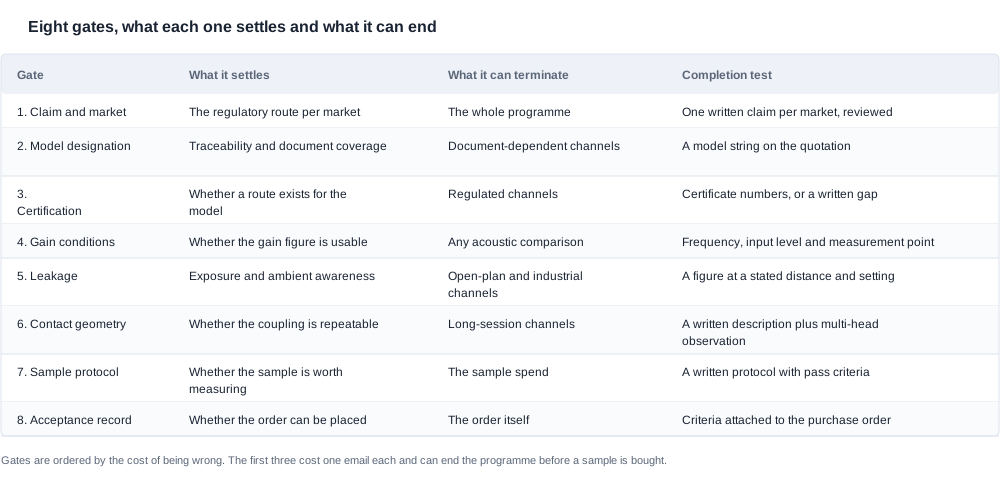
Gate one: the claim and the market. The claim determines the category, and the category determines the route. In the United States, over-the-counter hearing aids are defined under 21 CFR 800.30 in terms that centre on air conduction, so a bone conduction product sits outside that definition — which is not the same as being unregulated, and is not the same as being exempt. In Europe and the United Kingdom the boundary is drawn by each market's own rules. The completion test is a single written claim per destination market, reviewed by whoever owns regulatory sign-off in your organisation. If that review cannot happen before the artwork is approved, the answer to gate one is stop, and everything after it is waste.
Gate two: the model designation. Ask for a formal model string and check that it appears on the quotation. The completion test is the string itself, in writing, on the document that becomes the order. If the supplier cannot supply one, then the documentation package becomes a development task with a schedule attached, and the schedule belongs in your plan before the pilot rather than after it.
Gate three: the certification status. Ask for certificate numbers with the issuing body and the validity dates, per model, and look each one up in the issuing body's own register. If the answer is a gap — and for this entry the certification status is not published to us — then the honest output is that the market route has to be established by you, in each market, before launch. The completion test is either a checkable number or a written statement that no certificate exists for the model.
Gate four: the gain conditions. Ask for the frequency range, the input reference level, the weighting, the measurement point, and whether the published 35 dB is typical or maximum. The completion test is a written sentence containing a number and its conditions. A gain figure without conditions cannot be used in a specification and should not be propagated into a comparison table; the right move is to remove it rather than to caveat it.
Gate five: leakage. Ask for the figure, the distance and the gain setting it was taken at, and whether leakage changes with gain. The completion test is the same sentence structure. If the supplier will not facilitate a measurement, record that as a finding about the relationship, because it is also a finding about the documentation.
Gate six: the contact geometry. Ask what the transducer is, where it sits on the frame, and whether the contact pressure is adjustable. The completion test is a written description, plus your own observation on more than one head shape. This is the row where fit stops being a comfort question and becomes part of the acoustic specification, because the coupling is what determines what reaches the inner ear.
Gate seven: the sample protocol. Write the protocol before the sample arrives, and put the pass criteria in it. The minimum for this category is a fixed source at a fixed level, a leakage reading at a stated distance, a runtime run at the shipping gain setting with the radio connected, and a session on at least three head shapes recording where the contact sits and what changes after the fourth hour. The completion test is a protocol document with a signature line.
Gate eight: the acceptance record. Put the criteria from gates four to seven into the purchase order, with the measurement method attached as an annex, and define a lot as accepted or rejected at inspection against those criteria. The completion test is the purchase order with an annex. If the criteria live in an email they are not binding, and the first disagreement will be about what was agreed.
One warning applies to every gate: the numbers you collect are not directly comparable across suppliers, and the reason is usually the method rather than the product. A gain quoted at the transducer is not comparable with a gain quoted at the ear canal, and a runtime quoted with the radio connected is not comparable with one quoted in standby. Until the conditions are stated, two numbers in the same row are two different measurements.
Running the gates, and the ones that fail in practice
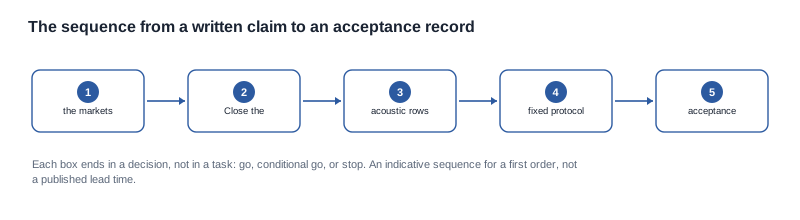
The running of the gates is a documentation exercise, and it goes faster than most buyers expect because the questions are few. The discipline that makes it work is that each gate produces one artefact, and the artefact is dated and stored in one place. By gate eight you should hold: a written claim per market, a model string, either certificate numbers or a written gap statement, four written acoustic answers, a measurement protocol, and your own measurement record. That set is the whole diligence for this category, and it is also the whole defence if a channel later asks why the product was described the way it was.
The gates that fail most often, and what each failure costs
Gate one fails late. The symptom is a legal review arriving after the listing copy is written and the artwork is approved. The root cause is that the claim was drafted by whoever wrote the product page rather than by whoever owns regulatory sign-off. The prevention is to draft the claim first, in one sentence, and let every downstream document — the listing, the packaging, the instructions, the support script — inherit it. A claim that changes between documents is the expensive kind.
Gate two is skipped because it feels administrative. The symptom is a channel onboarding that stalls because the SKU file has no model identifier, or a customs query on the first shipment. The root cause is that a designation was treated as paperwork rather than as a precondition. The prevention is to treat gate two as a stop condition: no model string on the quotation means no order, whatever the price looks like.
Gate three is satisfied by the wrong document. The symptom is a certificate arriving that names a sibling model. The root cause is that a family-level document was treated as coverage for this entry. The prevention is to compare the model string on the document against the string on the order character by character, and to check the issuing body's register rather than the PDF.
Gate four produces a number instead of a condition. The symptom is a specification sheet that ranks this entry against a competitor on gain. The root cause is that the gain was accepted as an input rather than as a claim to be tested. The prevention is the sentence test: if the answer cannot be written as one sentence with a number and its conditions, the row is unusable, and unusable rows are removed from comparisons rather than footnoted.
Gate seven is written after the sample. The symptom is a measurement that supports whichever conclusion the reader already held. The root cause is that the protocol was drafted once the demonstration had already made the case. The prevention is to write the protocol and the pass criteria before the units ship, and to send them to the supplier so that the supplier knows what will be measured.
What each gate is worth, and what a no-go at an early gate saves
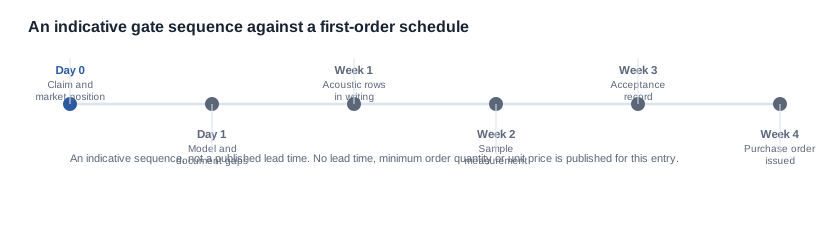
Gates one to three cost roughly an afternoon of someone's time and the price of a sample at most, and they can remove the programme. That is the cheapest kill in the whole chain, which is why they sit first. Gate four costs another afternoon and decides whether any acoustic comparison is legitimate. Gates five and six cost the sample and a sound meter, and they decide whether the product can go into a channel where the environment matters. Gates seven and eight cost a document review and are the only ones that convert everything above into a right to refuse a lot.
What can be negotiated is the programme structure around the gates: the sample quantity and whether the measurement unit is sold rather than returned, the number of configurations and the per-configuration minimum, the split between a pilot delivery and a production delivery with separate payment nodes, the artwork round count, the warranty definition if it is written against a failure criterion rather than a time period, and the acceptance window itself — which is the most valuable clause in this category, because it moves the argument from a returns conversation to an inspection table.
What cannot be negotiated is the cost and duration of certification, which are fixed per product family and are a queue rather than a price, and the nature of tooling, which is a one-off cost normally amortised over the first order — so the useful questions are over what volume it is amortised and what happens to it if the programme stops. The acoustic design work is not a commercial variable either: the product either couples or it does not. And the regulatory determination belongs to the party placing the product on a market, which is not the factory's to transfer.
The documents to collect before a deposit: the written claim per market with the reviewer's name and the date, the model string, the certificate numbers with issuing body and validity dates or a written gap statement, the four written acoustic answers with their conditions, the UN 38.3 test summary for the fitted cell, and the measurement protocol with its pass criteria. The clauses to write into the purchase order: the exact model designation, the acceptance criteria and their method as an annex, a notice obligation before any change of transducer, housing geometry, cell or firmware, a re-issue obligation for the documentation package when a configuration changes, and a warranty set against an agreed failure criterion.
A worked sequence, and what we will say at each gate
The sequence set out below is hypothetical. No client project is behind it, and the steps are shown rather than the outcome.
Assume a channel buyer sourcing one amplified SKU for a specialist retailer in two markets, with a supplier who quotes a catalogue configuration and a launch date that was set before the enquiry. The buyer's constraint is a deadline rather than a budget, which changes the order of the gates: when time is the constraint, the cheapest kills have to come first, because a kill at gate one costs nothing and a kill at gate five costs the sample and the schedule.
Gate one. The buyer writes the claim in one sentence, describing an amplified open-ear listening product with no hearing-related wording, and routes it to the compliance contact. The review comes back with one condition: the description may not change without re-review. That condition becomes a clause in the purchase order, because it is exactly the clause that stops the artwork from drifting later.
Gate two. The buyer asks for the model string and receives one. It appears on the quotation but not on the sample documentation, so the buyer makes the string on both the order and the packaging a condition of the first delivery.
Gate three. The buyer asks for certificate numbers per model and receives a written statement that no certificate exists for this entry in either destination market. That is a usable answer, and it moves the market route into the buyer's own work plan with a date on it.
Gate four. The buyer asks for the gain conditions and receives a frequency, an input level and a measurement point, together with a statement that the published figure is a maximum. The buyer records it as a maximum and removes the gain from any comparison table, because a maximum cannot be ranked against a typical value.
Gates five and six. The buyer writes the sample protocol, sends it to the supplier, and measures leakage at a stated distance, runtime at the shipping gain setting with the radio connected, and the contact position across three head shapes. The record is written as the buyer's own measurement with the protocol attached, and it becomes the annex to the purchase order.
Gates seven and eight. The buyer negotiates a pilot delivery with its own payment node, ties the second node to the documentation package, and defines acceptance at inspection against the annex.
The result is a programme with one channel-specific obligation, one model string and one document, and a measurable acceptance standard — arrived at in a week rather than a month, because the first three gates stopped being expensive the moment they were put first.
What we can answer at each gate, and what we cannot
We publish the five rows our documentation holds — the 35 dB amplification gain, the 200 mAh cell, the charge time of two hours or less, roughly seven hours of rated runtime and Type-C charging — and we do not extend them into an acoustic specification. We do not publish the conditions behind the gain, the model designation for this entry, the certification status, the frequency response, the leakage figure, the microphone specification, the frame weight or the ingress rating, and we will not estimate any of them.
We will confirm, at any gate, which of our published rows can be cited without qualification, which cannot, and which questions our own documentation genuinely answers. We will not make a hearing-aid claim, a hearing-protection claim or any medical claim, and we will not supply copy that implies one. The regulatory boundary that makes gate one a gate is set out under medical device boundary, and the mechanism behind the published gain figure is described under bone conduction audio technology.
Three things to send before the first gate
Send the claim and the market list. That is gate one, and we will tell you which rows of the published specification remain usable under an audio-side description.
Send the two numbers you already have. If you have a gain figure and a runtime figure from another supplier, send both with their conditions if you have them, and we will tell you whether they are comparable with ours.
Send the sample and the protocol. If you have run a measurement against the criteria above, send the protocol and the record, and we will say which observations are consistent with the published rows and which are not. The range is under bone conduction glasses range, and the evaluation route is under sample evaluation.
Related reading
- Where a claim triggers a different regulatory route — bone conduction regulatory questions
- Frame contact and why fit dominates — frame materials and durability
- Testing before you commit — sample evaluation
Tell us your target channel and claim, and we will tell you honestly whether this entry is a candidate today.


