

Bone conduction glasses technology: answering the compliance question
How regulation reaches a bone conduction product
Regulations reach a bone conduction product in a way they do not reach any other product in this catalogue, because the product's most important published specification is also the one that determines its regulatory category.
Our entry for the bone conduction product publishes a 35 dB amplification gain, a 200 mAh battery, a charge time of two hours or less, roughly seven hours of runtime, and Type-C charging. There is no model designation published, and the certification status is not published to us. That 35 dB figure is the most aggressive published parameter in the entire range, and it comes with the highest compliance exposure in the same row.
So bone conduction glasses technology smart glasses how regulations affect this is best understood as a question about which product it is, legally, in each destination market — and about the fact that the answer is set by a sentence of copy rather than by a component.
The practical consequence for a buying team is an inversion of the usual order of operations. In most hardware programmes, compliance is the last step before shipment. Here it is the first, because the claim has to be written before the file can be assembled, and the file has to be assembled before the artwork can be approved, and the artwork takes longer to correct than anyone expects.
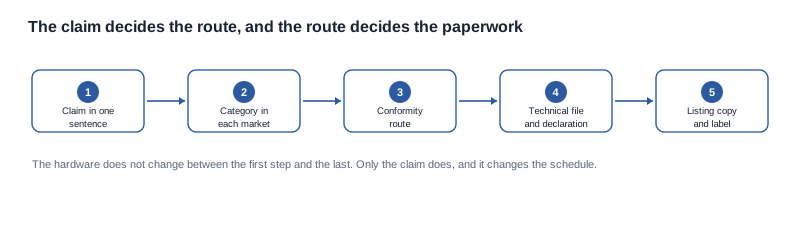
The buying task behind the compliance question
The reader is usually a buyer who has been told the product is "certified" or "compliant" and who has to decide whether that statement is worth anything. It frequently is not, because in this category the compliance position is a set of market-specific claims rather than a single certificate, and because the most commercially significant regulatory decision is a sentence in the listing copy that a legal function, not a supplier, has to own.
Four questions separate a usable compliance position from an unusable one, and they are the questions this article is built around. Which category is the product in, in each market you intend to sell into. What claim appears in the listing copy, and does it match that category. What evidence exists, per model, for the applicable regimes. And what happens to the programme if any of it is challenged after launch.
That last question is the one most programmes never answer, and it is the one that determines whether a launch is a marketing event or a supply chain event. A product that has to be withdrawn from a market has inventory in a warehouse, a listing to take down, a channel to notify and a customer base to service, and none of that is on the product plan.

Where regulation enters the programme
The four routes that reach this product
The medical boundary, stated precisely. The single most important fact about this category is that in the United States, over-the-counter hearing aids are regulated under the FDA's classification at 21 CFR 800.30, and that definition covers air conduction devices. A bone conduction device is a different device and sits in a different regulatory position. This is not a technicality a marketing team can work around. It determines whether the product may be sold in the United States and under what authorisation, what claims may be made about it in the listing copy, what the instructions and the labelling must say, and in some cases whether the product may be sold at all in a given configuration.
The 35 dB amplification gain in our published specification sits at the level where this question is real rather than theoretical. A buyer who reads the 35 dB figure as a differentiator and writes it into the product listing has created a regulatory problem, and the correction is a rewriting rather than a fix.
Radio conformity. A product with a radio is a radio product. In the European Union, the Radio Equipment Directive (EU) 2014/53/EU applies, with the EN 18031 harmonised standards cited into it covering the cybersecurity requirements for radio equipment. The General Product Safety Regulation (EU) 2023/988 applies from 13 December 2024 and layers obligations on top of the sector rules rather than replacing them. The United Kingdom applies UKCA with a framework that diverges from the European Union's. The United States applies FCC equipment authorisation, and the Bluetooth SIG qualification applies to the implementation.
Battery transport. A 200 mAh lithium cell inside the product is subject to the transport regime, and the UN 38.3 test summary covers a specific cell. A cell substitution invalidates the summary regardless of whether the finished product is unchanged, and in this product a cell substitution also has a direct effect on the amplification behaviour and therefore potentially on the regulatory position.
Product conformity and the technical file. A Declaration of Conformity, the technical documentation, the instructions, the labelling and the traceability. And here the missing model designation becomes a live issue: a product without a formal SKU is harder to place in a conformity file, harder to reference in a contract, and harder to trace in the field, and a family-level document does not automatically cover an unnamed model.
Where the programme cost actually sits
Regulation reaches the programme in four distinct places, and confusing them is how dates slip.
It consumes schedule before anything is built. The claim decision, the category determination, the assessment, the file, the labelling and the instructions all sit ahead of the artwork, and the artwork sits ahead of the print run. None of this is parallel to production in a way that compresses it.
It consumes money that does not negotiate. Assessment cost, laboratory time, the registration and the ongoing obligations are all fixed. What a buyer can change is scope: how many markets the file covers, whether one assessment covers several configurations, how narrow the claim can be kept, and whether a design change can be avoided to stay inside an existing document.
It consumes engineering attention through change control. A Declaration of Conformity has no expiry, and what invalidates it is a change to the product. A cell change, an amplifier change or a firmware change all need to be assessed against it, and in this category the cell is the change most likely to happen, because it is the easiest thing to re-source when a price moves. A buyer who treats the cell as a purchasing decision rather than a compliance decision creates the most common avoidable re-assessment.
It consumes the launch window. Listing review, channel onboarding and marketplace documentation are all downstream of the file, and all of them have their own queues.
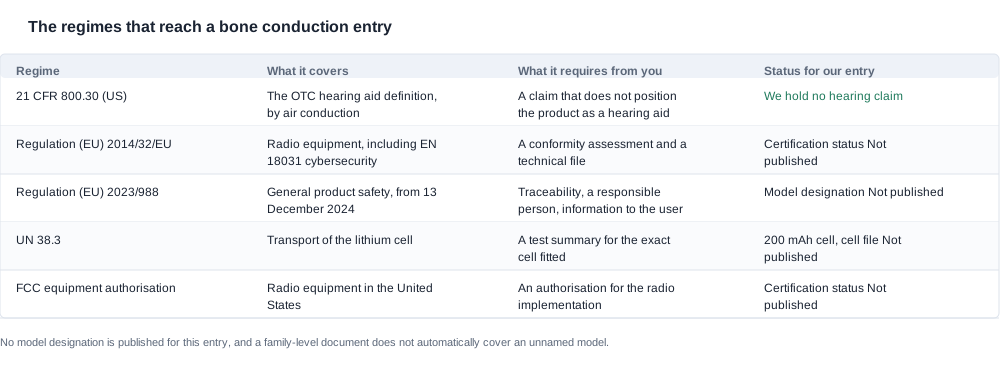
The tests that decide the regulatory route
The claim test, applied to a product page
The route is decided by the claim, so the useful discipline is to test the claim before it is written rather than after. Four questions do that work.
Does the claim describe what the device does, or what it achieves for a person? A device that amplifies environmental sound and leaves the ear open is describable. A device that improves hearing is not, without a regulatory position that a catalogue entry cannot supply. This is the single dividing line, and every other question is downstream of it.
Is the figure being used as an outcome? A gain figure describes the electronics. A headline that puts a decibel number where a customer will read it as a loudness or a clarity claim has moved the claim, whatever the intent was.
Does the copy describe a therapeutic or diagnostic effect? A market that regulates hearing assistance will treat a description of that kind as a device claim, and the route changes with it. This is a question for a legal adviser in your market, and for the medical device boundary that is described at medical device boundary.
Does the copy survive translation into the weakest market in the set? A listing is usually global, and the binding constraint is the market with the strictest rule, not the market with the largest volume. Buyers frequently write the copy for the largest market and discover the constraint in the smallest.
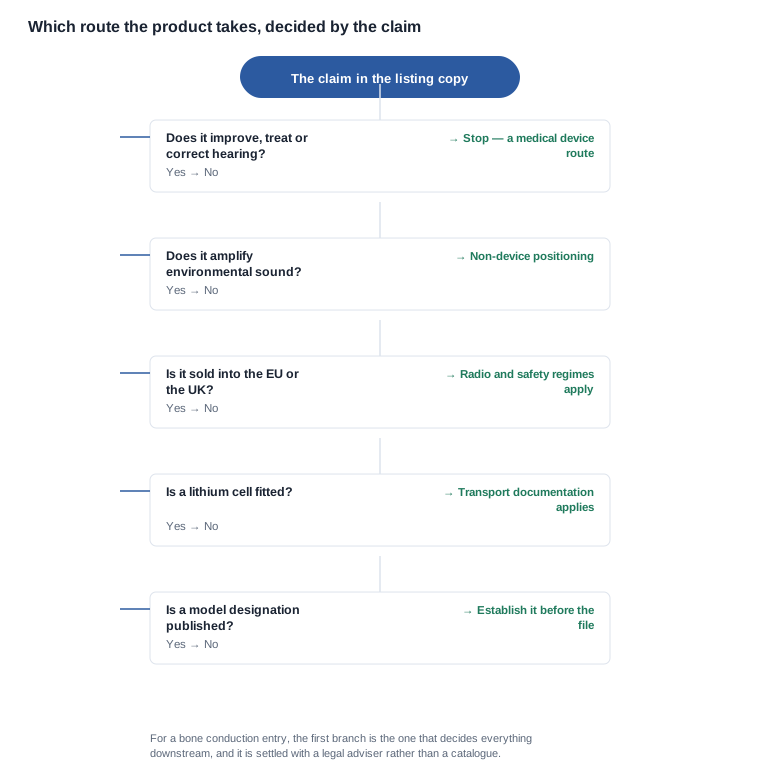
The thresholds, and what has to exist before a date holds
Four thresholds decide whether a launch date is real, and each one has an evidence requirement.
Category determination per market. The threshold: a written, per-market category, with the reasoning, reviewed by a function that carries regulatory risk. The failure mode: an oral assurance that the product is "not a medical device" and nobody can say on what basis.
Evidence that names the model. The threshold: a document, per model, that covers the configuration being shipped. The failure mode: a family-level document offered as covering a product that has no designation to be covered by.
A documented battery. The threshold: the transport test summary for the exact cell fitted, plus the cell specification, with the change-control rule that stops the cell being swapped without a re-assessment. The failure mode: the cell is changed in production to meet a price and the file no longer matches the goods.
A labelling and instructions set. The threshold: artwork that carries the required information and the prohibitions, approved before the print run. The failure mode: the claim was fine and the box was not, which is the more common version of this failure because the box is where the gain figure ends up in a headline position.
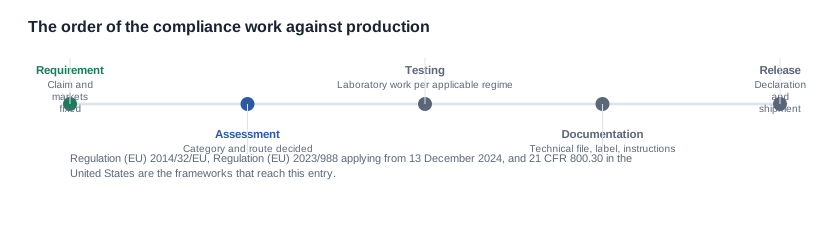

Building the file, and where the file breaks
How to check the position rather than take it on trust
The verification sequence for a compliance position is short, and each step has a completion standard.
Ask for the classification in writing, per market. Not "the product is CE marked" but which category it sits in, in which market, on what basis, and who made that determination. A supplier that cannot answer has not made the determination, and a product that has not been determined cannot be shipped with confidence. The range-wide checklist is at certification checklist.
Ask for the document set, not the certificate. The technical file, the declaration, the test reports behind it, the instructions, the labelling artwork and the certificates with their numbers and validity dates. The question to ask about each is whether it names the model and the configuration you are ordering.
Look up every certificate number in the issuing body's public register. Confirm the model, the configuration, the issuing body and the validity date. This is a five-minute task per certificate and it is the step that catches the most.
Ask what change invalidates the file, and confirm that the change-control process exists. In this category the answer should include the cell, the amplifier and the firmware. If the supplier's process is "we will tell you", ask to see it in the purchase order rather than in an email.
Ask who owns the listing copy, per market. Some suppliers write it, some buyers do, and the answer determines where the 35 dB figure will be positioned. It should not be a supplier writing a hearing-related description on your behalf, because the supplier does not carry your exposure.
Check the transport file against the fitted cell. The requirements are set out at battery transport, and the logistics provider will enforce them at the border regardless of what the paperwork says.
Where the file breaks
A certificate for a product that has no designation. This is the specific fragility of this entry. A model-specific document cannot cover an unnamed model, and a family-level document does not automatically cover it either. The remedy is not a document hunt; it is establishing the designation and then re-checking that every document names it.
A cell swapped after the file is complete. The most likely change in this product, because the cell is the item most exposed to price movement and to availability. The consequence is an invalid transport summary and a technical file that no longer describes the goods. The remedy is a change-control clause, not a request for goodwill.
A firmware or amplifier change made for a different market. A market-specific change made after the shared documentation is complete is still a change to the product, and it invalidates the file in every market, not only in the one that asked for it. The remedy is to hold a single configuration across markets wherever the claims allow it, which is an argument for one global configuration rather than several.
Copy approved after the print run. A claim that is fine in the listing and wrong on the box is a compliance problem that has already cost money. The remedy is an artwork approval step that includes a compliance reviewer and happens before the proof is signed.
A market that was never assessed. The most expensive version of this failure is a product sold into a market on the assumption that it works like the market next door. The United Kingdom already diverges from the European Union in this category, and the divergence is not limited to paperwork.

Terms and timing, and a worked launch plan
What the compliance position does to the commercial terms
The compliance position is a commercial term, not just a legal one, and it belongs in the contract.
Fixed and not a negotiation target: the regulatory classification work and its cost. The assessment cost and the laboratory time behind it. The cost of the technical file and the ongoing obligations that come with it. The cost of a second qualification run of the same model.
Negotiable: the scope of the assessment and the number of markets it covers; whether one file can serve several configurations; the labelling and artwork schedule; the change-control obligations on the cell, the amplifier and the firmware; the number of units taken at the pilot tier rather than the run tier, which is where most of the real room sits because the factory's exposure concentrates in the first run; and splitting a first production run into two deliveries against a staged payment.
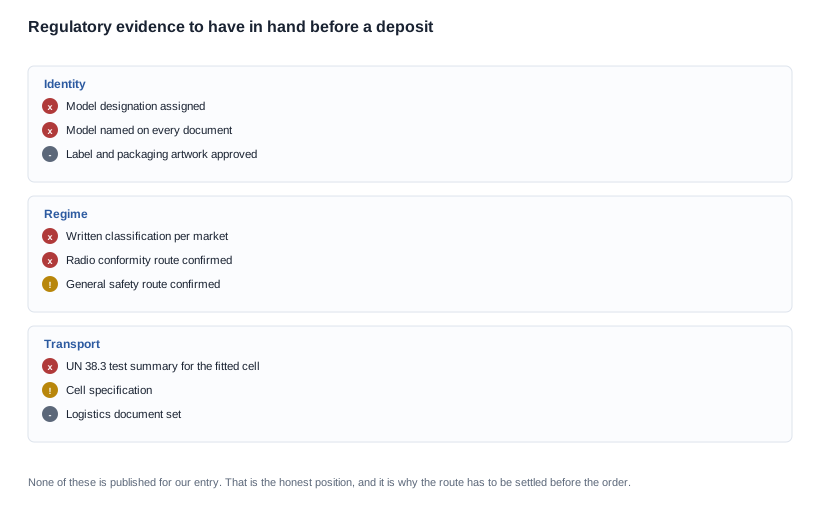
Documents to request before a deposit: the model designation table, the certificate register with numbers and validity dates, the technical file and the declaration, the battery transport documentation for the fitted cell, the packaging artwork proof with the compliance panel, the change-control procedure, the agreed acceptance criteria for incoming inspection, and written confirmation that no claim in the listing copy characterises the product as a hearing aid or makes any claim about treating, preventing or improving hearing. Clause language appears at contract terms, and the commercial structure of a first order appears at pricing.
A worked launch plan
Assume a brand owner wants to launch a bone conduction frame into the European Union, the United Kingdom and the United States, with a first production run and a marketplace listing in the first quarter.
The order of work is the whole lesson, so it is worth walking through in the sequence it has to happen.
First, the claim, in one sentence, for all three markets. "An open-ear audio frame that amplifies environmental sound while the ear stays clear" is the shape of claim that survives all three. It describes what the device does, it makes no statement about a person's hearing, and it does not need a figure it cannot support. It is written and approved by a legal reviewer before anything else starts, because the artwork, the instructions, the listing and the packaging all inherit from it.
Second, the category determination, per market. The claim above places the product on the non-device side of the air-conduction line in the United States under 21 CFR 800.30, which is a position that has to be written down and retained. In the European Union the radio and general safety regimes apply, so the file needs a technical file, a declaration, labelling, instructions and an economic operator in the market. In the United Kingdom the same structure applies under a diverging framework. All three determinations are documented in one place, because a launch into three markets is one product with three files, not three products.
Third, the identity. A model designation has to be established and used consistently on the purchase order, the label artwork, the declaration, the technical file and the certificates. For this entry, no designation is published, so this is work that has to be requested rather than assumed, and it gates everything downstream.
Fourth, the cell and the transport file. The cell is fixed, specified and the transport documentation is issued for it, and the change-control clause that prevents a later substitution is written into the purchase order. This is a small paragraph that prevents the most likely re-assessment in the programme.
Fifth, the artwork, with compliance in the loop. The proof carries the claim, the required information and the prohibitions, and it is approved by the compliance reviewer as well as by marketing. The gain figure is placed in the technical description, not the headline, and the box is treated as a customer-facing document.
Sixth, the schedule is built around the file, not around production. The date that matters to the buyer is not the production date; it is the date the product can lawfully be listed and shipped, and the gap between the two is the compliance work. A buyer who schedules on production and is surprised by the file has planned the wrong date.
Seventh, the contingency. If the position is challenged in any market after launch, the plan says what happens: the listing is taken down, the channel is notified, the affected inventory is quarantined, and the assessment is reopened. A buyer with that plan written before launch treats a challenge as a procedure; a buyer without it treats it as a crisis.
What we will and will not confirm
The hearing-aid claim, and where it stops
The working rule we apply: we publish the 35 dB gain as the catalogue states it, and we will not present it as a hearing-aid specification, a hearing-aid benefit, or an assistive-listening claim, because the regulatory position in the United States is governed by the air conduction definition in 21 CFR 800.30 and a bone conduction product sits outside it.
We will also say plainly that the certification status for this entry is not published to us, that no model designation is published, and that a product with a 35 dB gain and no published certification position is a product that requires a legal review before it is listed in any market. We will not tell you the product is approved for assistive listening, and we will not write listing copy that implies it.
What we will do is set out which regimes reach the product, which of them depend on the claim rather than the hardware, and which documents have to exist for each one. That is a schedule input, and it is the part a buyer can plan against.
Market, channel and the claim in one sentence
Send the destination markets, the intended channel, the intended claim in one sentence, and the target launch date you are working back from. We will say which regulatory questions are decisive, which parts of the file we can answer from what we hold, and which have to be established with a supplier before a date can be committed.
Where the file is assembled
- Complying with the medical device boundary
- Complying with the Radio Equipment Directive
- Battery transport compliance requirements
- Bone conduction glasses range
Send the destination markets and the intended channel and we will say which regulatory questions are decisive.


