

Bone conduction glasses technology: descriptions, not devices
Bone conduction is the category where buying mistakes are most expensive, because the mistake is rarely the wrong product. It is the right product sold with the wrong description — and in this category the description is what carries the risk, not the hardware.
The published specification makes the exposure concrete. The bone conduction entry publishes a 35 dB amplification gain, a 200 mAh cell, charging in two hours or less, roughly seven hours of rated runtime and Type-C charging. It publishes no model designation, and the certification status is not published to us. The 35 dB figure is the most aggressive published parameter in our entire catalogue, which means the same sentence can be a technical description on one page and a claim nobody can defend on another.
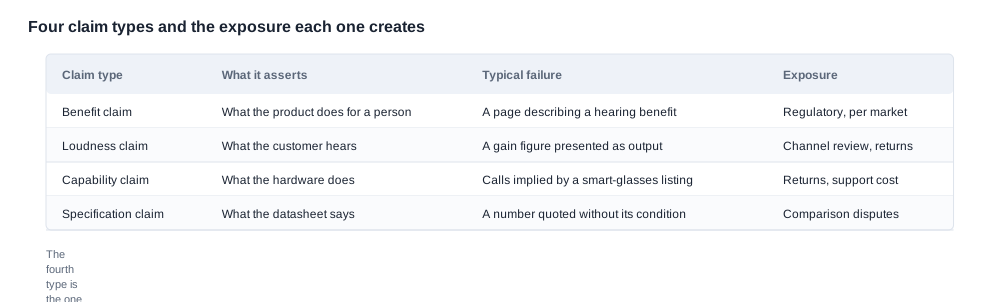
So the useful way to run this list is not as a list of faults. It is as a taxonomy of claim types, because the claim you make determines which mistake you are exposed to, how quickly it is found, and who finds it. Three of the four claim types are recoverable if you find them yourself. The fourth is not recoverable at all once it is live.
Who reviews the description, and what a challenge actually costs
The reader is a brand-side product or channel buyer, usually with artwork already close to approved and a launch date that is not theirs to move. What they are approving is a description, and the description is assembled from at least four places that rarely talk to each other: the product page, the packaging, the instructions, and the support script that a customer service team will read from when the first complaint arrives.
What the buyer is afraid of is not a supplier failing to deliver. It is a product that performs correctly and still cannot be sold, because the copy says something the documentation does not support. That is the failure mode that distinguishes this category, and it is worth understanding what it costs, because the cost does not sit where a buyer expects it.
A description challenge is not a marketing event. It is a supply chain event. A channel reviewer who rejects a listing means a listing that has to be rewritten, re-approved and re-uploaded; in a marketplace setting it can mean the product is suspended while the claim is reviewed; and a regulatory position that turns out to be wrong in one market stops that market, not just that page. Every one of those outcomes lands on the launch schedule and on the inventory that was bought against it.
There is a second supply chain consequence that buyers often underweight: the open-ear audio models in the same range publish cells from 55 mAh paired units up to 100 mAh, Bluetooth V5.3 and V5.4 variants, roughly six to eight hours of rated runtime, and surround audio, with the IP54 marking published only on the V06 and the S7. Those models are described with ordinary audio language, and the bone conduction entry is often placed beside them in the same range sheet, on the same shelf, in the same comparison table. That adjacency is exactly where a description error is born — the language of the open-ear models gets inherited by the entry that cannot carry it.
Four claim types, and the exposure each one creates
Benefit claims assert what the product does for a person. "Assists hearing", "helps you hear", "improves clarity of speech" — none of these are technical descriptions, and all of them describe a hearing benefit. In the United States the framework distinguishes a medical-device hearing aid, including the over-the-counter category, from a non-device personal sound amplification product, and the distinction is written around air conduction at 21 CFR 800.30. A bone conduction product sits outside that definition, which does not make it unregulated and does not make it exempt — it means the description has to be assessed against each destination market's own rules, and a benefit claim is the fastest way to trigger that assessment. The exposure here is regulatory and it is per market, so a listing written for one market is not automatically valid in another.
Loudness claims assert what the customer hears. The published 35 dB is an electronics gain figure, applied upstream of the coupling into the skull, and presenting it as an outcome misdescribes the product. The exposure is commercial before it is regulatory: a customer who measures the result and does not find it, a reviewer who knows what a gain figure means, and a returns pattern that is attributed to a defect rather than to a description.
Capability claims assert what the hardware does. This is where the missing microphone specification bites. No microphone specification is published for this entry, and we will not estimate whether it takes calls, yet a smart glasses listing that groups it with a bundle of media and call products implies call capability by adjacency. A customer who bought it for calls and finds it cannot is a returns event and a support cost, and both are avoidable by writing the exclusion in.
Specification claims assert what the datasheet says. A number quoted without its condition is the specification claim that quietly becomes a loudness claim, which is why it is listed last but causes the most confusion: the row looks technical, so it survives review, and then it is read by a customer as a promise. The threshold for every figure in this category is the same. A number that appears in customer-facing copy must carry its condition or be removed from the copy.
The four questions to ask before the copy is written
These are the questions to ask, and the order matters, because each one either narrows the field or removes a claim from the table.
- What is the product's claim, in one sentence, and which of the four claim types is it? Until this is answered, a copy review is a conversation about adjectives.
- Which figures will appear in customer-facing copy, and does each one have its condition or can it be removed? A figure with no condition is a claim in waiting, so the question is not whether to keep it but whether to qualify it or delete it.
- What will the product be sold as doing that is not published — calls, ingress protection, a specific runtime? Each of those is a capability claim, and each one has to be answered before the listing is written rather than after the first returns.
- Which criteria must the final copy satisfy for the channel, and who signs it? If nobody owns the sign-off, the copy will be approved by whoever is nearest the deadline, which is how a benefit claim reaches a product page.
The order is deliberate. A buyer who asks the fourth question first gets a copy review with no criteria to review against, and a buyer who asks the third before the second ends up describing capability that will be removed once the conditions are known.

How a claim gets approved before it reaches a listing
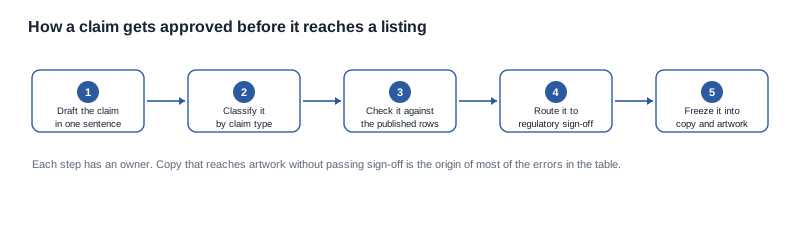
The approval chain is short, and most of the errors above exist because one of its steps is skipped. The steps are: draft the claim in one sentence; classify it by claim type; check it against the published rows; route it to whoever owns regulatory sign-off in your organisation; and freeze it into copy and artwork.
Drafting in one sentence is not bureaucracy. It forces the claim to say what the product is rather than what it does for someone, and it gives the rest of the chain a single object to check. "An open-ear listening product that amplifies environmental sound through the skull" is a sentence you can test. "A smarter way to hear" is not, because there is nothing in it to test.
Classifying by claim type tells you who has to sign. A benefit claim goes to legal before it goes anywhere else. A loudness claim goes to engineering, because the fix is to publish the conditions rather than to argue about the wording. A capability claim goes to the product owner, because the fix may be a functional statement rather than a copy edit. A specification claim goes to whoever owns the datasheet, because the fix is usually to add the condition or remove the number.
Checking against the published rows is where the copy gets its limits. The published rows are the 35 dB gain, the 200 mAh cell, the charge time of two hours or less, roughly seven hours of rated runtime and Type-C charging. Anything in the copy that is not one of those five numbers is either a claim you are making on your own authority or an error. The gain is the only one of the five that needs a condition attached, and it needs it because it is the only one that is not self-limiting.
Freezing the claim into copy and artwork is the step most often skipped. The freeze means that any change to the description re-enters the chain, and it means the packaging, the instructions and the support script inherit the same sentence rather than improvising their own. Most of the errors in the table below are variations on four documents disagreeing with each other.
Twelve errors ranked by who finds them first
1. Writing "hearing aid" anywhere, including in a comparison table. The symptom is a page that has to be pulled or a marketplace rejection. The root cause is that the term is treated as a synonym for open-ear audio. The prevention is to search the whole asset set for the term and its close variants, including in alt text and metadata, not just the product page.
2. Writing "amplified hearing" or "boosted hearing". The symptom is the same as error one, and the root cause is the belief that a hyphen makes it a technical description. The prevention is the same rule with a different search term: benefit language does not become technical because it is hyphenated.
3. Writing "assists hearing" or "helps you hear". The symptom is a review question from a channel that has seen the claim before. The root cause is that the sentence was written to describe the benefit rather than the mechanism. The prevention is to write the mechanism and let the reader draw the conclusion.
4. Quoting the 35 dB figure as a loudness claim. The symptom is a customer who measures the output and posts the result. The root cause is that the figure was lifted from the catalogue without its absence of conditions. The prevention is to write it as an amplification gain, and to keep it out of the headline.
5. Choosing the product on the gain figure. The symptom is a specification sheet that ranks products on a number whose conditions differ on both sides. The root cause is that a gain figure was treated as a quality measure. The prevention is to refuse to compare until both sides state their conditions, and to remove the row from the table rather than footnote it.
6. Choosing on the runtime without the condition. The symptom is a battery-life complaint that the supplier cannot reproduce. The root cause is that a rated figure was read as a working figure. The prevention is to require the load, the gain setting and the radio state, and to measure it yourself on the sample if they cannot be stated.
7. Treating fit as a comfort issue. The symptom is a returns cluster attributed to discomfort that is actually a coupling problem. The root cause is that the contact geometry was not treated as part of the acoustic specification. The prevention is to test on more than one head shape and to record where the contact sits.
8. Comparing against an air-conduction product as though like for like. The symptom is a comparison that reverses when the measurement methods are checked. The root cause is that two platforms share a shelf and not a measurement convention. The prevention is to keep the two mechanisms in separate tables and to state the measurement point on every figure.
9. Launching before the regulatory position is settled. The symptom is a market where the product cannot be sold, discovered after the inventory has landed. The root cause is a launch plan that treats regulatory review as a parallel activity rather than a precondition. The prevention is to make sign-off a gate on artwork.
10. Not asking for the model designation. The symptom is a channel onboarding that stalls, or a quality claim that cannot be traced. The root cause is that the entry was treated as a product rather than as a documentation subject. The prevention is to make the designation a condition of the order.
11. Not asking for the measured output rather than the gain. The symptom is an acoustic comparison nobody can reproduce. The root cause is that the gain was treated as the output. The prevention is to ask for the measurement point, and to accept that the answer may be that none exists.
12. Not asking whether the product has a microphone at all. The symptom is returns from a bundle listing. The root cause is that the product was assumed to be a full smart glasses platform. The prevention is to establish call function explicitly, in writing, before the copy is written.
Only one of the twelve is guaranteed to be found by you before it costs money. The rest are found by a channel reviewer, by a customer with a sound level meter, or by a returns team — which is the argument for writing the claim first and freezing it afterwards.
A worked scenario: a listing pulled eight days before launch
This is a hypothetical scenario, not a client project, and it is written to show how the sequence above operates when the timeline is already tight.
Assume a European brand that has been selling open-ear audio for two years, has added an amplified listening model to the range, and has already built the product page, the packaging artwork and the marketplace listing from the same copy block. The launch is eight days out and the first container is at the port. The brand's product page describes the product as helping users hear in noisy environments, and the packaging carries "35 dB amplification".
The finding. During a final artwork review, the brand's own compliance lead notices the benefit phrasing and asks whether the product has a market position in the two destination markets. The answer is that the supplier provided no certification status and no model designation for this entry, so no route has been established. This is not a copy problem yet; it is a gate problem, and it surfaces at the worst possible moment because the goods are already moving.
The triage. Rather than rewriting everything, the brand separates the assets. The claim sentence is rewritten to state the mechanism — an open-ear product that delivers amplified environmental sound through the skull, leaving the ear open — and that single sentence becomes the approved claim. The "35 dB amplification" on the packaging is rewritten as "35 dB amplification gain", which is a technical description and creates no exposure. The copy is frozen, and the four documents that had drifted are re-issued from the frozen text.
The cost. The packaging artwork has to be re-approved, which is a round and a week of the schedule, and the artwork cannot be reprinted once the container is loaded — so the launch either waits for the vessel or ships with corrected print inserts. That is the commercial decision the brand has to make, and it is the decision that makes an early claim freeze worth having.
The prevention, stated as criteria. The next model's copy is written from an approved claim before the artwork is commissioned, the claim is classified by type, and the packaging is printed from the frozen sentence rather than from a copy block written for the range as a whole. The two questions to ask any supplier for the next programme become a standard part of the request: what is the model designation, and what is the certification status for the model. The second question is the one that would have caught this eight days earlier, and it costs one email.
The point of the walk-through is that the expensive part was never the wording. It was the sequence, and the sequence was decided before anybody asked whether the product could be described in the first place.
Rewriting the risky wording, and what a rework costs
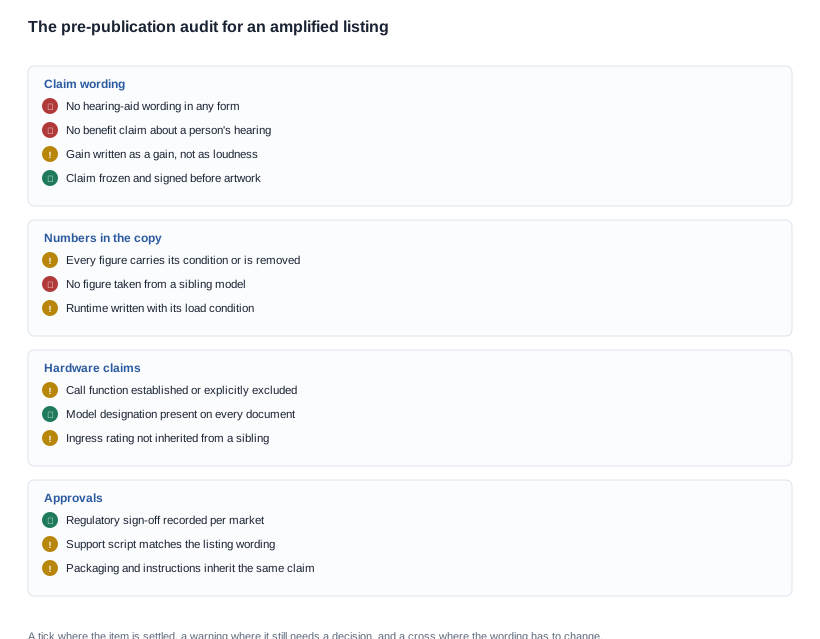
The cheapest way to remove this entire category of risk is a rewrite table. Take the wording that creates the exposure and replace it with wording that states the mechanism, and the claim stops being arguable.
| Wording that creates exposure | Wording that states the mechanism |
|---|---|
| "Hearing aid" | "Open-ear amplified listening device" |
| "Amplified hearing" | "Amplification of environmental sound" |
| "Helps you hear better" | "Delivers sound through the skull, leaving the ear open" |
| "35 decibels louder" | "35 dB amplification gain" |
| "Surround sound" | "Amplified listening" |
| "All-day battery" | "Rated runtime of roughly seven hours" |
| "Calls and music" | Only if call function is confirmed in writing |
The rewrites are not softer. They are more precise, and precision is what survives review.
What a description rework actually costs, and what can be negotiated
The cost of a rework is a schedule cost, an inventory cost and a labour cost, in that order, and none of them is a unit-price problem. A rework after artwork approval costs at least one artwork round per affected asset, and assets in this category are not one file: the product page, the packaging artwork, the printed instructions, the quick-start guide, the support script and the marketplace metadata all carry the claim. A rework after the units have landed costs the inventory that is already in the customs queue, because the description travels with the goods into the market where it may be challenged.
What can be negotiated is the structure that reduces this exposure. Approval artwork rounds, and whether a copy freeze at an agreed stage is a condition of the tooling release. Whether the packaging copy is drafted from a single approved claim, supplied by you, so that it cannot diverge. The number of documents the supplier provides pre-written rather than blank, since a blank instruction sheet is a claim waiting to be written badly by someone else. The pilot quantity, so that a claim problem is discovered on a small delivery rather than on the first production run. And the acceptance clause that ties the first shipment to the approved wording, so that a divergence between the approved copy and the delivered packaging is a documented non-conformance rather than a judgement call.
What cannot be negotiated is the review itself. The time it takes to establish a regulatory position in a destination market, and the cost of the testing that supports it, are fixed by the market rather than by the supplier. A supplier that offers to make that determination for you is offering something it is not positioned to give, and the same applies to the wording: the final claim is your organisation's decision, taken by the function that carries the consequence.
The clauses to write into the purchase order are short. That the claim in the listing is the claim in the technical file, and that any change to either re-enters approval. That the packaging and instructions inherit the approved wording and may not introduce a new claim. That no figure appears in customer-facing copy without its condition, or with a condition that differs from the documentation. And that a divergence between approved copy and delivered packaging is a non-conformance the buyer may refuse at inspection.
What we will and will not write
We publish the 35 dB gain as the catalogue states it, and we will not present it as a hearing-aid specification, a hearing-aid benefit or an assistive-listening claim, because the United States framework at 21 CFR 800.30 writes the over-the-counter hearing aid definition around air conduction and a bone conduction product sits outside it. We will not write copy that describes the product as a hearing aid, as hearing protection, or as a treatment for anything, and we would rather lose an enquiry than be the supplier attached to one.
There is a second half to that position, and it concerns who carries the determination rather than who made the product. A device carrying a 35 dB gain cannot go on sale in a market until somebody has established which regime governs it, and that establishment belongs to the party placing the product on that market rather than to the factory that assembles it. What we will do is supply whatever the technical file genuinely holds, and where it holds nothing — no model designation, no certification status, no frequency response, no leakage figure, no microphone specification — say so plainly rather than leave an impression of coverage that was never evidenced.
Three things to send us with the copy
Send the claim you intend to make, in one sentence. We will tell you which of the four claim types it is and which rewrite table row applies to it.
Send the destination markets. The frameworks that reach a radio product differ by market, and the boundary that decides this category is drawn by each market's own rules rather than inherited from a sibling model in the range.
Send the copy you already have. If artwork is close to approved, send the text and we will mark the sentences that carry an exposure, in the same way we marked the table above. The boundary itself is set out under medical device boundary, the range is under bone conduction glasses range, and the alternative architecture is under open-ear audio specifications.
Related reading
- Bone conduction audio technology
- Medical boundary compliance
- Bone conduction how to choose
- Bone conduction glasses range
Send the markets and the intended claim and we will say which mistake will cost you.


